Editor's Pick97%
Strike King Red Eye Shad
Green Pumpkin
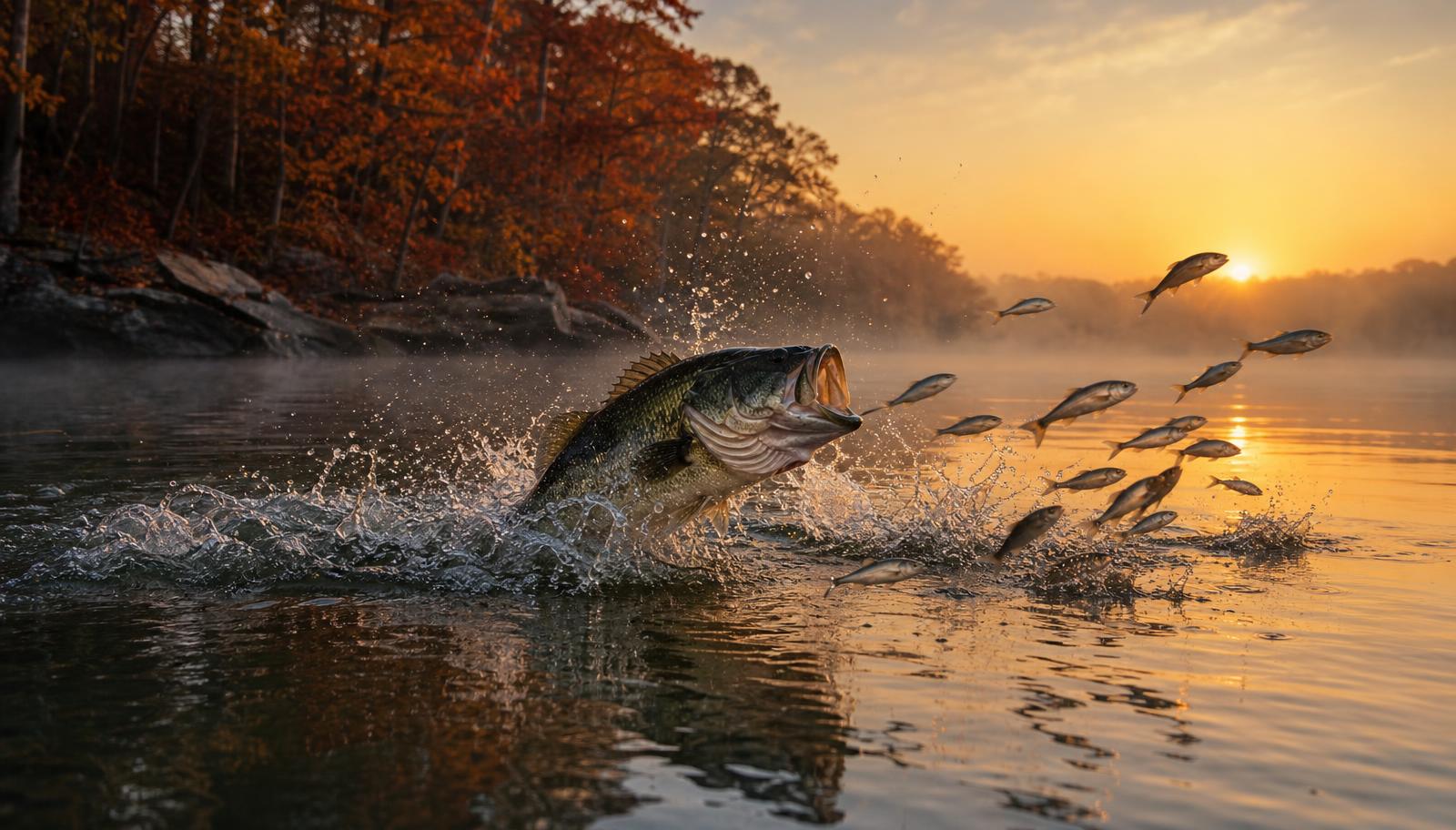
View Product →The best bass lures for fall — lipless cranks and squarebills chasing migrating shad, walking topwaters and Whopper Ploppers on schooling fish, spinnerbaits on wind-blown banks, and jerkbait follow-ups for the cooling-water late-fall bite.
Affiliate Disclosure: As an Amazon Associate I earn from qualifying purchases. Recommendations reflect on-the-water testing and the LureLogic ranking engine — not paid placement.
The one-paragraph version: throw a topwater or a Whopper Plopper on schooling fish and around creek mouths in early fall, rotate to a lipless crankbait and squarebill following shad into the backs of the creeks at peak fall, and shift to a suspending jerkbait and slow-rolled spinnerbait on staging structure once water drops below 55°F. Almost every productive fall day is some version of that three-window rotation, and shad location dictates every decision.
The Strike King Red Eye Shad is our Editor's Pick because it produces on the highest-value fall window (the peak-migration bite) on virtually every shad-forage reservoir in North America. Cast it into the backs of creeks, yo-yo it over hard-bottom flats, and rip it through submerged grass edges — it triggers reaction strikes from bass gorging on migrating shad from the day surface temperature crosses 72°F down through the low 50s. Inexpensive, durable, and the single highest-return fall purchase most anglers will make.
The Strike King KVD 1.5 Squarebill is our Best Migration Chaser — a 1/2 oz square-billed crankbait that deflects off shallow wood, rock, and stumps on creek-arm flats. When bass follow shad into 2–6 ft of water, no bait covers that depth range more efficiently. Sexy shad, chartreuse-with-blue-back, and phantom shad are the essential colors.
The River2Sea Whopper Plopper is our Best Schooling Bait — the plopping prop tail draws bass up from 6–10 ft in a way that a flatline walking topwater cannot, which is exactly the depth zone most fall schooling activity happens over. Bone, blue-back herring, and munky-butt cover almost every fall clarity.
The War Eagle Spinnerbait is our Best Wind-Blown Bank pick. A 1/2 oz double-willow spinnerbait slow-rolled through wind-blown creek arms and stained late-fall staging points catches quality bass that ignore the crankbait. White, white-chartreuse, and sexy shad are the workhorse colors.
The Megabass Vision 110 is our Best Late-Fall Cooldown pick. Once water drops below 58°F, a suspending jerkbait worked with long pauses on the outside edges of major creek mouths and on secondary points becomes the highest-percentage clear-water bait through the end of the fall calendar.
Round out a fall arsenal with a Heddon Super Spook for early-morning open-water schoolers, a Zoom Super Fluke on a weighted jighead for schooling follow-ups, a Booyah Buzz for overcast fall mornings, and a 6-inch shaky-head worm for pressured post-frontal fish. Those categories cover the entire fall decision tree.
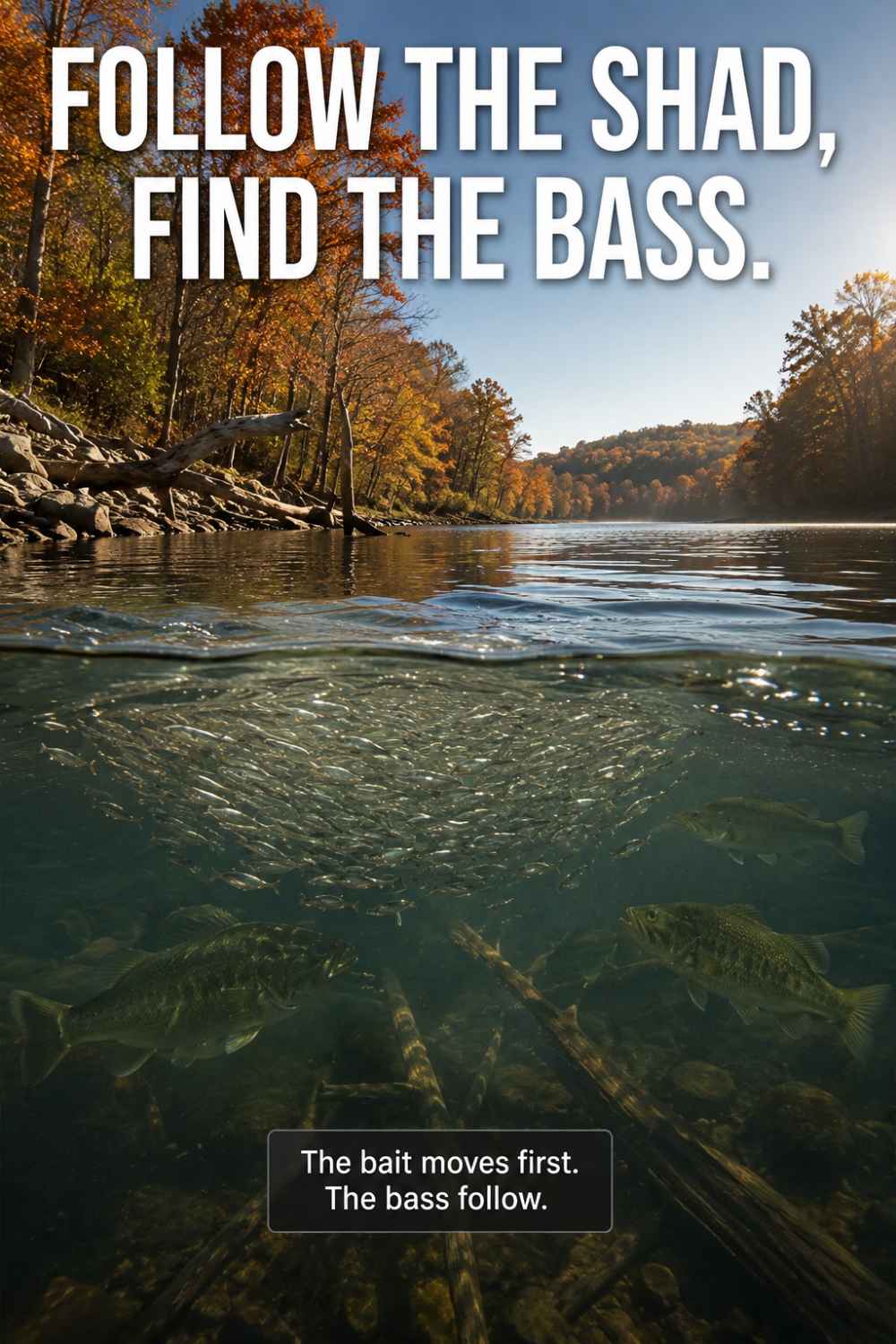
Fall bass fishing is defined by a single biological event — the shad migration — and by the pre-winter feeding urgency that accompanies it. Three realities drive every fall lure decision.
First, bass are eating on a deadline. Once surface temperature drops through the mid-70s and toward 60°F, bass metabolism actually spikes into an efficient feeding zone. Combined with dropping day length, that triggers a pre-winter feeding response — bass gorge on baitfish to build fat reserves before winter shuts feeding down for months. Fall bass, when you find them, eat aggressively and often eat multiple times per day. That is very different from summer, when metabolism is high but oxygen and heat compress feeding into narrow windows. Anglers who understand that fall bass want to eat, and that the challenge is locating them rather than triggering them, cover water aggressively rather than dead-sticking baits over the same spot. See seasonal bass patterns and how to choose a bass lure.
Second, the shad migration reorganizes the entire lake. Threadfin and gizzard shad respond to cooling water by leaving open main-lake basins and pushing into the backs of major creek arms — often three to five miles from where they spent August. Bass, whose entire food source just relocated, follow within days. That means an angler who fishes 'their summer spots' in October is often fishing water that literally does not contain bass anymore. Fall requires re-locating bass every trip because the migration progresses week by week: bass at the creek mouth Monday may be a mile back in the creek by Friday. Follow the bait or grind empty water. See the fall shad migration guide, bass baitfish movement, and threadfin vs gizzard shad.
Third, schooling activity concentrates fish into unbelievable densities. When a wolfpack of bass corners a shad pod in the back of a creek or on a main-lake point, they push the bait to the surface — the classic 'busting' schoolers. A single school can hold 30–100 bass, and a well-placed cast into a boil can produce fish after fish for 60–90 seconds before the school moves off. Anglers who idle from creek to creek looking for surface activity, keep a Whopper Plopper and a walking topwater rigged and ready on the deck, and cast quickly when a boil erupts often catch more bass in one hour than in an entire summer day. See wind, shad, and ambush zones.
The practical translation: fall bass are willing eaters in specific locations dictated by shad movement. Match the shad, follow the bait, cover water fast between schools, and rotate through the three temperature windows as fall progresses.
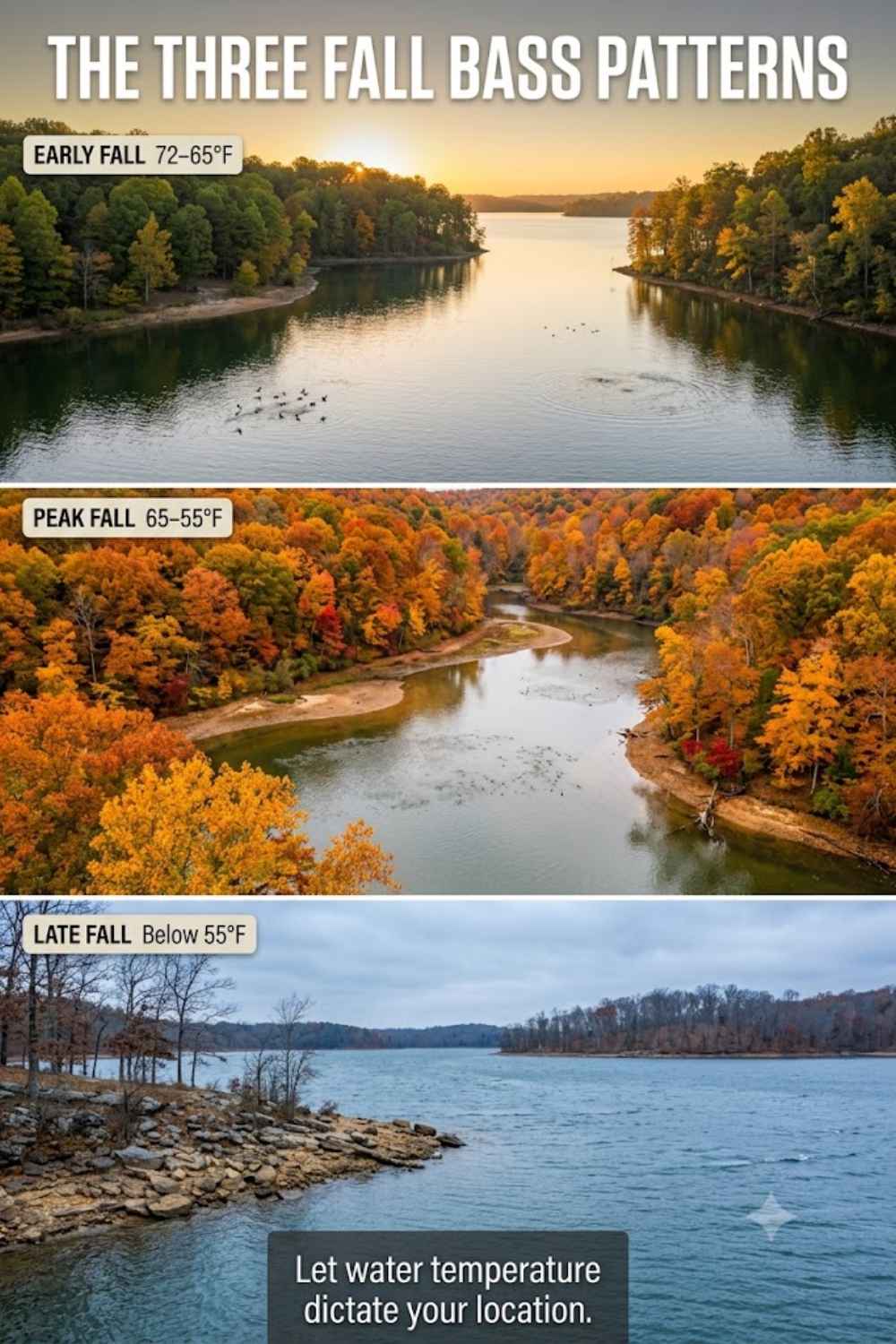
Early Fall (72–65°F) — Topwater and Schooling Baits.
River2Sea Whopper Plopper (90 or 130) — Best Schooling Bait. A plopping prop tail draws bass up from 6–10 ft — exactly the depth zone most fall schooling activity happens over. Bone, blue-back herring, and munky-butt are the year-round colors. Cast past the boil, retrieve steady until the plopper crosses the school, and hold on. See the topwater lures guide.
Heddon Super Spook — Best Walking Topwater. A 4.5-inch walking bait that casts extreme distance and walks the dog with almost no effort. The right choice on calm mornings when you need to cover long stretches of shoreline and creek flats looking for busting fish. Bone, sexy shad, and okie shad.
Zoom Super Fluke (weightless or on a 1/8 oz weighted hook) — Best Schooling Follow-Up. When schoolers bust and dive before you can throw the topwater, a Fluke cast into the same water and twitched back near the surface catches bass that dropped down. Pearl and albino are the essential colors.
Booyah Buzz — Best Overcast Fall Morning. On dark early-fall mornings with cloud cover and no wind, a 3/8 oz buzzbait retrieved just fast enough to stay on the surface picks up scattered shallow-cover bass that ignore a walking bait.
Peak Fall (65–55°F) — Shad-Matching Reaction Baits.
Strike King Red Eye Shad (1/2 oz lipless crankbait) — Editor's Pick. A vibrating, rattling, sinking crankbait that is the single most versatile fall bait in the box. Cast it into the backs of creeks, yo-yo it over grass edges (rip up sharply, let fall on slack line), and burn it across shallow flats. Chrome-black-back, sexy shad, and Rayburn red are the three colors that matter. See the lipless crankbaits guide.
Strike King KVD 1.5 Squarebill — Best Migration Chaser. A 1/2 oz square-billed crankbait that deflects off shallow wood and rock. Retrieve it steady with occasional pauses when it deflects off cover — most strikes come immediately after the deflection. Sexy shad, chartreuse-with-blue-back, and phantom shad. See the squarebill crankbaits guide.
Strike King Sexy Dawg — Best Peak-Fall Walking Topwater. A slightly smaller walking bait than the Super Spook that matches the 3-inch shad most fall schools are keyed on. Sexy shad and okie shad are the workhorse colors.
Z-Man ChatterBait JackHammer — Best Grass-Edge Bait. A 1/2 oz JackHammer around the outside edges of hydrilla and milfoil beds in the backs of creeks produces quality fall bass that a lipless crank hangs up on. White and bluegill are the essential fall colors. See the chatterbaits guide.
Late Fall (55–48°F) — Suspending Baits and Slow-Rolled Presentations.
Megabass Vision 110 — Best Late-Fall Cooldown. A suspending jerkbait worked with 4–8 second pauses on secondary points and on the outside edges of major creek mouths becomes the highest-percentage clear-water bait once surface temperature drops below 58°F. French pearl, mat tiger, and sexy shad. See the jerkbaits guide.
War Eagle Spinnerbait (1/2 oz double willow) — Best Wind-Blown Bank. A slow-rolled tandem spinnerbait through stained late-fall staging water on wind-blown creek arms catches quality bass that ignore the crankbait. White, white-chartreuse, and sexy shad. See the spinnerbaits buying guide.
Dirty Jigs Football Jig (1/2 oz) — Best Deep Late-Fall Structure. As bass slide back out to the first depth break, a football jig with a green-pumpkin craw trailer crawled across rock secondary points in 10–15 ft catches the biggest late-fall bass of the year. See the football jigs guide.
Roboworm Straight Tail (shaky head or drop-shot) — Best Post-Frontal Cooldown. When a hard cold front kills the reaction bite in late fall, a 4.5-inch Roboworm on a 1/4 oz shaky head or drop-shot on the outside edge of the same staging structure will still produce. Morning dawn and aaron's magic. See the finesse worms guide and drop shot baits guide.
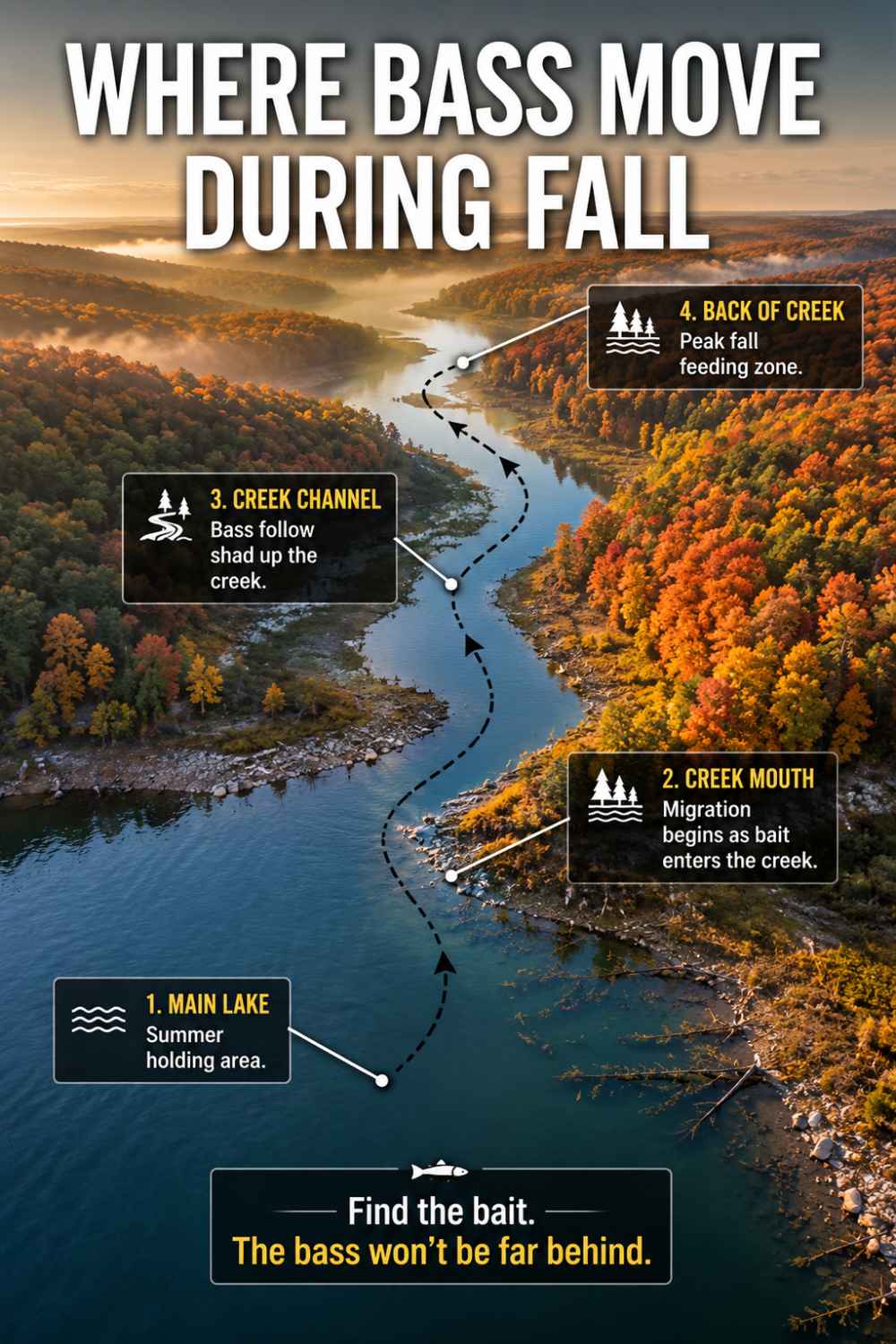
Four high-percentage fall positioning patterns, each tied to a window of the season.
Creek mouths and channel swings (early fall) — The main-lake side of major creek mouths, and the first channel swing inside the creek, are the highest-value staging structure of the entire fall for the first two to three weeks after surface temperature drops through 75°F. Bass ambush the first waves of migrating shad here before pushing further into the creeks. Focus on any hard-bottom transition (rock to sand, sand to gravel) within 200 yards of the creek mouth. See creek channel bass positioning.
Backs of creeks (peak fall) — Once water drops through the mid-60s, shad pile into the shallow ends of major creek arms — often into 3–8 ft of stained water at the very back of the creek where the feeder creek enters. Bass follow. This is the shallowest bass will be all year on many reservoirs, and it is where the peak-fall lipless-crank and squarebill bite happens. Look for surface disturbance from feeding shad, diving gulls or terns, and the darker stained-water color that marks the back-third of most creeks.
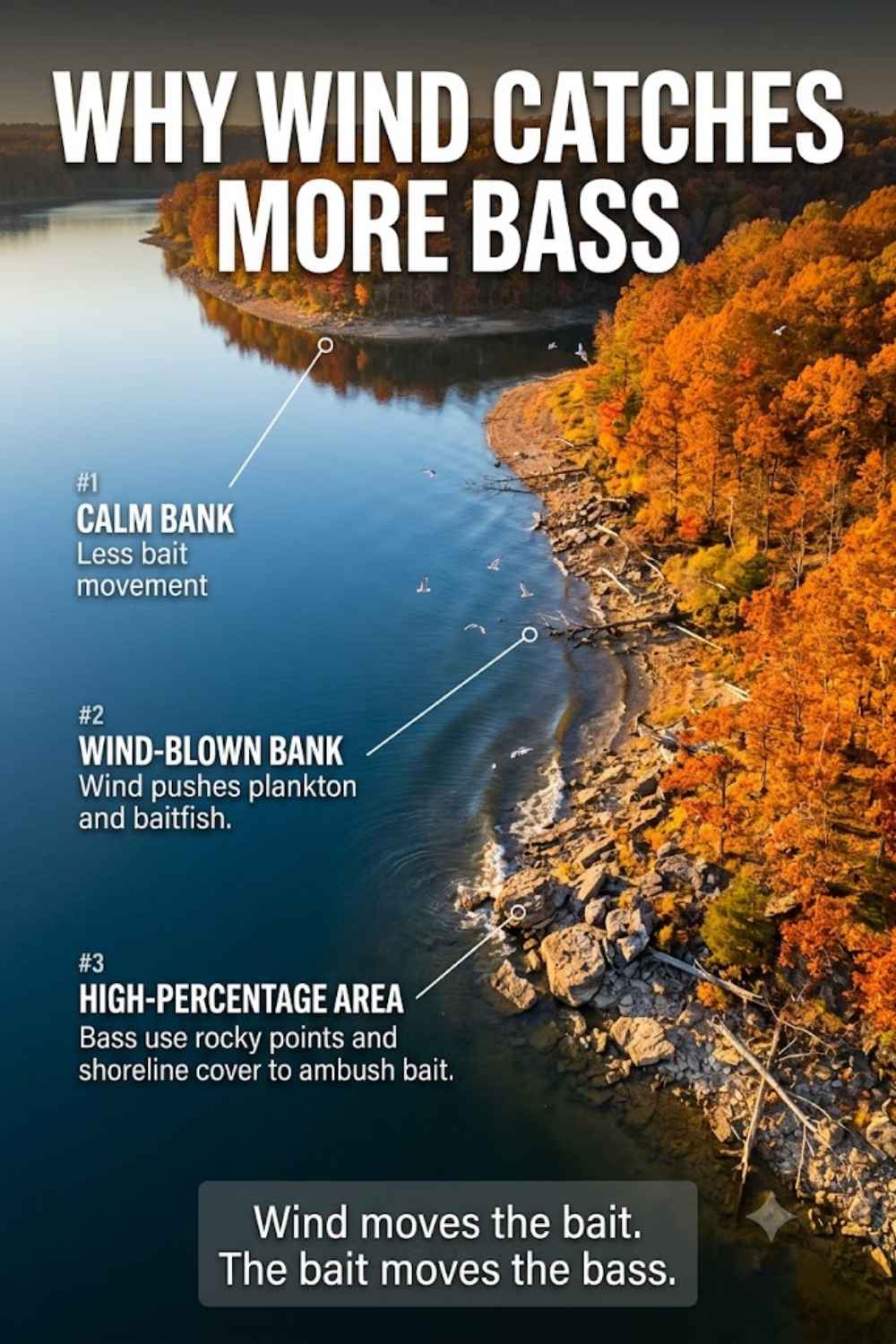
Wind-blown creek arms (late fall) — A 10–20 mph fall wind on a rocky secondary point in a stained creek arm can create the single best 90-minute bite window of the entire fall. Wind stacks plankton, plankton draws shad, shad pull bass shallow. Throw a lipless crank or spinnerbait parallel to the wind-blown side. See wind-blown banks positioning and wind, shad, and ambush zones.
Outside secondary points and staging structure (late fall through cold turnover) — As water crosses 55°F, the migration reverses. Bass slide back out to the first depth break outside the creek mouths — rocky secondary points, channel swings, and hard-bottom flats in 8–15 ft. This is the late-fall jerkbait and football jig water. See bass fishing points and bass transition banks.
A note on turnover — In lakes deep enough to stratify, fall turnover (when the thermocline collapses and surface and deep water mix) can shut the bite down for one to two weeks somewhere in the mid-to-late fall calendar. Symptoms: foamy or scummy surface water, dead vegetation floating up, a strong sulfur smell in bays, and a bite that dies across every pattern. If you hit turnover on your lake, move to shallow feeder-creek water above the turnover zone, where the effect is minimal.
Fall color decisions are simpler than any other season because bass are locked on one primary forage — shad. Get the match right, adjust for clarity, and move on.
Early and peak fall (72–55°F) — Shad-matching whites, chromes, and translucent baitfish patterns. Chrome-black-back, sexy shad, ghost shad, and phantom shad on lipless cranks and squarebills. Bone, sexy shad, and okie shad on topwaters. White and white-chartreuse on spinnerbaits. Size matters more than exact color — match the size of the shad in the school (usually 2.5–3 inch threadfin in early fall, growing to 3–4 inch by late fall). See threadfin vs gizzard shad.
Late fall clear-water shift (55–48°F) — Subtler, more natural jerkbait patterns. French pearl, ghost minnow, mat tiger, and clown as clarity improves in the coldest weeks and bass become more selective. Sexy shad still works but the flashier finishes drop in effectiveness.
Stained-water fall exception — The backs of creeks often carry more stain than the main lake, especially after fall rains. In that water, a Rayburn red or red-craw lipless crankbait outperforms natural shad patterns because the increased contrast helps bass locate the bait faster. Do not overthink it — chrome-black-back for clear-to-lightly-stained, red for muddy-and-stained. See water clarity lure selection.
Crankbait deflection colors — Sexy shad and chartreuse-with-blue-back on squarebills deflected off wood produce more strikes than any other patterns because the color transitions match the flash of a fleeing shad against a wood target. Reserve red craw squarebills for the coldest late-fall weeks when crawfish return as a secondary forage.
The fall color rule: if you can identify the size and species of shad the bass are eating, match that first. Every other color decision is secondary.
Three retrieve mistakes cost anglers more fall fish than any other errors — and the corrections.
Mistake 1 — Reeling the lipless crank steady in cold water. A steady straight retrieve wastes the single most productive presentation of the entire fall. The productive lipless retrieve varies with water temperature. In 65–72°F water, a burning steady retrieve just fast enough to keep the bait ticking the top of grass or bumping the bottom triggers reaction strikes on migrating fish. Below 60°F, switch to yo-yo: cast, let the bait fall to the bottom, rip up sharply 2–3 ft with the rod tip, let it fall back on slack line, repeat. Strikes almost always come on the fall. In the coldest late-fall weeks, add a 2–3 second pause on the bottom between rips.
Mistake 2 — Missing schooling opportunities because rigging is slow. Fall schoolers surface and dive in 60–90 seconds. If you have to tie on a Whopper Plopper when you see the first boil, the school is gone by the time you cast. Keep a walking topwater and a Whopper Plopper rigged and ready on the deck all fall. When a school busts within 100 yards, throw immediately without idling closer; the school will hear you and dive before you get in range if you close the distance.
Mistake 3 — Working the jerkbait too fast on late-fall staging fish. A suspending jerkbait at 48–55°F needs pauses of 4–8 seconds between short jerks. Most anglers pause 1–2 seconds and rip. Strikes come almost exclusively on the pause. On the coldest late-fall days, pauses can stretch to 10–12 seconds — count Mississippis if you cannot hold the pause on feel.
Other fall retrieve notes: Whopper Ploppers produce best at a slow, steady speed just fast enough to keep the tail plopping — faster is not better. Squarebills should be reeled at whatever speed the deflection triggers work — usually medium-fast in warm fall water, slowing as temperature drops. Spinnerbaits in stained fall water want a slow-roll speed with the bait ticking cover, not a burn.
When the bite dies during a fall cold front — See how to adjust when the bite dies. The most common fall adjustment is moving one depth contour deeper on the same structure and slowing the presentation. If bass were biting the lipless crank at 4 ft in the back of the creek the day before the front, they are usually at 8–10 ft on the first drop outside the same flat during and immediately after the front. See best bass lures after a cold front.
Fishing yesterday's location. Fall bass move fast — sometimes a quarter-mile a day during peak migration. The creek mouth that produced Saturday may be empty by Wednesday because the bass followed shad another 400 yards into the arm. Cover water and re-locate bait every trip.
Staying on the main lake through October. On most southern and midwestern reservoirs, the main lake is largely empty from mid-September through early November. Bass have followed shad into the creeks. Anglers who commit to 'my summer main-lake spots' catch a fraction of the fish that anglers fishing the backs of the same creeks catch.
Missing the schoolers. Idling with the trolling motor down between spots and never picking up your head is the single biggest fall opportunity cost. Keep your eyes on the water, watch for surface disturbance and diving birds, and be ready to cast a topwater at a moment's notice. A single school can produce more fish than an entire day of grinding cover.
Overlooking wind-blown banks. A rocky secondary point taking a 15 mph fall wind is often the highest-percentage 90-minute bite window of the entire fall. Most anglers avoid the wind because casting is harder; the bass do not.
Quitting after fall turnover starts. If your lake turns over in mid-October, the main-lake and larger-creek bite may die for one to two weeks. Move to shallow feeder creeks above the turnover zone, or to smaller creek arms that do not stratify. The fish are still eating somewhere on the lake.
Using summer-sized topwaters on schooling shad. Fall schools are usually on 2.5–3 inch threadfin. A 5-inch Super Spook draws follows but few commitments. Downsize to a Sexy Dawg or the smaller Whopper Plopper 90 and the commitment rate goes up sharply.
Why your lure isn't working — if you have moved through multiple fall categories and still cannot get a bite, the problem is often not the lure but the location. See why bass won't hit your lure and when to change bass lures.
Ask three questions before you tie anything on.
1. Where are the shad? If shad are still staging at the creek mouths (early fall, 72–65°F), fish topwater and shad-imitating reaction baits at the creek mouths and on the first channel swing inside the creek. If shad are packed into the backs of the creeks (peak fall, 65–55°F), fish lipless cranks and squarebills in 3–8 ft on creek-arm flats and around stained-water cover. If shad have started to slide back out (late fall, below 55°F), fish jerkbaits, spinnerbaits, and football jigs on staging structure outside the creek mouths.
2. What is the water temperature and trend? Warming days accelerate migration and pull fish shallower; cooling days push fish deeper and back a stage. A stable trend for two or three days is when the bite is most predictable. Watch the seven-day forecast, not the current day.
3. Is there wind or schooling activity? A wind-blown creek arm or bank always beats a calm one in fall. Visible schoolers always beat covering blind water. Prioritize wind direction and surface activity over your favorite spot from last week.
The answers to those three questions almost always narrow the tackle-box decision to two or three legitimate categories. From there, water clarity and cover type make the final call. If you find yourself standing on the deck cycling through 10 rods without confidence, that is the signal to open Today's Fishing Strategy and let it filter the categories by current conditions.
Building a fall arsenal is where anglers can save the most money while dramatically improving their fall results. A few purchasing rules.
Buy multiple lipless cranks in the two colors that matter. Lipless crankbaits are the most productive category of the entire fall and they get lost on rock, hung in grass, and destroyed by shad-hungry bass. Buy the 1/2 oz Strike King Red Eye Shad in chrome-black-back and Rayburn red by the six-pack, not one at a time. Value lipless cranks are perfectly acceptable — the fish do not know the difference.
Quality where it matters most. A quality Whopper Plopper and a quality Vision 110 justify their price through action and paint durability. A cheap Whopper Plopper knock-off does not produce the same plop pattern; a cheap suspending jerkbait rarely suspends level. Spend the money on those two categories.
Match the shad size. Buy squarebills, lipless cranks, and topwaters in the size that matches your local fall shad. On most southern reservoirs that is 2.5–3 inch bait in early-to-peak fall; on northern lakes it can be 3.5–4 inch by late fall. A tackle box full of 5-inch topwaters catches a fraction of the fish that a mix of 3-inch and 4-inch topwaters catches on the same water.
Spool line for the presentation. Lipless cranks want 15–17 lb fluorocarbon for shock strength and controlled sink rate. Squarebills want 12–15 lb fluorocarbon for deflection and depth. Late-fall jerkbaits want 10–12 lb fluorocarbon for stealth. Topwater walking baits want 30–40 lb braid or 15 lb monofilament for floating leader and hook-setting power.
Budget a dedicated cranking rod. A 7'0"–7'2" medium-power cranking rod with a moderate action covers lipless cranks, squarebills, and shallow crankbaits. It is the single highest-return rod purchase for the entire fall.
Do not over-buy specialty baits. Fall bass respond to a small number of categories aggressively. A giant selection of every 'fall' bait sold at the tackle shop is unnecessary — the seven categories in the Quick Picks section catch 95% of fall bass.
Fall is dominated by the categories above, but a few situations call for tools this guide does not lead with.
During fall turnover — When a lake turns over and the reaction bite dies for a week or two, a slow-fished finesse worm on the outside edge of the last stable staging structure often outproduces every reaction bait. See finesse worms and seasonal transition bass fishing.
Heavy fall rain and muddy runoff — After 2+ inches of rain, major creek arms can turn chocolate-milk muddy in fall. In that water a black-and-blue chatterbait or a dark spinnerbait produces the vibration and silhouette bass need to locate the bait. See best bass lures for muddy water and bass fishing after heavy rain.
Extreme cold snap in mid-fall — A hard cold front that drops water temperature more than 10°F in a week can push fall bass into an early-winter pattern before the calendar catches up. In those conditions a jigging spoon, blade bait, or slow-rolled small jerkbait on the deep end of the last stable staging structure will outproduce the standard fall reaction baits. See best bass lures for 55°F water, blade baits, and bass lures after a cold front.
High-pressure tournament water — On heavily pressured fall water where every migrating bass has seen a Red Eye Shad ten times, downsizing to a small hair jig, a shaky head worm, or a drop shot on the same structure often catches the pressured fish that will not commit to the reaction bait. See bass lures for high pressure and drop shot baits.
Ultra-clear herring lakes in late fall — On deep, ultra-clear herring reservoirs (Murray, Hartwell, Clarks Hill), suspended late-fall bass may push out to 25–40 ft chasing blueback herring. In those conditions an under-spin swimbait, a jigging spoon, or a small hair jig fished vertically on suspended arches outproduces every bait on this list. See swimbaits for bass.
Fall bass fishing is a three-window rotation driven by shad migration, not a single presentation. Topwater and plopper-style baits on schooling fish and at creek mouths in early fall, lipless cranks and squarebills chasing shad into the backs of the creeks at peak fall, and jerkbaits and slow-rolled spinnerbaits on staging structure once water drops below 55°F — that three-way rotation catches fall bass on almost every shad-forage reservoir in the country. Build a fall tackle box around a Strike King Red Eye Shad, a Strike King KVD 1.5 squarebill, a River2Sea Whopper Plopper, a Heddon Super Spook, and a Megabass Vision 110, and let water temperature and shad location dictate which of those five gets tied on.
For the broader fall context see the fall bass fishing bait guide, the fall shad migration, the winter shad die-off, creek channel bass positioning, and wind-blown banks positioning. For the temperature-specific playbook see best bass lures by water temperature and best bass lures for 55°F water. For the framework behind lure choice see how to choose a bass lure.
And remember — the best fall lure is the one that matches today's conditions on your lake. This guide narrows your fall box down to the categories that actually produce; Today's Fishing Strategy tells you which of those categories is the highest-confidence choice for the exact water temperature, clarity, shad location, and weather in front of you right now.
Excellent flutter on the fall over grass and flats.
Grass flats and creek arms — yo-yo it through the tops.
As an Amazon Associate I earn from qualifying purchases.
Staging fish on transition banks and the baits that work.
Fry guarders and the recovery slowdown.
Walking baits, frogs, and poppers in heat.
Deep structure or shade — pick one.
Shade plus structure in the heat of the year.
Shad migration and aggressive pre-winter feeding.
Plug in today's water temp, clarity, weather, and forage — the tool returns the highest-confidence presentations.
Build Today's Strategy →