Editor's Pick97%
Damiki Vault Blade Bait
Chrome / Blue
View Product →The best blade baits for bass — winter and cold-water reaction baits. Picks, color selection, and exactly how to fish blade baits on bluff walls, deep structure, and channel swings.
Affiliate Disclosure: As an Amazon Associate I earn from qualifying purchases. Recommendations reflect on-the-water testing and the LureLogic ranking engine — not paid placement.
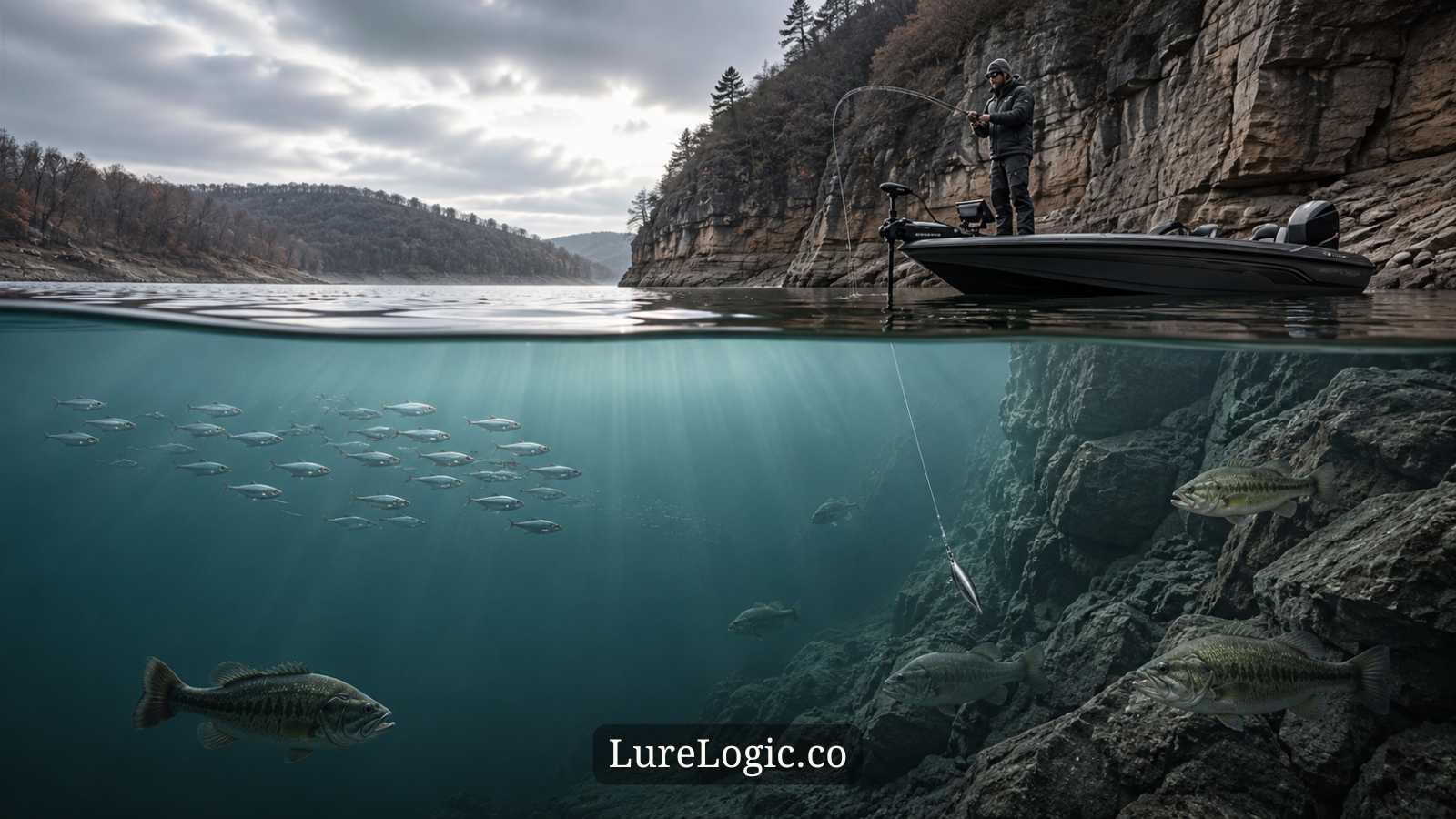
Blade baits are the most productive cold-water reaction bait in bass fishing. The flat metal body throws a tight high-frequency vibration that bass detect from a long distance through cold dense water, triggers reaction strikes when most other baits move too aggressively for cold bass metabolism, and presents a baitfish silhouette that matches dying or stunned shad — the dominant winter forage on most reservoirs.
Damiki Vault Blade Bait — Editor's Pick. The Damiki Vault is built specifically for vertical bass fishing on deep structure. The flat profile cuts cleanly through water on the lift, the tight vibration on the fall triggers neutral fish, and the heavy-wire treble holds up to repeated cold-water hooksets. Available in 3/8 and 1/2 oz; the 1/2 oz is the universal weight for most blade bait presentations.
Steel Shad — Best Value. The original mass-produced blade bait and still one of the most productive. Made of stainless steel for durability and corrosion resistance, the Steel Shad delivers premium-class action at a budget-friendly price. Available in multiple weights (1/4 oz through 1 oz) for different depth applications.
Heddon Sonar Flash — Classic Choice. The Heddon Sonar has been catching bass since the 1960s. The flat-sided body and tight vibration are the original blueprint for the entire blade bait category. Multiple line-tie positions on the back let anglers tune the bait's action — front tie for tighter vibration, back tie for more wobble.
Silver Buddy — Premium Tournament Bait. The Silver Buddy is a tournament-favored blade bait with refined balance and a slightly more aggressive vibration than the Sonar. Excels in clear water on bass keying on shad.
Johnson ThinFisher — Slim Profile. A thinner-bodied blade bait that produces in the clearest water and on the most-pressured fish. The reduced profile reads as a smaller, more natural baitfish silhouette.
Nichols Lures Magnum Blade — Big-Bait Specialist. A larger 1 oz blade bait for fishing very deep structure (25+ ft) on lakes where bass key on larger shad or alewife forage.
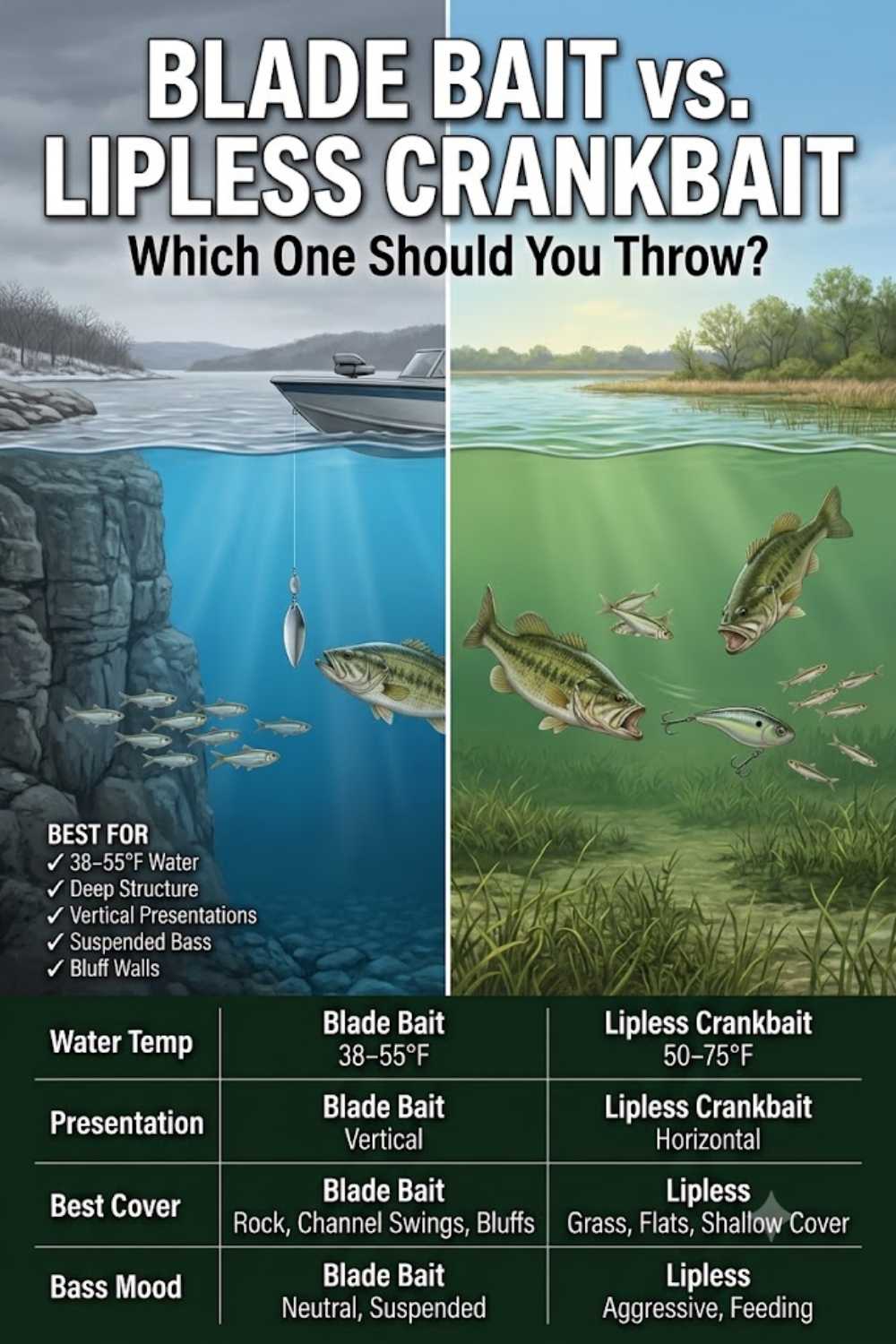
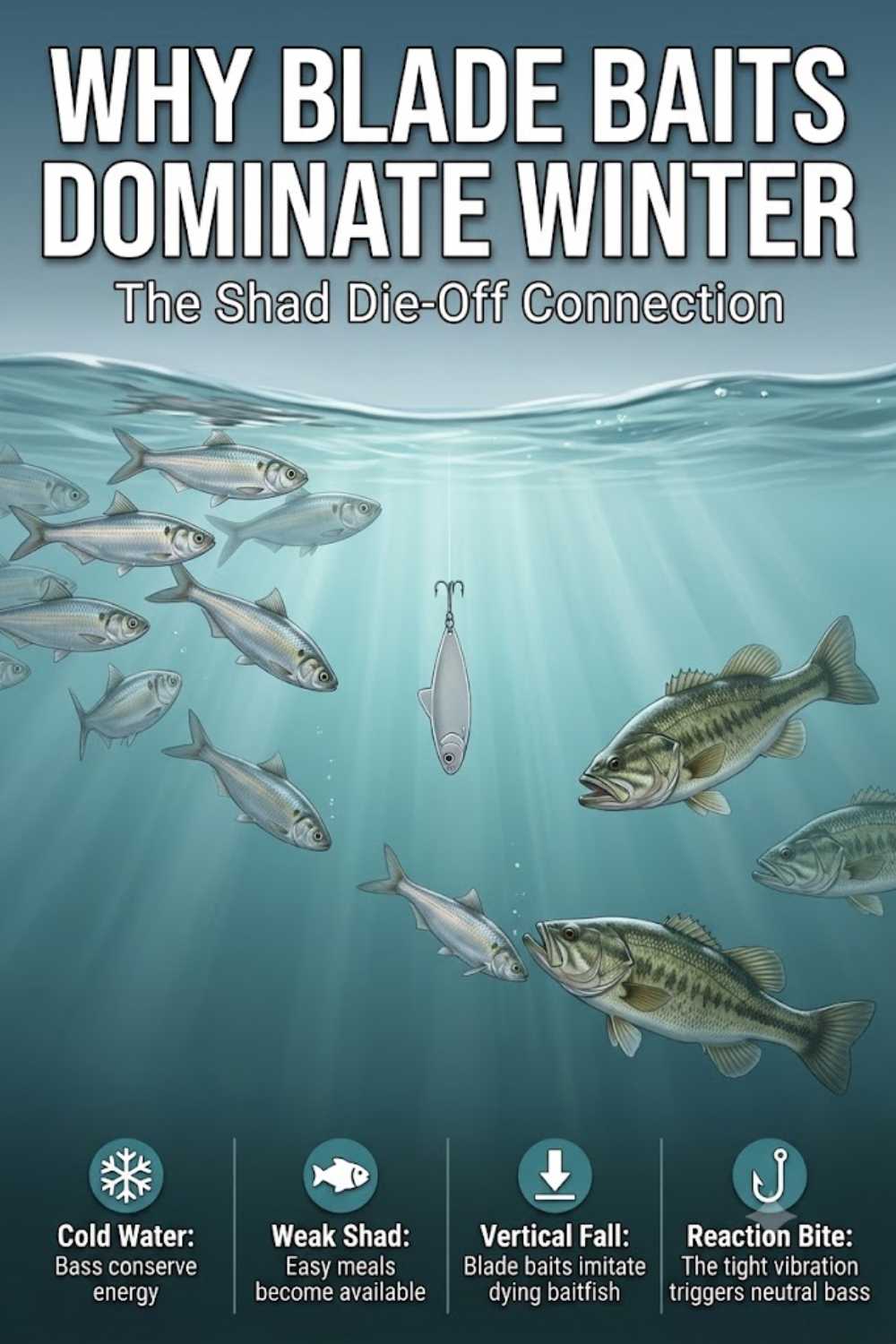
Blade baits work because they isolate the single sensory trigger that still functions in cold water — high-frequency vibration. As water temperature drops, bass metabolism slows and most reaction triggers (visual chase, wide wobble, loud rattle) become less effective. A cold-water bass at 40°F will not chase a fast-moving crankbait or commit to a spinnerbait throwing wide flash. But that same bass will lock onto the tight vibration of a blade bait being lifted and dropped 6 ft away, because the vibration profile sits in the frequency range bass detect best through cold dense water.
The second reason blade baits work is forage matching during cold-water shad die-off events. When water temperatures drop into the high 30s and low 40s in winter, threadfin shad become stressed and many die — creating clouds of dying baitfish that bass actively feed on. A blade bait fluttering on the fall is the perfect imitation of a dying or stunned shad falling through the water column, and the bites during a die-off event can be ferocious. Winter shad die-off bass fishing covers the pattern in detail.
Third, blade baits fish vertically, which matches how cold-water bass position. Winter bass stack on vertical structure — bluff walls, channel swings, the deep ends of points — and hold suspended in the water column rather than relating to bottom. A vertically-presented blade bait fishes the entire water column on each lift-and-fall cycle, finding suspended fish that horizontal baits would pass above or below. Combined with electronics, vertical blade bait fishing on suspended winter bass is one of the most efficient cold-water techniques in bass fishing.
Finally, blade baits trigger neutral fish. The combination of vibration on the lift, flash on the rotation, and flutter on the fall presents three distinct stimuli that override neutral-fish refusal. A bass that follows the bait for two lift-and-fall cycles without committing often crushes it on the third — the cumulative sensory input overcomes the metabolic reluctance to feed.
Blade baits are cold-water specialists. The productive window opens when water drops below 55°F and closes when it warms above 55°F.
Winter (water under 50°F) — The marquee blade bait window. Target vertical structure: bluff walls, channel swings, the deep ends of main-lake points, and offshore humps. Bass stack on these features during winter, holding in groups 5–20 ft off bottom. Vertical-jigging a blade bait on top of the school produces the year's biggest concentrations of quality bass. Winter bass fishing lures covers the broader cold-water playbook.
Late prespawn (water 50–58°F) — The secondary window. As bass migrate from winter holding toward spawning areas, they stage on the first deep structure inside spawning bays — typically secondary points, channel swings inside creek arms, and rocky transitions. A blade bait worked across these staging areas produces aggressive prespawn fish. The prespawn lures guide and 55-degree water bass lures guide cover the pattern.
Fall (water 60–50°F) — The third window. Late-fall bass following shad migrations into creek arms and out to offshore structure respond well to blade baits as water temperatures begin dropping toward winter holding. Particularly effective on lakes with strong threadfin shad populations.
Blade baits are less effective in warm water (above 60°F) where moving baits like crankbaits and chatterbaits cover water more efficiently and trigger more fish. The category is a dedicated cold-water tool — extremely productive when the conditions are right, replaceable by other techniques when conditions warm.
Depth selection — Blade baits produce from 8 ft to 35+ ft. Most cold-water bass hold in the 15–25 ft range on vertical structure; that depth band is the bread-and-butter of blade bait fishing. Use a 3/8 oz blade in 8–15 ft, a 1/2 oz in 15–25 ft, and a 3/4–1 oz in deeper presentations or strong wind.
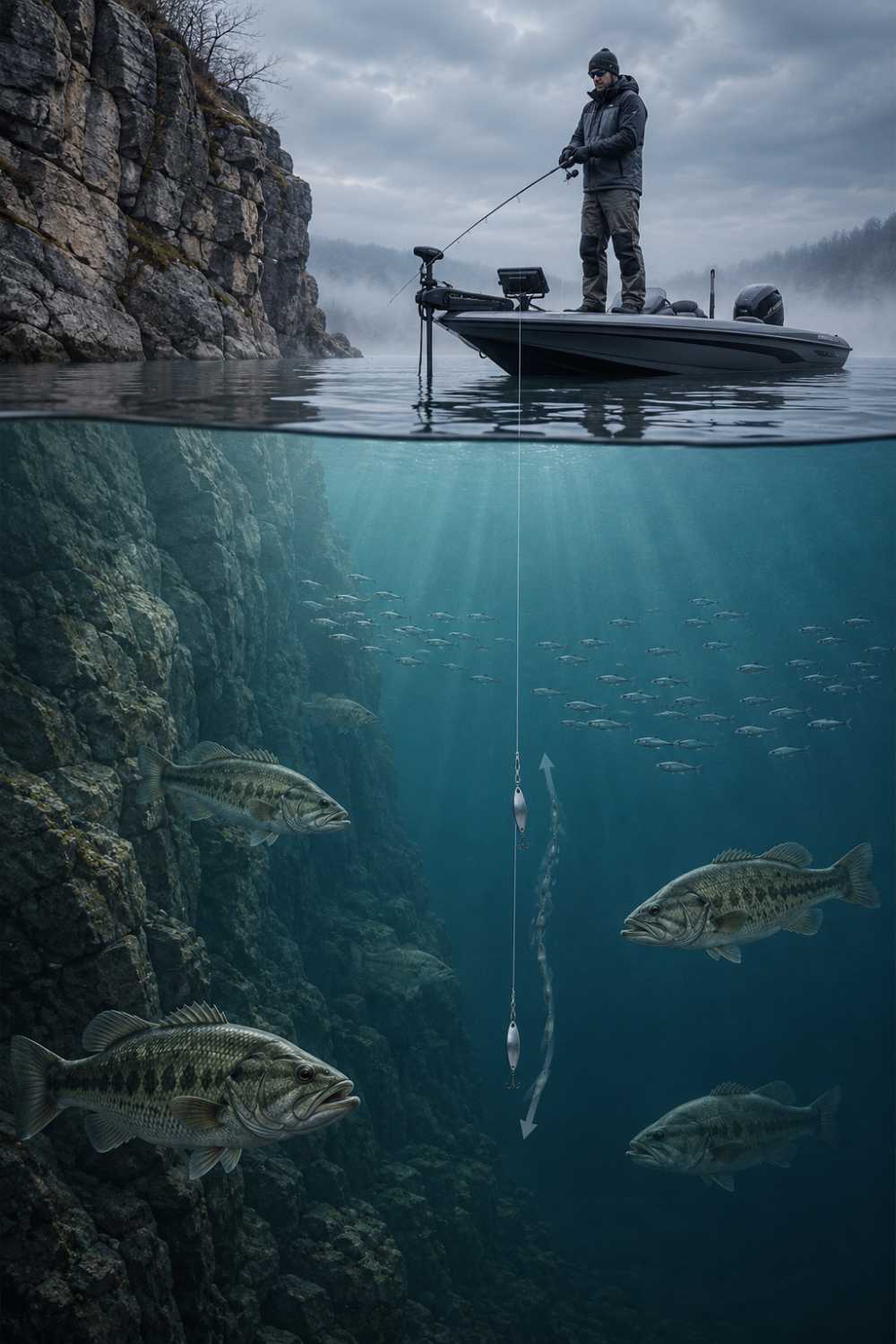
Three distinct blade bait presentations cover most cold-water situations.
Vertical jigging — The bread-and-butter winter presentation. Position the boat directly over the structure (bluff wall edge, channel swing, deep point) and drop the bait to the bottom. Lift the rod tip sharply 2–3 ft, then let the bait fall back on a controlled slack line (not free-fall — keep slight tension to feel the bite). Repeat. Most bites happen on the fall. Pair with electronics to confirm depth and locate suspended fish; drop the bait to just above the suspended school and work it through the strike zone.
The ripping retrieve — The cast-and-retrieve presentation. Make a long cast across deep structure, let the bait sink to the desired depth, then retrieve with a slow steady reel speed combined with sharp rod-tip rips every 3–5 cranks. The constant vibration plus the periodic rip-and-flutter produces a wide search pattern that finds scattered cold-water fish.
Lift-and-fall — The horizontal jigging presentation. Cast and let the bait fall to bottom. Sweep the rod tip sideways from the 9 o'clock position to the 11 o'clock position, lifting and pulling the bait 4–6 ft, then let it fall back on a controlled slack line. The horizontal sweep covers more water than vertical jigging while still presenting the fall as the bite trigger.
Line selection — 8–12 lb fluorocarbon is the standard. Fluorocarbon sinks (helps maintain bait contact), has minimal stretch (transmits subtle bites), and provides invisibility in clear winter water. Some anglers run 15–20 lb braid with a 10-lb fluorocarbon leader for maximum sensitivity on deep vertical presentations.
Rod — Medium-heavy fast-action 7'0" to 7'3" baitcasting rod for cast-and-retrieve presentations; 6'10" to 7'0" medium-action spinning rod for vertical jigging with lighter blade baits.
The hookset — Reel down to remove slack, then sweep the rod hard. Treble hooks penetrate easily but the cold water and the bass's slower reaction time mean hooksets must be deliberate — pause for a half-second after feeling the bite before setting to allow the bass to close fully on the bait.
Blade bait color selection is forage-driven and clarity-modified.
Chrome and silver — The universal shad-mimic. Produces on clear-water bass keying on threadfin shad and herring. The flat metallic finish reflects ambient light at the same wavelength as dying or stunned shad, triggering bites during winter die-off events. Carry both chrome-with-black-back (clear water) and chrome-with-blue-back (slightly stained or low-light) variants.
Gold — The slightly-stained-water alternative. Produces around bass keying on gizzard shad (which display a more gold-and-silver flank than threadfin) and on perch-dominated northern lakes. Pair with brown or black back for contrast.
White and pearl — The bright-water specialist. Produces in stained water (under 2 ft visibility) where chrome reads as too obvious. Less common but worth carrying for tough conditions.
Glow and chartreuse — The deep-water and dark-day option. In water deeper than 25 ft or on heavily overcast winter days, a glow or chartreuse blade bait adds visibility that natural finishes cannot match. Particularly effective on extremely deep vertical jigging presentations where light penetration is limited.
Black — The night and ultra-clear-water option. On lakes where night fishing is legal, black blade baits produce winter bites that natural finishes cannot match. Also worth carrying for the clearest winter water (10+ ft visibility) where natural colors get inspected and refused.
Forage matching extends beyond color. Bait size matters — a 1/4 oz blade bait matches threadfin shad (2–3 inches) on most southern reservoirs; a 1/2 oz matches medium gizzard shad (3–5 inches); a 1 oz matches larger gizzard shad and herring (5–7 inches). Pick weight based on both the forage size and the depth being fished. The bass forage guide covers regional forage profiles.
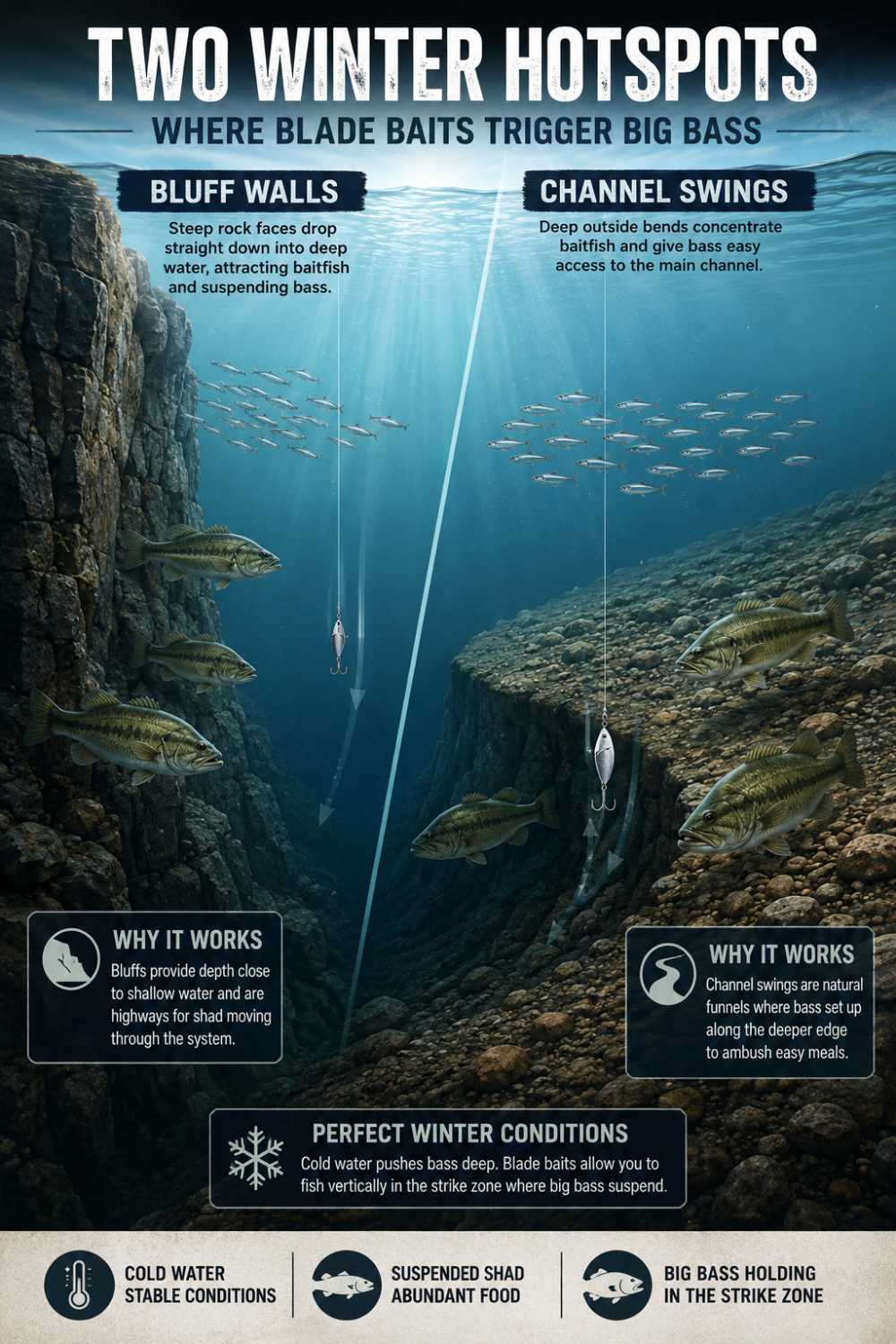
Winter blade bait fishing is largely about two structure types: bluff walls and channel swings. Master those two structures and the technique produces all winter.
Bluff walls — Vertical or near-vertical rock walls dropping into deep water (typically 15–40 ft). Winter bass suspend tight to the wall at depths between 15 and 30 ft, holding on small irregularities, isolated boulders, and shelves cut into the wall. Position the boat 15–20 ft off the wall and parallel to it. Cast tight to the wall and let the blade bait fall on a controlled drop, then work the lift-and-fall along the wall face. The bait should occasionally tick the wall — that contact-and-recover triggers reaction strikes. Move along the wall slowly, working productive sections multiple times.
Channel swings — Where a creek or river channel makes a sharp turn against a hard-bottom shoreline. These swings concentrate baitfish in winter (current and depth combine to keep water slightly warmer) and bass stack on them in numbers. Position the boat over the deep side of the swing and work the blade bait vertically across the channel break. Bass typically hold on the upstream side of the swing in the 15–25 ft depth range.
Main-lake points (deep ends) — Long points dropping into the main lake basin hold winter bass at the deep tip and along the deeper of the two sides. Work the blade bait vertically over the deep tip first, then move along the deeper side.
Isolated humps and offshore brush — Less-pressured cold-water structure that often holds the biggest fish. A blade bait dropped on top of an offshore hump and worked vertically across it produces winter bass that anglers chasing the obvious bluff-wall and channel-swing patterns miss.
The pattern is repetitive but effective: find the structure on electronics, position the boat directly over the bass, and work the blade bait until the school is exhausted or the fish stop biting. A productive winter day on blade baits often produces 15–25 quality bass from 3–5 structures.
Blade baits are the dedicated cold-water reaction tool in bass fishing. When water temperatures drop into the 40s and 50s and other reaction baits stop producing, blade baits continue catching quality bass on deep vertical structure. Master the vertical jigging presentation, learn to find bluff walls and channel swings, and add the lift-and-fall and ripping retrieves for variety, and the technique will produce winter bites that put together kicker-fish stringers when most anglers can't get bit.
For the warmer-water reaction-bait alternative, see the best lipless crankbaits guide — lipless cranks fill the same reaction-bait role in 50–75°F water that blade baits fill in cold water. For the broader winter playbook, see winter bass fishing lures and best bass lures by water temperature. For finesse cold-water alternatives, see the best Ned rigs guide and the best drop shot baits guide.
Tight vibration — an ideal winter vertical blade.
Cold water on deep structure — short rips with long pauses.
As an Amazon Associate I earn from qualifying purchases.
Temperature-by-temperature lure logic.
The prespawn temperature threshold.
Natural presentations and finesse profiles.
Vibration, dark silhouette, and visibility tactics.
Adjusting across the full clarity spectrum.
Topwater and reaction baits for the dawn window.
Plug in today's water temp, clarity, weather, and forage — the tool returns the highest-confidence presentations.
Build Today's Strategy →