Editor's Pick97%
Dirty Jigs Compact Pitchin' Jig
Bluegill
View Product →Which flipping jig to tie on for matted grass, laydowns, and docks — weight by cover density, color by water clarity, trailer pairings, and the hooks that hold up on 50-pound braid.

Affiliate Disclosure: As an Amazon Associate I earn from qualifying purchases. Recommendations reflect on-the-water testing and the LureLogic ranking engine — not paid placement.
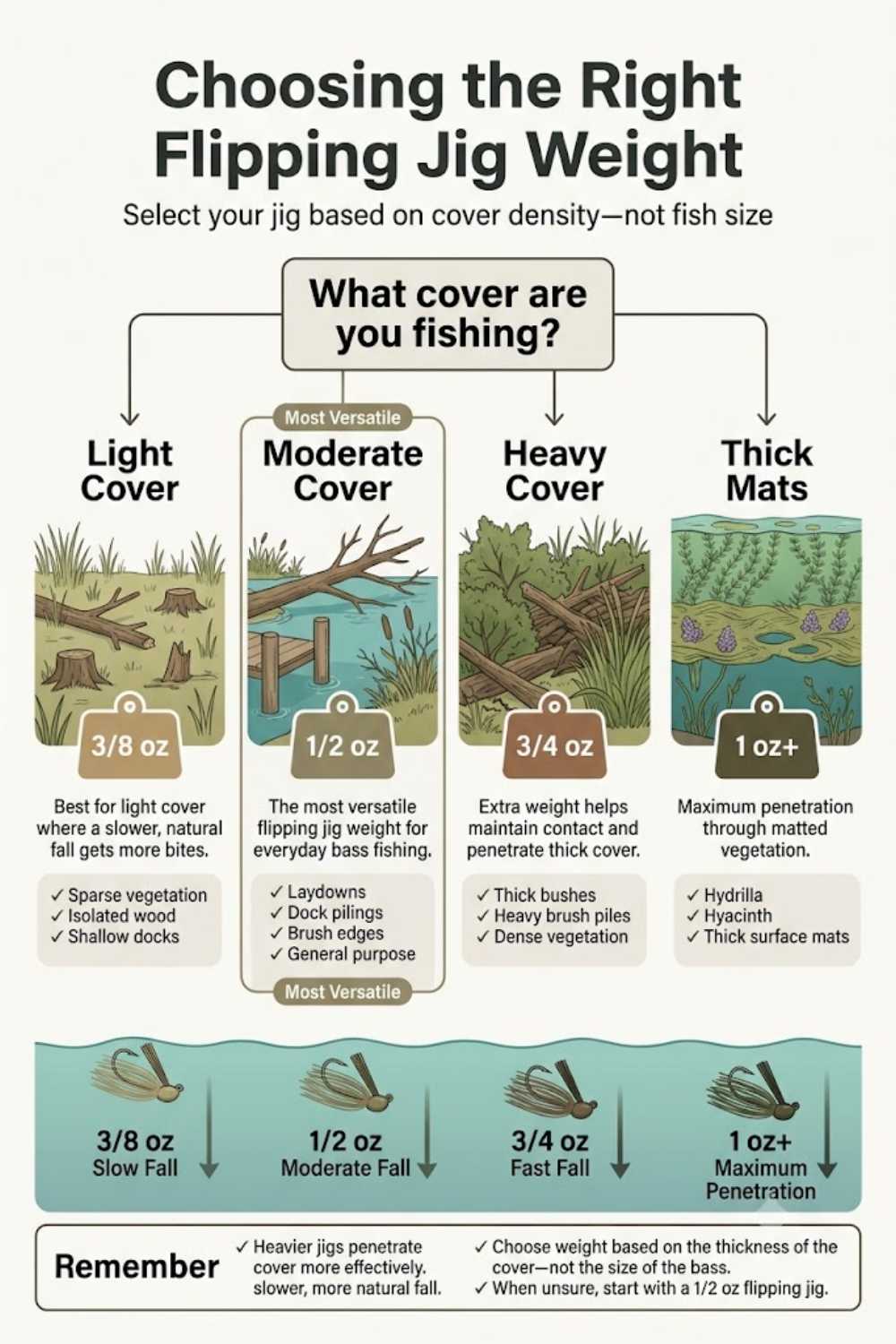
Short answer: a 1/2 oz compact flipping jig in black-and-blue handles most docks, laydowns, and brush; step up to 3/4–1.5 oz to punch matted grass, and drop to 5/16–7/16 oz for pressured or clear water. Weight is chosen by cover density, color by water clarity.
Flipping jigs are the heavy-cover specialists of the jig family. They are designed for one job — penetrating dense cover, drawing reaction strikes, and getting big bass out before they can wrap up. The best flipping jigs share three traits: a heavy-gauge hook that drives through bone on a short-line hookset, a stiff fiber weed guard that deflects sticks and grass without burying the hook point, and a compact head that punches cleanly through matted vegetation and dock cables.
Dirty Jigs Compact Pitchin' Jig — Editor's Pick. Combines a premium Gamakatsu Heavy Cover hook, a tight head profile, and a hand-tied skirt that pulses on a slack-line fall. The right answer for the vast majority of flipping scenarios — docks, laydowns, isolated brush, moderate vegetation.
Strike King Hack Attack Flipping Jig — Best Heavy Cover. Designed with Greg Hackney. Heavier hook gauge, stiffer weed guard, head built to punch matted hyacinth, hydrilla, and bush piles where lighter jigs foul. The jig you tie on when bites are happening in cover most anglers refuse to fish.
Beast Coast Tungsten Flipping Jig — Premium Tungsten. Tungsten heads run smaller per ounce than lead, generate sharper bottom feedback, and punch cover more efficiently. Tournament-grade hook and skirt.
Siebert Outdoors Flipping Jig — Custom Build. Boutique builder with custom skirt blends and head finishes that produce on heavily-pressured lakes where mass-produced jigs lose their edge.
Missile Baits Ike's Mini Flip Jig — Compact Specialist. A 5/16- and 7/16-oz finesse flipping jig that excels around pressured fish, in clear water, and during cold-front conditions when bass want a smaller meal but still hold in cover.
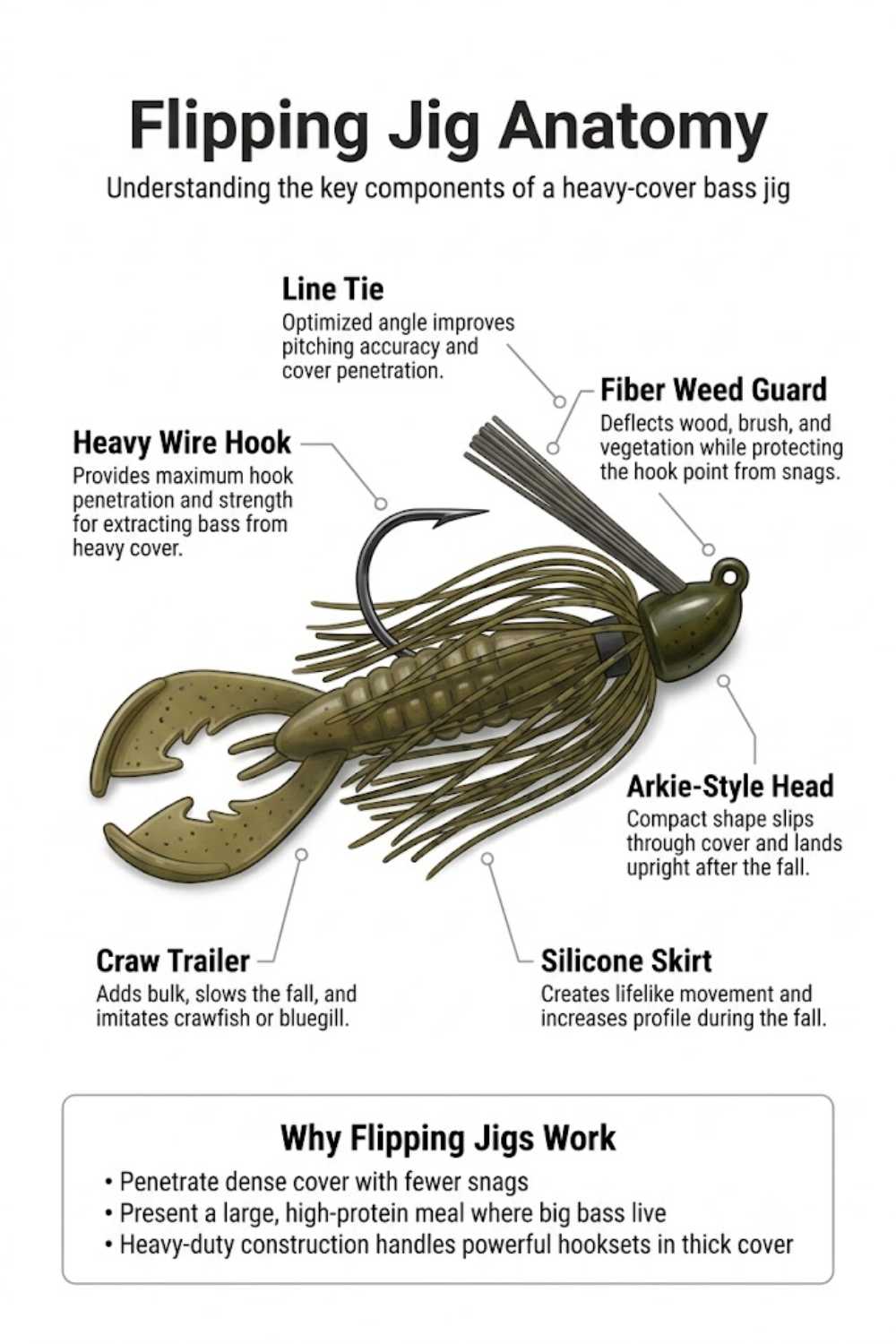
Flipping jigs catch bass for one fundamental reason: they go where bass live but other lures cannot reach. Mature bass in any system spend a disproportionate amount of their lives oriented to cover — wood, grass, docks, brush, and any irregularity that gives them ambush leverage. The bigger the bass, the more committed it usually is to that cover orientation. A 5-lb largemouth does not patrol open water hunting for shad; it sits inside a brush pile or under a dock and waits for prey to come to it.
That reality is what makes flipping jigs so productive. A weightless soft plastic, an open-hook swimbait, or even a Texas-rig cannot consistently fish the heart of dense cover. They snag, foul, or skip past the strike zone too quickly. A flipping jig — heavy enough to punch through, weed-guarded to keep the hook clean, and compact enough to slide between branches — drops vertically into the exact spaces where the biggest bass hide.
The second reason flipping jigs work is profile matching. A jig with a chunk or craw trailer presents a high-calorie meal — crawfish, bluegill, or large baitfish — exactly the forage adult bass have evolved to ambush from cover. The fall rate of a 1/2 oz jig (roughly a half-second per foot) sits in the natural fall window for those forage items, which is why so many flipping bites occur on the initial drop.
Finally, flipping jigs draw reaction strikes from bass that are not actively feeding. Repeated pitches into the same piece of cover often produce on the third or fourth presentation as a previously-neutral fish reacts to the persistent intrusion. That ability to manufacture a strike from a non-feeding bass is what separates flipping from search techniques and is why so many tournaments are won on a flipping jig during otherwise tough conditions.
Color choice in flipping is simpler than it looks. Three core color families cover almost every situation, and the right choice is dictated more by water clarity and light than by forage matching alone.
Black and blue — The default. The right color in stained water (1–2 ft visibility), muddy water (under 12 inches), overcast conditions, after-rain runoff, and night fishing. The dark silhouette is what bass can actually resolve against low-visibility water. If you carry only one flipping jig color, make it black-and-blue.
Green pumpkin — Clear-to-lightly-stained water. When visibility exceeds 2 ft and bass have time to inspect the bait, natural colors outproduce dark profiles. Green pumpkin with a flash of orange or chartreuse mimics bluegill, gobies, and lightly-stained crawfish. The right color for sight-fishing the spawn and postspawn bluegill patterns. The bluegill spawn positioning guide details where to focus.
Brown and orange — The crawfish specialist. Rocky lakes in spring (water 50–62°F) when crawfish are actively molting and showing orange highlights call for a brown craw-pattern jig with a matching craw trailer dipped in orange. Pair with hard-bottom transitions, riprap, and chunk-rock banks. See the crawfish color cycle for season-specific molt colors.
Bluegill — The shallow-cover summer color. From late May through July when bluegill colonies are active around docks and shallow grass, a bluegill-pattern jig flipped to dock posts and shaded grass edges outproduces every other color.
In extremely muddy water (post-rain), add a rattle to whatever color you choose. The sound profile gives bass another sensory cue when visibility is functionally zero. Muddy water bass fishing covers this approach.
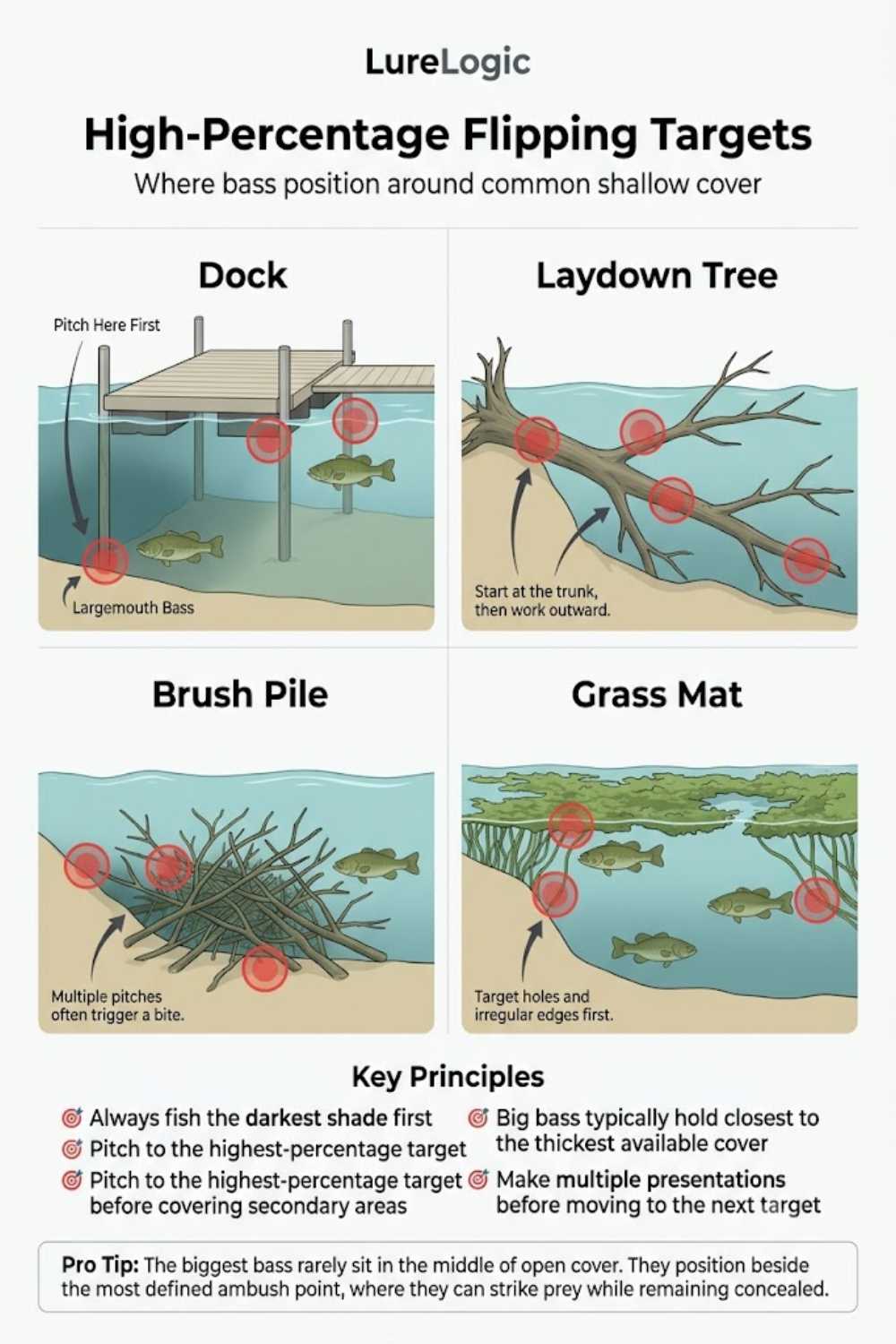
Flipping jigs work in every type of shallow cover, but each cover type demands a small adjustment in jig style, trailer, and presentation. Reading the cover before the first pitch is what separates a few bites from a 20-fish day.
Docks — Predictable targets: shaded corners, walkway shadows, deep posts, cable anchors, floating-dock perimeters. Skip a 1/2 oz compact jig (black/blue or green pumpkin) deep under the dock and let it fall on slack line. Most dock bites happen on the initial drop or the first hop. Floating docks in summer hold the biggest fish on the shaded side. See the summer dock bass fishing guide.
Laydowns — Approach from a 45-degree angle, pitch tight to the trunk, then work outward along main branches. Bass orient to the trunk junction, large limb forks, and the deepest end of the laydown. A 3/8 to 1/2 oz jig with a beaver-style trailer slides through branches without fouling. The laydowns guide covers the angles.
Matted vegetation — Punch with a 3/4 to 1.5 oz jig, trailer with a compact beaver. Bass under mats sit in small open pockets beneath the canopy. Make repeated pitches to the same opening — the third or fourth flip often triggers a reaction strike from a previously-neutral fish.
Bush piles and brush — A 1/2 oz jig with a stiffer weed guard. Pitch past the cover, swim the jig into the bush, let it fall slack-line through the branches. Most strikes occur as the jig contacts the first major branch and tips downward.
Grass lines — Hydrilla and milfoil edges. A 3/8 oz jig with a swimming retrieve along the outside edge produces active fish; flip the same jig into isolated holes in the canopy for inactive fish. See the grass line bass fishing guide.
Rock and riprap — Often overlooked but riprap during spring crawfish migrations holds quality bass. Pitch a brown/orange 1/2 oz jig parallel to the rocks, let it fall along the face, hop it back.
Flipping jigs catch bass twelve months a year, but cover type, jig weight, and trailer change with water temperature.
Prespawn (water 48–58°F) — Bass migrate from deep winter holding into staging areas adjacent to spawning bays. Target hard-cover transitions: laydowns on creek points, brush piles on secondary points, the first wood cover inside spawning pockets. A 3/8 oz black/blue or brown/orange jig with a craw trailer worked slowly through staging cover produces some of the year's biggest fish. The prespawn bass fishing guide covers the staging pattern.
Spawn (58–68°F) — Sight-fishing transitions into pure cover flipping in stained-to-muddy water where beds are invisible. Pitch a green pumpkin jig into laydowns and isolated wood adjacent to spawning flats. Cruising males and bedded females both eat the jig as it invades their bed perimeter.
Postspawn (68–75°F) — Females recover on the first shaded cover adjacent to the spawning bay. Shallow brush piles, deeper laydowns, and shaded docks all hold recovering fish. A 1/2 oz green pumpkin or bluegill-pattern jig with a Rage Craw trailer outproduces nearly every other technique. Postspawn bluegill behavior explains why.
Summer (75–88°F) — Flipping splits between shallow shade-line fish (early/late and overcast days) and dock fish (all day). The biggest summer flipping bass live under floating docks in main-lake pockets and under matted vegetation in upper-end creek arms. A 3/4 oz black/blue punch rig produces midday on matted grass; a 1/2 oz compact jig flipped to dock shade produces in the magic-hour windows. Shade-line bass fishing covers the geometry.
Fall (75–55°F) — Bass push shallow chasing baitfish. Flip shallow wood cover on creek banks and the backs of pockets. A 3/8 oz green pumpkin or bluegill jig produces fall bass that followed bait into cover. Fall bass fishing covers the broader pattern.
Winter (water under 50°F) — Most anglers put flipping rods away. The ones who keep flipping during midday warm spells, into the heaviest available shallow cover, catch trophy fish. A 1/2 oz black/blue jig with a compact chunk trailer worked extremely slowly produces. See the winter bass fishing lures guide.
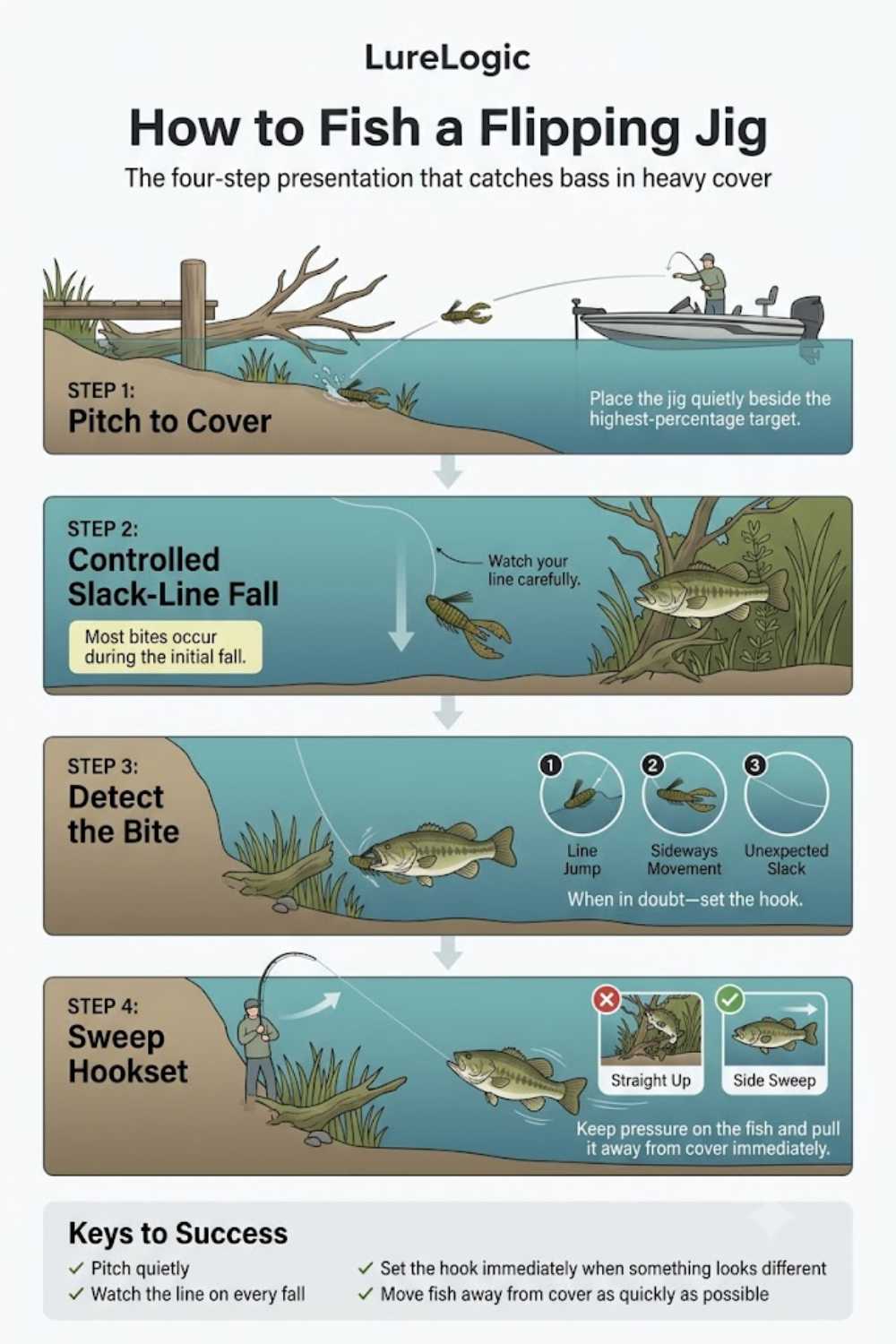
Flipping is a precision technique, not a search technique. Distance to cover is short (often 10–25 ft), pitches are accurate, and the angler sees and feels almost every bite. Mechanics matter more than equipment.
Flipping vs pitching — A flip is a controlled underhand swing where the line stays in the same hand throughout the cast — used at very short distances (10–15 ft) to drop the jig vertically with no splash. A pitch uses the reel and a longer underhand swing to deliver the jig at 15–30 ft. Both end with the jig falling on a controlled slack line so bites can be detected on the drop.
The presentation — Make the pitch, watch the line as the jig falls, feel for any tick, jump, or sudden slack. Most flipping bites happen on the initial fall. If no bite, let the jig settle, then make one or two small hops back along the bottom before lifting and re-pitching to the next target.
The hookset — Reel down to remove all slack, then sweep the rod hard upward and to the side. Avoid a vertical hookset in heavy cover — a side-sweep keeps the bass moving sideways out of cover instead of straight up into the canopy. With 50–65 lb braid, hook penetration is rarely the issue; the issue is getting the bass moving away from cover in the first 1.5 seconds.
Target selection — Read every piece of cover before pitching. Bass orient to the deepest, shadiest, most-defined ambush point — the trunk junction of a laydown, the corner shade of a dock, the densest interior of a brush pile, the deepest hole in matted grass. Pitch to the highest-percentage target first, then work outward only after the prime spot produces or fails to.
Repeated presentations — Some bass eat the first pitch; some need three. If a piece of cover looks high-percentage and the first pitch produces no bite, make 2–4 additional pitches from slightly different angles before moving on. Many tournament wins come from the third pitch to the same dock corner.
Reading the bite — Flipping bites range from a hard thump to a subtle line tick or sideways line jump. When in doubt, set the hook.
Flipping jigs catch the biggest bass in a system because they fish exactly where the biggest bass live. The technique requires more precision than skill, more patience than power, and more reading of cover than reading of electronics. Get those fundamentals right, pair them with a quality jig and a matched trailer, and the flipping rod will produce kicker fish that nothing else in the boat can match.
For anglers expanding their jig arsenal beyond flipping, the football jig guide covers the offshore counterpart, the jig trailers guide dives deeper into trailer selection, and the chatterbait guide covers another premier cover-search technique. Match the right jig to the right cover, and the bass will tell you the rest.
Premium skirt and head shape for pitching tight cover.
Pitch to docks, laydowns, and isolated cover for big fish.
As an Amazon Associate I earn from qualifying purchases.
Temperature-by-temperature lure logic.
The prespawn temperature threshold.
Natural presentations and finesse profiles.
Vibration, dark silhouette, and visibility tactics.
Adjusting across the full clarity spectrum.
Topwater and reaction baits for the dawn window.
Plug in today's water temp, clarity, weather, and forage — the tool returns the highest-confidence presentations.
Build Today's Strategy →