Editor's Pick97%
SPRO Bronzeye Frog 65
Leopard Frog
View Product →The best topwater frogs for bass, ranked by cover type — heavy mats, lily pads, hydrilla, and open shallow water. Hollow-body picks, color by light and clarity, hook-up fixes, and how to walk a frog.
Affiliate Disclosure: As an Amazon Associate I earn from qualifying purchases. Recommendations reflect on-the-water testing and the LureLogic ranking engine — not paid placement.
If you only have time to read one paragraph: the SPRO Bronzeye Frog 65 is the Editor's Pick because it nails the three things that matter in a hollow body — easy walking action straight out of the package, exceptional weedlessness through pads and matted grass, and a hook gauge that holds up on a 5-pounder dragged out of hydrilla.
The Booyah Pad Crasher is our Best Value pick. The soft body collapses on the strike, the action is reliable without tuning, and the price point lets you fish aggressively into the nastiest cover without flinching when one finally gets buried. It is the perfect frog for anglers building confidence in the technique.
The Strike King KVD Sexy Frog is the best dedicated walking frog on the list. It excels around sparse vegetation, grass edges, and open pockets where side-to-side action is the primary trigger.
The LiveTarget Hollow Body Frog is the realistic-profile choice for clear water and pressured fisheries where bass have seen every standard frog silhouette in the box. The Scum Frog Trophy Series is the heavy-cover specialist — designed to slide across cheese mats, hyacinth fields, and the thickest duckweed where ordinary frogs foul.
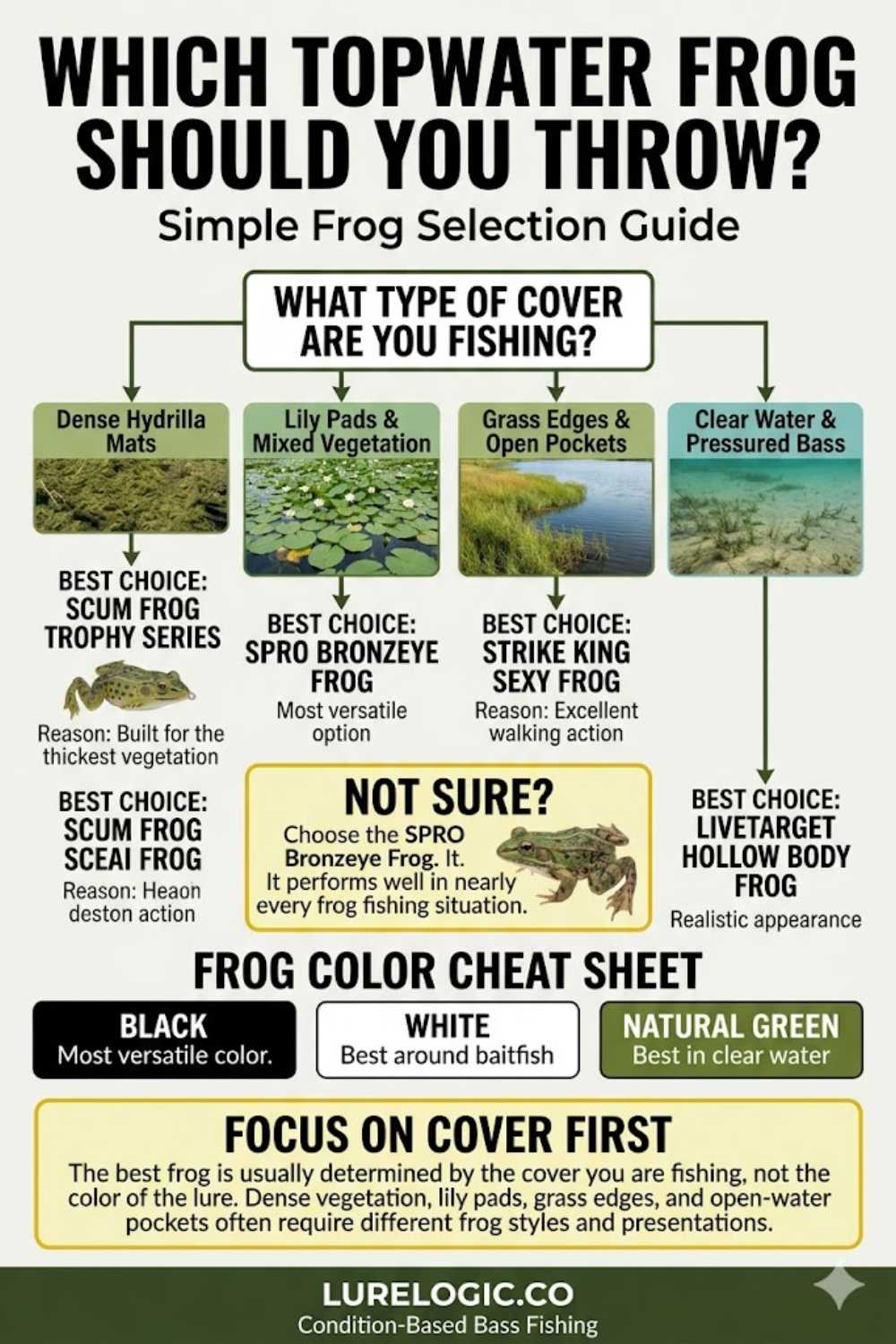
The recommendation cards above are ordered by overall versatility for the broadest range of frog fishing scenarios. Use them as a starting point, then refine by cover density, water clarity, and forage as covered in the following sections.
SPRO Bronzeye Frog 65 — The benchmark by which most hollow-body frogs are judged. Tournament anglers have relied on it for years because it performs across nearly every frog scenario: pads, hydrilla, sparse grass, reeds, and shoreline cover. It walks easily, skips effectively under overhangs, casts long distances, and maintains excellent weedlessness while still delivering strong hookup percentages. In clear water, natural green and brown patterns excel because bass can inspect the bait closely. In stained water, black creates a stronger silhouette and often outperforms more detailed colors. On bluegill-driven fisheries, the Leopard Frog and Bluegill patterns become primary picks from late spring through early fall when bass patrol shallow cover hunting sunfish.
Booyah Pad Crasher — Outstanding performance at an affordable price. The soft body collapses easily during strikes, improving hook penetration and reducing fish lost during the fight. It excels around lily pads, shoreline grass, emergent vegetation, and shallow cover, and is particularly effective for anglers still learning frog fishing because it requires zero tuning and produces reliable action right out of the package. Frog fishing involves casting into the nastiest cover available — the Pad Crasher lets you fish aggressively without worrying about losing an expensive bait. During summer mornings, work it slowly across pad fields and pause near isolated openings, which bass use as feeding windows.
Strike King KVD Sexy Frog — One of the best options when walking action becomes a priority. Some hollow-body frogs require extensive practice to walk effectively; the Sexy Frog was designed to make that presentation easy. It shines around sparse vegetation, grass edges, submerged grass lines, and open-water pockets within larger vegetation fields. Bass position along these transition areas because they provide feeding opportunities while retaining access to cover. The side-to-side walking action imitates a struggling frog, fleeing baitfish, or wounded prey item — versatility that triggers strikes from both feeding and territorial bass. During late summer and early fall, bass frequently feed along grass edges as vegetation begins to thin; walking the Sexy Frog parallel to these edges often produces explosive strikes.
LiveTarget Hollow Body Frog — Emphasizes realism more than most competitors. While many bass anglers focus exclusively on action and profile, appearance can become important in clear water and heavily pressured fisheries. The realistic profile closely resembles an actual frog, making it particularly effective around shallow spawning flats, shoreline vegetation, and clear-water lakes where bass regularly encounter real amphibians. In pressured lakes, bass often become conditioned to seeing traditional frog shapes and color patterns — the realistic LiveTarget can provide a subtle advantage that generates extra bites. Work it with slower retrieves and strategic pauses rather than aggressive walking.
Scum Frog Trophy Series — Built for one purpose: heavy cover domination. If the vegetation looks too thick to fish effectively, this frog is usually the answer. Dense hydrilla mats, duckweed, hyacinth fields, cheese mats, and surface vegetation create ideal conditions, and many anglers avoid these areas because traditional lures constantly foul. The Trophy Series lets anglers target bass that receive significantly less pressure. The biggest bass in a lake frequently position beneath the thickest available cover, using the mat for shade, security, oxygen, and ambush opportunities. Slow retrieves consistently outperform fast presentations because they keep the frog in the strike zone longer.
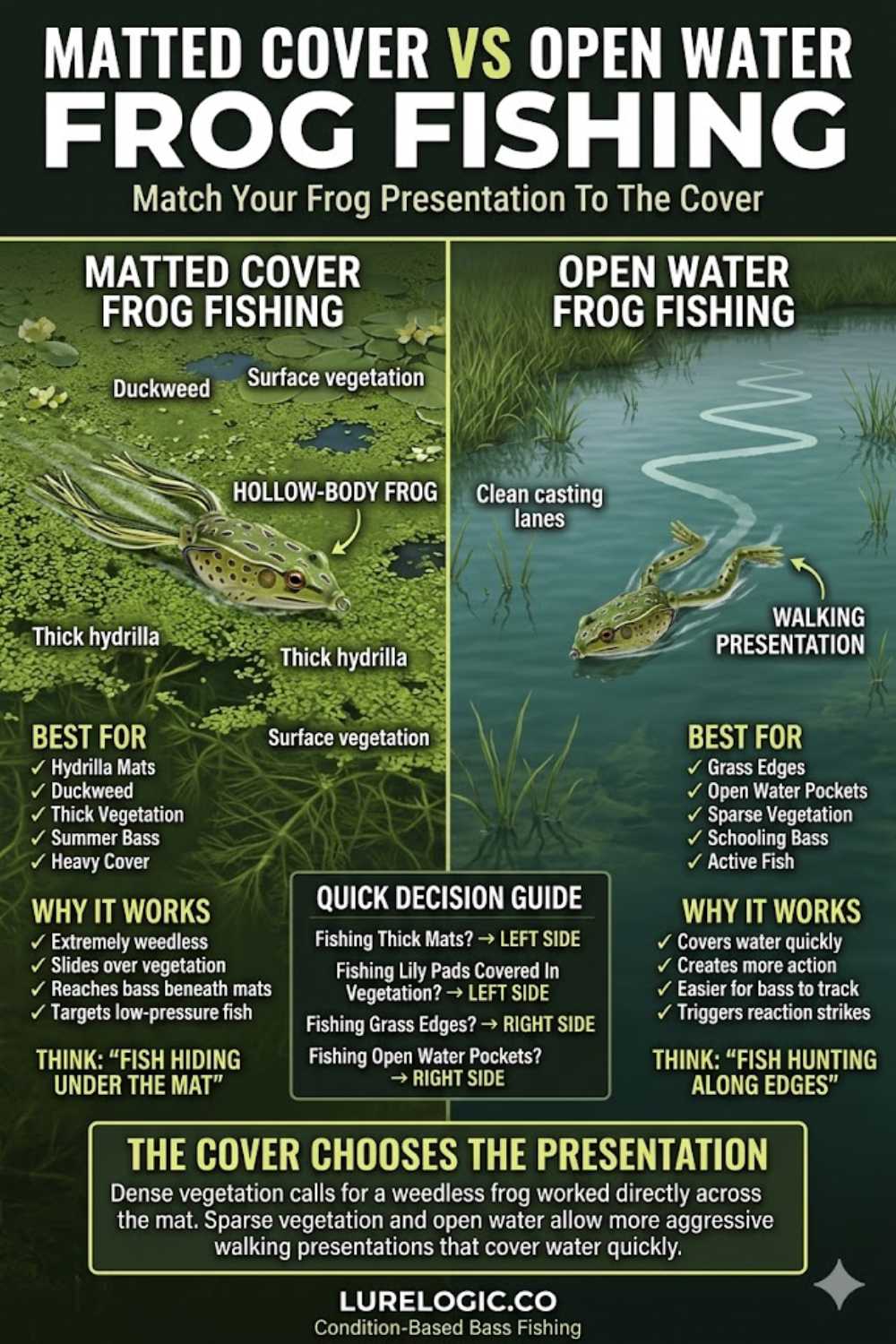
Understanding frog fishing conditions is far more important than understanding individual frog models. The best anglers do not simply tie on a frog because they feel like throwing one — they recognize environmental clues that indicate when frog fishing should become a primary pattern.
Vegetation is the most obvious factor. Frogs excel around cover that would make traditional treble-hooked topwaters nearly impossible to fish. Lily pads, hydrilla, milfoil, coontail, duckweed, hyacinth, reeds, and shoreline grass all create ideal frog environments. These areas provide security for bass and concentrate prey species.
Water clarity dramatically influences how bass interact with frog presentations. In clear water, fish can inspect the lure closely — natural colors, realistic profiles, and subtle retrieves become increasingly important, and long casts help avoid spooking fish. In stained water, visibility decreases and silhouette becomes the primary trigger. Black frogs often dominate because they produce maximum contrast against the surface. Bass are not necessarily identifying detailed features; they are reacting to movement and profile.
Weather conditions also influence frog success. Overcast skies generally extend the topwater bite and encourage bass to roam farther from cover. Bright bluebird conditions often push bass tighter to vegetation, making matted cover especially productive. Wind creates both advantages and challenges: moderate wind can position baitfish along vegetation edges and improve feeding activity, while excessive wind makes frog control difficult and reduces strike detection. Cross-reference our overcast-day pattern and the sunny-day cover playbook to dial in conditions on your fishery.
Oxygen is the overlooked factor. During hot summer periods, healthy vegetation produces oxygen and attracts baitfish; bass often position around these areas for extended periods. This is one reason frog fishing peaks during summer despite the challenging conditions. Forage availability also matters — lakes with abundant bluegill populations often produce exceptional frog fishing because bass naturally patrol shallow cover searching for sunfish, while in shad-based reservoirs, frogs worked along vegetation edges frequently imitate vulnerable baitfish as effectively as they imitate amphibians.
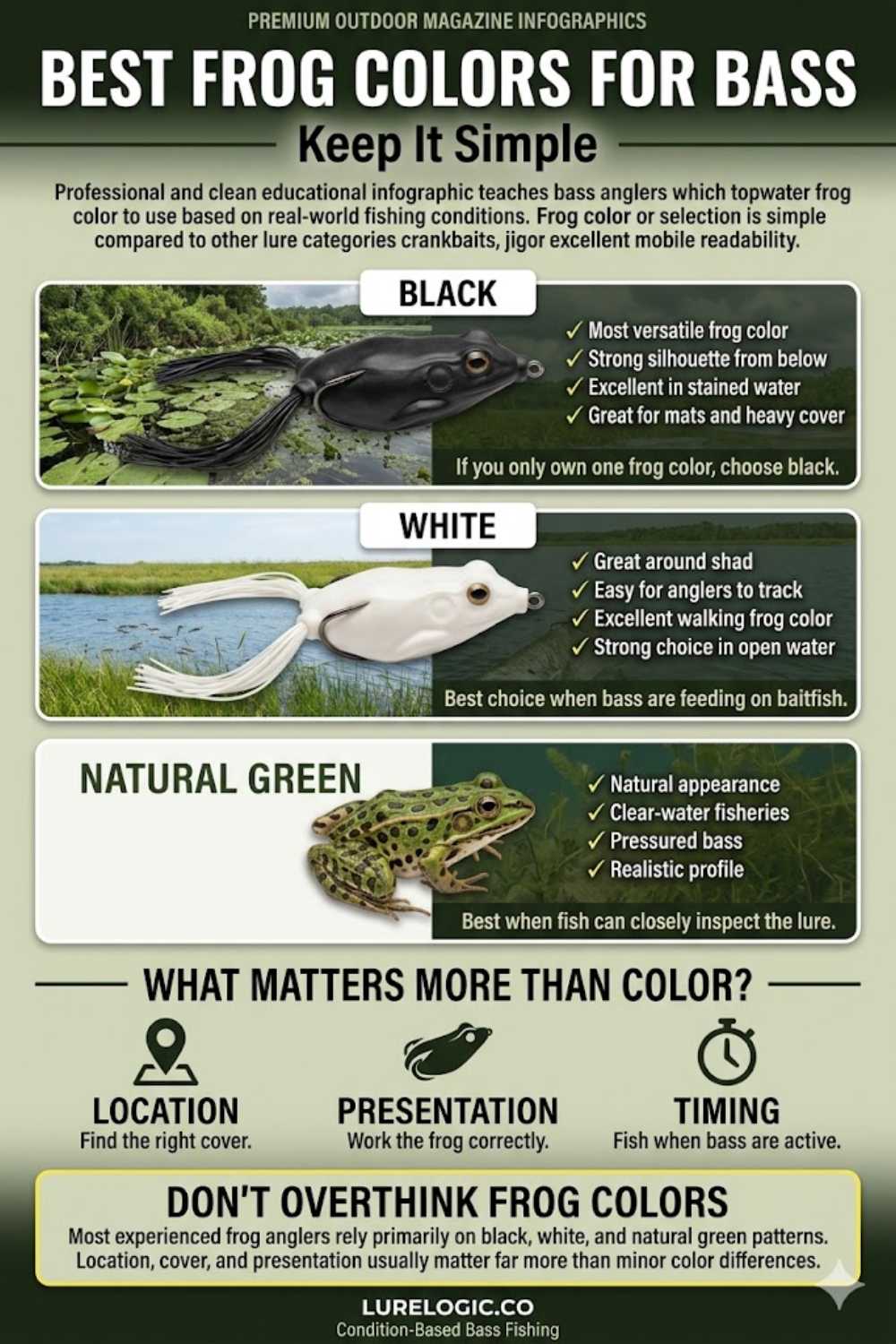
Color selection creates endless debates among bass anglers, yet most successful frog fishermen rely on only a handful of proven patterns. The key is understanding visibility, forage, and presentation rather than carrying dozens of nearly identical colors.
Black remains the gold standard for frog fishing. It produces a strong silhouette in virtually every condition and allows bass to easily identify the target from below. Contrary to popular belief, black works exceptionally well in both clear and stained water because bass are looking upward toward a bright background. Black frogs excel during cloudy weather, early mornings, evenings, stained water conditions, and heavy vegetation scenarios. If you could carry one frog color, black would be the safest choice.
White frogs often imitate baitfish better than they imitate amphibians. In lakes where bass feed heavily on shad, white frequently becomes the top producer. White also provides a visibility advantage for the angler because it is easier to track during retrieves. Schooling fish, grass edges, sparse vegetation, and open-water pockets are prime environments for white frogs.
Green and natural patterns excel in clear water where bass can inspect details. These colors become increasingly important around shallow vegetation, spawning areas, and lakes containing large frog populations. Bluegill colors represent one of the most underutilized frog categories — during summer, bass frequently target bluegill around grass, pads, docks, and shallow cover, and a frog featuring bluegill coloration imitates a sunfish struggling near the surface. This strategy is especially effective in ponds, natural lakes, and southern reservoirs with strong bluegill populations.
Instead of matching colors to personal preferences, match them to conditions. Black dominates low visibility. White shines around shad. Natural patterns excel in clear water. Bluegill patterns work when sunfish are primary forage. Simplifying color selection reduces decision fatigue and helps you focus on presentation, which matters more than color anyway.
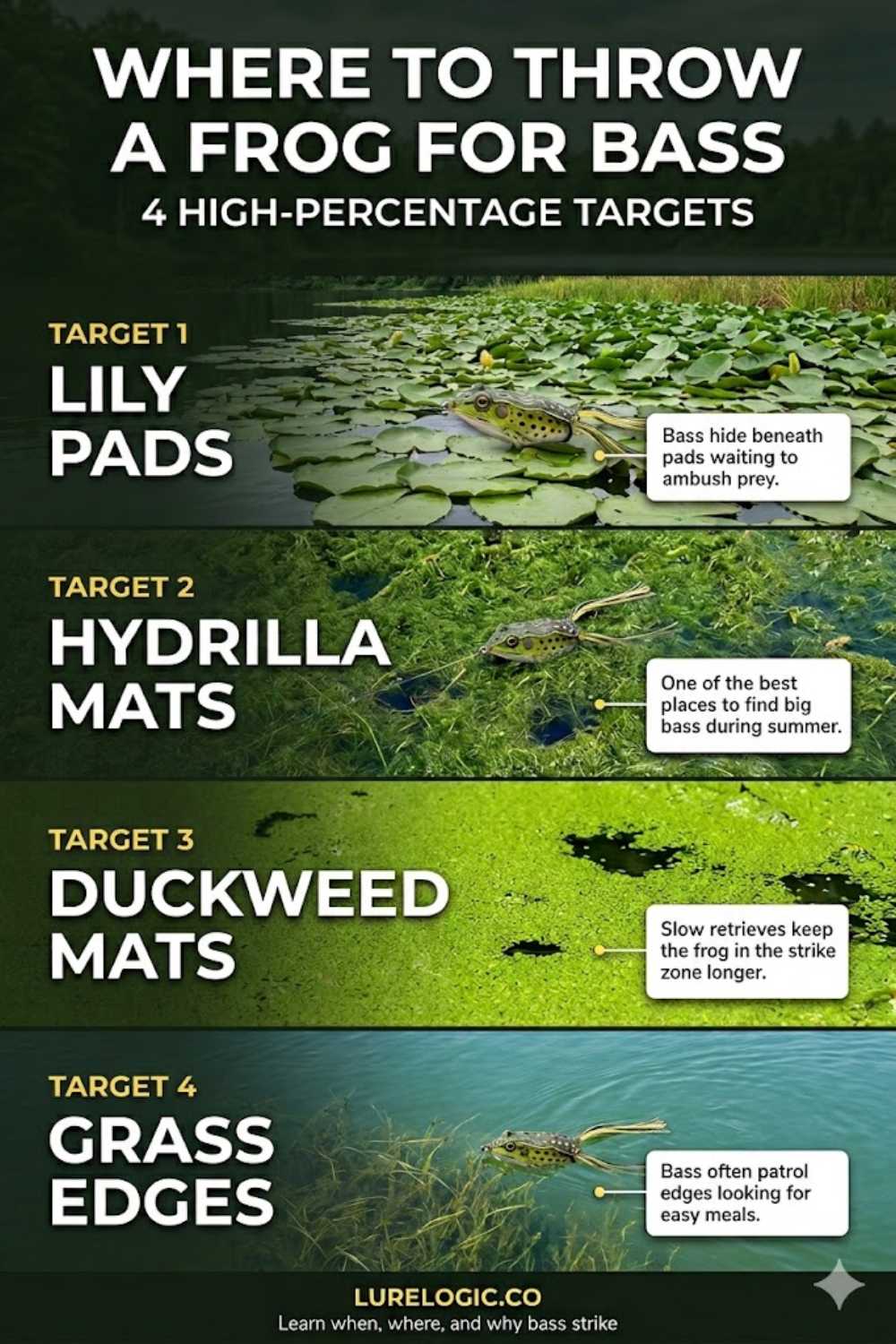
Not every frog is designed to accomplish the same objective. Understanding categories helps you make better lure selections and improves efficiency on the water.
Traditional hollow-body frogs prioritize weedlessness above all else. Their compact design lets them glide over vegetation with minimal resistance — ideal for matted grass, lily pads, duckweed, and other snag-prone environments. Walking frogs emphasize action: their shape and balance make side-to-side movement easier, creating a more aggressive presentation. Bass often respond strongly to this action when feeding actively around sparse cover and open water.
Cover density should largely dictate your choice. Thick vegetation favors hollow-body frogs because snag resistance is critical. Open pockets and grass edges often favor walking frogs because action becomes the primary trigger. Fish mood matters too — aggressive fish frequently respond to walking presentations that cover water quickly, while neutral fish often require slower presentations that remain in the strike zone longer.
Experienced frog anglers rarely commit to one style for an entire day. They rotate between styles based on vegetation density, bass positioning, and feeding activity. That flexibility often separates average days from exceptional ones.
Spring — Marks the beginning of productive frog fishing in many regions. As water temperatures rise and vegetation emerges, bass move shallow to spawn and feed. Frog fishing during this period revolves around shoreline cover, emerging grass, and spawning pockets. Retrieve speed should remain slower than during summer; bass are becoming active but may not yet chase aggressively. Focus on isolated cover and likely spawning areas, and pair this approach with the broader prespawn lure playbook for staging fish.
Summer — Unquestionably prime frog season. Vegetation reaches maximum density, baitfish concentrate around cover, and bass seek shade beneath mats. Early mornings produce explosive action around grass edges and shallow cover; as the sun rises, shift focus toward thicker vegetation where bass seek protection from heat and light. One of the biggest mistakes anglers make is abandoning frogs after the morning bite — midday frog fishing over dense mats often produces the largest fish of the day. Bass buried beneath heavy cover may travel several feet vertically to attack a frog crossing overhead. Long pauses become especially effective during summer because bass frequently track a frog beneath the mat before committing.
Fall — Creates a unique transition period. Vegetation begins dying back, forcing bass into remaining healthy cover. Baitfish become increasingly important and bass feed aggressively in preparation for winter. Walking frogs frequently outperform crawling presentations during fall — bass are willing to chase and position along edges rather than deep beneath vegetation. Focus on remaining green vegetation, grass transitions, and areas where baitfish are concentrated.
Winter — Generally the least productive frog season, but opportunities exist in southern fisheries. Warm afternoons, stable weather patterns, and shallow vegetation can produce occasional frog bites. Presentations should be extremely slow; bass metabolism declines significantly, reducing willingness to chase. Patience is critical.
Successful frog fishing requires more than casting into vegetation and retrieving. Different situations demand different presentations.
The standard crawl remains one of the most effective retrieves ever developed. Cast beyond the target area and slowly work the frog across the surface — this excels around mats where bass are positioned directly beneath the lure. Walking presentations create more action and help cover water efficiently. Short rod twitches combined with controlled slack cause the frog to dart side to side; this retrieve is ideal around sparse cover, grass edges, and open-water pockets.
Pausing may be the most important skill in frog fishing. Every opening in the vegetation represents a potential ambush point. Allowing the frog to sit motionless for several seconds often triggers strikes from bass that were previously following. Skipping frogs beneath overhanging cover expands the number of available targets — docks, bushes, laydowns, and low-hanging trees often receive less fishing pressure and can hold quality bass.
Speed adjustments are critical. Aggressive fish may respond to fast-moving frogs while pressured fish require slower presentations. Experiment throughout the day until a productive cadence emerges. Target selection matters as much as retrieve — rather than randomly casting across large vegetation fields, focus on irregularities. Holes, points, edges, isolated clumps, and transitions consistently attract bass and increase strike probability.
Landing fish is where many frog anglers struggle. The explosive nature of frog strikes creates excitement, but excitement often leads to mistakes.
The most common mistake is setting the hook too quickly. When a bass explodes on a frog, many anglers react immediately — but the fish often has not fully engulfed the bait. Waiting until tension develops dramatically improves hookup percentages. Equipment matters: heavy-power rods paired with braided line provide the strength necessary to move fish through vegetation. Lighter setups frequently result in lost fish.
Hook maintenance is equally important. Sharp hooks penetrate more effectively and require less force during the hookset. Regularly inspect and sharpen hooks throughout the season. Body position also influences success — maintaining a direct line to the fish improves hook penetration and reduces slack during the fight.
When a fish misses the frog, avoid immediately ripping the lure away. Many bass will strike multiple times if the bait remains nearby. Pause briefly and continue the retrieve naturally. Finally, consider tuning your frogs: slightly bending hooks outward and trimming skirt legs can improve both action and hookup ratios. Small adjustments produce meaningful improvements over an entire season.
Walks easily, casts a mile, and clears the pads.
Matted vegetation and lily pads — walk it slowly across openings.
As an Amazon Associate I earn from qualifying purchases.
Temperature-by-temperature lure logic.
The prespawn temperature threshold.
Natural presentations and finesse profiles.
Vibration, dark silhouette, and visibility tactics.
Adjusting across the full clarity spectrum.
Topwater and reaction baits for the dawn window.
Plug in today's water temp, clarity, weather, and forage — the tool returns the highest-confidence presentations.
Build Today's Strategy →