Editor's Pick97%
War Eagle Spinnerbait
Bluegill
View Product →Discover the best bass spinnerbaits for every season, water clarity, and forage situation with expert recommendations and proven color selections.
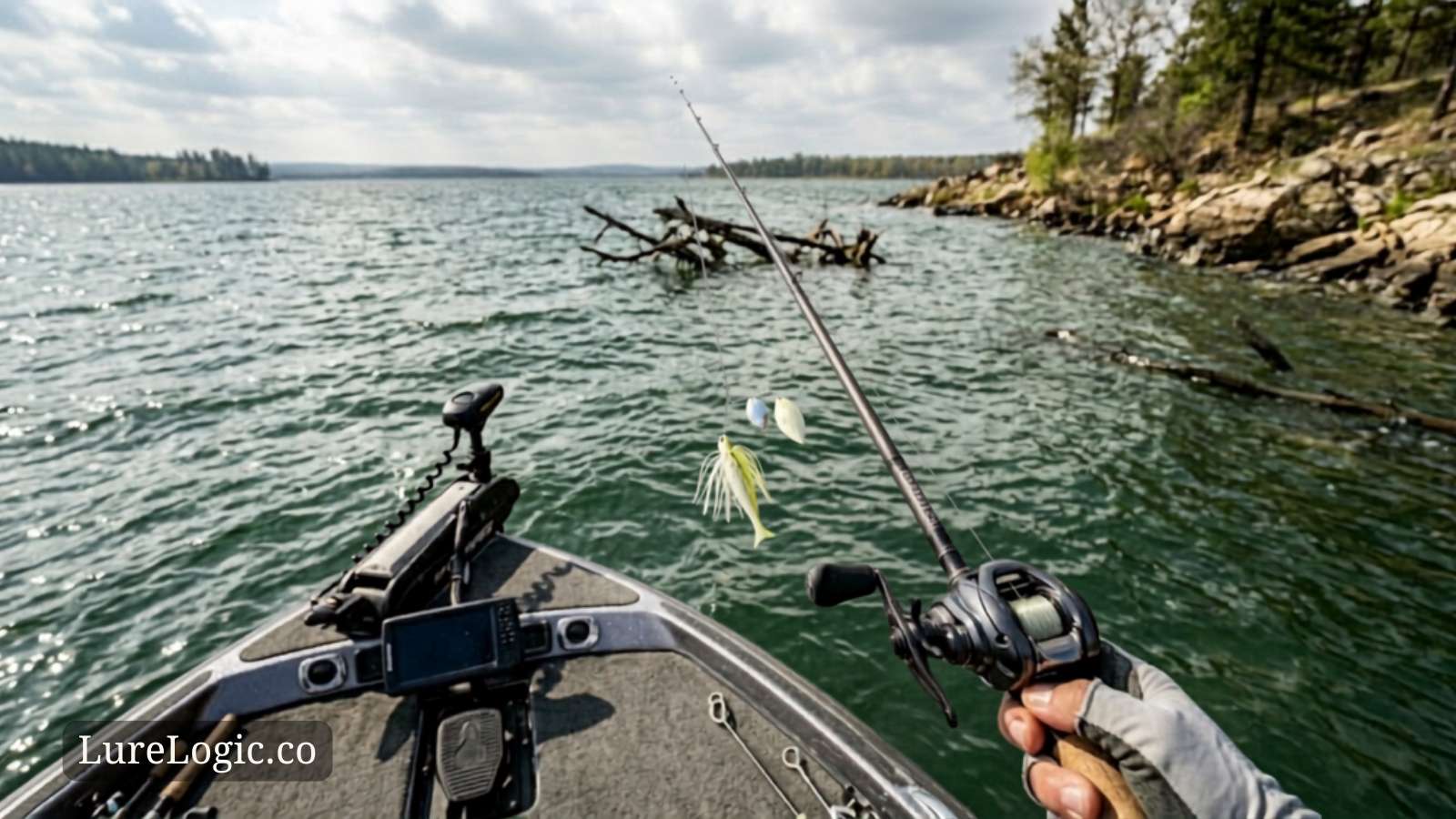
Affiliate Disclosure: As an Amazon Associate I earn from qualifying purchases. Recommendations reflect on-the-water testing and the LureLogic ranking engine — not paid placement.
If you only have time to read one paragraph, here it is: the War Eagle Spinnerbait is the Editor's Pick because it nails the three things that matter — balanced blade-to-head ratio, the right skirt density, and a hook that does not bend on a 5-pounder. It runs true at any retrieve speed without tuning, lasts season after season, and at its price point you can carry several configurations in the box without flinching when one gets buried in a laydown.
The Booyah Covert Spinnerbait is our Best Value pick for anglers stocking a full spinnerbait box on a budget. The components are a clear notch below the War Eagle but the bait runs true out of the package and the painted heads stand up to repeated cover contact. Pair it up with upgraded trailer hooks and you have a tournament-capable bait.
The Strike King Hack Attack Heavy Cover spinnerbait is the right tool when you are throwing into thick grass, lily-pad edges, and laydowns where bass need to be horsed out before they wrap. The heavy 0.045" wire holds shape under load and the oversized hook gives you the leverage to land mid-3-pound class fish that would straighten lighter hooks.
If you are building a three-bait spinnerbait arsenal from scratch, make it: a 3/8 oz double willow in White / Chartreuse for warm-water shallow water, a 1/2 oz Colorado/willow in Chartreuse / White for stained water and slow-rolling, and a 1/2 oz double willow in Sexy Shad for clear water and shad-spawn windows. Those three configurations cover roughly 90% of the seasonal scenarios discussed in our lure selection guide.
The Recommendation cards above are pulled live from the LureLogic ranking engine, so the order reflects condition-based confidence — season, water clarity, and forage — not editorial bias or sponsorship. Use the cards as the starting point, then tune blade size, skirt color, head weight, and trailer to the day in front of you using the guidance in the next sections.
One thing the cards cannot do is fish your home water for you. Two pieces of information you should always layer on top of any 'best' list: what the dominant forage is on your lake (shad-driven lakes fish very differently from bluegill-driven lakes) and what the typical visibility looks like over a 12-month cycle. Once you know those two answers for your fishery, the rest of this guide becomes specific instead of generic.
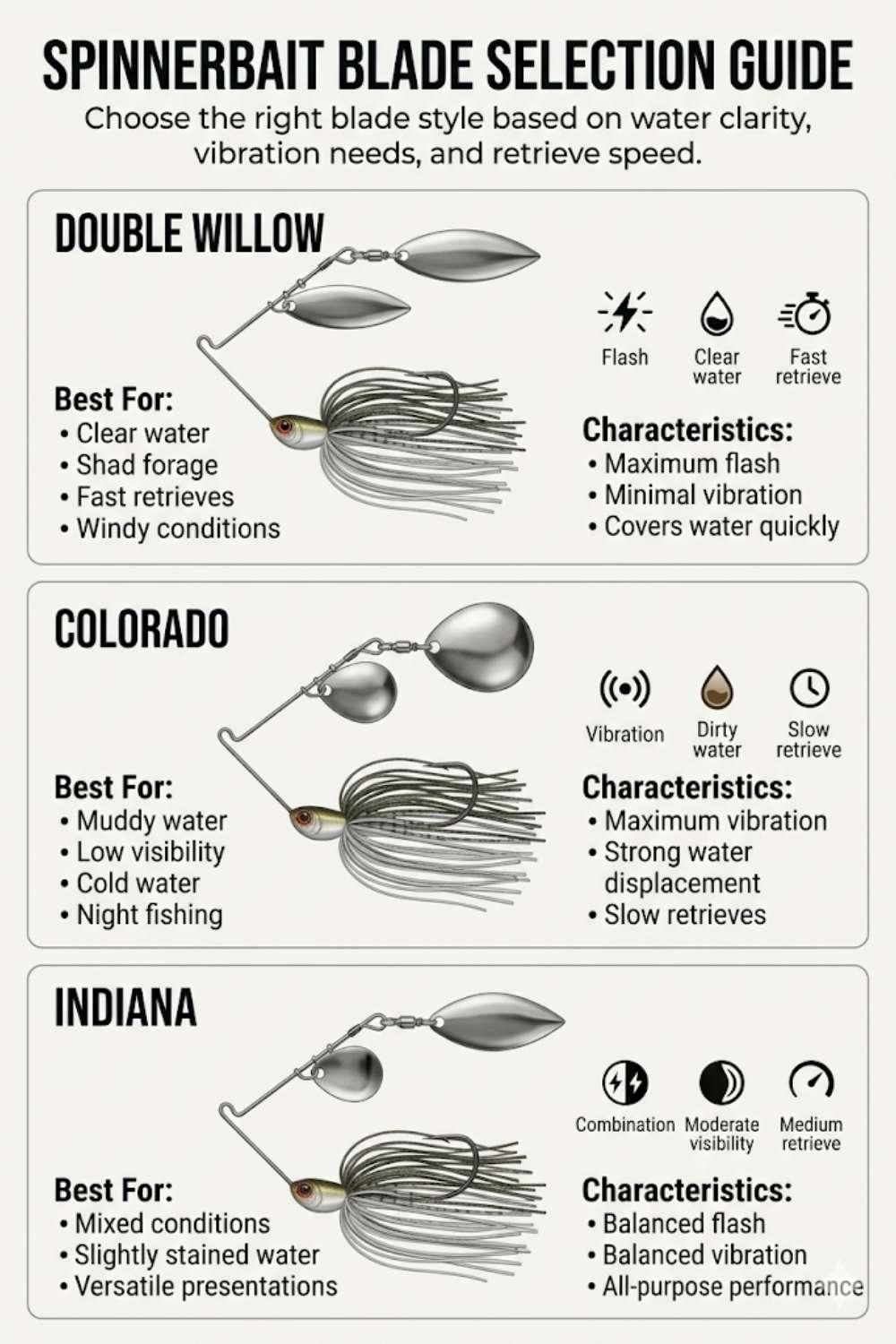
Six variables — blade configuration, wire diameter, head design, skirt material, hook quality, and trailer options — collectively decide whether a spinnerbait is a tournament-grade bait or a parking-lot disappointment. Every one of those variables has a 'right' answer that changes with water clarity, water temperature, and the size of the bass you are targeting. This is the section to read slowly, because the difference between landing a 5-pounder and pulling the bait out of its mouth is almost always one of these six choices.
Blade configuration — Double willow is the all-purpose configuration. Two willow blades stacked one behind the other run high in the water column, produce sharp flash from both blades, and let you fish fast. Use double willows from 55°F up through the heat of summer, in clear to stained water, and any time you want to burn the bait past shallow cover. A Colorado/willow combo (small Colorado on the front clevis, larger willow on the rear) is the most versatile pick — the front Colorado throws heavy low-frequency thump that bass can feel on their lateral line, and the rear willow adds flash. Use Colorado/willow when slow-rolling, in stained or muddy water, on cold-front days, and anytime fish are using their lateral line more than their eyes. Tandem Colorado blades give you the heaviest thump and the slowest possible retrieve before the blades stop turning — that is the cold-water and muddy-water specialist. A single Colorado on a heavy 3/4 oz to 1 oz head is the slow-roll deep-water spinnerbait for winter offshore and bluff-wall fishing. Carry all four configurations and you will never lack the right blade for the day.
Wire diameter — Wire holds the head, blade arm, and hook in alignment. Heavier wire (0.040–0.045") flexes less under load, holds its shape after multiple fish, and is the right choice around grass, laydowns, and heavy-cover situations where you may need to horse a fish. The trade-off is reduced vibration transmission — heavy wire absorbs some of the blade pulse. Thinner wire (0.032–0.035") transmits more vibration and gives the bait a livelier, tighter feel that pressured and clear-water fish often prefer. The trade-off is that the bait can bend out of tune after a tough fight or a hard hook-set. Match wire diameter to the size of bass you expect and the cover you are fishing, not to the lure itself. After every keeper you land, take 5 seconds to look down the wire and verify it still aligns straight through the bait — a bent wire kills the action.
Head design — Head shape decides how the bait tracks, how it deflects off cover, and how it falls. A round 'bullet' head is the standard all-around shape — it tracks straight, casts well, and slides through cover. A 'shad' head with a flat, baitfish-shaped profile gives the bait a faster fall and a tighter swimming action — good in clear water and on slow falls past laydowns. A wedge or arrowhead-shaped head is the grass specialist — the wedge slips through vegetation cleanly and rights itself faster after deflection. Head weight controls running depth and retrieve speed: 3/8 oz for waking and shallow burning, 1/2 oz as the everyday workhorse, 3/4 oz for slow-rolling and deeper water, 1 oz for winter offshore and bluff walls.
Skirt material — Silicone skirts have been the modern standard for two decades because they pulse aggressively, do not collapse on the head, and hold color through season after season of UV exposure. Living rubber skirts (still used on some specialty jigs) pulse less and shed strands faster but give a denser profile — they are a niche choice for cold-water spinnerbaits where you want a slow, subtle action. The number of skirt strands matters more than the material: a sparse skirt of 40–50 strands gives a tighter, more baitfish-like profile that works well in clear water and on finicky fish; a dense skirt of 60–80 strands gives a fuller, more imposing profile for stained and muddy water. Strategic flash strands (gold, copper, silver, or holographic) add a few percent of extra attraction without overdoing it — three or four flash strands woven into the skirt is the sweet spot. Trim the skirt flush with the hook bend in cold water to reduce profile and improve hookups on short-strike fish.
Hook quality — Every other variable on the bait is wasted if the hook fails. Look for chemically sharpened, black-nickel or red-finished forged hooks with a clear gauge spec. Premium spinnerbaits ship with VMC, Gamakatsu, or Mustad Ultra Point hooks in the 4/0 to 5/0 range. Budget baits often skimp on hook quality, so an inexpensive upgrade is to swap the stock hook for a 5/0 EWG trailer hook and add a dressed trailer hook in line with the main hook to convert short strikes into landed fish. Sharpen hooks anytime they touch wood, rock, or a deflection — a few passes of a hook hone is the single best return on time investment in spinnerbait fishing.
Trailer options — A 3-inch white split-tail grub is the classic spinnerbait trailer and still hard to beat for an all-purpose presentation. A small paddle-tail in the 2.8–3.75-inch range (Keitech 2.8, Strike King Rage Swimmer 3.75) adds a touch of extra vibration and is the right call when bass are eating slightly larger shad. A craw trailer slows the fall and adds a craw silhouette — that is the winter slow-roll trailer. Sometimes the right answer is no trailer at all: in heavy wind, when bass are eating tiny shad, or when you need maximum casting distance. Trailer hooks deserve the same attention — a 4/0 to 5/0 trailer hook on a soft keeper sleeve converts short-strike fish, especially in cold water and around bedding fish.
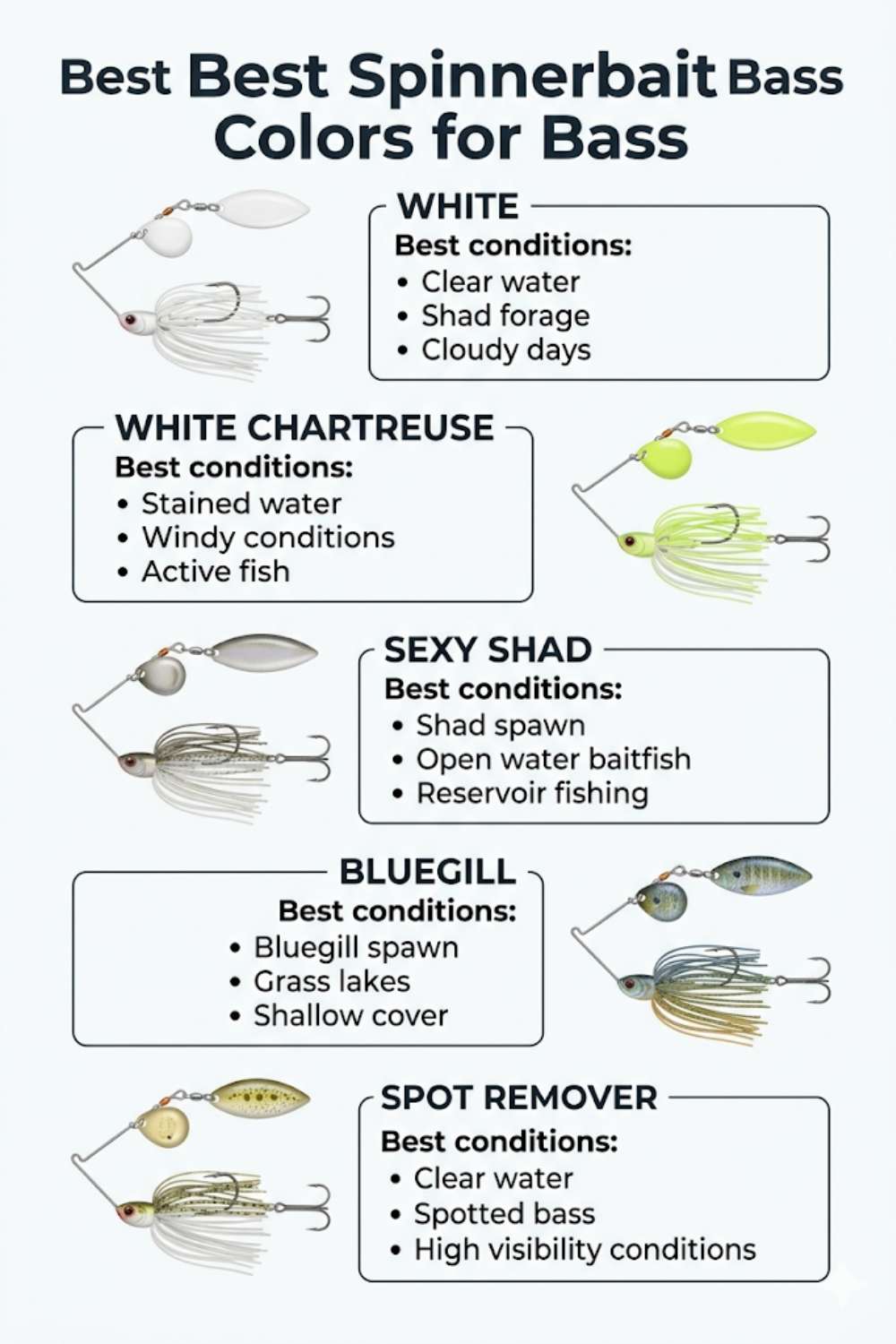
Color choice on a spinnerbait is less about exact shade and more about contrast and reflectivity for the conditions. Get clarity and light level right and the bass will eat almost any color in the family — get those wrong and the best shade in your box will not produce. Below are the five most productive spinnerbait colors and the conditions each one was made for.
White — The default spinnerbait color and the right pick anytime you are unsure. White silhouettes well in stained water, looks natural in clear water, and matches every variation of shad in North America. Run pure white skirts with silver blades in clear water on sunny days. Add a few strands of chartreuse or pink to a white skirt for the shad spawn at first light. Pair white with gold blades on overcast days and in slightly stained water. White is also the right choice on bluebird-sky postfrontal days when you need a subtle, natural baitfish profile.
White / Chartreuse — The most-used color combination in tournament spinnerbait fishing for a reason. The white body silhouettes correctly, the chartreuse strands give bass a strike target, and the combination reads as a fleeing shad with a slight color shift. This is the everyday color for stained water (1–3 ft visibility), windy banks, the bluegill spawn (chartreuse picks up the orange/yellow tones bluegill flare with), and most cloudy-day situations. If you only carry one spinnerbait color, make it White / Chartreuse with a Colorado/willow blade combination.
Sexy Shad — A blue-back, silver-sided, white-belly pattern that mimics threadfin and gizzard shad perfectly. Sexy Shad is the clear-water specialist — the translucent blue back disappears against open water and the silver sides flash when the blade does. Run Sexy Shad with double willow blades in 3+ ft of visibility, on sunny days, and any time bass are keyed on shad and you can see the bait at three feet near the boat. It is also the right color for the shad spawn proper in clear-water lakes.
Bluegill — A green-pumpkin and orange-highlighted pattern that becomes the highest-percentage spinnerbait color on bluegill spawning flats from late May through July. Bluegill colonies stage in shallow flats with hard bottom and bass cruise the perimeter eating them by the dozen. A Bluegill spinnerbait with gold willow blades, fished slowly across the perimeter of these flats, will outproduce every shad-colored bait in the box for those six to eight weeks. Bluegill is also a strong color on rocky, clear, smallmouth-style fisheries where craws and panfish make up more of the forage than shad.
Spot Remover — A black or black-blue skirt with red or orange flash strands. Spot Remover is the mud-water, low-light, and night-fishing color. In muddy water, the dark silhouette is the only thing bass can see — bright colors actually disappear faster than dark colors against the dim ambient light. Pair Spot Remover with a single Colorado or tandem Colorado blade combination in copper or black for muddy water, and run a black skirt under a black single Colorado for night fishing in summer. Bass cannot see exact colors in muddy water — they see silhouettes, and a heavy, dark silhouette is what produces.
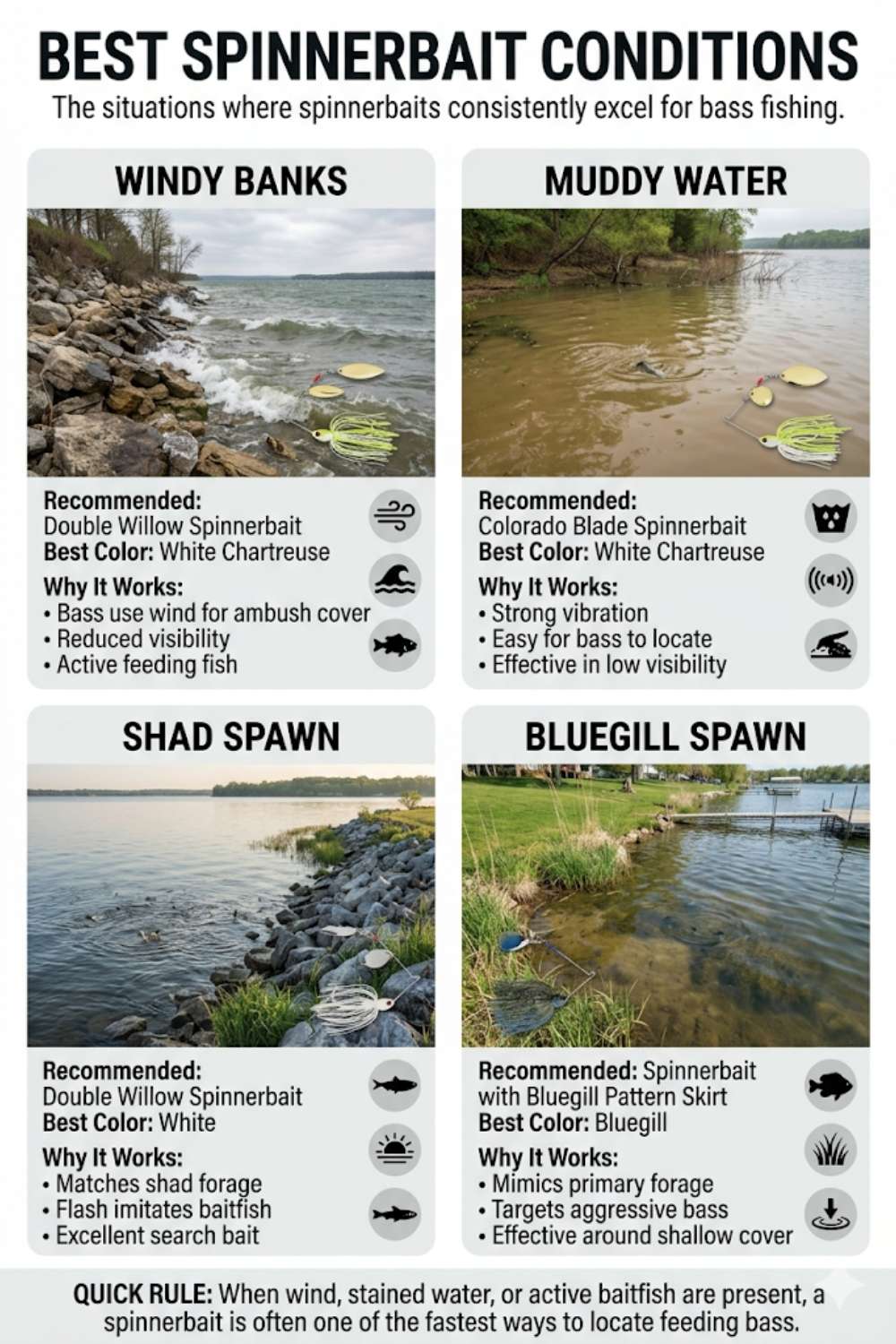
Spinnerbaits are condition-driven baits. The same bait that wins on Tuesday's windy stained-water bite can be the worst choice on Wednesday's bluebird-sky calm day. Below are the seven scenarios where the spinnerbait jumps to the top of the list — and why bass respond to a vibrating, flashing wire-bait in each one.
Windy days — Wind is the spinnerbait angler's best friend. Wind pushes plankton, plankton pulls baitfish, and baitfish pull bass to windblown banks. Wind also adds a chop that breaks up the light penetration, hides the wire, and reduces the bass's ability to inspect the bait. On 10–20 mph wind days, fish a 1/2 oz double willow or Colorado/willow parallel to windblown banks and let the trolling motor work into the chop. See our windy day playbook for additional positioning specifics.
Cloudy days — Overcast skies pull bass out from under cover and let them roam farther for a bait. A 3/8 oz waking spinnerbait fished just under the surface bulge is deadly on cloudy days in spring and fall. The lack of overhead glare means bass commit to the bait from farther away and the blade flash is visible across a wider zone. Pair cloudy with wind and you have the textbook spinnerbait day.
Clear water — Spinnerbaits work in clear water but require adjustments: smaller blades (size 3 or 4 willows instead of 5s), thinner wire, sparser and more natural skirts (Sexy Shad, plain White), and faster retrieve speeds so bass cannot inspect the bait. The clear-water spinnerbait window is dawn, dusk, and any time wind puts chop on the surface. Long casts and fluorocarbon line keep the presentation low-visibility.
Stained water — The textbook spinnerbait clarity. With 1–3 ft of visibility, the blade flash registers from a long way off and bass cannot inspect the bait closely enough to reject it. Run a standard 1/2 oz Colorado/willow in White / Chartreuse parallel to any shallow cover. Slow down 10% and upsize blades one number when the stain gets darker.
Muddy water — Sub-12-inch visibility favors the spinnerbait because the blade pulse calls bass on lateral line alone. Switch to a heavy 3/4 oz tandem Colorado, a Black / Blue or Chartreuse / White high-contrast skirt, and a slow retrieve so the blades have time to thump. The strike-zone shrinks to inches in muddy water — fish must be hit on the nose. Work cover slowly and methodically. Our muddy water lure playbook covers the broader strategy.
Shad spawn — From mid-spring through early summer, shad spawn on shallow hard cover at first light. A 3/8 oz double willow in White or White / Chartreuse waked just under the surface past riprap, seawalls, and shallow grass during the 45-minute dawn window is one of the most predictable big-bass bites in the calendar. See our shad spawn guide for timing and location specifics.
Bluegill spawn — Late May through July, bluegill colonies form on shallow flats and bass orbit them eating bluegill all day long. A 1/2 oz Bluegill-colored Colorado/willow fished slowly along the edge of bluegill beds outproduces every other moving bait in this window. Bass on bluegill flats eat aggressively and a slow, wide-tracking spinnerbait gives them the right profile.
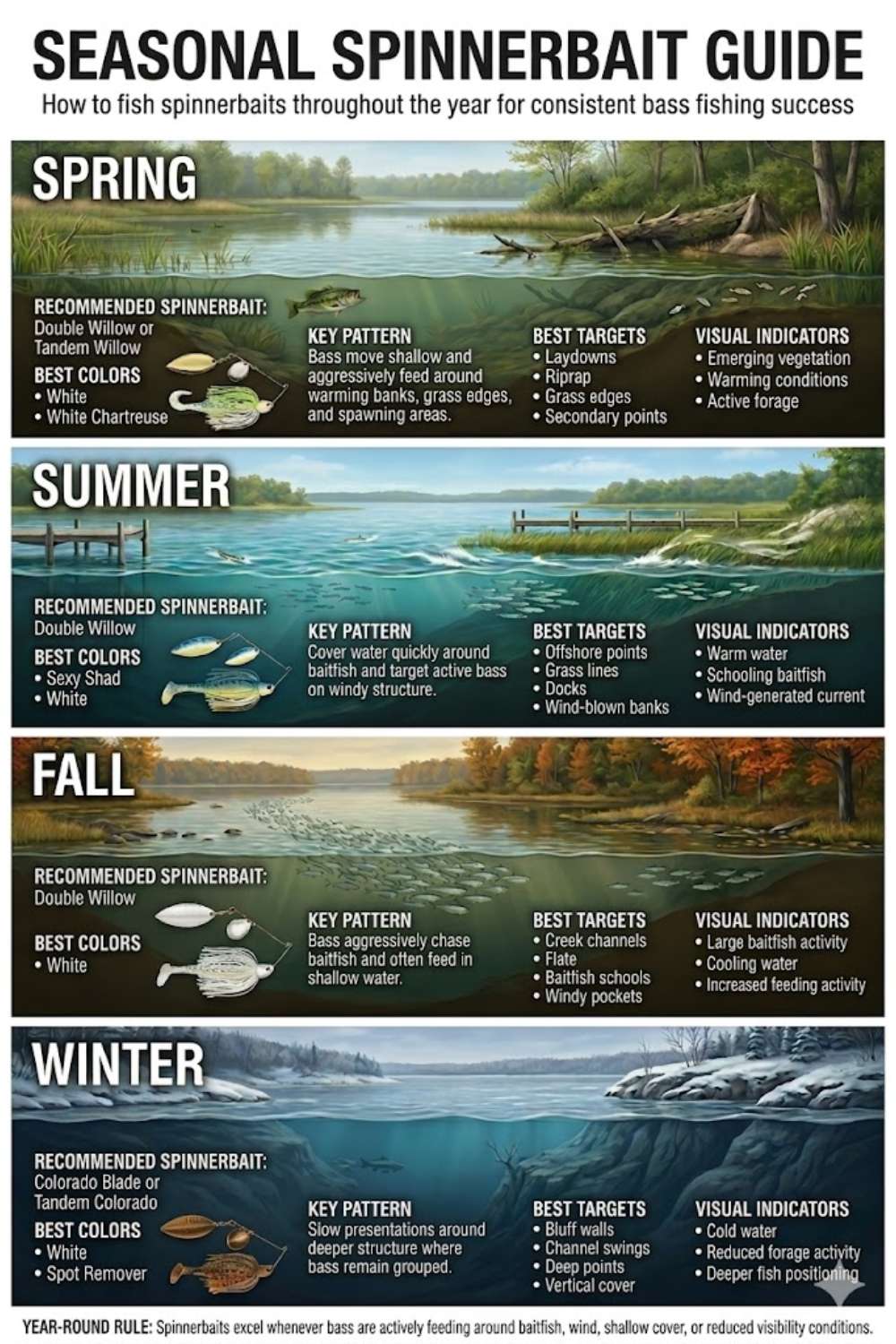
Spinnerbait selection by season is mostly a story of weight, blade configuration, and retrieve speed shifting in lockstep with water temperature. Below is a season-by-season breakdown that you can apply to any lake in temperate North America.
Prespawn (water 45–58°F) — Bass stage on transition banks, secondary points, and the first major drop into spawning pockets. A 1/2 oz Colorado/willow in White / Chartreuse or Chartreuse / White slow-rolled across the first hard-bottom break is the textbook prespawn spinnerbait presentation. Keep the rod tip low and let the bait tick along bottom or the edge of cover. Color choice: White / Chartreuse on cloudy days, Sexy Shad on rare sunny prespawn days, Chartreuse / White when wind stains the bank. Cover: chunk rock, pea-gravel banks, secondary points, the outer edge of dock lines. Our 55°F-water playbook covers cadence and bait selection at the heart of this window.
Spawn (water 58–68°F) — Bass move shallow onto beds and stage on the first shallow cover near spawning flats. A 3/8 oz double willow burned past beds and through bluegill flats triggers male bass guarding fry. Color choice: White, White / Chartreuse, Bluegill on bluegill flats. Cover: shallow grass lines, the inside edge of spawning pockets, isolated stumps and laydowns next to beds. Retrieve speed: faster than prespawn — burn the bait so it shows for a brief flash and disappears, which triggers reaction strikes from defensive males.
Postspawn (water 65–72°F) — Bass recover on shallow points, creek mouths, and the first significant drops out of spawning bays. A 3/8 oz double willow waked or burned across points is the textbook postspawn presentation. Color choice: Sexy Shad or White (matching emerging shad fry), Bluegill on flats where bluegill have started spawning. Cover: secondary points, shallow flats, riprap, seawalls. Retrieve speed: moderate to fast — these fish are recovering but still aggressive when a bait comes by.
Summer (water 72–88°F) — Shallow spinnerbait fishing tightens to early morning and late evening windows. The midday play is offshore: target schooling bass on offshore points and humps with a 3/4 oz tandem Colorado or a single-Colorado slow-roll, or burn a 1/2 oz double willow over the top of bait-school activity on the surface. Color choice: Sexy Shad in clear water, White / Chartreuse in stained water, Black / Blue for night fishing. Cover: deep grass lines, the shady side of points, offshore brush and rock. Pay attention to windy days as the prime windows in this window.
Fall (water 72–55°F as it drops) — A second prime spinnerbait window as bass follow shad into creek arms. A 1/2 oz double willow in White or Sexy Shad waked just under the surface in creek arms, parallel to shoreline structure, is one of the most reliable fall presentations. Color choice: White, Sexy Shad, White / Chartreuse late in the window as water cools. Cover: pockets in creek arms, secondary points, isolated cover near migrating bait. Retrieve speed: fast in warm water (above 65°F), slow down as water cools through the 50s.
Winter (water below 50°F) — The slow-roll specialist window. A 3/4 oz to 1 oz tandem Colorado fished extremely slowly across bluff walls, channel swing banks, and offshore rock piles is the winter spinnerbait presentation. The blades should barely turn. Color choice: White, Sexy Shad on sunny days, Spot Remover on overcast days or muddy water from runoff. Cover: vertical structure, deep rock, bluff walls, channel swings. Most strikes feel like the bait simply got heavier — set the hook on any change in feel.
Spinnerbaits reward retrieve variation more than almost any other moving bait. The same bait fished six different ways will produce in six different scenarios. Below are the six retrieves every spinnerbait angler should be able to execute on command.
Slow rolling — The cold-water and deep-water specialist. Cast a 3/4 oz or 1 oz Colorado-blade spinnerbait and crawl it just fast enough to keep the blades turning. The bait should tick bottom or brush cover on the slow retrieve. Use slow rolling in water below 55°F, on bluff walls, on channel swing banks, and any time bass are sitting deep on hard structure. Watch your line carefully — most bites feel like added weight or a sideways tick rather than a hard strike.
Burning — Cast a 3/8 oz or 1/2 oz double willow and crank as fast as you can comfortably retrieve without rolling the bait sideways. Burning is the warm-water, postspawn, and reaction-bite retrieve. Use it during the shad spawn at first light, when bass are schooling on the surface, and any time bass are chasing bait. The blade flash and rapid pulse triggers fish that would inspect and reject a slower bait.
Waking — Reel just slow enough that the bait pushes a visible bulge on the surface without breaking through. Waking is a low-light retrieve — dawn, dusk, overcast days, and the shad-spawn window. Bass crash a waking spinnerbait from underneath with explosive strikes. A 3/8 oz double willow with an extended skirt is the textbook waking setup. Hold the rod tip high and steady so the bait stays in the surface film for the entire retrieve.
Yo-yo retrieve — Cast a 1/2 oz Colorado/willow or tandem Colorado, let it fall on slack line to a target depth, then snap the rod tip up sharply and let the bait fall back on slack line. The bait flutters and helicopters on the fall, which is when most strikes occur. The yo-yo is the suspended-bass retrieve — use it on deep structure in summer and winter, around bait balls suspended over deep cover, and any time fish show on electronics in the 8–18 ft range.
Deflection retrieve — The shallow-cover specialist. Cast past a piece of cover (stump, laydown, dock post, rock) and bring the bait directly into the cover so it ticks or deflects off. The brief erratic change in direction triggers reaction strikes from bass holding tight to the cover. This is the retrieve to use around laydowns, stumps, isolated rocks, and dock posts. Steer the bait into cover, do not steer it around cover.
Killing the bait — On any retrieve, the instant the bait makes contact with cover or you feel a bass swirl near the bait, throw immediate slack and let the bait fall for a count of two to three seconds. The kill on a spinnerbait is the most under-used trigger in moving-bait fishing. Bass that follow without committing will often pile on the bait the moment it stops fluttering. Always be ready to set the hook the instant you tighten back up — most kill-strikes feel like a soft weight, not a thump.
Classic Colorado/willow combo for windy banks and stained water.
Windy banks and stained water — burn it parallel to cover.
As an Amazon Associate I earn from qualifying purchases.
The pre-frontal feeding window, explained.
Pre-storm feeding windows and falling pressure tactics.
Post-front lure adjustments and finesse plays.
Slow, downsized presentations for shrunken strike zones.
Working the toughest condition in bass fishing.
Why clouds extend the feeding window on both ends.
Plug in today's water temp, clarity, weather, and forage — the tool returns the highest-confidence presentations.
Build Today's Strategy →