Editor's Pick97%
Heddon Super Spook
Bone
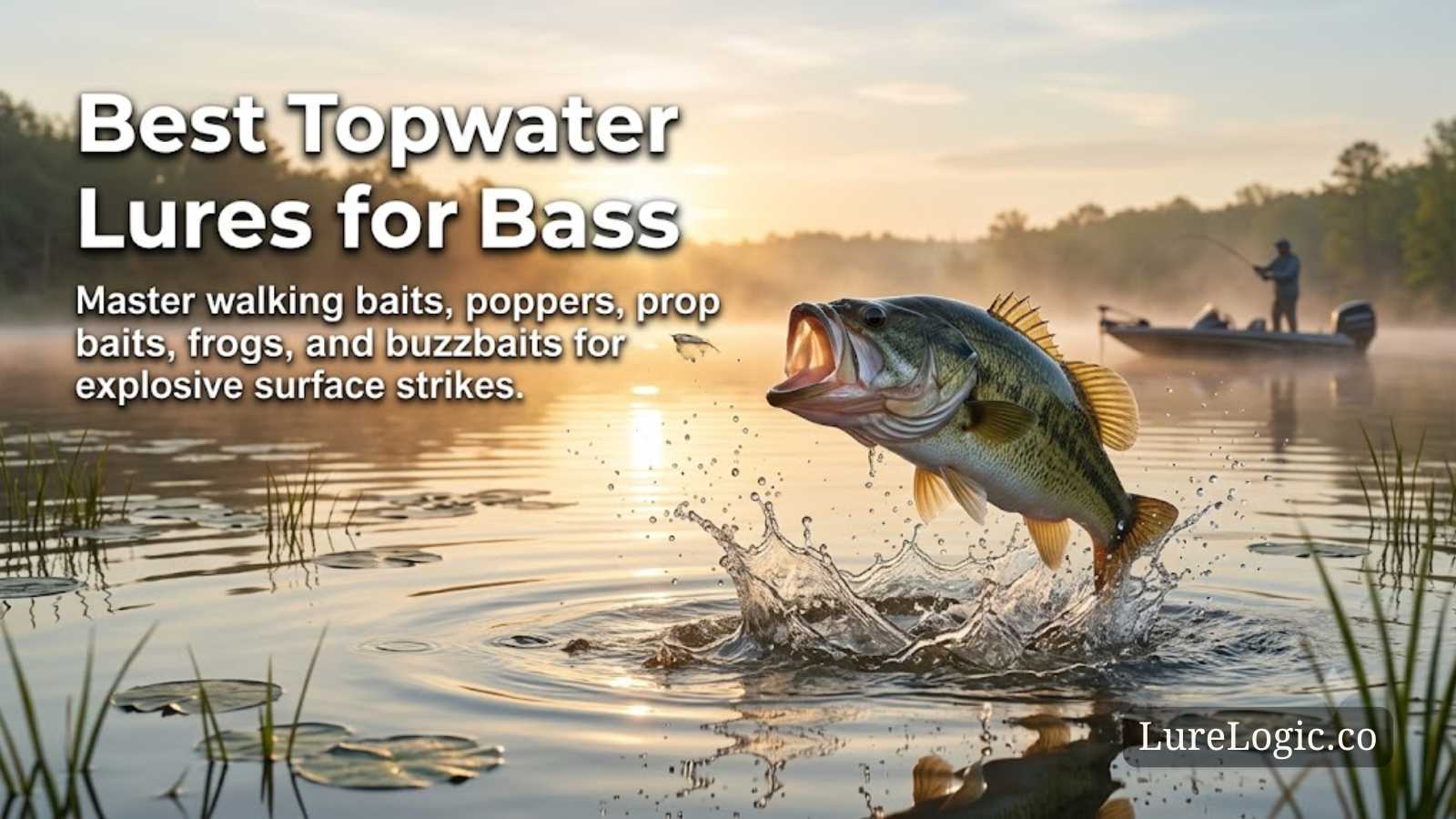
View Product →Walking bait, popper, prop bait, buzzbait, or frog? Pick the right topwater for your cover, light, and water temp — plus the retrieve cadence that triggers strikes.
Affiliate Disclosure: As an Amazon Associate I earn from qualifying purchases. Recommendations reflect on-the-water testing and the LureLogic ranking engine — not paid placement.
Cover and light pick the bait for you. Work down this list in order.
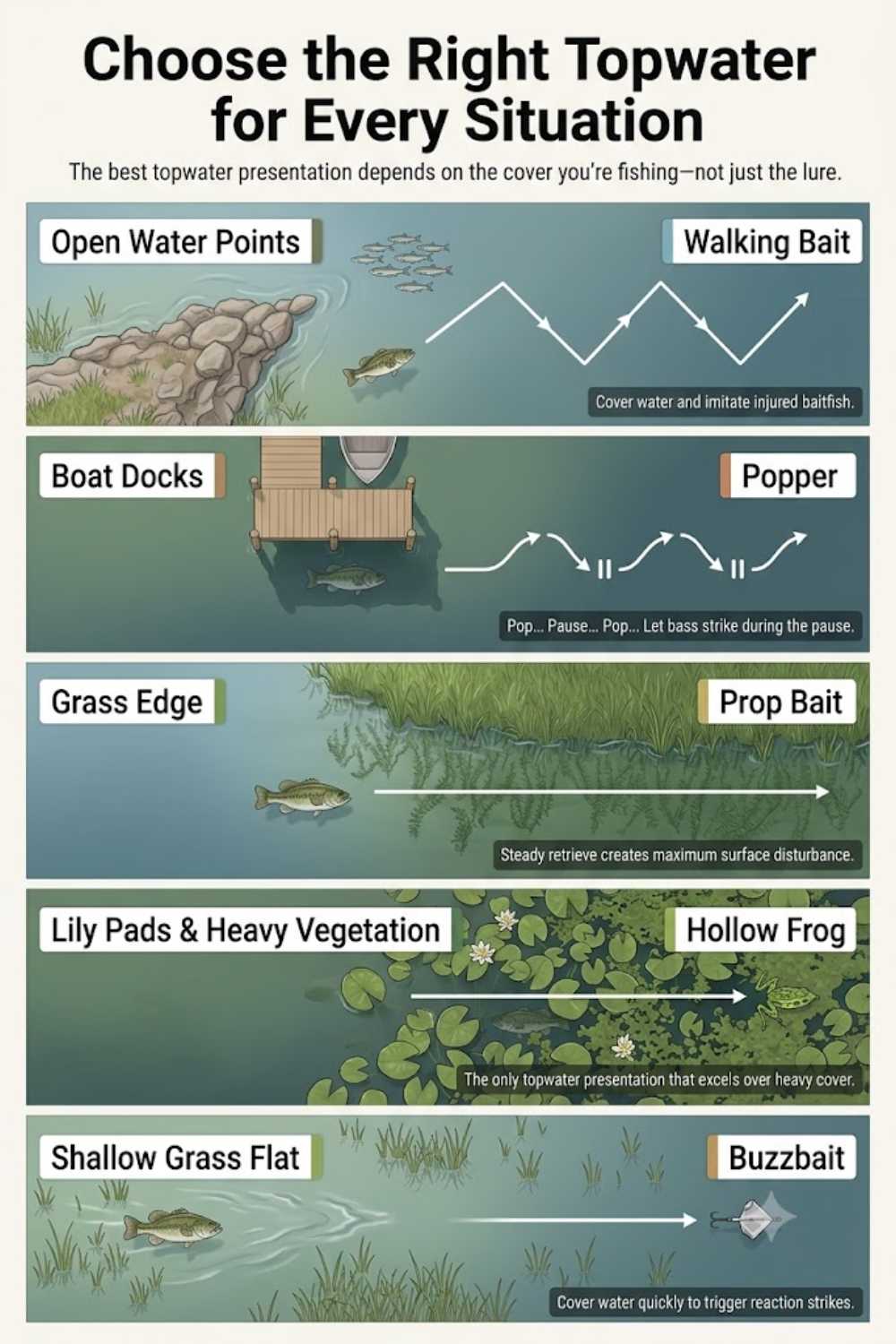
Open water, points, flats, or fish busting bait — a walking bait. Heddon Super Spook or Spook Jr, walked with a pause every three or four twitches.
Matted grass, pads, or slop — a hollow-body frog. Nothing else stays weedless in that cover; see the topwater frogs guide.
Docks, laydowns, isolated cover, slick calm water — a popper. Short pops with long pauses, worked tight to shade.
Stained water, wind, or fish you need to call from a distance — a prop bait like the Whopper Plopper or Berkley Choppo. Steady retrieve, no cadence required.
First light on a windy bank when you need to cover water fast — a buzzbait.
Water temp check: 60°F is the floor for reliable topwater, 70–88°F is prime, and above 90°F it shrinks to the first and last half hour of light. Low light — dawn, dusk, clouds, rain, or a good chop — beats every other variable on this list.
Topwater isn't one technique — it's five different presentations that share a common medium. The right topwater depends entirely on the conditions and cover.
Heddon Super Spook and Spook Jr — Editor's Pick (Walking Bait). The most productive walking topwater ever made. The Super Spook (5 inches) targets larger profile situations — herring lakes, big bass hunting, and gizzard-shad-dominant systems. The Spook Jr (3.5 inches) is the day-in-day-out producer for most anglers — matches threadfin shad and bluegill profiles, walks easily on a moderate-action rod, and casts well into wind.
River2Sea Whopper Plopper — Best Prop Bait. The Whopper Plopper changed topwater fishing when it was introduced. The rotating tail blade creates a chopping water disturbance that pulls fish from 15+ ft away to investigate. Available in multiple sizes (90, 110, 130) for different forage profiles. The 110 size in bone or loon is the universal starting point.
Berkley Choppo — Best Value. The Choppo delivers Whopper Plopper-class performance at a working-angler price. Identical body style and rotating-tail design, with reliable hooks and a strong color lineup. Many tournament anglers carry both brands.
Rebel Pop-R — Classic Popper. Still one of the most productive popping topwaters for stop-and-go presentations around docks, laydowns, and shaded shoreline cover. The concave face throws a controlled water disturbance on each pop, and the small profile catches everything from 1-lb fish to giants.
SPRO Bronzeye Frog — Cover Specialist. The standard hollow-body frog for matted vegetation, lily pads, and any cover too thick for open-hook baits. The dedicated topwater frogs guide covers the full frog category.
Additional premium options: Lucky Craft Sammy and Gunfish (premium walking baits and slow-rise topwaters for pressured fish), Megabass Pop-Max (premium popper for clear water), and the Heddon Zara Spook (full-size walking bait for big-bass-dedicated arsenals).
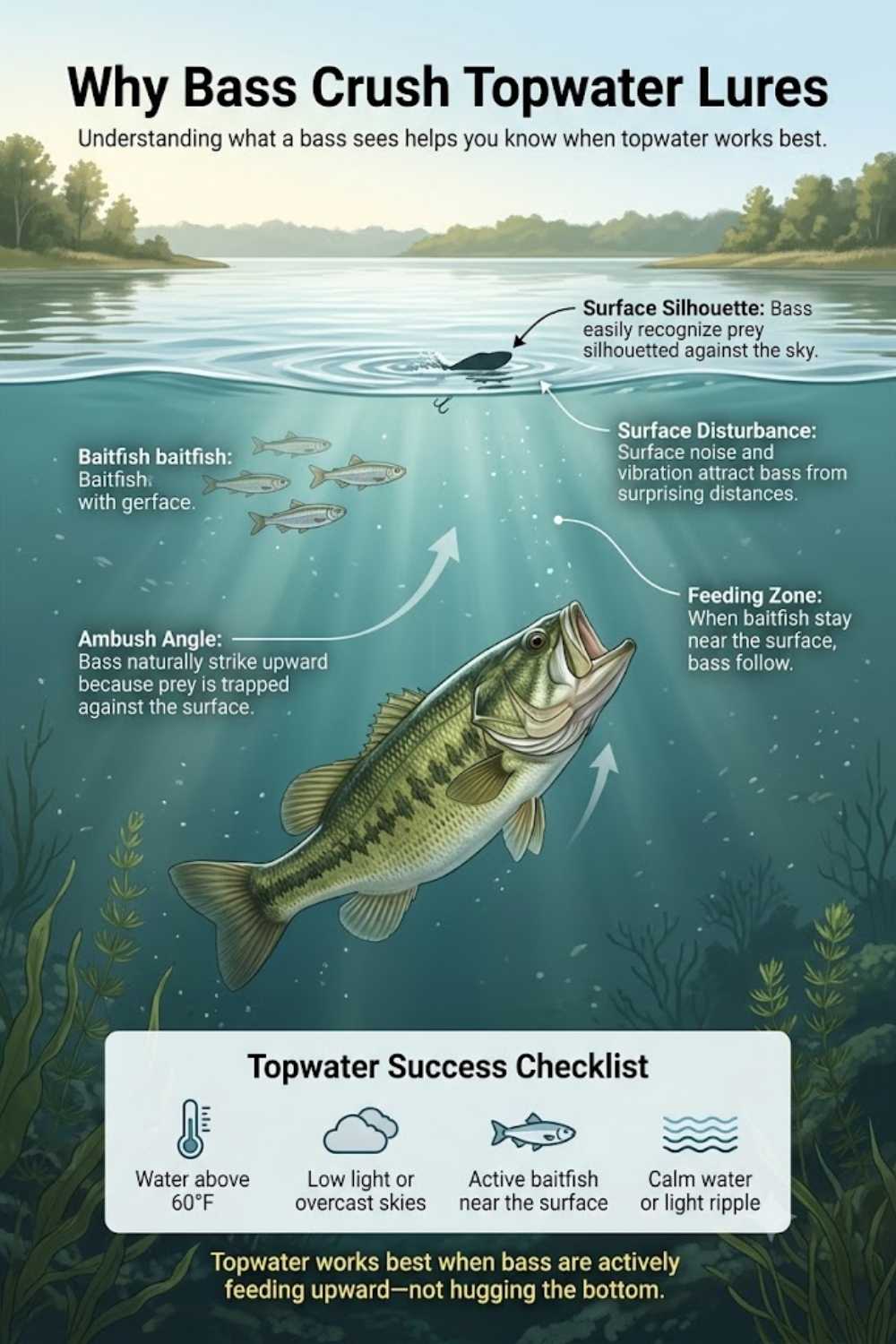
Topwater produces because it isolates a single sensory channel — the bass's surface-strike instinct — and presents it with maximum visibility against the water surface. A bait on the surface creates a sharp silhouette against ambient sky light, a vibration profile (depending on bait style) that the bass detects from 10–20 ft, and an audio signature (chugging, walking, propping) that adds another sensory dimension. The combination triggers explosive reaction strikes that don't exist with sub-surface presentations.
The second reason topwater works is the predator behavior it triggers. Bass evolved to ambush prey trapped on the surface — frogs, injured baitfish, insects, small mammals. That surface-strike instinct is hard-wired and remains active even in highly pressured fish. A topwater that mimics surface prey triggers strikes from bass that have been educated to refuse every sub-surface presentation in the box.
Third, topwater filters out smaller fish. The largest bass in a system are disproportionately willing to attack large surface prey, while smaller bass often refuse or fail to commit. That size-selectivity is why topwater is a tournament-winning technique on big-bass lakes — when the topwater bite is on, the average fish size is larger than any other presentation in the day.
Finally, topwater is the most efficient search technique in the box for shallow-water bass. The cast distance is long, the retrieve speed is moderate-to-fast, and the visual feedback (you see every strike) lets the angler immediately confirm location and pattern. A single morning of working a shoreline with a Spook teaches an angler more about where the active fish are holding than a full day of slower presentations.
The limitation of topwater is its weather and water-temp window. Topwater needs water above 60°F, manageable cloud cover or low-light conditions, and bass in active feeding mode. Outside those conditions, sub-surface presentations outproduce topwater every time.
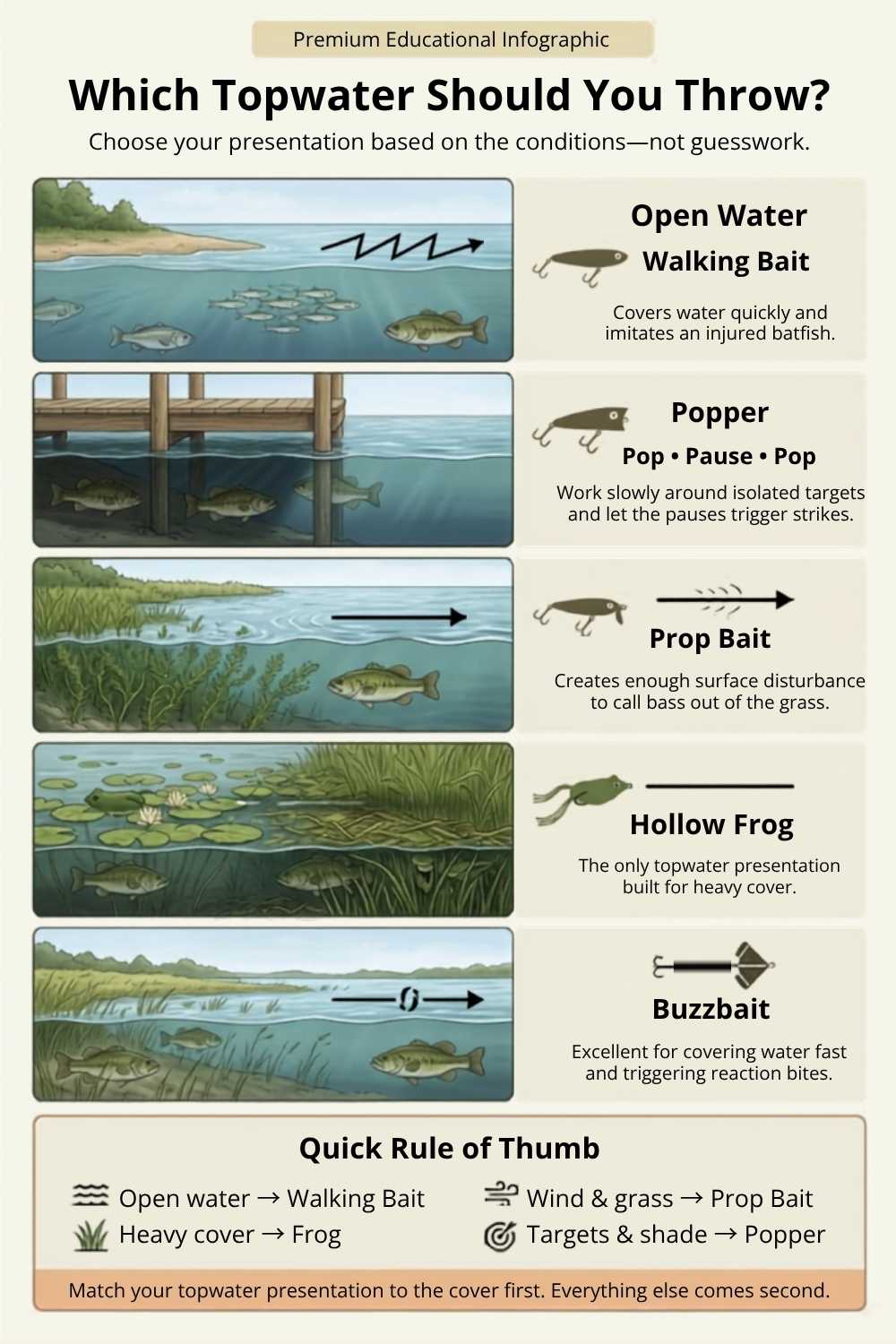
Walking baits (Heddon Spook, Lucky Craft Sammy) — The all-around topwater. Use around shallow points, flats, over submerged grass tops, and along shoreline cover. The walking action (tail-side-to-tail-side glide) mimics injured baitfish struggling on the surface. Work with a high rod tip and rhythmic 'walking' cadence — gentle rod twitches synced to the bait's natural side-to-side glide. The right cadence is the cadence the bass want on that day, so vary the speed and the pause length until you find what produces.
Prop baits (River2Sea Whopper Plopper, Berkley Choppo) — The water-disturbance topwater. Use when bass need a louder, more aggressive surface profile to be drawn to the bait. Particularly effective in rougher water (light chop), around schooling fish, and over deep water where bass need a strong audio cue to commit to coming up to the surface. The rotating tail blade does the work — a steady retrieve at moderate speed produces.
Poppers (Rebel Pop-R, Booyah Boss Pop) — The stop-and-go topwater. Use around discrete cover targets — docks, laydowns, isolated stumps, shaded shoreline corners. The popping action (sharp rod-tip downstroke that pulls the cupped face through the water) creates a localized splash that draws bass from cover. Work with longer pauses than walking baits — bass often commit on the pause, not the action.
Hollow-body frogs (SPRO Bronzeye, Booyah Pad Crasher) — The cover specialist. Use over matted vegetation, lily pads, slop, and any cover too thick for open-hook baits. The closed-cell body and tucked hooks make the frog completely weedless. The dedicated topwater frogs guide covers the full technique.
Buzzbaits — The reaction topwater. Use when bass need a high-speed, high-vibration surface bait to commit. Particularly effective at first light, during shad spawns, and over submerged grass tops. A buzzbait with a Colorado/willow blade combo run parallel to grass edges or over flooded grass tops produces explosive bites.
Topwater color matters less than in most categories because the bass is silhouetting the bait against the sky, not seeing the surface color directly. That said, a few color principles consistently produce.
Bone and white — The universal starting color for walking baits and prop baits. The white belly silhouettes cleanly against sky light and the bone topside (off-white) reads as natural across most forage types. If you carry one walking bait color, make it bone.
Sexy shad and ghost shad — Clear-water topwater colors. The translucent finish and natural shad pattern produce in clearer lakes and on pressured fish where bone reads as too obvious.
Black and black-chrome — Low-light and overcast colors. At first light, last light, on heavily overcast days, and at night, a black or black-chrome topwater silhouettes more sharply against ambient light than lighter colors. This is counterintuitive — black against a black sky looks wrong on paper but works because the bass is seeing pure silhouette, and black creates the sharpest silhouette.
Bluegill and bream patterns — Postspawn and bluegill-spawn windows. From late May through July when bluegill are spawning and concentrated in shallow cover, a bluegill-pattern walking bait produces giants. The bluegill spawn positioning guide covers when and where.
Chartreuse and bright colors — Stained-water topwater. When water clarity drops under 2 ft, bass need brighter colors to locate a topwater. A chartreuse-bellied Spook or a chartreuse Whopper Plopper produces in conditions where bone refuses to draw bites.
For frog colors, the frog guide covers the specific bluegill, shad, black, and white color logic for matted vegetation.
Topwater is a warm-water technique. The seasonal window opens when water hits the low 60s and closes when it drops below the low 60s in fall.
Prespawn (water 55–62°F) — Generally too cold for topwater. Some early-prespawn topwater bites occur on warm afternoons on north banks but the technique isn't reliable until water sustains 62°F+.
Late prespawn through spawn (62–68°F) — The first reliable topwater window. Walking baits and small poppers around spawning flats and the first stretches of shallow cover produce cruising males and roaming fish.
Postspawn (68–75°F) — Topwater becomes a primary technique. Bass recovering around shallow cover crush walking baits and prop baits. The postspawn bluegill behavior guide explains why bluegill-pattern topwater dominates this window.
Summer (75–88°F) — The marquee topwater season but with a narrower daily window. Magic-hour windows (first 90 minutes after dawn, last 90 minutes before dark) produce explosively; midday topwater bites occur only on heavily overcast days. Summer topwater bass fishing and early-morning bass lures cover the timing in detail.
Fall (75–55°F) — The second peak. Bass actively chase shad migrating into creek arms and shallow flats. A walking bait or prop bait worked over schooling fish or along creek-channel banks during fall migrations produces some of the year's most aggressive topwater bites. Fall bass fishing covers the broader pattern.
Late fall through winter (water under 60°F) — Topwater window closes. A few exceptions: warm-spell afternoons on shallow lakes during early-to-mid November can still produce. Generally not a primary cold-water technique. See winter bass fishing lures for the cold-water replacement playbook.
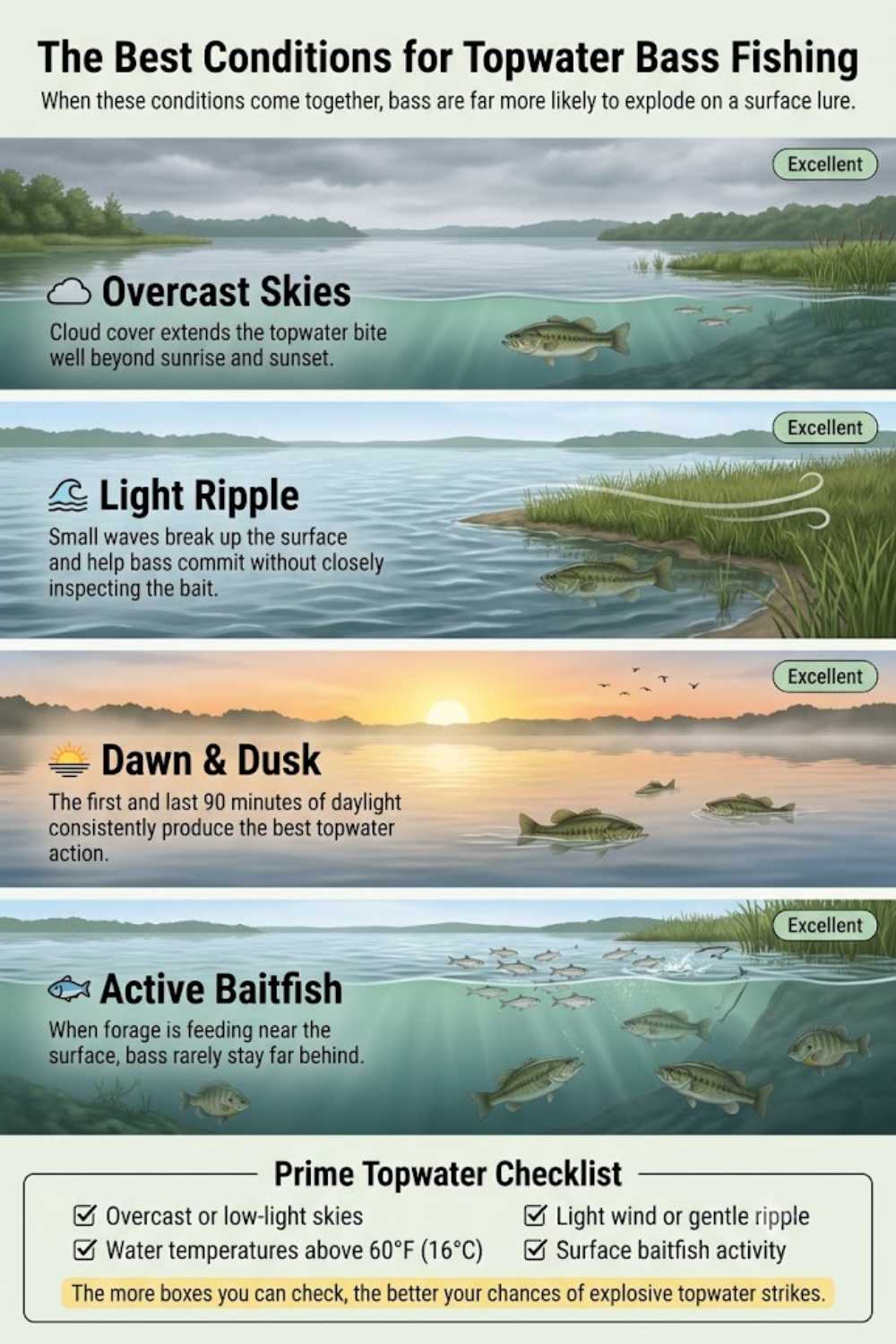
Reading the conditions is what separates topwater days from non-topwater days.
Cloud cover — The single biggest topwater multiplier. Overcast skies extend the topwater window from a 90-minute magic hour to an all-day pattern. Light rain and fog work the same way. See overcast bass fishing.
Light chop — Slight surface ripple favors topwater because it conceals the bait from inspection while keeping surface activity visible enough for bass to lock on. A 5–10 mph breeze creating one-foot chop on a clear lake often produces the best topwater bite of the day.
Low-light periods — Pre-dawn through about 90 minutes after sunrise, and the final 60–90 minutes before sunset, are the topwater magic hours regardless of season. Early-morning bass lures covers the dawn window in depth.
Water temperature — 65–82°F is the productive window. Below 65°F bass metabolism is too slow to consistently commit to surface strikes; above 82°F topwater shifts to the magic hours only as midday water becomes too warm for sustained shallow feeding.
Forage activity — Topwater is most productive when bass are eating bait near the surface. Shad spawn windows, fall shad migrations, schooling activity in summer, and bluegill spawn periods all generate strong topwater bites.
Poor topwater conditions — Bluebird midday skies with no wind, water under 60°F, water over 88°F, heavily-pressured tournament water during peak boat traffic, and post-cold-front days when bass are buried in cover. On these days, switch to sub-surface presentations and save topwater for the next favorable window. Bluebird sky bass fishing covers the post-front adjustment.
Topwater is the most exciting and one of the most productive shallow-water bass techniques. Build a topwater arsenal that covers all five sub-categories — walking bait, prop bait, popper, frog, and buzzbait — and you will have the right surface tool for almost every shallow-water condition. Read the cloud cover, wind, water temperature, and forage activity, and the bass will tell you when to throw it.
For matted vegetation and the slop, the dedicated topwater frogs guide covers the cover-specialist side. For the broader summer playbook, see summer topwater bass fishing. For the moving-bait family more broadly, the spinnerbaits guide and chatterbait guide cover the sub-surface cousins of topwater search baits.
The benchmark walking topwater — long casts and big bites.
Low-light, calm surface — walk the dog over open water.
As an Amazon Associate I earn from qualifying purchases.
Temperature-by-temperature lure logic.
The prespawn temperature threshold.
Natural presentations and finesse profiles.
Vibration, dark silhouette, and visibility tactics.
Adjusting across the full clarity spectrum.
Topwater and reaction baits for the dawn window.
Plug in today's water temp, clarity, weather, and forage — the tool returns the highest-confidence presentations.
Build Today's Strategy →