Editor's Pick97%
Strike King 6XD
Sexy Shad
View Product →The best crankbaits for bass — squarebill, mid-diver, and deep-diver picks, color selection by water clarity, seasonal strategy, and how to pick depth, color, and cadence.
Affiliate Disclosure: As an Amazon Associate I earn from qualifying purchases. Recommendations reflect on-the-water testing and the LureLogic ranking engine — not paid placement.
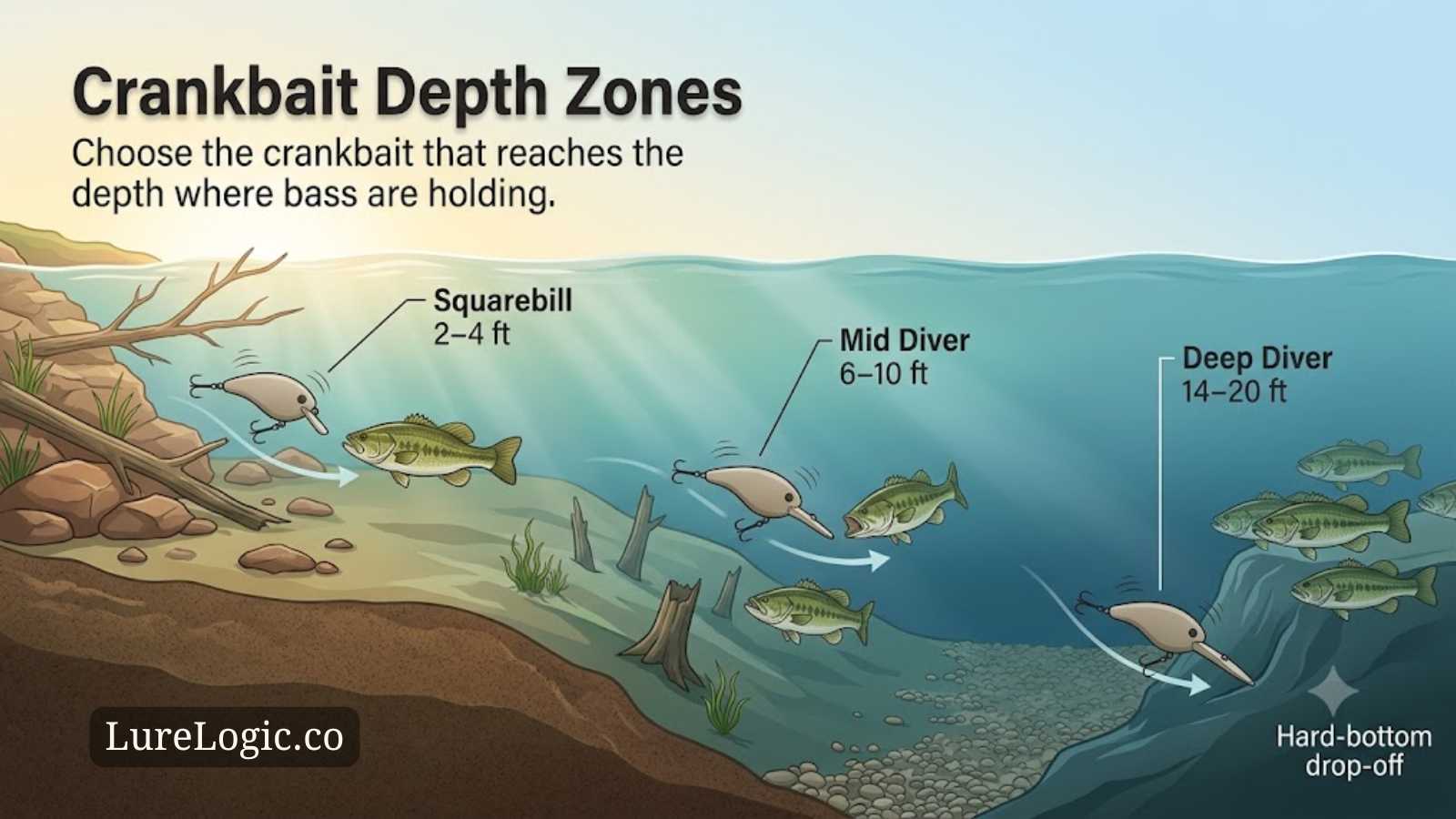
Crankbait selection is a depth question first, brand question second. A crankbait's diving depth — controlled by lip size, body shape, and line diameter — determines whether it ever reaches the bass. The right crankbait is the one whose dive curve crosses the depth bass are holding at, contacts the cover or bottom they relate to, and matches the prevailing forage profile.
Strike King 6XD — Editor's Pick (Deep). The 6XD dives 18–20 ft on 10-lb fluorocarbon with a relatively easy pull, making it the best all-around deep crankbait for the majority of anglers. The bill design tracks straight under heavy load, the body wobble is balanced (not too tight, not too wide), and the standard color lineup covers the productive shad and crawfish patterns.
Rapala DT-16 — Best Tracking. Rapala's Dives-To series guarantees the named diving depth on the right line. The DT-16 is the standard for fishing the 14–18 ft band — slightly tighter wobble than the 6XD, exceptional tracking through deflections, and balsa construction that floats up off snags. Many tournament anglers pair both cranks and let conditions pick which to throw.
Berkley Frittside — Best Value. The Frittside is a flat-sided crankbait built for cold water and pressured fish. The tighter wobble and slimmer profile produces in clear water and post-front conditions where wider-bodied cranks get refused. Available in shallow (5 series) through deep (10 series).
Spro Little John — Premium Mid-Diver. The Little John series covers the 5–12 ft range with one of the best deflection-and-recovery actions in the category. The bait kicks aggressively off cover, then resumes its natural wobble — exactly the cadence bass key on around rocky banks and laydowns.
Lucky Craft LC Series — Pressured-Water Specialist. The LC 1.5, LC 2.5, and LC 3.5 are tighter-wobbling, more refined finishes that produce on heavily pressured fish where Strike King and Rapala alternatives get inspected and refused.
For the squarebill side of the family, see our dedicated squarebill crankbaits guide. For the rattling shad-mimic side, see the lipless crankbait guide.
Crankbaits work because they combine three powerful triggers in one bait — vibration, visual profile, and deflection-driven reaction strikes. A crankbait moving through water displaces enough volume to be detected by a bass's lateral line from 6–20 ft away (depending on water clarity and crank size), which is how bass first locate the bait. The visual profile then either matches the dominant forage (shad, crawfish, bluegill) or contrasts sharply enough to look like a wounded baitfish — both of which trigger feeding interest. The deflection off cover is the third and often most important trigger: a crankbait that ticks a rock or branch and immediately resumes its retrieve looks exactly like a baitfish escaping cover after being startled, and reaction strikes from neutral bass account for a huge share of crankbait bites.
The second reason crankbaits work is their efficiency at covering water. A crankbait fishes the entire retrieve in the strike zone, unlike a soft plastic that spends most of its retrieve sinking and lifting. That sustained presence in the strike zone, combined with the long casts crankbaits enable, lets an angler cover three to four times more water per hour than with bottom-contact presentations. When bass are scattered across a stretch of shoreline, a creek arm, or an offshore ledge, the crankbait finds the concentrations.
Third, crankbaits trigger size-selective feeding because bass associate the moving profile with a fleeing meal worth chasing. Cover-oriented adult bass that hold tight in cover for finesse presentations will often charge out 6–10 ft to crush a crankbait deflecting off the cover edge. That cover-edge interception pattern is why so many tournament wins come on a crankbait, even on lakes where finesse techniques dominate.
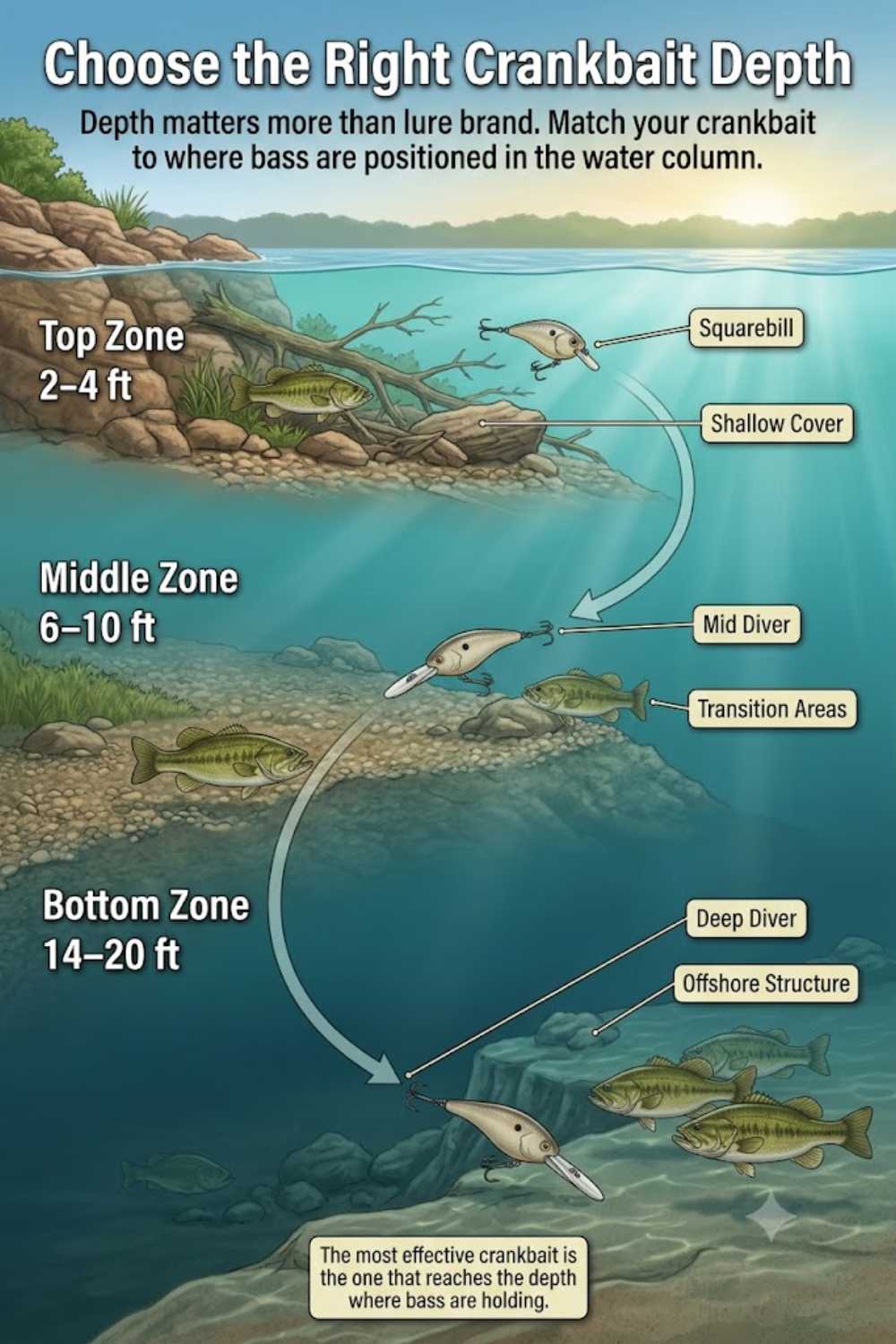
Depth selection is the most important crankbait decision. A crankbait that runs above or below the bass produces nothing regardless of how perfect the color and cadence are. The bait must reach the depth bass are holding at and ideally tick the cover or bottom they relate to.
A practical depth ladder for serious bass anglers: • 2–4 ft: Strike King KVD 1.5 squarebill, Spro Little John 1.5 • 4–7 ft: Rapala DT-6, Spro Little John 2.0 • 7–10 ft: Rapala DT-10, Berkley Frittside 7 • 10–14 ft: Rapala DT-14, Strike King 5XD • 14–18 ft: Strike King 6XD, Rapala DT-16 • 18–22+ ft: Strike King 8XD, Rapala DT-20
The diving depths above assume 10–12 lb fluorocarbon line. Lighter line lets the crankbait dive deeper; heavier line keeps it shallower. Long casts maximize dive depth; short casts reduce it. Wind affects both retrieve depth and tracking.
Reading the bottom — Most experienced crankbait anglers spend the first 30 seconds of a new spot finding what their crankbait is contacting. A bait that runs free with no contact is fishing above the strike zone. A bait that constantly bottoms out is fishing too deep. The sweet spot is intermittent contact with bottom, cover, or grass tops — that contact-and-recover cycle is what generates reaction strikes.
Use the water-temperature lure guide to identify what depth bass should be at on a given day, then pick the crankbait whose dive curve hits that depth.
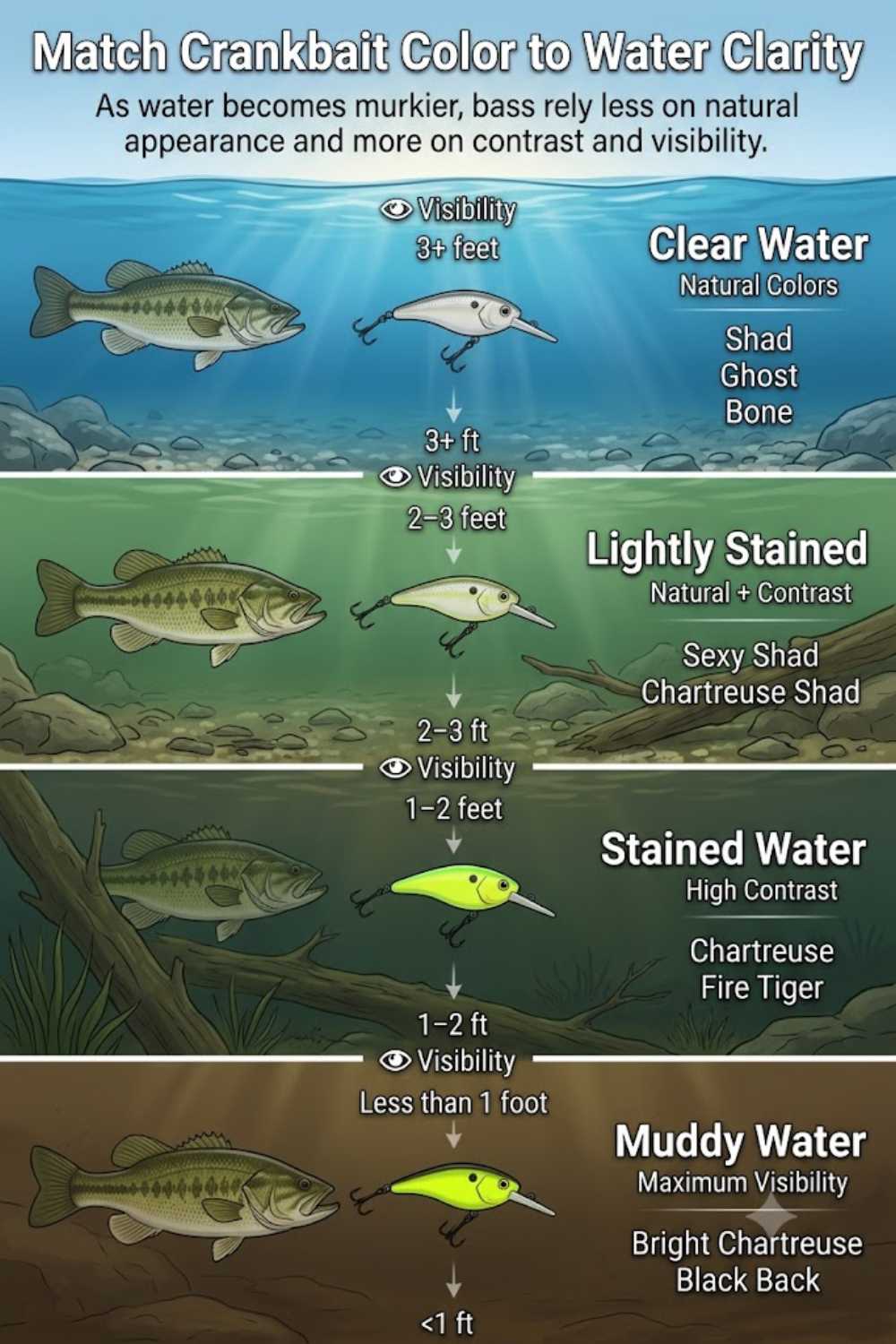
Crankbait color is more clarity-driven than forage-driven, but the two interact and the best anglers think about both.
Clear water (3+ ft visibility) — Natural finishes win. Ghost shad, citrus shad, bone, sexy shad, and translucent-bellied patterns produce because bass have time to inspect the bait. Avoid bright chartreuse and high-contrast finishes in clear water — they read as artificial and get refused. Slow the retrieve and lengthen the cast.
Lightly stained water (2–3 ft) — The sweet spot for crankbait color. Sexy shad, chartreuse-and-blue-back, sexy shad with a slight chartreuse belly, and shad patterns with subtle red highlights all produce. This is the clarity at which most tournament wins on a crankbait happen.
Stained water (1–2 ft) — Step up contrast. Chartreuse-and-blue-back, fire tiger, and chrome-with-red-flash are the standards. The blue-back-chartreuse combination is the single most productive stained-water crankbait color across the country.
Muddy water (under 12 inches) — Maximum contrast. Bright chartreuse with a black back, solid chartreuse, and fluorescent reds all produce when bass cannot resolve subtler finishes. Slow the retrieve dramatically and make repeated casts to the same high-percentage spots. Muddy water bass fishing covers the broader pattern.
Crawfish patterns — Spring crawfish migrations call for red craw, brown craw, and orange craw colors regardless of clarity. From late March through May on rocky lakes, a crawfish-colored crankbait ticking riprap or chunk-rock outproduces shad patterns. The crawfish color cycle guide covers the seasonal molt colors.
Overcast vs sunny — Overcast days favor brighter, higher-contrast finishes; bluebird-sky days favor more natural finishes. See sunny day bass fishing and overcast bass fishing.
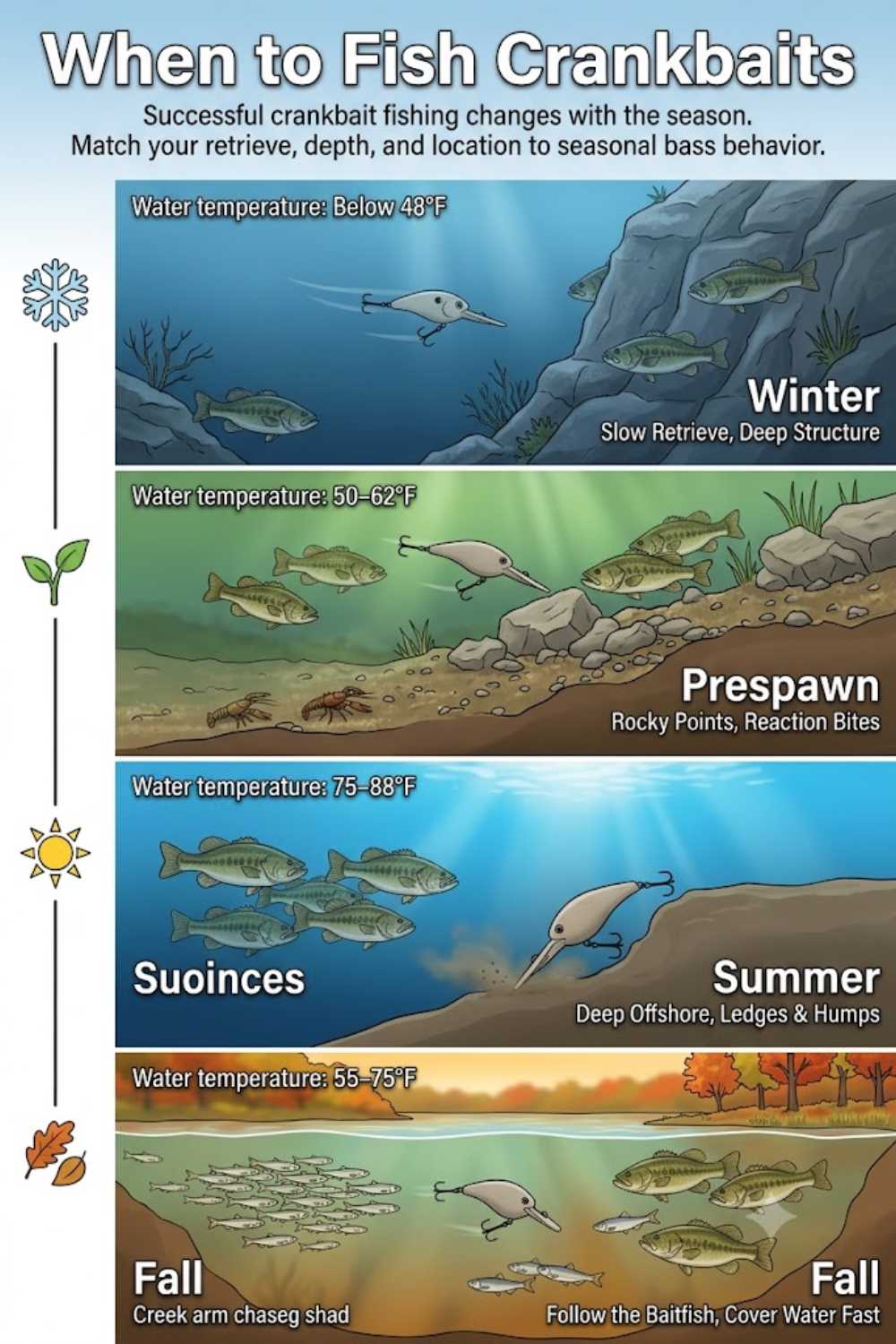
Crankbaits produce in every season but the depth, speed, and color change with water temperature.
Winter (water under 48°F) — Tight-wobbling flat-sided cranks (Berkley Frittside, Spro Little John DD) on slow retrieves around bluff walls, channel swings, and main-lake points. The tighter wobble is critical — wide-wobbling cranks throw too much vibration for cold-water metabolism. The winter bass fishing lures guide covers the broader cold-water playbook.
Prespawn (water 50–62°F) — The marquee crankbait window. Bass stage on rocky transitions, secondary points, and the first hard-bottom areas inside spawning bays. A 5–10 ft diving crankbait in crawfish or sexy shad colors run across these areas catches some of the year's biggest fish. 55-degree water bass lures and prespawn lures cover the staging pattern.
Spawn (62–70°F) — Secondary technique. Crankbaits produce on cruising males and roaming fish but lose to flipping and sight-fishing baits for bedded fish.
Postspawn (68–75°F) — Squarebills shine. Postspawn females recover on shallow rock and cover; a squarebill bumped through those areas produces aggressive reaction strikes. See the dedicated squarebill guide.
Summer (75–88°F) — Two patterns. Early morning and late evening squarebill bites around shade and rocky banks; midday deep-cranking on offshore ledges, humps, and main-lake points. A 6XD or DT-16 worked across deep structure during the heat of the day produces the biggest bass schools of the year. Summer midday bass fishing covers the offshore pattern.
Fall (75–55°F) — Cranking around fall shad migrations is one of the most productive windows of the year. Squarebills in creek arms intercept shad and the bass following them; mid-divers along creek-channel ledges produce schooling fish. Fall bass fishing and the fall shad migration guide cover the seasonal timing.
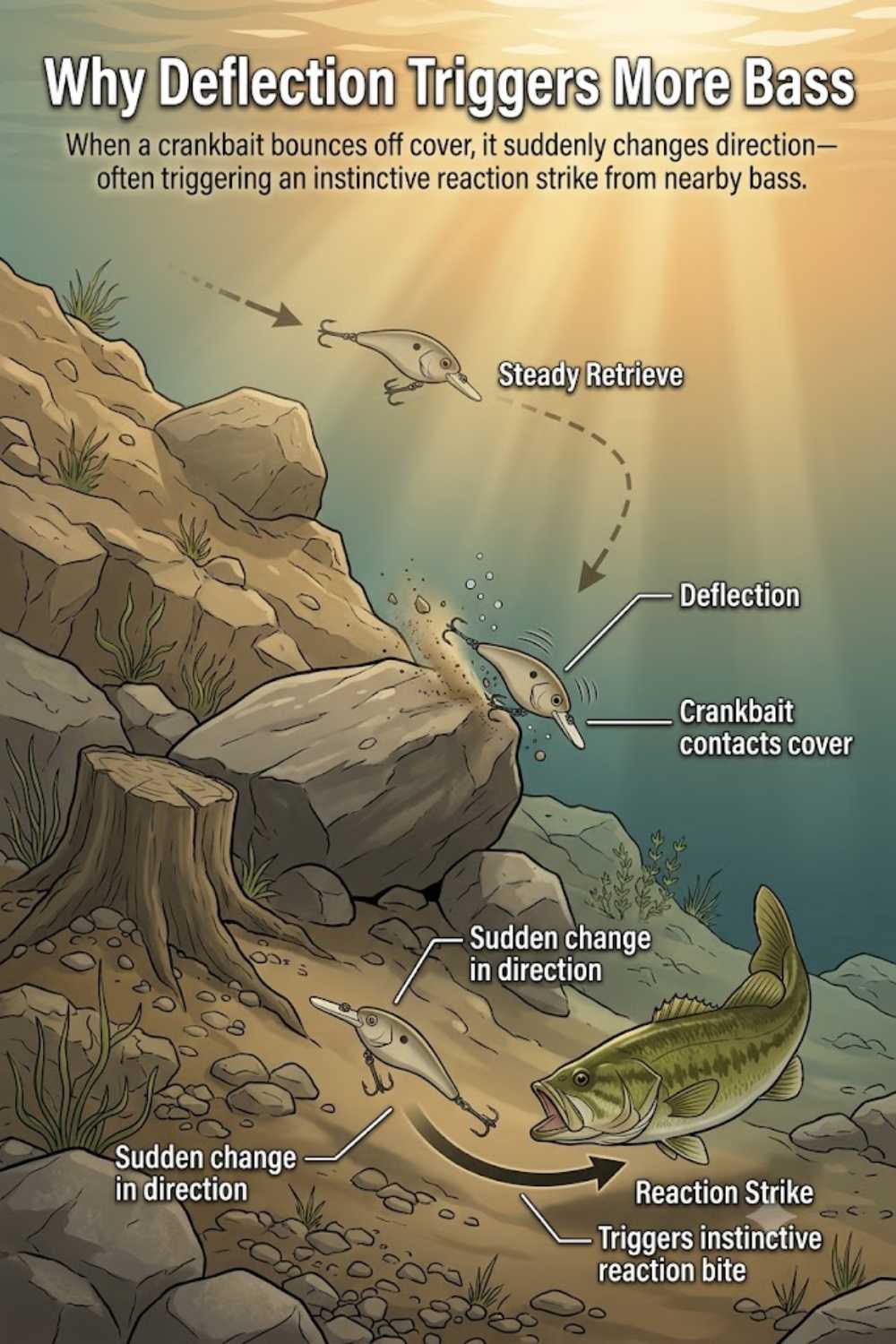
Retrieve cadence may be the second-most-important crankbait decision after depth.
Steady retrieve — The default. A constant moderate reel speed that keeps the bait at depth produces the majority of crankbait bites. Use as the search retrieve to find concentrations of fish before experimenting with cadence variations.
Stop-and-go — The reaction trigger. After 3–4 cranks of the reel, pause briefly (1–2 seconds), letting the bait float up slightly, then resume. The pause-and-resume cadence triggers neutral fish that follow but won't commit on a steady retrieve. Particularly effective in cold water and on pressured fish.
Burn-and-kill — The big-fish trigger. Burn the bait at maximum reel speed for 3–4 seconds, then suddenly kill the retrieve and let the bait deflect or float up. The sudden change in speed and direction triggers reaction strikes from following fish that wouldn't commit to a steady retrieve.
Deflection-driven — Around cover. Aim casts so the bait deflects off rocks, stumps, dock posts, and grass tops. The deflection-and-recovery is the single most important reaction trigger crankbaits offer.
Rod-tip control — Use the rod tip to manage depth. A high rod tip keeps the bait shallower; a low rod tip pulls it deeper. Around suspended fish, work the rod tip in subtle sweeps that introduce micro-pauses into the retrieve.
Line selection — 10–12 lb fluorocarbon is the standard for most crankbait depths. Drop to 8 lb for maximum diving depth and clear water; step up to 14–17 lb around heavy cover. Fluorocarbon sinks (helping cranks dive) and has minimal stretch (improving hookup percentage on long casts).
Crankbaits remain one of the most efficient ways to find and catch bass because they combine vibration, visual profile, deflection triggers, and water-coverage rate in a single bait. Build a depth-ladder covering 2 ft through 22 ft, carry shad and crawfish color families for every clarity range, and learn to read what your bait is contacting — the rest of crankbait fishing follows naturally.
For specialty crankbait applications, see the best squarebill crankbaits guide for shallow-cover specialists and the best lipless crankbaits guide for the year-round rattling-shad-mimic alternative. For the moving-bait family overall, the spinnerbaits guide covers the flash-and-vibration cousin.
Reaches deep with predictable wobble for offshore ledges.
Offshore ledges and humps — grind it into the bottom.
As an Amazon Associate I earn from qualifying purchases.
Temperature-by-temperature lure logic.
The prespawn temperature threshold.
Natural presentations and finesse profiles.
Vibration, dark silhouette, and visibility tactics.
Adjusting across the full clarity spectrum.
Topwater and reaction baits for the dawn window.
Plug in today's water temp, clarity, weather, and forage — the tool returns the highest-confidence presentations.
Build Today's Strategy →