Editor's Pick97%
Strike King KVD 1.5
Sexy Shad
View Product →Discover the best squarebill crankbaits for shallow cover, rock, wood, and stained water bass fishing situations.
Affiliate Disclosure: As an Amazon Associate I earn from qualifying purchases. Recommendations reflect on-the-water testing and the LureLogic ranking engine — not paid placement.
Best Overall: Strike King KVD 1.5. Best Premium Option: Lucky Craft LC 1.5. Best Cold-Water Option: Berkley Frittside. Best All-Around Performer: Spro Little John. Best Large Profile Option: Norman Fat Boy.
If you can only carry three squarebills, build the box around a KVD 1.5 in Chartreuse Black Back for stained water, a Lucky Craft LC 1.5 in Sexy Shad for clear water and pressured fisheries, and a Spro Little John in Spring Craw for prespawn rock and riprap. Those three colors and three baits cover the vast majority of seasonal scenarios discussed in the rest of this guide.
Strike King KVD 1.5 — The benchmark squarebill. Its combination of hunting action, cover deflection, affordability, and proven fish-catching ability makes it one of the safest recommendations in bass fishing. Excels around laydowns, shallow rock, riprap, dock posts, and isolated cover. The buoyant body backs away from cover after impact, reducing hangups while maximizing deflections. Where it truly shines is stained water: Chartreuse Black Back, Sexy Shad, and crawfish patterns consistently produce. During prespawn periods, the KVD 1.5 is often the first bait tournament anglers reach for.
Lucky Craft LC 1.5 — Refinement. The finishes are exceptional, balance is precise, and action remains consistent cast after cast. Particularly effective on heavily pressured lakes where fish see endless crankbait presentations and small differences in vibration, profile, and finish matter. Clear-water reservoirs, rocky transitions, and pressured fisheries are ideal environments.
Berkley Frittside — Offers a tighter wobble than traditional squarebills, a major advantage during colder water periods when bass reject wide, aggressive actions. Prespawn, winter warming trends, and post-front conditions are where the Frittside frequently outperforms wider-wobbling competitors. Slow your retrieve and let the bait tick the tops of cover to maximize cold-water effectiveness.
Spro Little John — Combines strong casting performance with excellent deflection. Anglers covering miles of shoreline appreciate how effectively it fishes around multiple cover types without constant retuning. Performs particularly well around mixed-cover environments where rock, wood, grass, and docks intersect.
Norman Fat Boy — Larger profile and stronger vibration signature. In stained water, muddy water, windy conditions, and aggressive feeding situations, the added presence helps bass locate the bait. A strong choice whenever visibility is limited or larger forage dominates the system.
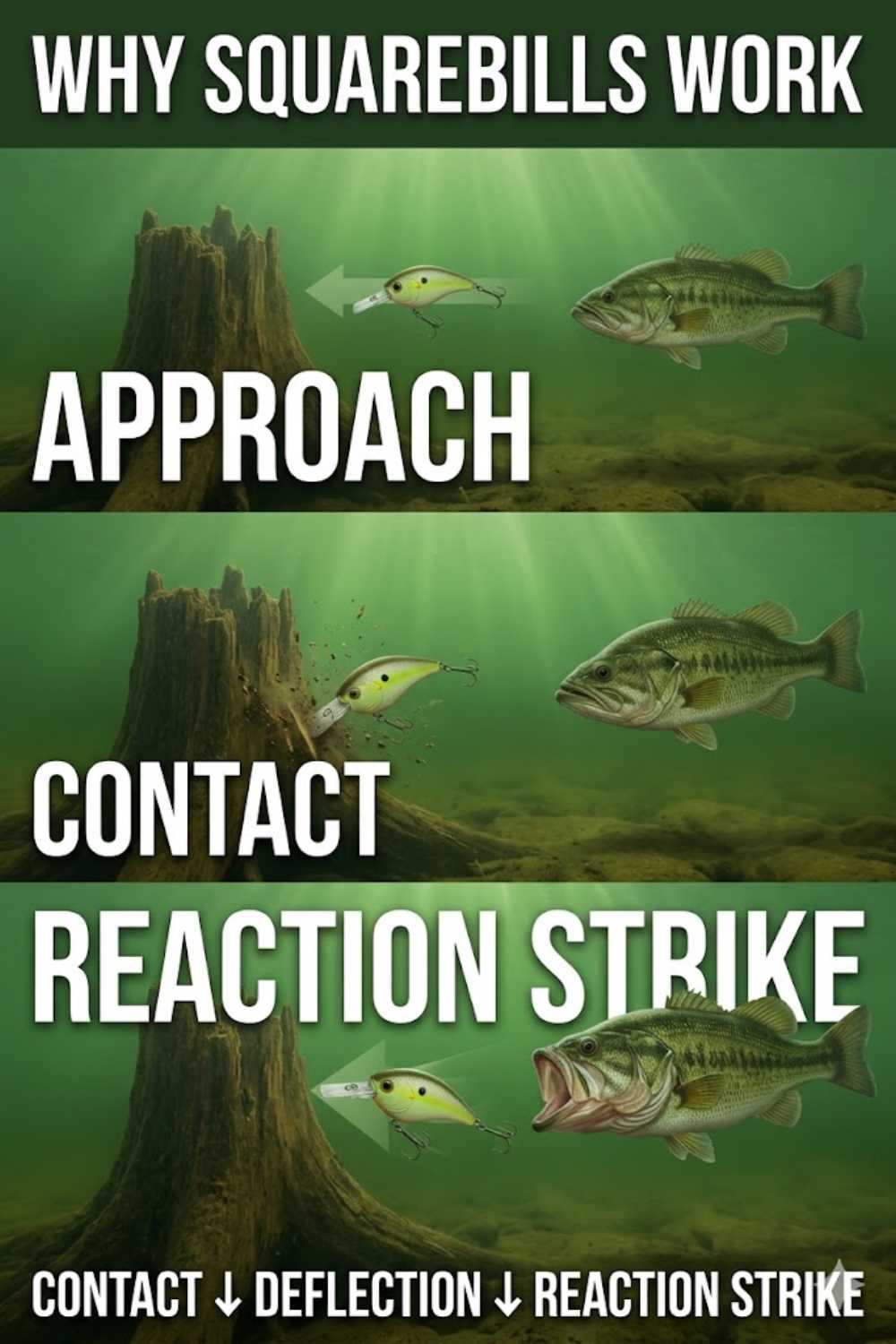
Reaction strikes are the foundation of squarebill fishing. Most anglers assume bass bite because they are hungry — but many squarebill fish strike for an entirely different reason. The bait enters the strike zone unexpectedly, changes direction violently, and triggers an instinctive response.
Bass are ambush predators. They spend much of their lives positioning around objects that funnel prey: stumps, riprap, dock posts, isolated boulders, and grass edges all create predictable ambush opportunities. When a squarebill collides with one of these objects, it behaves differently than a baitfish swimming naturally — it suddenly darts sideways, rises, stalls, or changes direction. To a bass, this resembles vulnerable prey attempting escape, and the reflex commit overrides any inspection behavior.
Another reason squarebills excel is efficiency. Anglers can cover water quickly while still fishing high-percentage targets. A jig may thoroughly fish one stump; a squarebill can efficiently target fifty stumps in the same period. This efficiency becomes especially important during prespawn and fall when bass spread across large sections of shallow water and locating active fish is half the battle.
Many anglers carry dozens of crankbait colors. Most successful squarebill fishermen rely on five or six core patterns.
Shad Colors — White, silver, pearl, translucent baitfish finishes, and sexy shad variations consistently produce whenever baitfish dominate the forage base. Fall, summer schooling periods, and clear-water fisheries heavily favor shad colors.
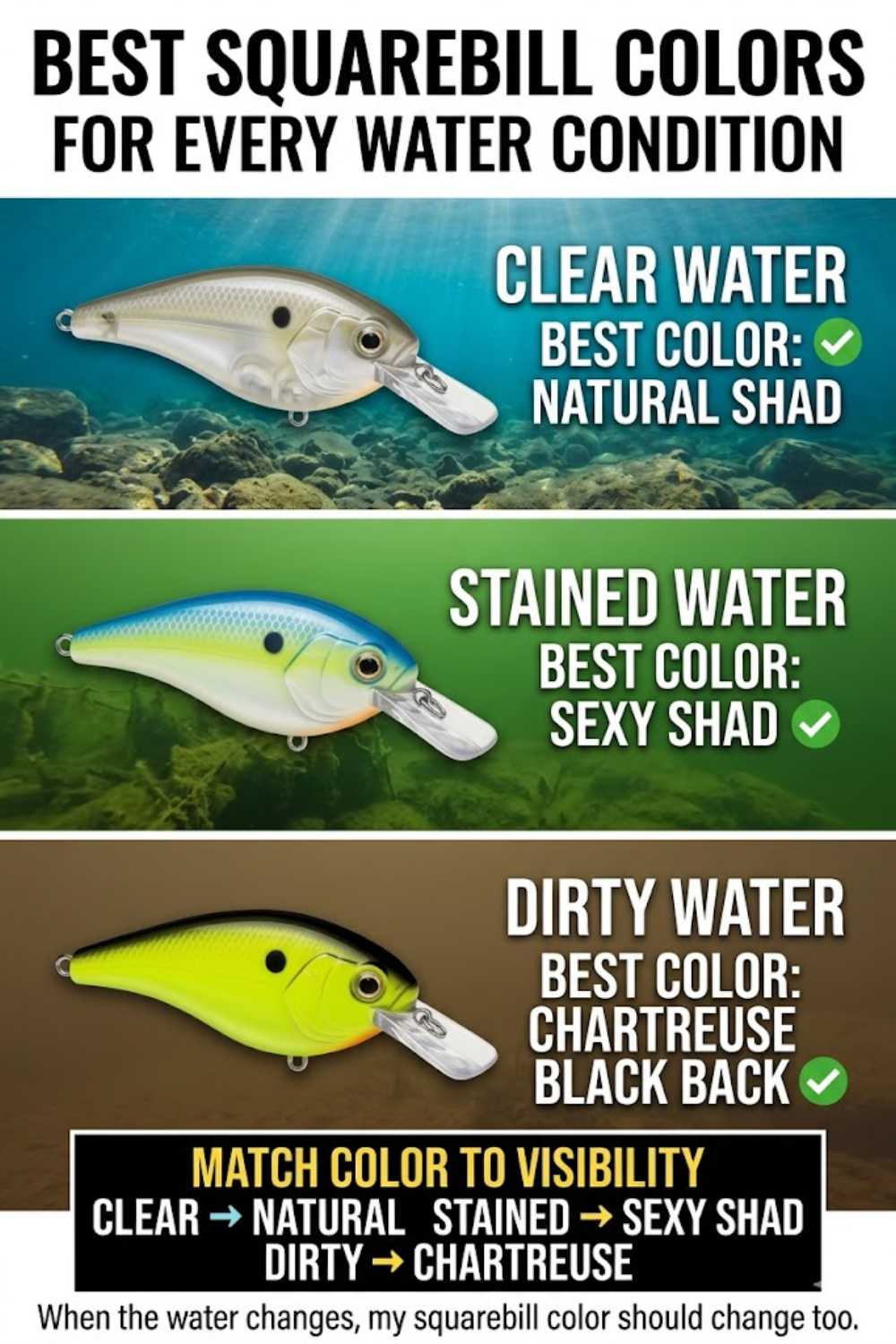
Chartreuse Black Back — If there is a universal stained-water squarebill color, this is it. The chartreuse body increases visibility while the dark back provides contrast bass can easily locate when visibility declines significantly.
Crawfish Patterns — Especially important during late winter and prespawn. Red craws, brown craws, orange craws, and muted crawfish patterns consistently excel around rock banks and riprap because crawfish represent a major forage source in those seasons.
Bluegill Patterns — Summer bass frequently feed on bluegill around shallow cover. Bluegill-colored squarebills can produce exceptional results around docks, wood, grass lines, and shoreline cover, particularly on southern reservoirs and natural lakes with strong sunfish populations.
Color Selection by Water Clarity — Clear water: natural shad, translucent finishes, subtle colors. Moderately stained: sexy shad, chartreuse shad, brighter naturals. Dirty water: chartreuse black back, firetiger, bold contrast colors. Layer this with the broader muddy-water bait playbook when visibility drops below 12 inches.
Squarebills catch fish year-round but certain conditions dramatically increase their effectiveness.
Stained water is often considered ideal squarebill water. Bass have reduced visibility, making reaction strikes more common — fish have less time to inspect the lure and more incentive to react instinctively. Moderately stained water (1–3 ft visibility) often produces the best combination of visibility and aggression.
Clear water can still be excellent, particularly during prespawn and fall. The key adjustments are natural colors, longer casts, and more realistic presentations. Wind significantly improves squarebill fishing because it pushes forage against shorelines and creates feeding opportunities — many of the best squarebill days occur when conditions are too windy for finesse presentations.
Current creates another opportunity. River systems, current-generating reservoirs, and moving water concentrate fish around predictable ambush points. Temperature also matters: squarebills shine when bass are feeding shallow. Spring and fall naturally create those conditions, but summer and winter opportunities remain available when fish position correctly.
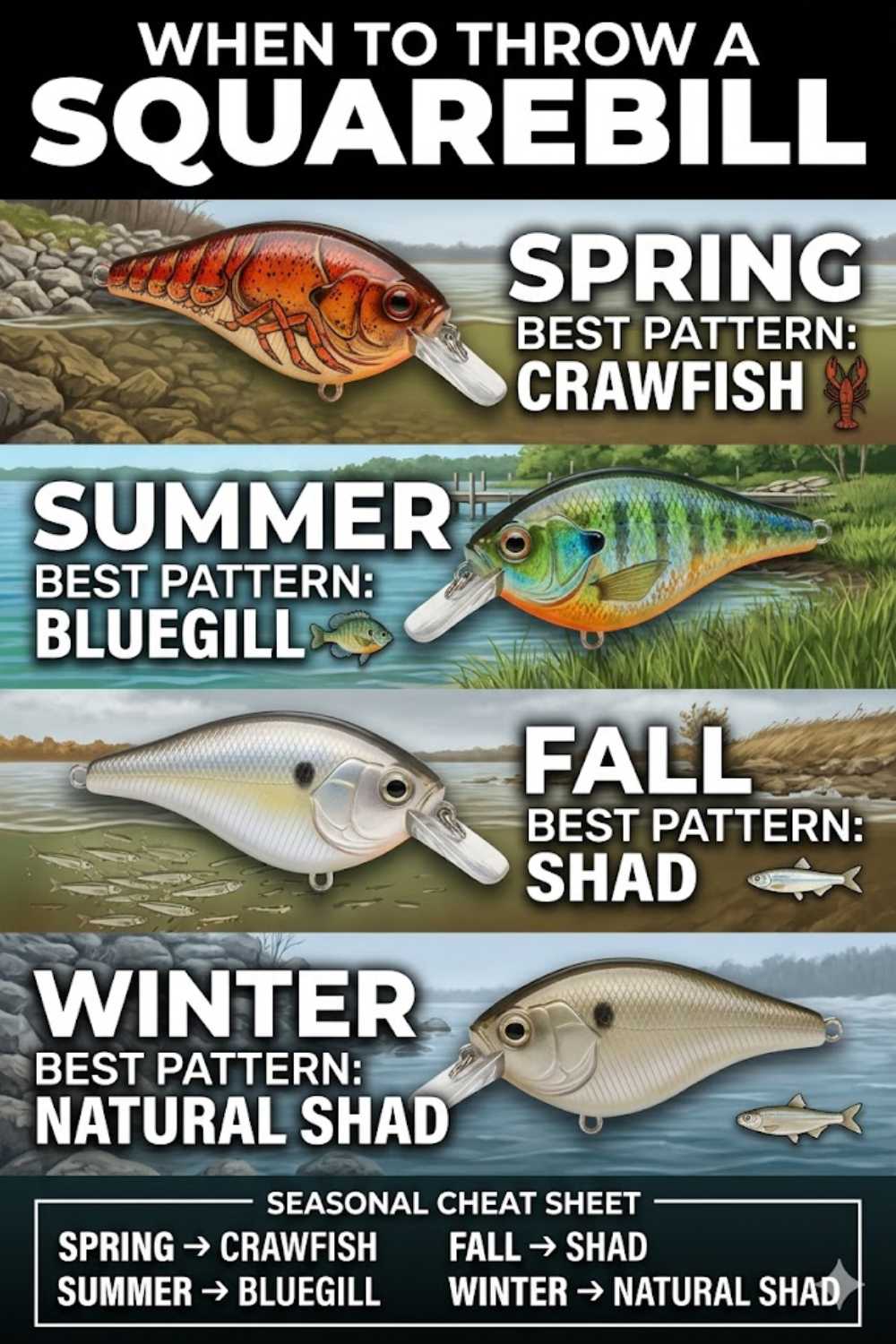
Prespawn — May be the greatest squarebill season of all. Bass move shallow, feed aggressively, and position around rock, riprap, transition banks, and staging cover. Crawfish become increasingly important, making red and orange patterns highly effective. Deflecting a squarebill through shallow rock often produces some of the biggest fish of the year. Pair with the prespawn playbook for staging-bank specifics.
Spawn — Squarebills remain useful for covering water around spawning pockets, secondary points, and nearby staging cover. They are not usually the primary bedding lure but can quickly identify aggressive fish moving between spawning locations.
Postspawn — Many anglers struggle during postspawn transitions; squarebills simplify the process. Recovering fish often position around shallow cover and begin feeding aggressively again. Covering water becomes critical, and squarebills excel in that role.
Summer — Underrated. Bass position around shade, wood, docks, grass edges, and current. Early mornings are productive, but shallow squarebill bites can continue all day around quality cover. Bluegill colors become increasingly important.
Fall — Ideal squarebill conditions. Bass chase baitfish aggressively and frequently use shallow cover as feeding stations. Shad colors dominate while anglers cover large amounts of water searching for active fish.
Winter — Opportunities exist, especially in southern fisheries. Focus on warmer afternoons, tighter-wobbling crankbaits like the Frittside, and slower retrieves. Cover remains important but fish often require more precise presentations.
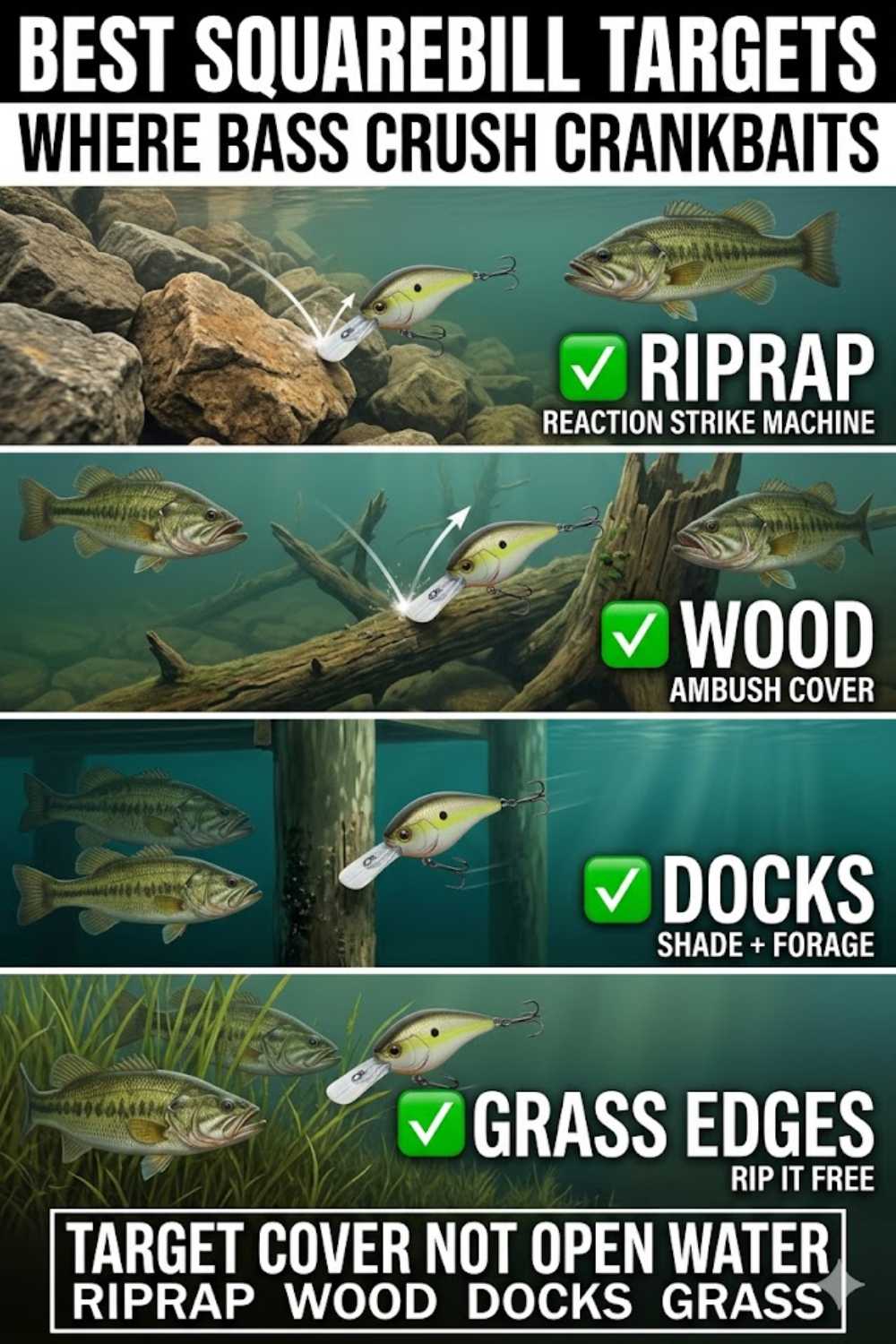
The best squarebill anglers think about cover differently than most fishermen. They do not simply fish near cover — they fish into cover.
Riprap consistently attracts bass because it provides forage, warmth, current breaks, and ambush opportunities. Squarebills excel here because repeated rock contact creates reaction strikes. Rock banks become especially productive during prespawn and fall — target irregularities, isolated boulders, transitions, and changes in rock size.
Wood cover remains one of the highest-percentage squarebill targets available. Laydowns, stumps, brush piles, and flooded timber all create ambush opportunities. Direct contact is essential. Docks create shade and attract forage; accurate casts around dock posts frequently generate strikes from fish that receive less pressure. Squarebills are often overlooked around vegetation — contacting grass and ripping the lure free can trigger violent strikes from bass positioned along the edge.
Retrieve speed is one of the most important variables in squarebill fishing. The standard medium retrieve is the starting point, but conditions often demand adjustments. Burning a squarebill can trigger reaction strikes during warm-water periods. Stop-and-go retrieves excel when fish are pressured. Deflection remains the primary goal regardless of retrieve style — contact every available piece of cover whenever possible.
Rod position influences running depth and control. Lower rod positions help maintain depth; higher rod positions help navigate shallow cover and pull the bait over grass tops. The best squarebill fishermen constantly experiment with speed, angle, and cadence until fish reveal their preferences. Common mistakes: avoiding cover, retrieving too consistently, choosing colors based on personal confidence instead of visibility and forage, abandoning squarebills after spring, and fishing only obvious targets while ignoring subtle irregularities where the biggest fish often live.
Deflects off cover like nothing else — the go-to shallow crank.
Shallow wood and rock — make it deflect off cover.
As an Amazon Associate I earn from qualifying purchases.
Temperature-by-temperature lure logic.
The prespawn temperature threshold.
Natural presentations and finesse profiles.
Vibration, dark silhouette, and visibility tactics.
Adjusting across the full clarity spectrum.
Topwater and reaction baits for the dawn window.
Plug in today's water temp, clarity, weather, and forage — the tool returns the highest-confidence presentations.
Build Today's Strategy →