Best Overall / Editor's Pick97%
Z-Man JackHammer ChatterBait
Green Pumpkin
View Product →Discover the best chatterbaits for bass fishing, including proven colors, trailers, seasonal strategies, and the top vibrating jigs for every condition.
Affiliate Disclosure: As an Amazon Associate I earn from qualifying purchases. Recommendations reflect on-the-water testing and the LureLogic ranking engine — not paid placement.
Few bass lures have changed modern bass fishing as dramatically as the chatterbait. Also known as a vibrating jig or bladed jig, this lure combines elements of a spinnerbait, crankbait, and jig into a single presentation capable of producing reaction strikes from bass throughout the year.
The biggest reason chatterbaits consistently catch bass is versatility. A bladed jig can imitate shad, bluegill, perch, juvenile crappie, and even crawfish depending on color, trailer selection, and retrieve speed. Unlike many moving baits that excel during only one season, chatterbaits remain productive from late winter through late fall.
The lure's signature vibration is generated by a metal blade positioned directly in front of the jig head. As the lure moves forward, the blade oscillates rapidly, creating vibration, flash, and water displacement. Bass detect this vibration through their lateral line, allowing them to locate the bait even in stained water.
One reason chatterbaits excel is their ability to trigger reaction strikes. Bass often attack vibrating jigs out of instinct rather than hunger. This makes them especially effective around grass lines, shallow cover, and transitional areas where bass are actively moving.
Many anglers associate chatterbaits primarily with spring, but that view limits their effectiveness. They can be deadly during summer grass fishing, fall baitfish migrations, and even winter warming trends when retrieved slowly near bottom structure.
Not all vibrating jigs perform the same. Several design factors separate average chatterbaits from elite performers.
The blade connection is arguably the most important component. Premium chatterbaits start vibrating immediately after the retrieve begins. Inferior designs may require several feet of movement before activating properly. Immediate vibration matters because many strikes occur immediately after the lure enters productive water.
Head design influences both tracking and cover navigation. A well-designed head allows the lure to deflect off grass, wood, and rock without rolling onto its side. This becomes especially important when targeting bass positioned along submerged vegetation or laydowns.
Hook quality is another major differentiator. Chatterbaits frequently attract larger-than-average bass, particularly during feeding windows. Strong hooks improve landing percentages and hold up better during repeated encounters with heavy cover.
Trailer retention is often overlooked. Soft plastic trailers are critical to chatterbait performance. Lures with secure trailer keepers maintain consistent action and prevent plastics from sliding down the hook after every strike.
Premium chatterbaits also exhibit a hunting action. Rather than tracking perfectly straight, they occasionally surge or wander slightly. This unpredictable movement often resembles fleeing baitfish and can trigger aggressive strikes from following bass.
When evaluating any bladed jig, anglers should prioritize startup vibration, tracking consistency, hook quality, durability, and compatibility with trailers before considering price.
Color selection plays a major role in chatterbait success, but many anglers overcomplicate the process. In reality, a small group of proven patterns covers most situations.
For a deeper breakdown of proven patterns, anglers should review the condition-by-condition color notes below when building their color selection strategy.
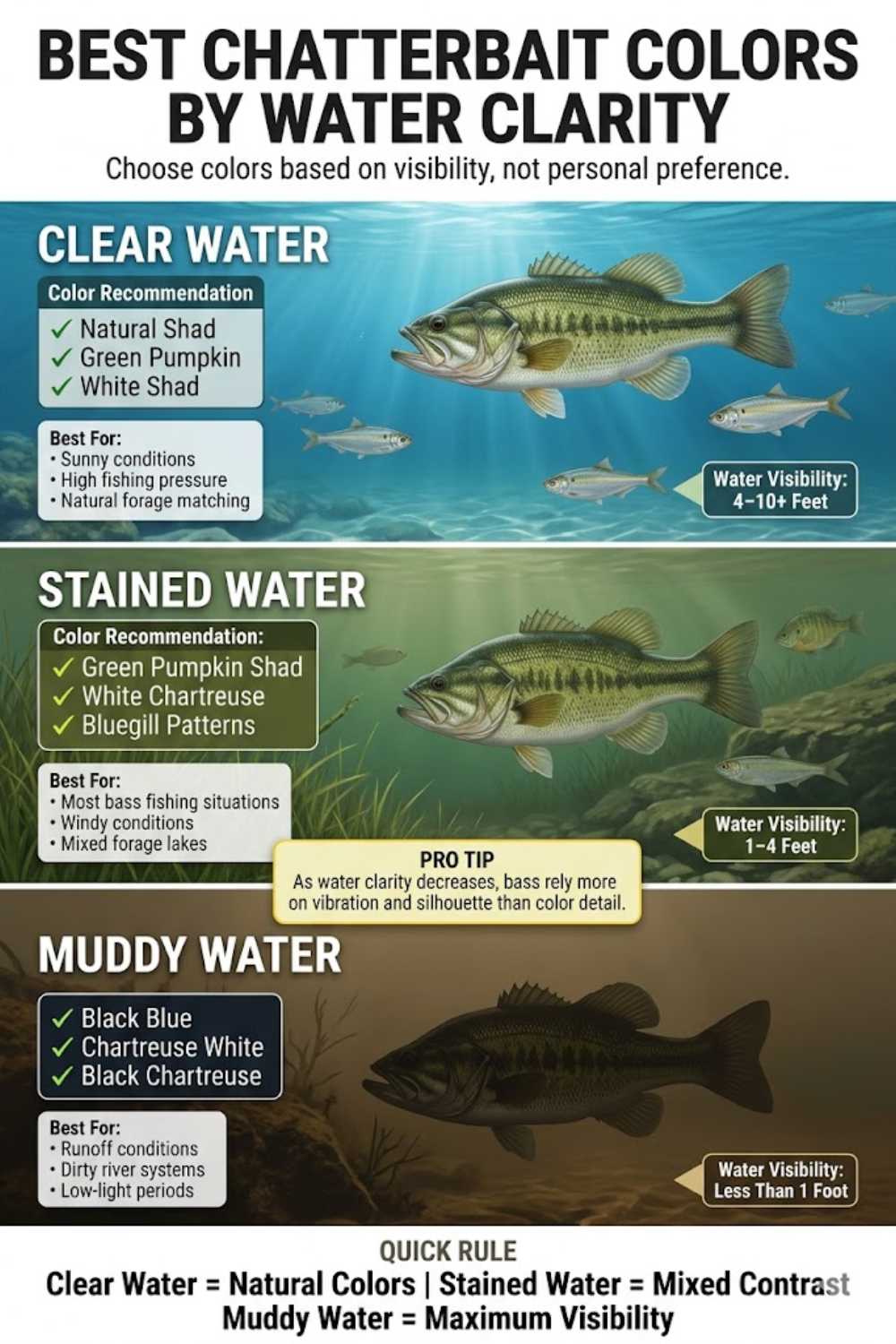
White and shad-based colors dominate whenever bass are feeding heavily on baitfish. During spring baitfish activity and the annual shad spawn period, white chatterbaits consistently generate some of the fastest action of the year.
Green pumpkin remains the most versatile color overall. It effectively imitates bluegill, perch, juvenile sunfish, and even crawfish depending on trailer choice. When uncertain, green pumpkin is rarely a poor decision.
Black and blue excel in dirty water and low-light conditions. The strong silhouette helps bass locate the lure when visibility is reduced.
Chartreuse combinations become valuable in heavily stained water. Rather than matching forage exactly, these colors increase visibility and help bass track the lure.
Trailer color should complement the skirt rather than contrast dramatically. White chatterbaits perform best with white or pearl trailers. Green pumpkin skirts pair naturally with matching craw-style or swimbait trailers.
Seasonal forage shifts should also influence color choices. Bluegill patterns become more productive throughout summer, while shad patterns often dominate during spring and fall feeding periods.
The trailer often determines whether a chatterbait becomes good or exceptional. It influences vibration, lift, profile, and forage imitation.
Paddle-tail swimbaits remain the most popular trailer option. They complement blade vibration while creating a realistic baitfish profile. These are excellent choices when bass are feeding heavily on shad.
Split-tail trailers create a more subtle presentation. They reduce lift and allow the lure to run deeper while maintaining a streamlined appearance.
Craw-style trailers shine during spring when bass focus heavily on crawfish. Their kicking appendages create additional movement and can help trigger strikes around rock and wood cover.
The most versatile setup for most anglers is a 3/8-ounce chatterbait paired with a 4-inch paddle-tail swimbait. This combination covers shallow grass, docks, riprap, and transition banks effectively.
Rod selection is equally important. Most experienced anglers prefer a 7-foot to 7-foot-4 medium-heavy moderate-fast rod. The moderate action helps prevent fish from throwing the lure during violent head shakes.
A high-speed reel in the 7:1 range provides excellent control. It allows anglers to speed up during active feeding periods and slow down when bass become less aggressive.
For line, 15–20 pound fluorocarbon works well in open water, while 30–50 pound braid excels around dense vegetation.
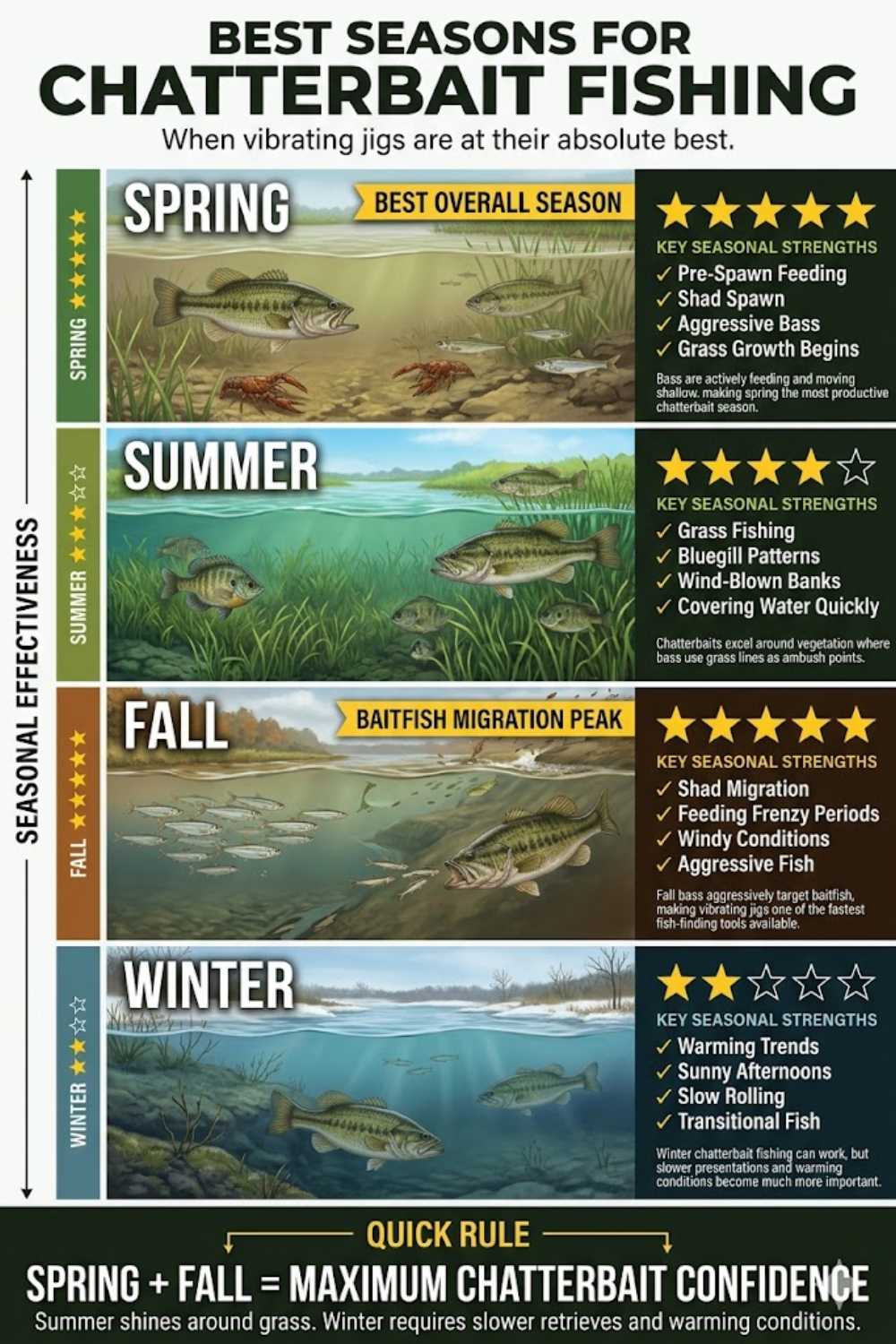
Spring may be the most productive chatterbait season of the year. As water temperatures rise and bass move toward spawning areas, vibrating jigs become one of the most efficient tools for locating aggressive fish.
The period leading into the spawn is particularly productive. Bass position along secondary points, channel swings, staging flats, and emerging vegetation. These fish are actively feeding and often respond aggressively to moving baits.
Many of the same locations discussed in /spring-bass-fishing become prime chatterbait targets because they concentrate fish transitioning toward shallow spawning habitat.
During the pre-spawn, retrieve speed matters. Water temperatures between 50 and 60 degrees generally favor moderate retrieves that keep the bait near the tops of vegetation. Sudden rod twitches often trigger strikes from following fish.
One of the biggest mistakes anglers make is fishing too quickly. Bass may be active, but they are not yet operating at summer metabolism levels. Allowing the lure to occasionally contact grass, wood, or bottom structure often increases strike frequency.
The spawn itself can be inconsistent for chatterbait fishing because many bass become focused on reproduction. However, post-spawn fish frequently feed aggressively on shad and bluegill, creating excellent opportunities for vibrating jigs.
The annual shad spawn is perhaps the most exciting chatterbait period of the year. White chatterbaits retrieved around seawalls, grass edges, marinas, and shallow hard cover can produce explosive action during the first few hours of daylight.
Summer is often overlooked by chatterbait anglers, yet it can produce some of the biggest bass of the year.
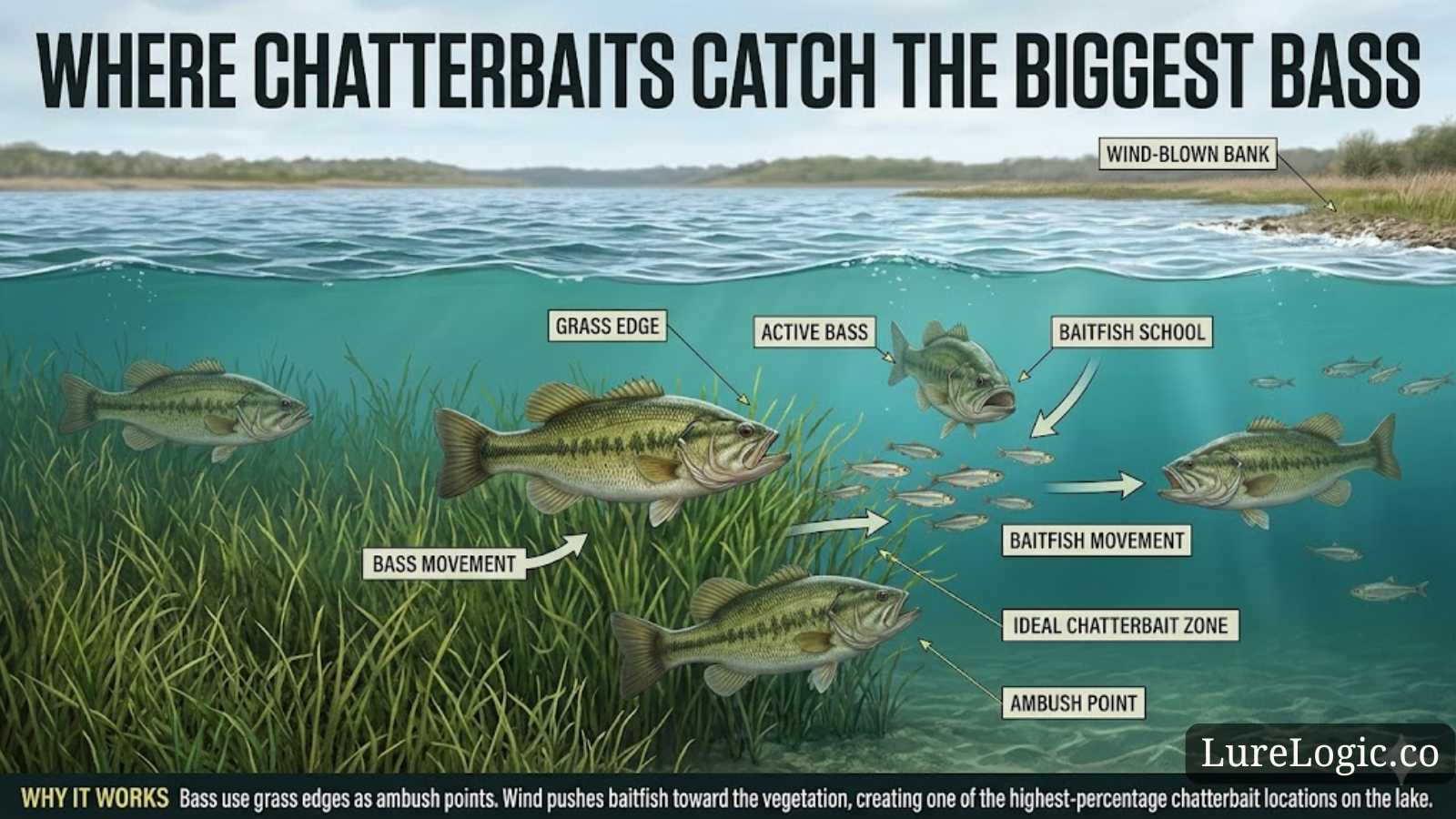
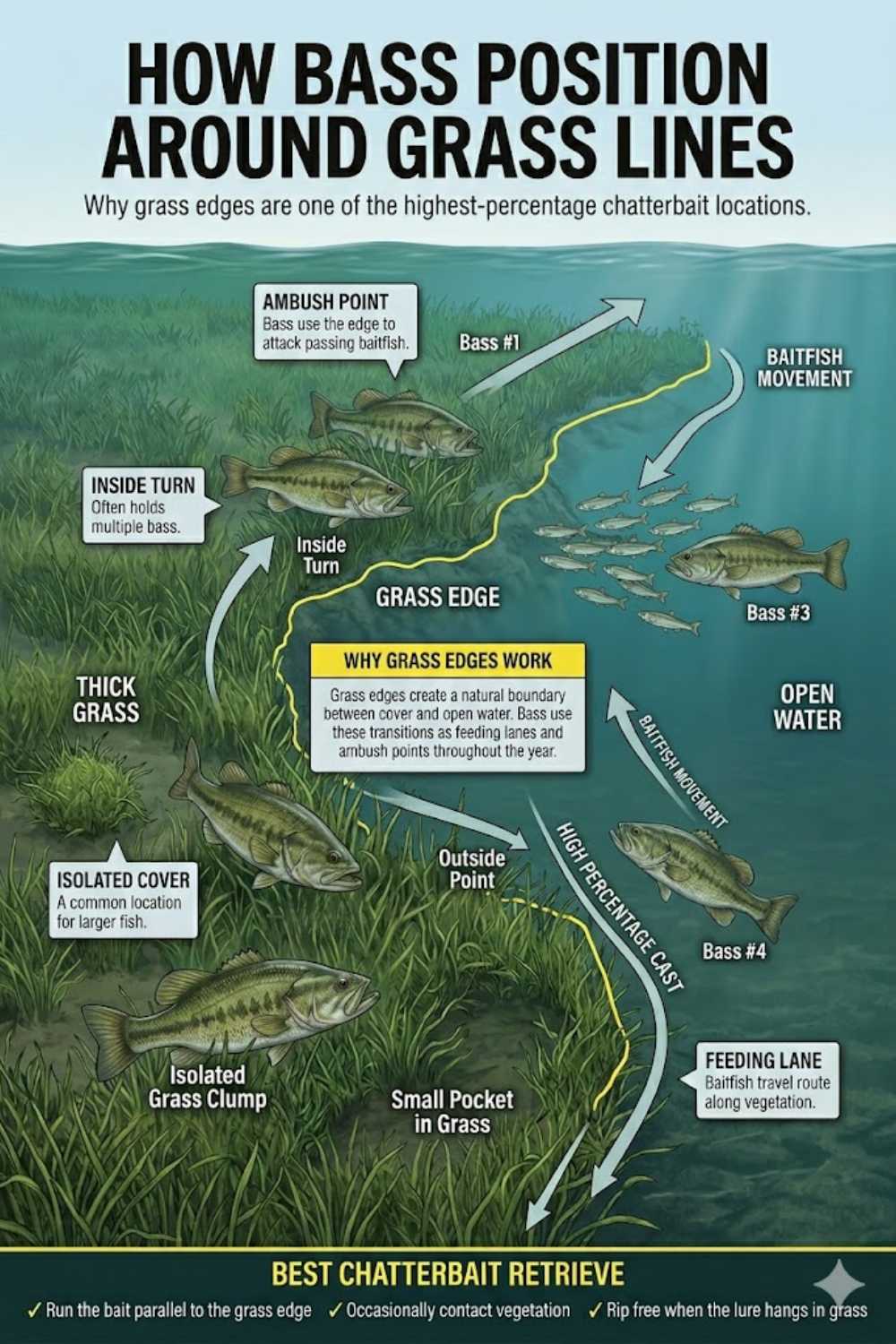
Submerged vegetation becomes a dominant factor during summer. Bass use grass edges, submerged points, holes, and irregularities as ambush locations. Chatterbaits excel because they can be retrieved through these areas while maintaining constant vibration.
Many of the concepts discussed in /bass-fishing-grass-lines apply directly to bladed jig fishing. Grass edges create predictable travel routes and feeding lanes that bass use throughout the day.
One of the most productive techniques involves ticking the tops of submerged grass. Rather than avoiding contact, experienced anglers intentionally allow the lure to collide with vegetation before ripping it free. The sudden burst often triggers reaction strikes.
Bluegill-oriented patterns become increasingly effective during summer. Green pumpkin, bluegill, and bream-colored chatterbaits frequently outperform traditional shad colors around vegetation.
Weight selection becomes critical. Heavier 1/2-ounce models help maintain depth control when fish position slightly deeper. Lighter versions excel over shallow grass flats.
Cloud cover, wind, and current significantly increase chatterbait effectiveness during summer. These conditions encourage bass to roam and feed more aggressively.
When bass become pressured, downsizing trailers or switching to subtler colors can restore productivity. Many anglers continue throwing oversized profiles when fish would respond better to a more natural presentation.
Fall is another prime season for vibrating jigs because bass increasingly focus on baitfish.
As water temperatures decline, shad often migrate into creek arms and shallow feeding areas. Bass follow these forage movements closely, creating predictable feeding patterns.
Chatterbaits are particularly effective because they allow anglers to cover water quickly while maintaining a realistic baitfish profile. White, pearl, and shad-colored patterns dominate in many fisheries during this period.
Wind becomes a major factor. Windblown banks frequently concentrate both baitfish and feeding bass. The combination of reduced visibility, increased oxygen, and forage concentration often creates ideal chatterbait conditions.
One productive strategy involves targeting transition banks near creek-channel swings. Bass frequently position along these routes as they follow migrating bait schools.
Retrieve speed can generally increase compared to spring fishing. Fall bass are often aggressive and willing to chase. Faster retrieves occasionally trigger larger fish by forcing reaction strikes.
The challenge during fall is locating active schools. Once baitfish concentrations are identified, chatterbaits often become one of the fastest ways to catch multiple fish from a productive area.
Few lures excel in reduced visibility conditions as consistently as chatterbaits.
The blade's vibration allows bass to locate the lure through their lateral line even when visibility is poor. This makes vibrating jigs highly effective whenever runoff, wind, algae blooms, or natural coloration reduce water clarity.
The principles covered in /bass-fishing-stained-water frequently align with chatterbait strengths because both rely heavily on vibration and profile rather than visual realism alone.
Color selection becomes simpler in dirty water. Black-and-blue, chartreuse-white, and bold contrast patterns often outperform subtle natural colors.
Retrieve speed should generally slow slightly as visibility decreases. Bass may need additional time to track and intercept the lure.
Adding larger trailers can increase profile and help fish locate the bait more easily. Bulk often matters more than exact forage matching under these conditions.
Target selection also changes. Bass frequently position tighter to cover in stained water. Dock posts, laydowns, grass edges, and shallow wood become high-percentage targets because fish use these structures as ambush points.
Many anglers incorrectly assume muddy water eliminates chatterbait effectiveness. In reality, vibrating jigs often outperform crankbaits, spinnerbaits, and swimbaits when visibility is severely reduced.
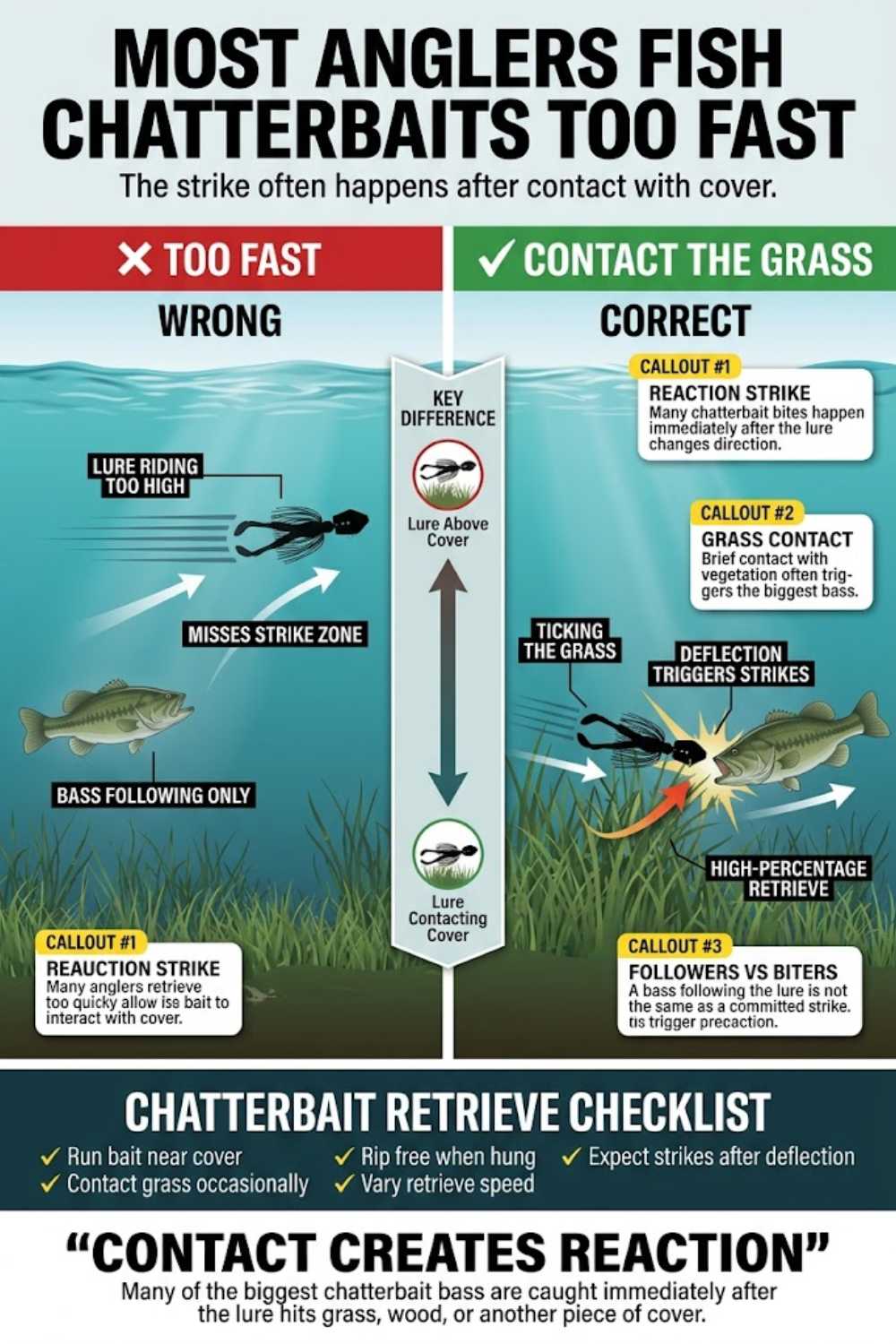
One of the most common mistakes is retrieving the lure at the same speed all day. Bass behavior changes with water temperature, weather, forage activity, and fishing pressure. Successful anglers constantly experiment with retrieve cadence.
Another frequent error is choosing trailers that overpower the lure. Excessively large trailers can dampen vibration and negatively affect tracking.
Many anglers also fail to make contact with cover. Chatterbaits are designed to deflect and trigger reaction strikes. Fishing them exclusively through open water reduces their effectiveness.
Poor rod selection causes lost fish. Extra-fast rods often pull hooks away from bass or allow fish to throw the lure during jumps.
Some anglers become overly focused on color while ignoring location. Bass positioning remains far more important than precise color selection. A mediocre color in the correct location typically outperforms the perfect color in unproductive water.
Fishing the wrong depth is another major issue. Chatterbaits can be fished shallow, mid-depth, or near bottom depending on weight and retrieve speed. Anglers who fail to adjust depth frequently miss active fish.
Finally, many anglers abandon chatterbaits too quickly after a few unproductive casts. Vibrating jigs excel as search baits. Their greatest strength often lies in locating active fish rather than generating immediate bites from every target.
The best chatterbait ultimately depends on water clarity, forage, cover type, and seasonal conditions.
If you fish a wide variety of lakes and want the most consistent performer available, the Z-Man Jack Hammer remains the standard. Its startup vibration, hunting action, and overall versatility justify its reputation.
For anglers seeking maximum versatility at a slightly lower price point, the Elite EVO provides exceptional performance across most scenarios.
Tournament anglers covering large amounts of water often gravitate toward the Thunder Cricket because of its aggressive vibration and fish-finding capability.
Budget-conscious anglers should strongly consider the Project Z. It delivers dependable performance while allowing anglers to carry multiple colors and sizes without excessive cost.
Clear-water specialists may find the Picasso Shock Blade particularly effective when bass become pressured and less willing to commit to louder presentations.
Regardless of model choice, success with chatterbaits depends less on owning dozens of variations and more on understanding seasonal fish behavior, forage movements, and location patterns. The anglers who consistently catch bass with vibrating jigs focus first on where bass are positioned and then use chatterbaits as tools to exploit those opportunities.
The benchmark bladed jig — premium hardware and perfect vibration.
Stained water, wind, scattered grass — moderate-paced reaction bait.
As an Amazon Associate I earn from qualifying purchases.
Temperature-by-temperature lure logic.
The prespawn temperature threshold.
Natural presentations and finesse profiles.
Vibration, dark silhouette, and visibility tactics.
Adjusting across the full clarity spectrum.
Topwater and reaction baits for the dawn window.
Plug in today's water temp, clarity, weather, and forage — the tool returns the highest-confidence presentations.
Build Today's Strategy →