Best for Numbers97%
Keitech Swing Impact FAT
Bluegill Flash
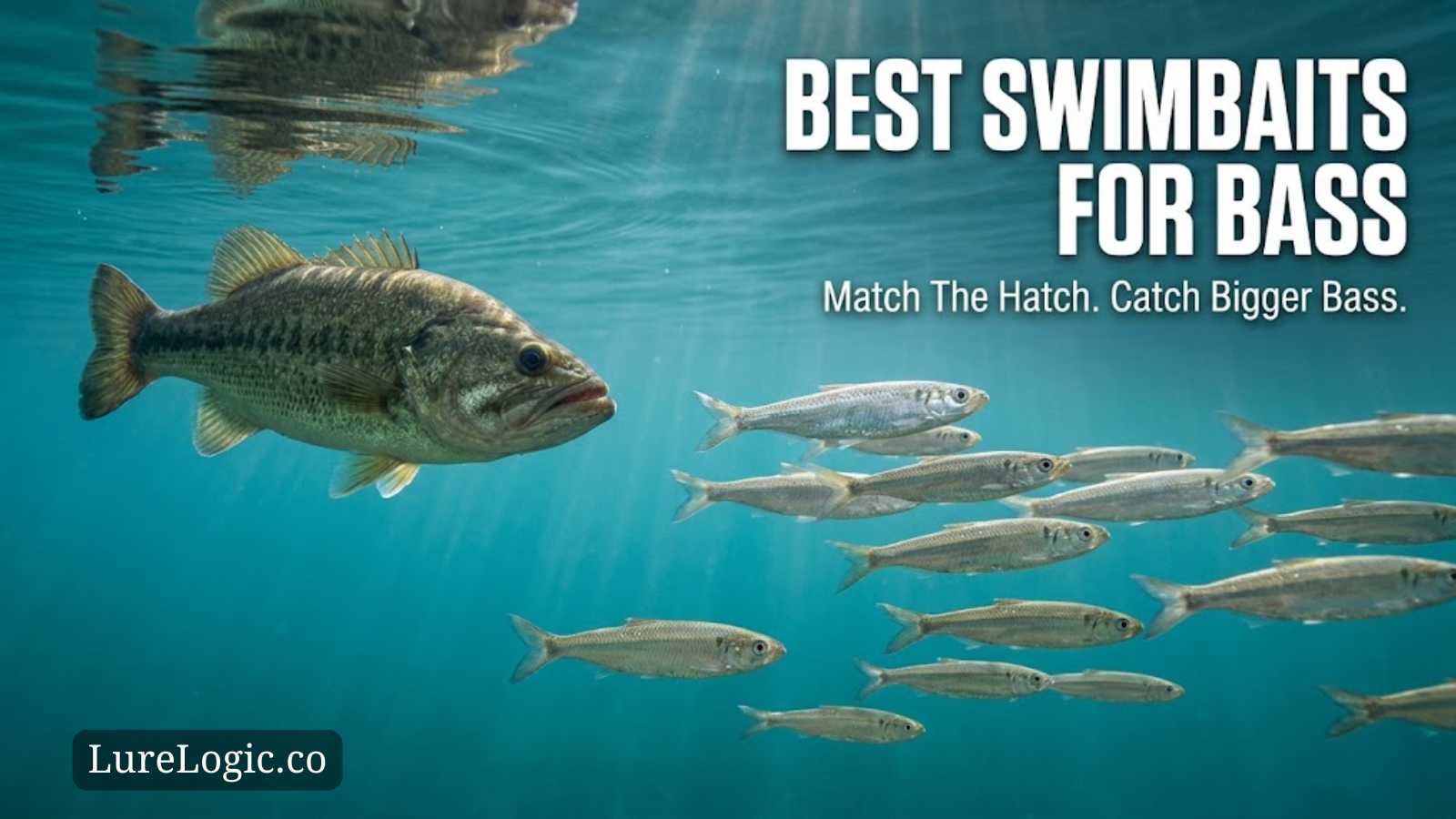
View Product →Which swimbait should you throw? Paddle tails for numbers, line-through for pressured fish, glides and big baits for giants — picked by season, clarity, and forage.
Affiliate Disclosure: As an Amazon Associate I earn from qualifying purchases. Recommendations reflect on-the-water testing and the LureLogic ranking engine — not paid placement.
Start with the job you need done, not the brand on the package.
If you want bites today — a 3.8" or 4.8" Keitech Swing Impact FAT on a 1/4 to 1/2 oz weighted swimbait hook. It is the highest-percentage swimbait in the country and matches adult shad on most lakes.
If you are hunting a bigger average fish — a 6" or 8" Megabass Magdraft. Same natural body roll, far more profile, and it still covers water like a search bait.
If the fish are pressured or the water is clear and calm — a line-through style bait such as a Huddleston or a soft glide. The free-sliding body means fewer thrown hooks and a slower, more believable swim.
If you are on a budget or fishing stained water — a Strike King Rage Swimmer on a jighead. Heavy tail thump, hard to fish wrong, and cheap enough to lose in cover.
If you want one giant bite — a hard glide bait or a big line-through trout, fished slowly on main-lake structure in cold, clear water.
Quick rule of thumb: clearer and calmer means smaller and slower; dirtier and windier means bigger, heavier, and more tail thump.
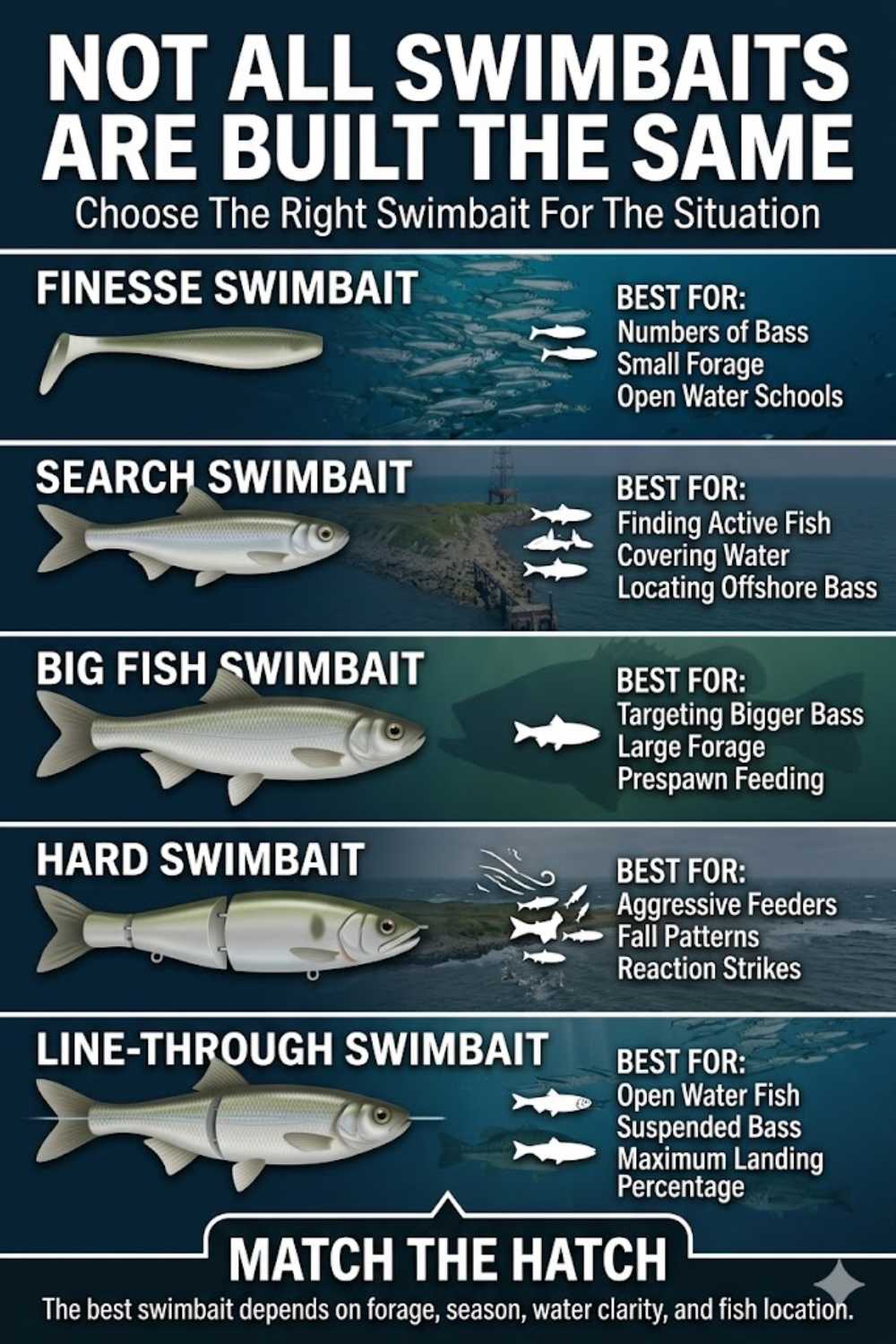
The five categories of swimbaits below cover every meaningful bass-fishing situation: mid-size paddle tails for numbers, hollow-body searchers for cover, soft-body trophy hunters for big fish, hard-bodied multi-section baits for realism, and line-through designs for tournament hook-up percentages.
Megabass Magdraft — Editor's Pick. The Magdraft is the most versatile mid-to-large swimbait in production. The hidden top hook keeps it relatively snag-free around grass and wood, the body roll mimics a healthy adult shad or herring, and the size range (6" and 8") spans from a numbers bait to a legitimate trophy tool. If you only buy one mid-size swimbait, this is it.
Keitech Swing Impact FAT — Best for Numbers. The 4.8" Keitech on a weighted swimbait hook, underspin, or swim-jig head has caught more bass nationally than every other swimbait combined. The tail action is alive at any retrieve speed and the soft-plastic body lets bass hold on long enough for a proper hook-set.
Strike King Rage Swimmer — Best Value. The Rage Swimmer is the budget-friendly alternative to the Keitech with a slightly more aggressive paddle kick. Fish it on the same heads and rigging.
Huddleston Deluxe (special-order) — The original West Coast trophy swimbait. Built specifically to match planted trout, the Huddleston Deluxe in 6" and 8" sizes remains the benchmark for big-fish swimbait anglers on clear-water reservoirs.
Bull Shad (special-order) — A multi-section hard-bodied swimbait with class-leading realism. The Bull Shad shines on suspended fish in clear water and around standing timber where a slow, natural glide outproduces aggressive presentations.
Line-Through Designs (Spro BBZ-1, Savage Gear Line Thru Trout) — Best when hook-up percentage matters most. The body slides up the line on the strike, eliminating leverage and improving landing percentages on schooling bass and pressured trophies.
Swimbaits earn their reputation for producing larger-than-average bass because they capitalize on how mature predators actually feed. As bass grow past the three-pound mark, they shift from opportunistic feeding to energy-efficient predation — they prefer fewer, larger meals because a single large prey item delivers significantly more calories per chase than a half-dozen tiny meals. A six-pound bass can still eat a two-inch shad, but given the choice it will commit to a six-inch baitfish every time. Swimbaits in the 4" to 8" range land directly inside that preferred prey window.
The second reason swimbaits produce trophies is realism. Most traditional bass lures trigger reaction strikes through flash, vibration, or deflection — a bass commits before it has time to inspect the lure. Mature bass on pressured water have survived thousands of those reaction-bait encounters and become increasingly difficult to fool. A high-quality swimbait does not rely on tricking the fish into reacting; it relies on looking like legitimate forage that the bass has already eaten thousands of times. Modern finishes, scale patterns, eye placement, body roll, and tail kick combine to produce a lure that reads as food even at close inspection.
Third, swimbaits cover the entire water column. Depending on rigging and bait type, a swimbait can be fished on the surface, mid-column, or dragged along the bottom. That flexibility lets you match fish positioning without switching lure categories — a major efficiency advantage when you are searching for active schools on points, humps, or grass edges (see our bass fishing points guide for positioning details).
Fourth, swimbaits match an extraordinarily wide range of forage. Shad-driven lakes reward 3.8"–5" paddle tails. Herring lakes favor longer, slimmer profiles. Trout-stocked reservoirs reward 6"–10" trout imitators. Bluegill-dominated lakes reward bluegill-pattern paddle tails fished slowly around spawning flats. Anglers who tune profile and color to local forage consistently outproduce those throwing a generic swimbait setup.
Finally, swimbaits work because committed swimbait anglers fish them with conviction. The technique often produces fewer bites than finesse, but the average fish is dramatically larger. Anglers who understand that trade-off remain patient and keep casting through slow periods — and those long stretches of unanswered casts are frequently broken by the biggest fish of the season.
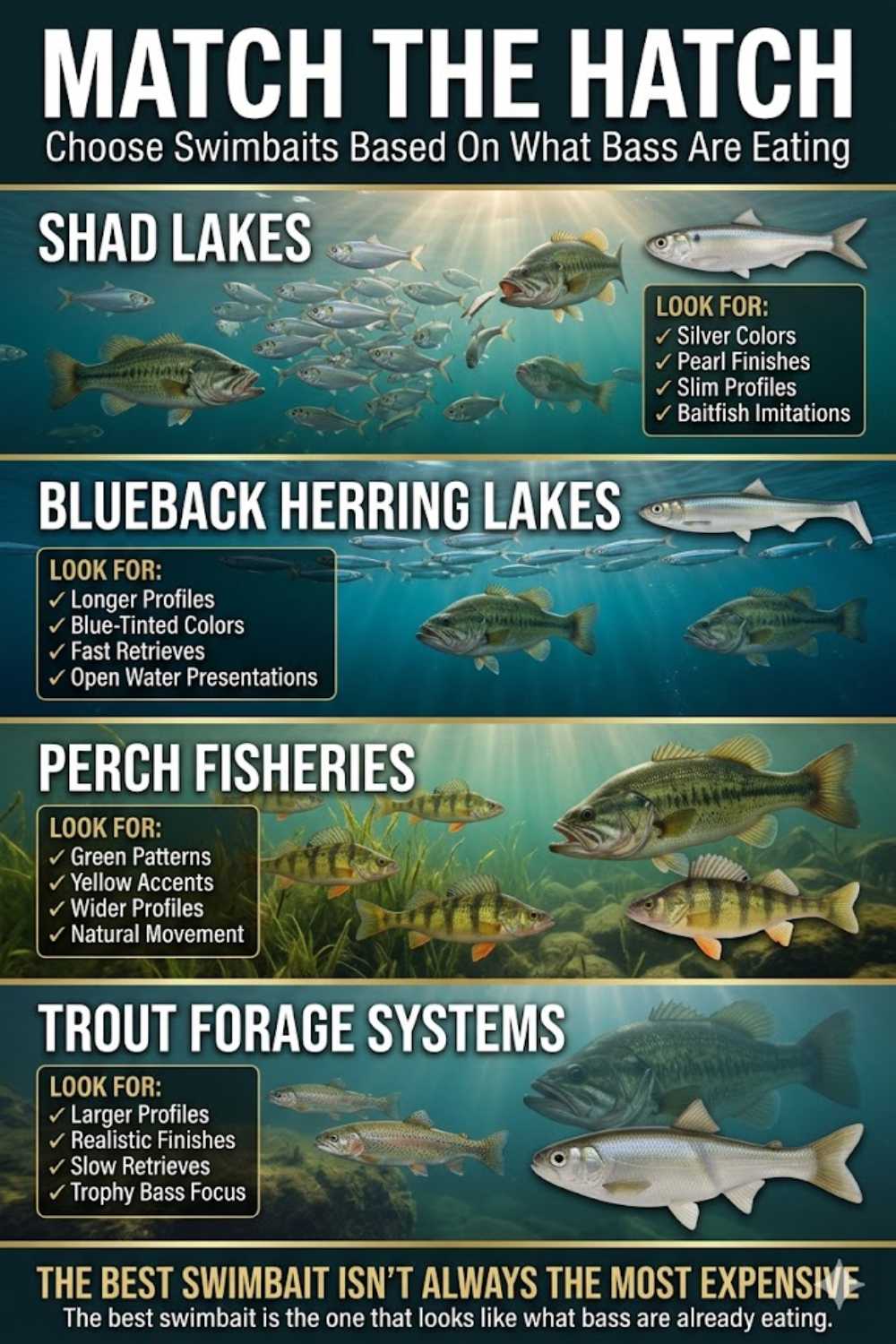
Swimbait selection breaks down into five decisions: forage, water clarity, season, fishing goals (numbers vs. size), and bass positioning. Get those right and the brand label on the package matters less than most anglers think.
Start with forage. Look at what bass already see every day. On lakes dominated by threadfin shad, 3.8"–4.8" paddle tails in pearl, ayu, and natural shad colors produce best — the bait should match the average adult shad profile. On lakes with gizzard shad, blueback herring, alewives, or stocked trout, step up to 5"–8" baits with longer, slimmer profiles. On northern fisheries with abundant perch, wider-bodied swimbaits in perch patterns excel. On bluegill-driven southern lakes, a 4"–5" bluegill-pattern paddle tail fished slowly around shallow flats during the bluegill spawn outproduces every shad pattern in the box. For a deeper dive into baitfish-driven bass behavior, study the patterns in our threadfin vs gizzard shad guide.
Water clarity drives the realism vs. visibility trade-off. In clear water (3+ ft visibility), realism is everything — translucent natural finishes, subtle action, and accurate baitfish profiles. In stained water (1–3 ft), step up size and contrast slightly so bass can locate the bait. In muddy water under 12 inches, swimbaits are not the highest-percentage tool — switch to a thumping bait like a Colorado-blade spinnerbait or a vibrating jig.
Season changes both retrieve and size. Winter favors slow presentations on underspins and small jigheads with 3.8" paddle tails — the goal is a barely-swimming bait that looks like a dying shad. Prespawn and the prespawn-to-spawn transition is one of the year's best windows for larger swimbaits because bass are loading up before bedding. Postspawn through summer rewards medium-to-large swimbaits around offshore bait schools, points, and ledges — see our summer bass fishing guide for positioning. Fall is the second-best big-swimbait window of the year as bass aggressively chase migrating shad through creek arms and on main-lake flats.
Numbers vs. size is a conscious choice. If you want a five-fish limit and consistent action, a 4.8" Keitech on a 3/8 oz weighted hook is the answer. If you want a personal-best bass, a 6"–8" Magdraft, Huddleston, or Bull Shad fished slowly through the right water is the answer.
Bass positioning closes the loop. Fish on shallow grass edges, secondary points, and laydowns favor weedless hidden-hook swimbaits like the Magdraft. Fish suspended over deeper open water or schooling on offshore humps respond to line-through designs and underspun paddle tails. Fish holding tight to deep structure want a slow-falling soft swimbait or a swim-jig-rigged paddle tail bumped along bottom. Match the bait's rigging style to where the fish are living and the rest of the selection process becomes substantially easier.
The Megabass Magdraft has become one of the most influential swimbaits ever introduced because it bridges the gap between traditional soft paddle tails and large-profile trophy swimbaits. The hidden top-mounted hook system, magnetic hook hold-down, realistic body roll, and ribbed soft body combine into a bait that swims like a healthy adult shad while remaining relatively weedless through grass and wood.
When to use it — The Magdraft excels whenever bass are actively feeding on adult-size baitfish: prespawn staging, postspawn recovery on secondary points, summer schooling on main-lake points and humps, and fall shad migrations through creek arms. The bait works on main-lake points, grass lines, secondary points, shallow flats, open-water bait schools, and offshore structure. Many anglers use the 6" Magdraft as a primary search bait for locating quality bass because it covers water efficiently while maintaining a substantial profile.
Why it works — Three design elements drive Magdraft performance. First, the body roll mimics a healthy baitfish swimming naturally. The roll generates flash without looking unnatural — the bait reads as food, not a lure. Second, the hidden top hook with magnetic hold-down keeps the bait clean through cover while delivering a clean hook-set when a fish commits. Bass strike swimbaits from behind and below; the top-mounted hook position improves landing percentage substantially. Third, the bait appeals to multiple feeding moods — aggressive fish chase it down, neutral fish commit because it resembles legitimate forage.
Water clarity — Best in clear to moderately stained water. In clear water run natural shad, herring, or ayu finishes. In stained water shift to a louder pearl-belly pattern with a touch of chartreuse for visibility without sacrificing realism.
Seasonal performance — Winter: fair (slow retrieve only). Prespawn: excellent. Spawn: good around staging fish. Summer: outstanding around offshore bait schools. Fall: excellent during shad migrations.
Forage matches — Gizzard shad, threadfin shad, blueback herring, alewives, juvenile trout, large perch.
Situational advantages — The Magdraft shines when an angler needs to cover water while still targeting above-average fish. It is particularly effective around main-lake points because bass use points as feeding stations during baitfish movements. For anglers wanting a swimbait capable of catching five-pound class fish while still producing consistent action, the Magdraft is one of the strongest choices in production.
The Keitech Swing Impact and Swing Impact FAT family has arguably caught more bass nationwide than any other swimbait on the market. Where the Magdraft and Huddleston are precision trophy tools, the Keitech is the high-efficiency fish-catcher that anglers reach for when they need bites. The 3.8" and 4.8" sizes cover most bass-fishing scenarios; the 5.8" steps up to a legitimate big-fish tool.
When to use it — The Keitech is effective virtually year-round. It can be rigged on jigheads, weighted swimbait hooks, underspins, swim jigs, Alabama rigs, drop shots, and even Carolina rigs. That versatility lets anglers match bass positioning across every depth range and seasonal pattern.
Why it works — The Keitech's defining feature is its tail. Even at extremely slow retrieve speeds the paddle tail generates a tight, natural kick — the bait stays alive on a dead-stick or a near-stopped retrieve, which is critical in cold water and on pressured fish. The soft-plastic body construction is the second advantage. Bass hold onto the bait longer than they hold onto harder swimbaits, giving anglers more time to detect the strike and improve hook-up percentages.
Water clarity — Performs in nearly every clarity scenario. Clear water favors translucent natural shad and pro-blue colors. Stained water rewards brighter pearl-belly patterns with chartreuse or pink tails.
Seasonal performance — Winter: excellent on underspins and small jigheads. Prespawn: excellent. Spawn: good. Summer: outstanding around offshore schools on points and humps. Fall: excellent during shad migrations and schooling activity. The bait is genuinely a 12-month tool.
Forage matches — Threadfin shad, juvenile gizzard shad, juvenile herring, smelt, alewives, juvenile sunfish.
Situational advantages — The Keitech shines when bite count matters. It is also the highest-percentage swimbait on suspended schools in open water; rigged on a 3/8 oz underspin and counted down to the school, it consistently produces multiple fish per school. Look for those schooling situations around the offshore humps that hold summer bass and during the fall shad migration.
The Huddleston Deluxe is the original West Coast trophy swimbait and arguably the most copied design in the category. Built specifically to match planted rainbow trout in California reservoirs, the Huddleston combines a slow-sinking soft body, a hand-poured profile, and a natural drop-and-glide action that has fooled some of the largest largemouth bass ever caught.
When to use it — The Huddleston is at its best on clear-water reservoirs with stocked trout, on deep-water bass holding around standing timber and bluff walls, and on giant largemouth that have refused every other presentation. The 6" ROF (rate of fall) models cover mid-column applications; the 8" baits target trophy fish exclusively. This is not a numbers bait.
Why it works — Bass in trout-stocked reservoirs key heavily on planted trout because the calories-per-meal ratio is unmatched in the system. The Huddleston's soft body, realistic profile, and slow descending action perfectly match a dying or stressed trout — the highest-value meal a giant bass can find.
Water clarity — Clear water only. Realism is the entire premise of the bait and any clarity below 2.5 ft of visibility eliminates the advantage.
Seasonal performance — Prespawn through postspawn (when stocked trout are most concentrated) is the prime Huddleston window on West Coast reservoirs. Summer thermocline fishing on standing timber is the second window. Winter slow-rolling on bluff walls produces some of the year's biggest fish.
Forage matches — Rainbow trout, brown trout, large gizzard shad, juvenile bass.
Situational advantages — The Huddleston is the trophy-bass specialist. On the right water — a clear, deep, trout-stocked reservoir — it remains one of the most reliable tools for catching a 10-pound class largemouth.
The Bull Shad is a hand-painted multi-section hard-bodied swimbait that delivers class-leading realism. Where soft swimbaits rely on body roll and tail kick, the Bull Shad relies on a precise side-to-side glide and an articulated body that mimics a swimming baitfish almost perfectly. Each bait is hand-built, which is reflected in the price and the limited availability.
When to use it — The Bull Shad is at its best on suspended bass in clear water, around standing timber, isolated brush piles, and bluff walls. It excels on pressured fisheries where bass have seen every soft swimbait and refused them. The slow, methodical retrieve required for the bait often produces the year's biggest bites from fish that ignore faster-moving presentations.
Why it works — Three design elements separate the Bull Shad from cheaper hard-bodied swimbaits. First, the articulated joint produces a side-to-side glide that mimics a healthy baitfish swimming naturally. Second, the hand-painted finishes capture color details — gill plate red, lateral-line shimmer, scale-pattern reflectivity — that mass-produced baits cannot match. Third, the balanced weighting allows the bait to suspend mid-column on the pause, which is when most trophy strikes occur.
Water clarity — Clear to lightly stained only. In dirtier water, the realism advantage disappears.
Seasonal performance — Prespawn through postspawn is prime time. Summer suspended-fish patterns are excellent. Fall around standing timber and creek mouths is a third strong window.
Forage matches — Gizzard shad, threadfin shad, herring, juvenile bass.
Situational advantages — The Bull Shad shines when bass have refused every reaction bait and every soft swimbait. The slow, deliberate glide gives mature fish time to inspect and commit to a bait that looks unmistakably like food.
Line-through swimbaits (Spro BBZ-1 Line Thru, Savage Gear Line Thru Trout, Storm WildEye Line Thru) feature a design in which the fishing line passes through the body of the bait rather than tying directly to a fixed hook. On the strike, the bait body slides up the line, eliminating the leverage bass use to throw a conventional hard-bodied swimbait. The result is a substantial improvement in hook-up and landing percentages on schooling fish and pressured trophies.
When to use it — Line-through baits excel during the summer schooling window when bass are pinning baitfish on points, humps, and offshore structure, and during the fall shad migration when fish are aggressively chasing forage. They are also the go-to choice on heavily pressured trout-stocked reservoirs where bass have seen every conventional swimbait and become hook-shy.
Why it works — Hard-bodied swimbaits give bass leverage to throw the lure on the head shake — the rigid body, treble hooks, and concentrated weight all work against the angler during the fight. The line-through design solves this by allowing the bait body to slide free of the hook after the strike. Once the bait slides, the bass is fighting only the small, lightweight treble hook on a free length of leader.
Water clarity — Best in clear to moderately stained water.
Seasonal performance — Summer (schooling fish): outstanding. Fall (shad migration): excellent. Prespawn (suspended fish around bluff walls): good.
Forage matches — Gizzard shad, threadfin shad, blueback herring, stocked rainbow and brown trout, alewives.
Situational advantages — Line-through baits earn their keep when hook-up percentage matters most: tournament fishing, trophy hunting on pressured water, and any time you find a school of feeding bass on a point or hump and need every bite to land. Pair them with a quality fluorocarbon leader and inspect the line through the body for nicks after every fish. Open-water schooling situations like those described in our summer thermocline guide are exactly the windows that reward this design.
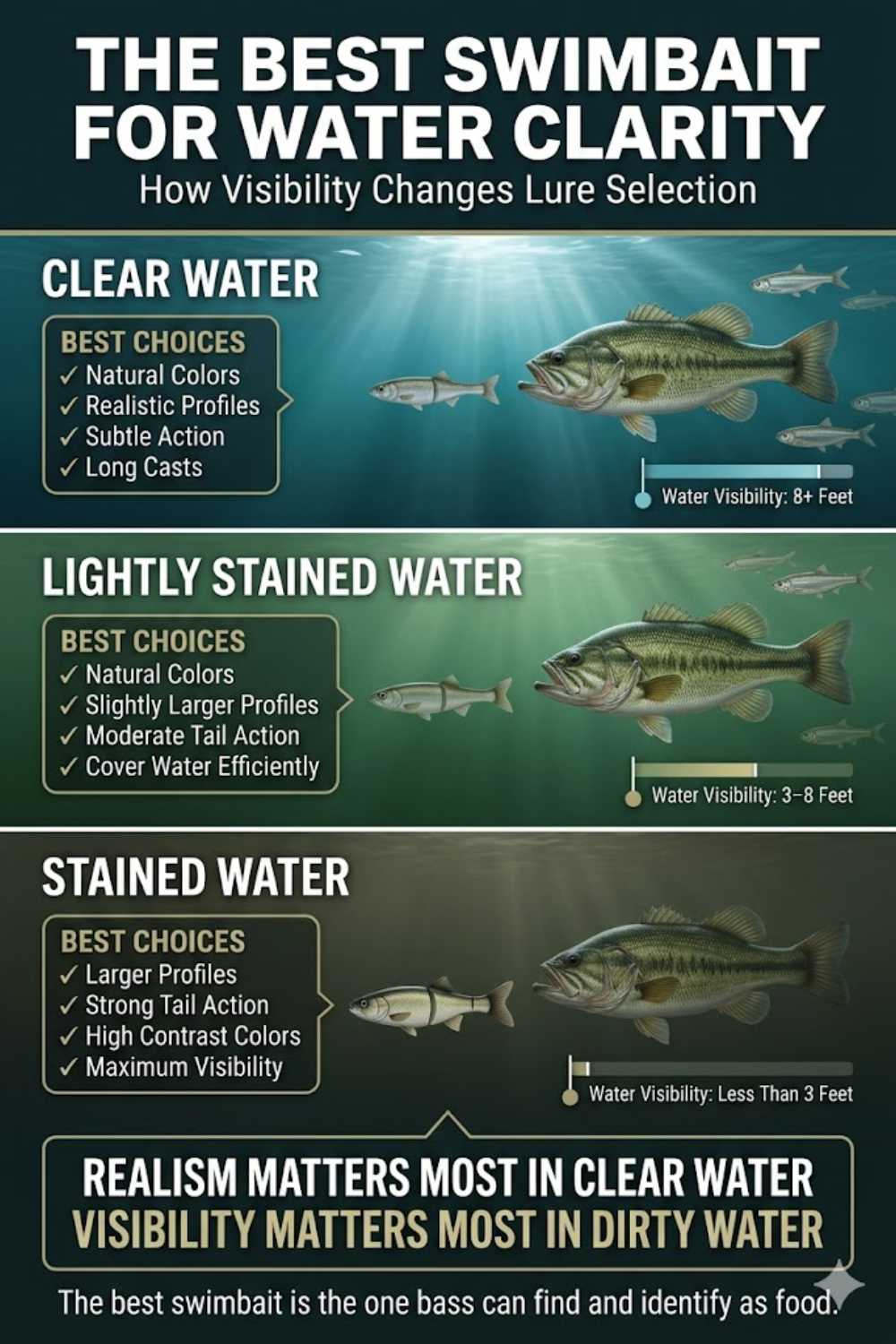
Water clarity drives swimbait color selection more than any other variable. Match clarity first, then refine for forage and light level.
Clear water (3+ ft visibility) — Translucent natural finishes. Sexy Shad, Pro Blue Red Pearl, French Pearl, Ayu, Ghost Minnow, and natural Threadfin. The goal is a bait that disappears into the water column and lets the realism of the action do the work. Bright colors and high-contrast patterns get inspected and rejected in clear water.
Lightly stained water (2–3 ft visibility) — Step up to slightly louder shad patterns with a pearl belly and a touch of chartreuse, white, or pink in the tail. Tennessee Shad and Pearl Chartreuse are reliable.
Stained water (1–2 ft visibility) — Bigger profile, more contrast. Chartreuse Shad, Pearl Pepper, and Blue/White produce.
Muddy water (under 12 inches) — Swimbaits are not the highest-percentage tool, but if you fish them, run dark profiles. Black or Black/Blue baits silhouette best against the dim ambient light in muddy water. Pair with a Colorado underspin to add thump.
Bluegill-flat presentations — On bluegill spawning flats from late May through July, a 4"–5" Bluegill-pattern paddle tail with green-pumpkin and orange accents outproduces every shad pattern in the box. Bass are keyed on the exact color of the forage they are eating.
Trout-stocked reservoirs — A Rainbow Trout or Brown Trout pattern in 6"–10" sizes is the only color that matters when targeting trophy bass on planted-trout fisheries.
Light level also matters. On bluebird-sky high-pressure days, drop a half-shade more natural and slow the retrieve. On overcast days and during low-light feeding windows, you can push contrast slightly without spooking fish.
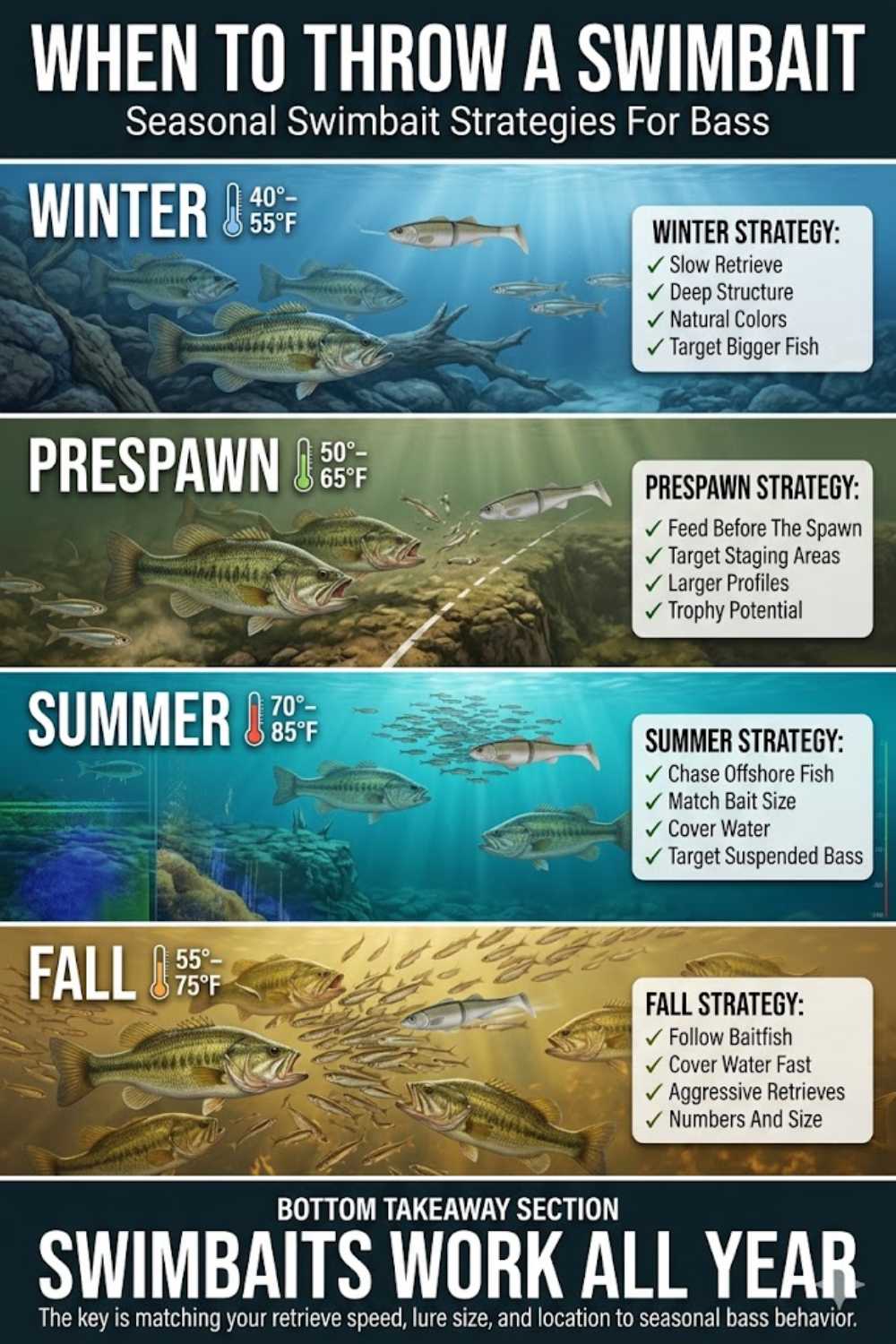
Each season rewards a different swimbait, rigging style, and retrieve. Match the season correctly and the bait works at a much higher percentage.
Winter (water under 50°F) — Slow is everything. The most productive winter swimbait is a 3.8" or 4.8" Keitech on a small underspin (1/4 oz to 3/8 oz) or jighead, counted down to the depth of the bass and slow-rolled barely fast enough to keep the paddle kicking. Target bluff walls, channel swings, and deep main-lake points where bass suspend over cold-water shad.
Prespawn (50–60°F) — One of the year's two best swimbait windows. Bass are loading up before bedding and respond aggressively to larger profiles. Mid-size Magdrafts, 4.8" Keitech FATs, and soft trophy swimbaits all produce. Focus on staging areas: secondary points, creek-channel swings, and the first deep break adjacent to known spawning flats.
Spawn (60–68°F) — Larger females cruise shallow water and many ignore aggressive presentations. A slow-falling Keitech FAT on a weighted hook or a small soft swimbait dragged past cruising fish often draws strikes when other lures fail.
Postspawn (68–75°F) — Bass recover on secondary points and the first deep break. The 6" Magdraft and 4.8" Keitech on weighted hooks both produce.
Summer (75–85°F) — The prime offshore swimbait window. Schooling bass on main-lake points, humps, and ledges crush swimbaits, line-through baits, and underspun paddle tails. See our summer bass fishing guide for additional positioning details.
Fall (back through 75–55°F) — The second prime swimbait window. Migrating shad pull bass into creek arms, on main-lake flats, and across points. The 6" Magdraft waked just below the surface during the fall shad migration produces extraordinary numbers and average fish size.
Five mistakes separate frustrated swimbait anglers from confident ones.
Underpowered tackle — A 4.8" Keitech on a medium-action 6'10" rod looks reasonable on paper and fails on the water. Casting accuracy suffers, the rod cannot drive a heavy single hook through a jaw, and bigger fish bend lighter hooks. Match the rod to the bait: medium-heavy 7'2" for 4" baits, heavy 7'6" for 5"–6" baits, extra-heavy 7'10"+ for 6"–8" baits.
Wrong retrieve speed — Most swimbait failures come from reeling too fast. Bass need time to evaluate and commit to a bait that looks like real food. Slow the retrieve until the bait barely swims, then slow it more.
Wrong color for clarity — Bright chartreuse in gin-clear water and translucent ayu in muddy water both fail. Match color to clarity first, then refine for forage.
Quitting too early — Swimbaits are a low-bite-count, high-quality presentation. Anglers expecting a finesse-rig bite count abandon swimbaits after two hours of slow fishing and miss the trophy bite that often comes mid-afternoon. Commit to a full day of swimbait fishing on the right water.
Ignoring the pause — Especially on hard-bodied glide baits and the Magdraft, most strikes happen on the pause when the bait suspends or glides naturally. Anglers who never give the bait slack miss the majority of trophy bites.
Best-in-class paddle-tail action for any swimbait rig.
Imitate shad — steady retrieve over points, flats, and drops.
As an Amazon Associate I earn from qualifying purchases.
Temperature-by-temperature lure logic.
The prespawn temperature threshold.
Natural presentations and finesse profiles.
Vibration, dark silhouette, and visibility tactics.
Adjusting across the full clarity spectrum.
Topwater and reaction baits for the dawn window.
Plug in today's water temp, clarity, weather, and forage — the tool returns the highest-confidence presentations.
Build Today's Strategy →