Editor's Pick97%
Z-Man JackHammer ChatterBait
Green Pumpkin
View Product →In under 12 inches of visibility, throw a 1/2 oz black-and-blue chatterbait, a double-Colorado spinnerbait, or a black/blue jig in 2-6 ft of shallow cover. Exact baits, colors, and locations.
Affiliate Disclosure: As an Amazon Associate I earn from qualifying purchases. Recommendations reflect on-the-water testing and the LureLogic ranking engine — not paid placement.
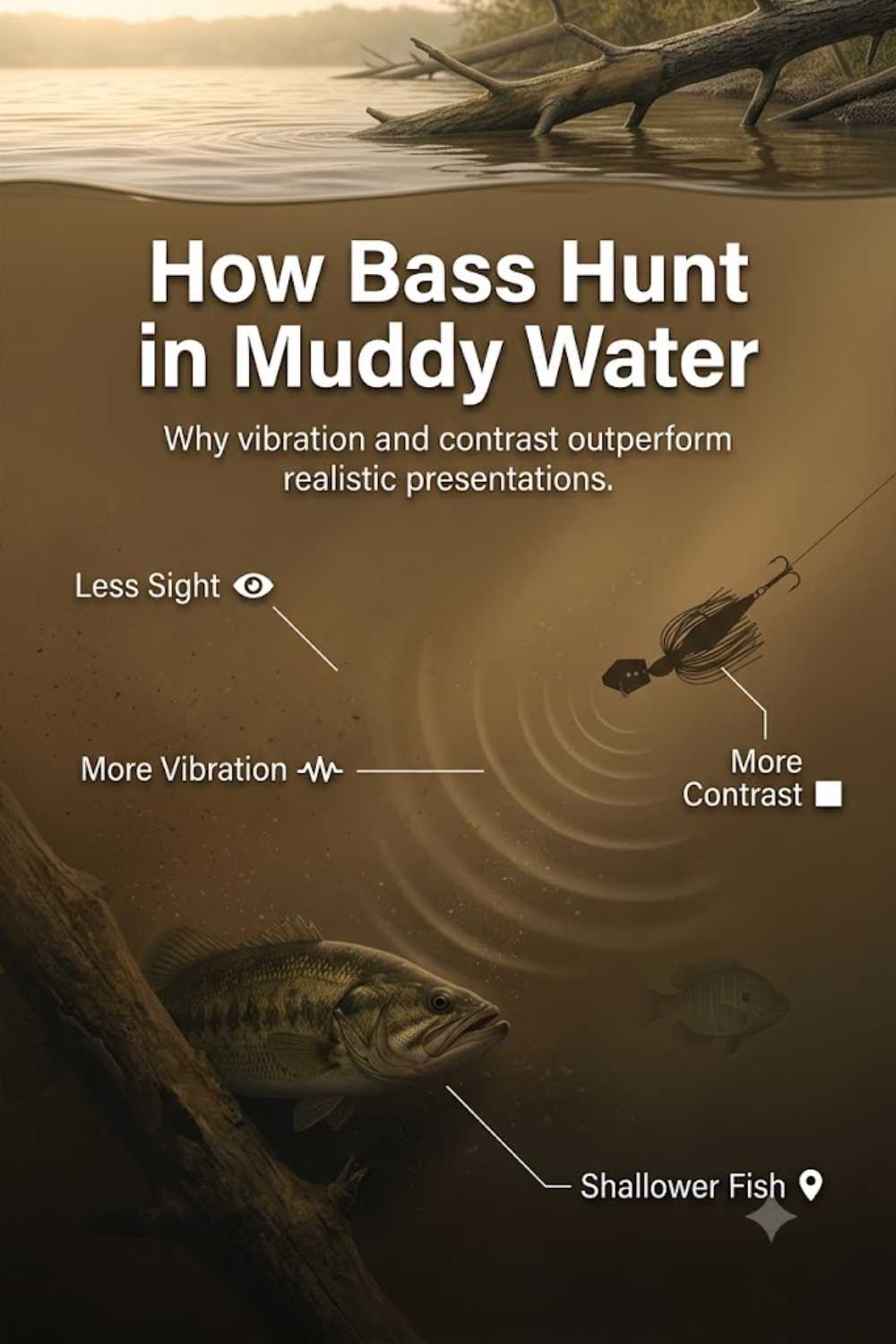
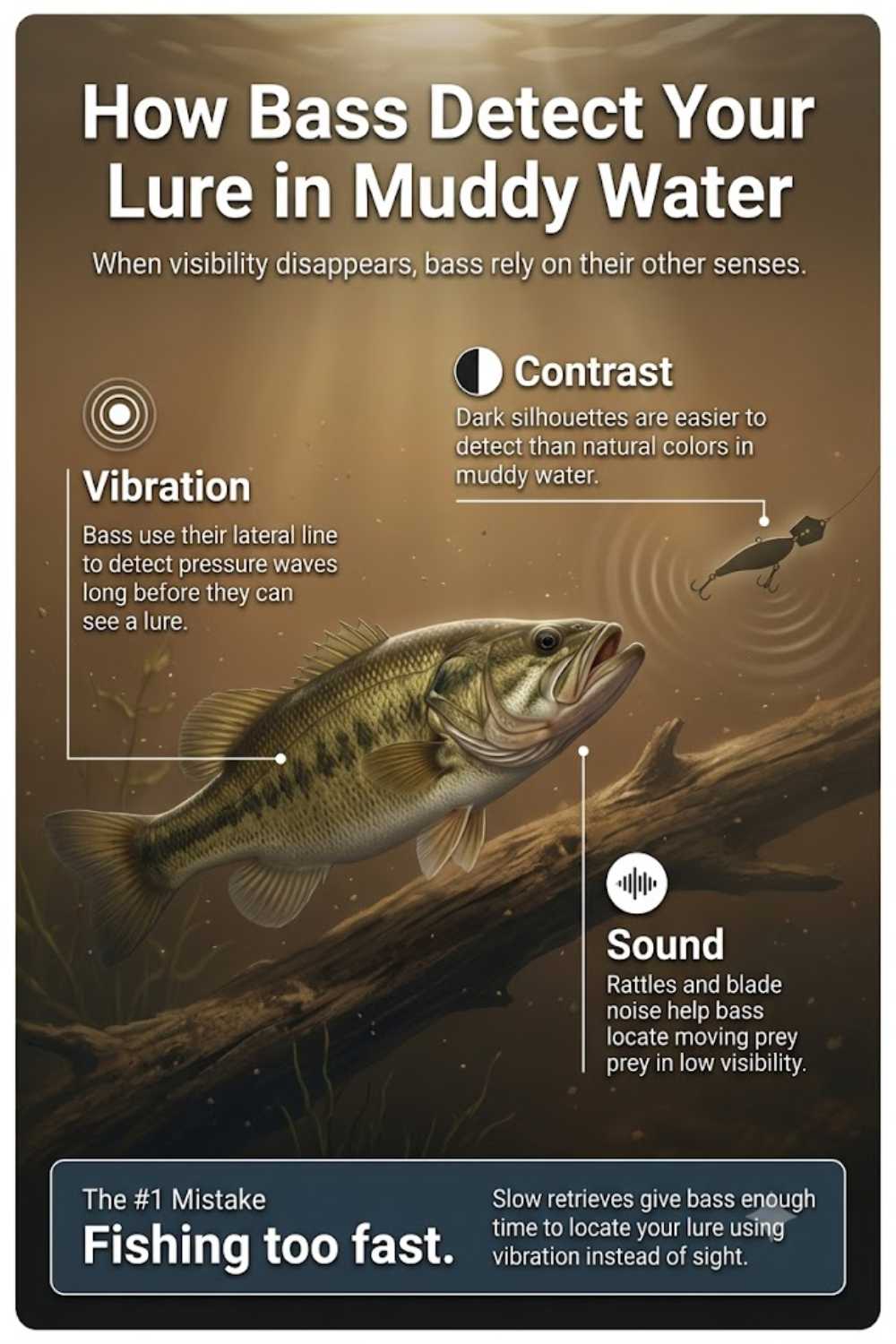
Muddy water — visibility under 12 inches — fundamentally changes how bass locate and commit to prey. The visual system is largely unusable, so bass rely on the lateral line (vibration and pressure-wave detection) and to a lesser extent scent. This shifts the lure decision away from realistic profiles and natural colors and toward hard vibration, high-contrast silhouettes, and slow presentations that give the lateral line time to lock on.
Muddy water also concentrates bass spatially. Light penetration drops, so the productive water column shrinks to the upper 2–6 ft on most lakes. Bass that would scatter across multiple depths in clear water stack against shallow cover (wood, rock, grass) in muddy water. This is good news for the angler — the productive zones are smaller and more obvious, and bass are pushed toward cover that's easy to find and fish.
The muddy-water lure shortlist is small but lethal: hard-thumping bladed jigs (chatterbaits), Colorado-blade spinnerbaits, lipless crankbaits, squarebill crankbaits with rattles, and dark flipping jigs with bulky trailers. Quiet finesse presentations (drop shots, ned rigs, jerkbaits) lose most of their effectiveness in muddy water because they don't produce enough sensory output to be located. For the broader framework, see water clarity lure selection.
The muddy-water bite is also generally aggressive when you find fish. Bass committed to a strike in muddy water rarely refuse — the same fish that inspects a bait for 5 seconds in clear water commits in 0.5 seconds in muddy water. This means catches per opportunity are often higher in muddy water than in clear water, despite the lower-frequency opportunities.
Z-Man JackHammer ChatterBait — Editor's Pick. A 1/2 oz black-and-blue or junebug JackHammer with a black-and-blue Keitech FAT trailer is the most productive muddy-water bait. The blade vibration is the loudest in the chatterbait category, the dark profile silhouettes against any background, and the bait covers water efficiently. See the chatterbaits guide.
War Eagle Spinnerbait (Double Colorado) — Best Vibration. A 1/2 or 3/4 oz double-Colorado-blade spinnerbait in black-and-blue or black-and-chartreuse pushes more water than any other category. Slow-rolled along shallow cover, it produces in water visibility under 6 inches. See the spinnerbaits guide.
Dirty Jigs Compact Pitchin' Jig — Best Heavy Cover. A 1/2 or 3/4 oz black-and-blue flipping jig with a bulky craw trailer (Yamamoto Flappin' Hog, NetBait Paca Craw) pitched into shallow wood and grass produces the biggest muddy-water bass. The bulky trailer adds water displacement and gives bass a larger target. See the flipping jigs guide.
Rapala Rippin' Rap — Best Lipless Reaction. A 1/2 oz red-craw or black-and-chartreuse lipless crankbait with internal rattles produces along shallow grass edges and over hard-bottom flats. Yo-yo retrieve. See the lipless crankbaits guide.
Strike King KVD 1.5 Squarebill — Best Cover Deflection. A 1.5 squarebill in chartreuse-with-black-back or sexy craw ticked through shallow wood and rock produces deflection-triggered reaction strikes. See the squarebill crankbaits guide.
Dirty Jigs Swim Jig — Best Grass Search. A 3/8 or 1/2 oz black-and-blue swim jig with a paddle-tail trailer through shallow grass edges produces muddy-water bass that won't commit to faster baits. See the swim jigs guide.
Generally avoid: drop shots, ned rigs, jerkbaits, finesse worms, and small natural-color baits in true muddy water. These categories produce in clearer water but lack the sensory output to be located in under 12 inches of visibility.
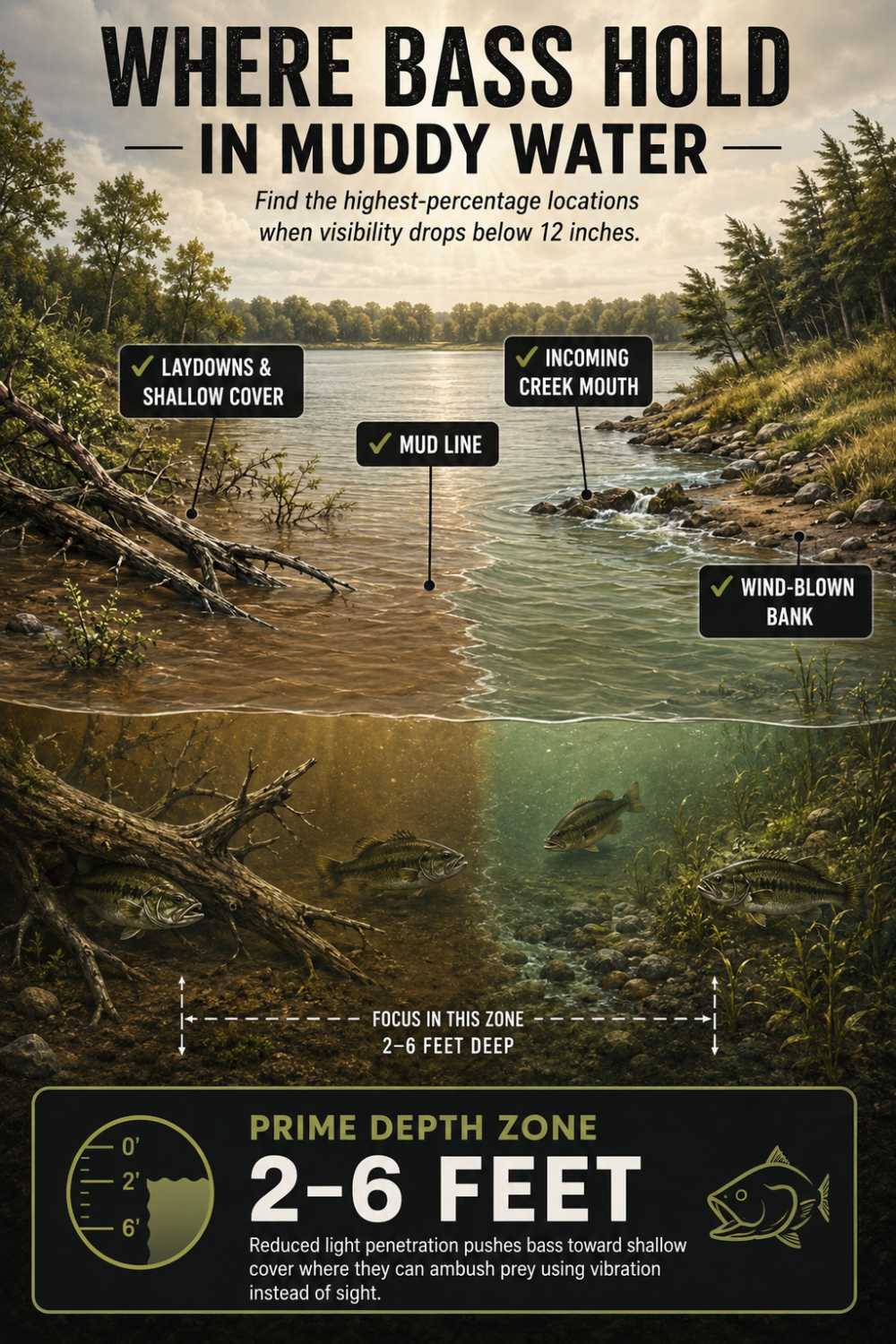
Four high-percentage muddy-water positioning patterns.
Shallow cover — Bass pushed shallow by reduced light penetration stack against the first available shallow cover: laydowns, brush piles, dock pilings, grass edges, rock piles. The 2–6 ft depth range holds most muddy-water fish. Bass fishing laydowns covers the wood cover pattern.
Mud lines — Where muddy and clearer water meet (typically at creek mouths after rain, or where wind creates a turbidity boundary), bass stack on the clearer side and ambush bait crossing the boundary. The mud line is the single highest-percentage piece of structure in a muddy-water lake. See bass fishing after heavy rain.
Incoming creek mouths — Creeks delivering fresh water (cooler, more oxygenated, with food washed in) concentrate bass at the mouth. Particularly productive 24–72 hours after a rain event.
Windblown banks — Wind concentrates bait and feeding bass on the windblown side of points and banks even in muddy water. The combination of wind plus shallow cover plus mud is the muddy-water sweet spot. See wind-blown banks bass positioning.
Water temperature still matters within muddy water. In cold muddy water (under 50°F), slow down dramatically and focus on the warmest available water (sun-baked flats in afternoon). In warm muddy water (over 75°F), focus on the deepest available cover with shade and the most-oxygenated water (current, wind). For temperature overlays see 50°F water guide and 70°F water guide.
Color selection in muddy water is opposite to clear-water intuition. Dark, high-contrast colors outproduce bright colors because contrast matters more than brightness when light penetration is limited.
First choice: black and blue. The dark silhouette is detectable against any background, the blue accent provides contrast under what light does penetrate, and the combination works across season, temperature, and cover type.
Second choice: junebug (dark purple-and-green). Slightly more subtle than black-and-blue but produces when fish refuse the more aggressive color.
Third choice: black-and-chartreuse. The chartreuse accent provides the highest-contrast color signal available. Particularly effective with spinnerbaits and chatterbaits.
Fourth choice: red craw. A red-craw lipless crankbait or squarebill provides contrast and matches a high-percentage forage. Particularly effective in red-stained muddy water (common in southern reservoirs).
Sound and vibration tuning — Rattles in squarebills, internal rattles in lipless crankbaits, double-Colorado blade configurations on spinnerbaits, and heavy-hardware chatterbaits all increase sensory output. The general rule: more vibration, more sound, more contrast in muddier water.
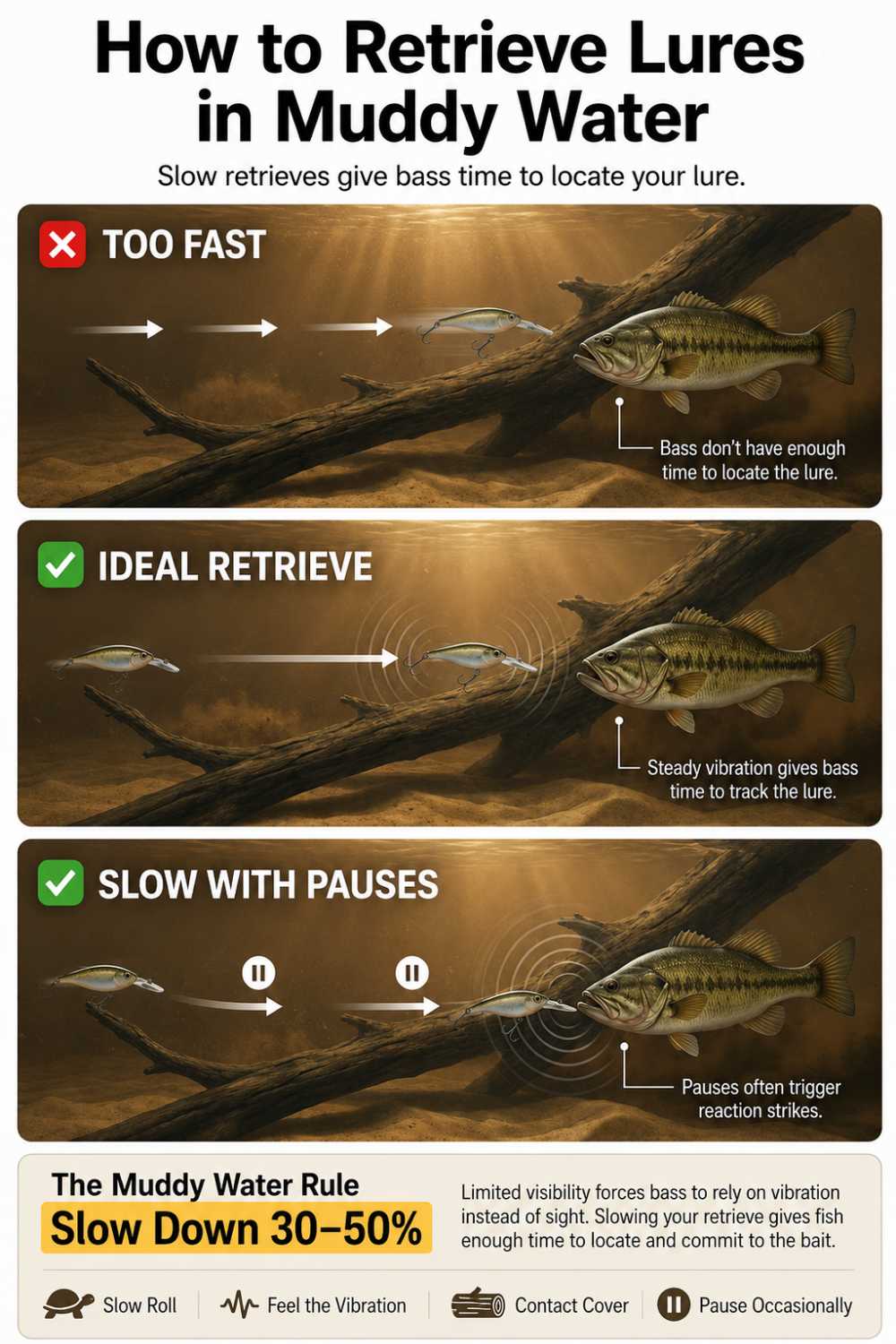
Retrieve speed — Slow down 30–50% from clear-water retrieves. Bass need extra time to locate the bait via the lateral line. A chatterbait that you'd burn through grass in clear water gets slow-rolled in muddy water. A spinnerbait gets slow-rolled with periodic pauses to let the bait sink and re-trigger.
Muddy water interacts with weather and season.
Muddy water + cold front — The standard cold-front shutdown is dampened in muddy water because bass aren't visually inspecting baits anyway. A cold-front muddy-water day often produces better than a cold-front clear-water day. See cold-front lure guide.
Muddy water + high pressure — Similar effect. The bright sun and high pressure that suppress clear-water bass have less impact in muddy water because the visual feeding mode is already disabled. See high-pressure lure guide.
Muddy water + spawn — Bedded bass in muddy water are harder to sight-fish (visibility is too low) but easier to catch by blind-casting reaction baits across spawning flats. A chatterbait or spinnerbait covered across spawning flats produces aggressive cruising males.
Muddy water + winter — Cold muddy water is the toughest combination. Bass metabolism is suppressed by cold, and the muddy water further reduces feeding opportunities. Focus on the warmest available water (afternoon sun-baked banks, current-influenced areas) and slow down dramatically. See winter bass fishing lures.
Muddy water + falling water — Concentrating effect. As water drops, bass push deeper into the remaining shallow cover and stack on whatever shallow structure remains submerged. A flipping jig in the densest remaining shallow cover produces.
Muddy water + rising water — Dispersing effect. As water rises and floods new shallow cover, bass spread out to take advantage. A chatterbait or spinnerbait covering newly flooded cover produces. See rising water bass fishing.
Muddy water rewards a short shortlist of high-vibration, high-contrast, slow-retrieve presentations focused on shallow cover. Black-and-blue chatterbaits, double-Colorado-blade spinnerbaits, and black-and-blue flipping jigs cover 80% of muddy-water situations. Find the shallowest cover with the most water displacement, slow your retrieves, and the muddy-water bite is often more aggressive per opportunity than the clear-water bite.
For the slightly clearer transition water, see best bass lures for stained water. For the opposite end of the clarity spectrum, see best bass lures for clear water. For the full clarity framework, see water clarity lure selection.
The benchmark bladed jig — premium hardware and perfect vibration.
Stained water, wind, scattered grass — moderate-paced reaction bait.
As an Amazon Associate I earn from qualifying purchases.
Temperature-by-temperature lure logic.
The prespawn temperature threshold.
Natural presentations and finesse profiles.
Vibration, dark silhouette, and visibility tactics.
Adjusting across the full clarity spectrum.
Topwater and reaction baits for the dawn window.
Plug in today's water temp, clarity, weather, and forage — the tool returns the highest-confidence presentations.
Build Today's Strategy →