Editor's Pick97%
Z-Man JackHammer ChatterBait
Green Pumpkin
View Product →The best bass lures for 55°F water — the prespawn metabolism switch. Jerkbaits, chatterbaits, lipless cranks, and how to fish the most aggressive cold-water window of the year.
Affiliate Disclosure: As an Amazon Associate I earn from qualifying purchases. Recommendations reflect on-the-water testing and the LureLogic ranking engine — not paid placement.
55°F is the temperature at which everything changes. Below 55°F, bass are still in cold-water mode — slow metabolism, narrow feeding windows, and a preference for vertical and slow presentations. At 55°F, the metabolism switch flips. Bass move from deep winter holding into prespawn staging areas, begin chasing moving baits 4–6 ft, commit on shorter pauses, and feed throughout the day rather than only in midday windows. The lure box that was right for 50°F is wrong for 55°F.
The metabolic shift is biological. At 50°F, a bass burns roughly 30% more energy than at 45°F but still well below the energy budget of 60°F water. At 55°F, the energy budget doubles compared to 45°F, and the bass actively needs to feed to replace the spawning energy reserves being built up. This is why the 55°F window is one of the most productive of the entire year — bass are actively feeding, moving into accessible shallow-to-mid-depth areas, and not yet locked onto bedding behavior.
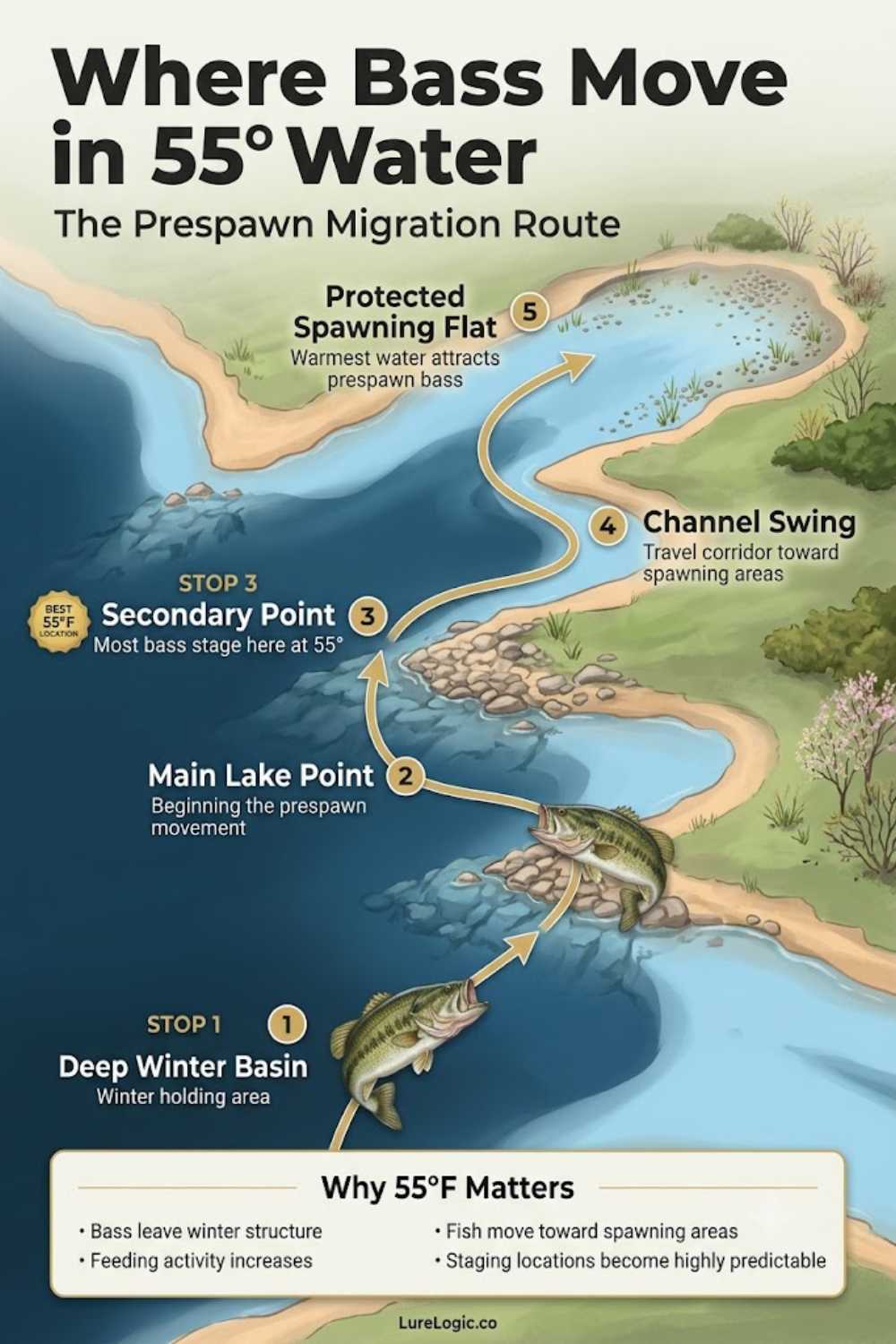
The prespawn migration runs roughly: deep winter holding → main-lake points → secondary points inside creek arms → channel-swing banks → flats inside spawning bays. The 55°F window typically catches bass in the middle of this migration, somewhere between secondary points and the first staging flats. Pick the area type based on how warm the water has been for how long.
The weather pattern matters too. A 55°F day during the third day of a warming trend produces aggressive bites across the full day. A 55°F day after a cold front (water was 60°F three days ago, dropped to 55°F today) produces more like 50°F water — bass slide back toward staging structure and shorten the strike window. Cold front bass fishing lures covers the post-front adjustment.
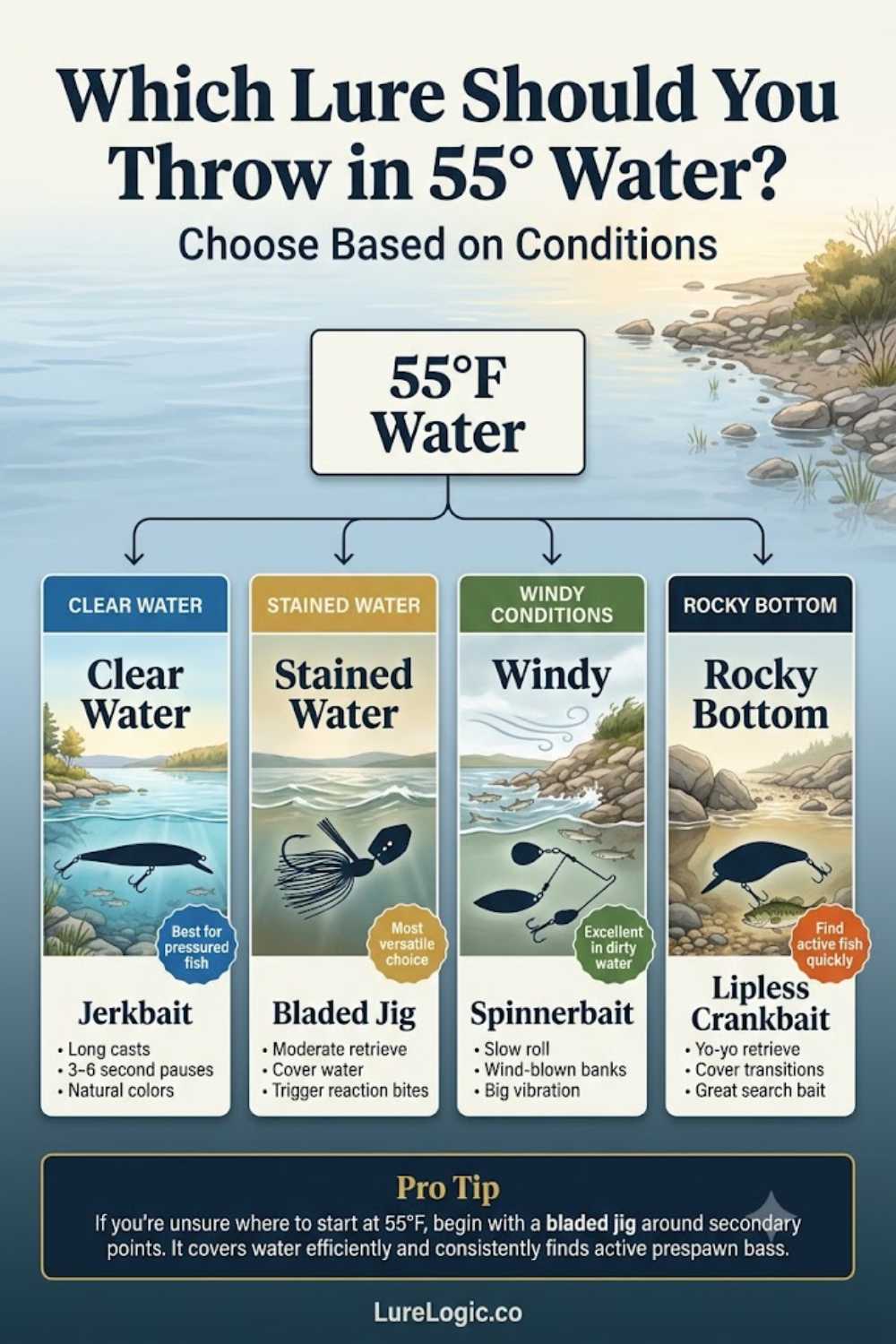
Z-Man JackHammer ChatterBait — Editor's Pick. The JackHammer is the most productive 55°F lure ever made. The tight vibration profile matches cold-water metabolism perfectly, the baitfish silhouette mimics threadfin shad and herring, and the rate of water coverage finds prespawn bass scattered across staging areas. A 3/8 oz JackHammer in sexy shad with a Keitech FAT 3.8 trailer is the universal 55°F starting point. The best chatterbaits guide covers the full chatterbait playbook.
Megabass Vision 110 — Best Reaction Bait. A premium suspending jerkbait remains a primary 55°F producer, particularly in clear water and on highly-pressured fish. Cadence: jerk-jerk-pause with 3–6 second pauses (much shorter than 50°F). See the jerkbaits guide.
Bill Lewis Rat-L-Trap or Strike King Red Eye Shad — Best Search Bait. A 1/2 oz lipless crankbait yo-yoed across rocky transitions, staging flats, and channel-swing banks produces aggressive prespawn fish. The rattle profile reaches bass that vibration-only baits miss. Particularly effective on overcast 55°F days. See the best lipless crankbaits guide.
War Eagle Spinnerbait — Slow-Rolled Classic. A 1/2 oz double-Colorado-blade spinnerbait slow-rolled across staging structure (especially in stained water) produces some of the year's biggest prespawn fish. The slower retrieve and wider thump match cold-water metabolism better than fast spinnerbait presentations. See the best spinnerbaits guide.
Dirty Jigs Compact Pitchin' Jig — Cover-Specific Producer. For pitching into prespawn cover (laydowns on staging banks, brush piles on secondary points), a 3/8 oz black/blue or brown/orange jig with a craw trailer produces. Slow drag presentation with 5–10 second pauses. See the flipping jigs guide.
Strike King KVD 1.5 Squarebill — Shallow Cover. A 1.5 squarebill bumped across rocky banks, riprap, and shallow chunk-rock produces in the warmer end of the 55°F range. See the squarebill guide.
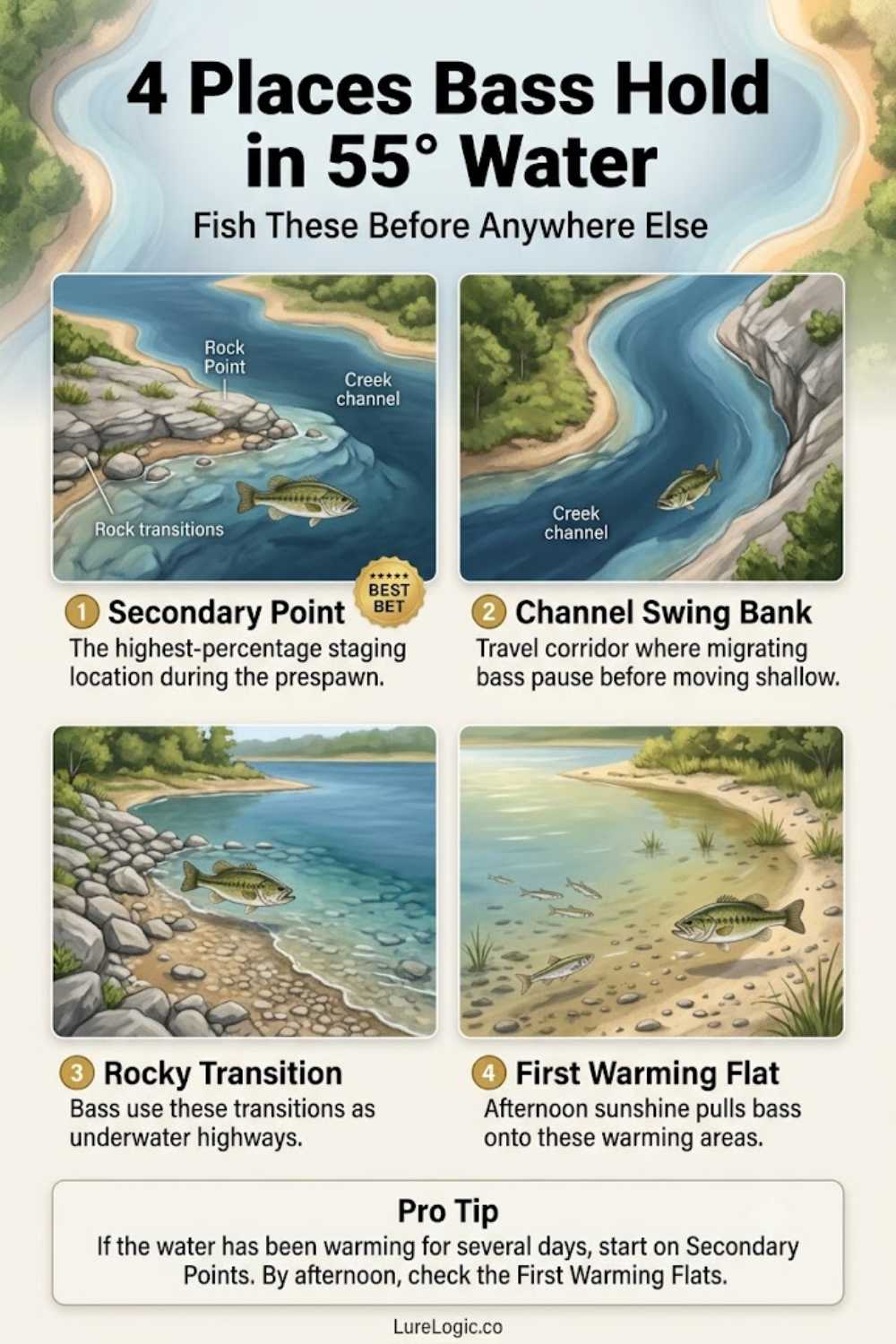
Four primary 55°F positioning patterns.
Secondary points inside major creek arms — The dominant 55°F holding area. Bass migrate from main-lake winter structure into the major creek arms in spring; secondary points (the points inside creek arms, not the main-lake creek mouths) hold staging fish in 6–12 ft. Both chatterbaits worked across the points and jerkbaits worked on the deeper edges produce.
Channel-swing banks — Where a creek channel makes a sharp turn against a hard-bottom bank in a creek arm. These swings concentrate prespawn bass on the deeper side of the swing (typically 8–15 ft). A lipless crankbait yo-yoed across the swing or a slow-rolled spinnerbait produces.
Rocky-to-gravel transitions — The 'spawning highway' where chunk-rock or larger gravel transitions to pea gravel or hard sand. Bass use these transitions as a directional corridor moving from deep winter holding to shallow spawning flats. A chatterbait swam parallel to the transition zone or a squarebill bumped along it produces. Bass fishing transition banks covers the pattern.
First-warming flats inside protected pockets — The shallowest 55°F holding area. Bass push onto these flats during midday warming windows on sunny days. A squarebill or shallow lipless crankbait worked across the flat produces. These bass are aggressive and the bite is fast — work areas quickly and move when production drops.
Reading conditions — Sunny days favor the warming-flat pattern; overcast days favor the secondary-point and channel-swing patterns. Wind concentrates bass on windblown banks of the staging areas — wind-blown rocky banks during 55°F warming trends are some of the most productive of the year. Wind and bass positioning covers the wind pattern.
55°F presentations are slower than warm-water cadences but substantially faster than 50°F cadences.
Chatterbait — Steady moderate retrieve with occasional rod-tip pops every 4–6 cranks. The pops trigger reaction strikes from following fish. Make casts parallel to staging banks and across the deeper edges of staging flats. Most bites happen on the pop-and-recover transition.
Jerkbait — Jerk-jerk-pause with 3–6 second pauses (substantially shorter than the 8–15 second pauses required at 50°F). The bait should still suspend perfectly horizontal on the pause — tune with suspend strips if necessary. Most bites happen during the pause or on the first jerk after the pause.
Lipless crankbait — Yo-yo presentation. Cast across deep staging structure, let the bait fall to bottom on slack line, lift sharply to swim the bait 3–4 ft, then let it fall back. Repeat. The fall is the bite trigger. A steady slow-burning retrieve also produces but the yo-yo trigger is more reliable in 55°F water.
Spinnerbait — Slow-rolled across staging structure. Use a 1/2 oz double-Colorado-blade for the slowest retrieve and biggest vibration profile. Keep the bait 6–12 inches above the structure on a slow steady retrieve.
Squarebill — Standard cast-and-retrieve with deflection-triggered strikes around rocky cover. Speed up slightly compared to mid-summer retrieves — the warmer end of the 55°F range supports a moderate retrieve speed and the deflection triggers excite aggressive prespawn fish.
Jig — Drag and pause with 5–10 second pauses (faster than 50°F's 15–30 second pauses). A 55°F jig fish is willing to commit on shorter pauses as the metabolism switch activates.
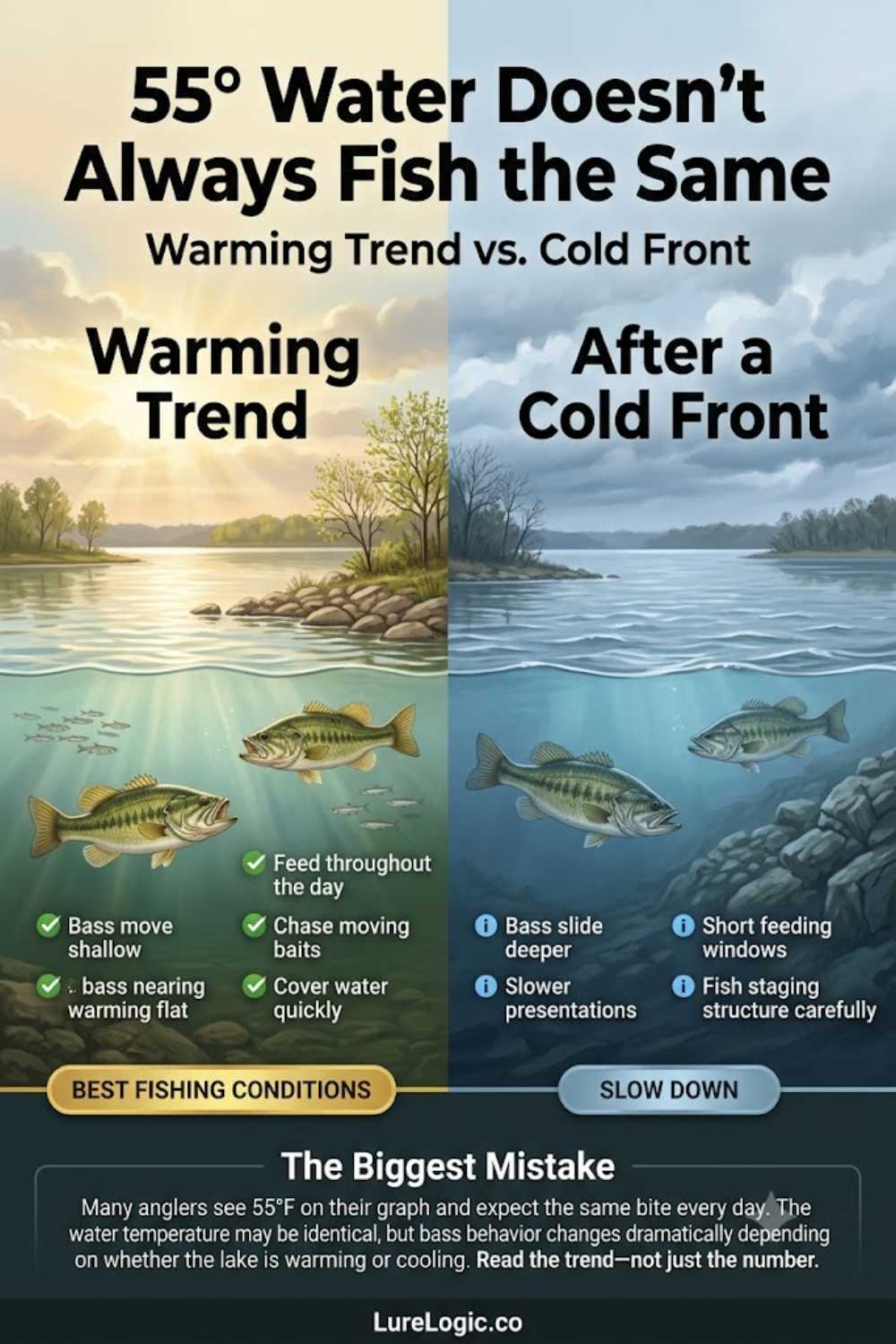
Best 55°F conditions — Sunny days with stable barometric pressure, water on a warming trend, light to moderate wind, and at least 5 ft of visibility (clear to lightly stained). These conditions concentrate prespawn bass on staging structure and trigger active feeding throughout the day. The 55°F productive window typically opens around 10 AM as solar warming begins, peaks from 12 PM to 4 PM, and slows after 5 PM.
Good 55°F conditions — Lightly overcast days with stable pressure, water holding steady at 55°F for 3+ days, and moderate wind. Production is slightly lower than ideal conditions but the window extends across most of the day rather than concentrating in the midday warming window.
Difficult 55°F conditions — Post-cold-front days where water dropped from 60°F to 55°F over 24–48 hours. Bass slide back toward staging structure and the bite shortens dramatically. Switch to slower presentations (jerkbait with longer pauses, jig with longer pauses, Ned rig) and concentrate effort on the deepest staging structure rather than warming flats. Cold front bass fishing lures covers the post-front pattern in depth.
Wind — A 5–15 mph wind on a 55°F warming day is ideal — it pushes warmer surface water into protected pockets and concentrates baitfish on wind-blown banks. Wind-blown rocky banks during the 55°F window are some of the highest-percentage bass-fishing areas of the year.
Water clarity adjustments — Clear water (5+ ft visibility) favors jerkbaits and natural-color presentations; stained water (1–3 ft) favors chatterbaits, lipless cranks, and brighter colors; muddy water (under 12 inches) favors black/blue chatterbaits and slow-rolled black/blue spinnerbaits. See water clarity lure selection for the broader logic.
55°F is the prespawn metabolism switch — the temperature where bass transition from cold-water survival to active prespawn feeding. Chatterbaits, jerkbaits, lipless crankbaits, and slow-rolled spinnerbaits all produce. Focus fishing time on secondary points, channel-swing banks, rocky transitions, and first-warming flats. Read the temperature trend (warming vs cooling) and adjust presentations accordingly.
For the cold-water side of the transition, see the best bass lures for 50-degree water. For the warmer side, see best bass lures for 60-degree water. For the broader prespawn playbook, see prespawn bass fishing lures.
The benchmark bladed jig — premium hardware and perfect vibration.
Stained water, wind, scattered grass — moderate-paced reaction bait.
As an Amazon Associate I earn from qualifying purchases.
Staging fish on transition banks and the baits that work.
Fry guarders and the recovery slowdown.
Walking baits, frogs, and poppers in heat.
Deep structure or shade — pick one.
Shade plus structure in the heat of the year.
Shad migration and aggressive pre-winter feeding.
Plug in today's water temp, clarity, weather, and forage — the tool returns the highest-confidence presentations.
Build Today's Strategy →