Editor's Pick97%
Dirty Jigs Guppy Football Jig
Green Pumpkin
View Product →Which football jig should you buy? Top picks for offshore bass, plus the right weight by depth, best colors by clarity, trailer choices, and how to fish rock, ledges, and points.
Affiliate Disclosure: As an Amazon Associate I earn from qualifying purchases. Recommendations reflect on-the-water testing and the LureLogic ranking engine — not paid placement.
Pick by how you actually fish, not by price.
You fish offshore structure as a primary pattern — Dirty Jigs Guppy Football Jig. Gamakatsu hook, hand-tied skirt, and the best bottom feel in the category. Worth the money if the football jig is a rod you keep on the deck all summer.
You fish it a few times a month — Strike King Tour Grade Football. Roughly 90% of the premium performance at a working-angler price, sharp out of the package.
You are hunting 4-lb-plus fish in deep water — Booyah Boo Football Jig. Heavier wire and an oversized hook hold up on long-distance hook-sets where light wire flexes.
Weight by depth: 3/8 oz shallower than 8 ft, 1/2 oz for 8–18 ft (the default), 3/4 oz for 20–25 ft, 1 oz past 25 ft and for stroking. Color by clarity: green pumpkin clear-to-lightly-stained, brown/orange on crawfish rock, black/blue stained-to-muddy. Trailer by fall rate: bulky craw to slow the fall and hunt big fish, compact chunk or double-tail grub to speed it up in cold water and on pressured fish.
Where it earns its keep: offshore humps, main-lake points, ledges, and shell beds. For the broader offshore playbook, see deep-water bass lures and summer midday bass fishing. For why the craw profile matters, see crawfish movement and bass feeding.
Football jigs occupy a unique place in bass fishing. They rarely produce the excitement of a topwater blow-up or the speed of a crankbait bite, but when the goal is consistently catching quality bass around offshore structure, few lures are as dependable. Experienced anglers reach for football jigs because they reveal bottom composition, maintain contact with key structure, and imitate the high-value forage bass naturally hunt around hard-bottom areas.
Dirty Jigs Guppy Football Jig — Editor's Pick. The Guppy combines premium components — a Gamakatsu hook, a balanced head shape that crawls cleanly over rock, and a hand-tied skirt that pulses naturally — into a tournament-grade football jig. Sensitivity, hook penetration, and durability are all at the top of the category. It is the right answer for serious offshore anglers who fish football jigs as a primary technique.
Strike King Tour Grade Football — Best Value. Strike King's Tour Grade football jig delivers 90% of premium performance at a working-angler price. The hook is sharp out of the package, the head shape crawls cleanly through rock and shell, and the skirt holds up to multiple fish per bait.
Booyah Boo Football Jig — Best for Big Fish. The Boo Football's heavier wire gauge and oversized hook give it leverage advantage on 4-lb-plus fish in deep water, where light-wire jigs flex during long-distance hook-sets and lose fish.
Missing from the LureLogic catalog at the time of this guide: Santone Football Jig (refined finesse profile for pressured clear-water fish), Nichols Football Jig (durable build for rough offshore structure), and Jewel Football Jig (deep-water specialist with elite bottom contact). All three are legitimate tournament-grade options worth seeking out when adding to a serious football jig arsenal.
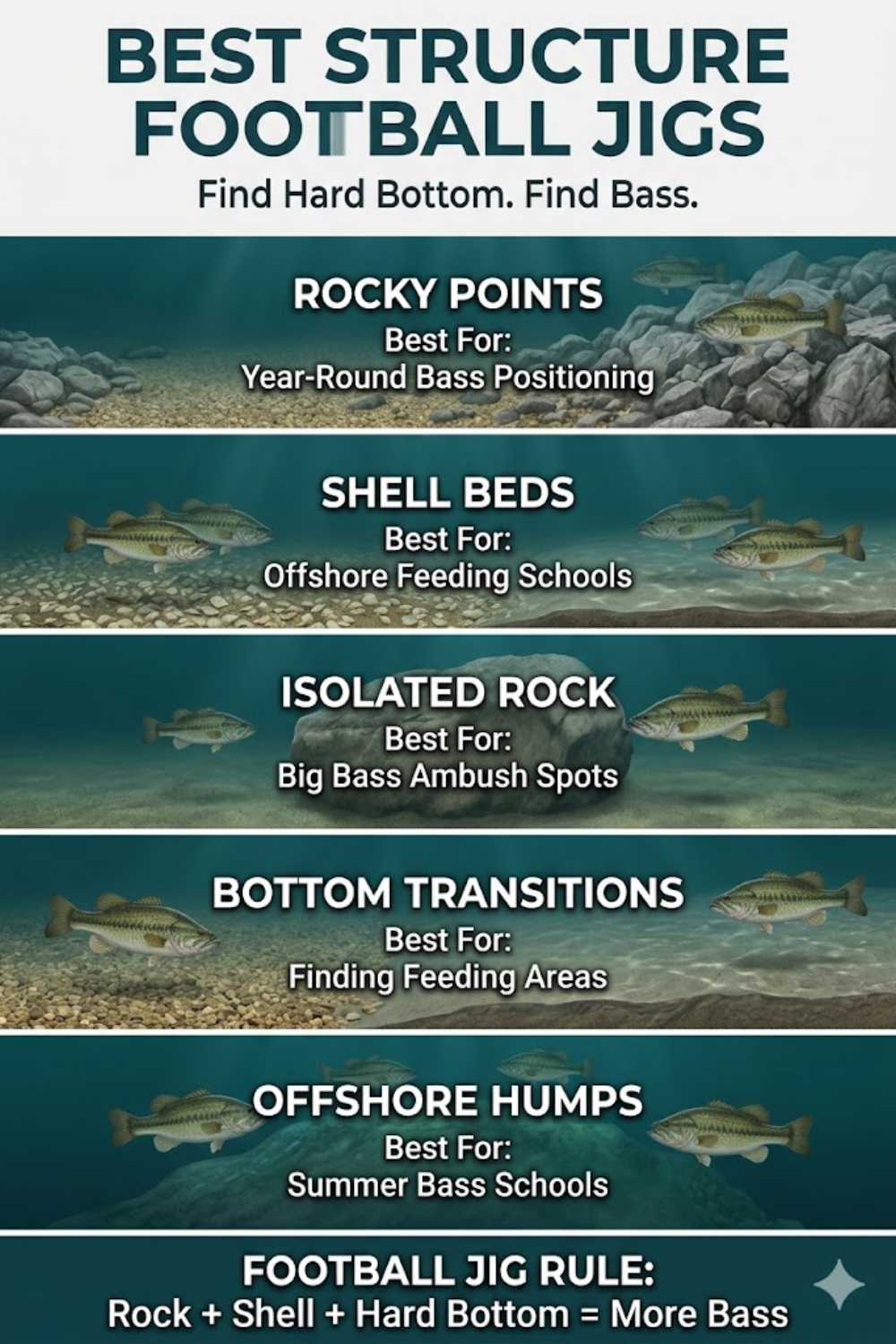
Football jigs excel because they match how bass naturally feed around hard structure. Adult bass position on bottom transitions, isolated rock, shell beds, and hard-bottom areas where crawfish and bottom-oriented forage concentrate. Unlike moving baits that pass quickly through a strike zone, football jigs remain in contact with the structure for the entire retrieve — that means substantially more time in front of fish.
The wide football-shaped head is the design feature that defines the category. The shape creates stability: instead of tipping over and snagging in cracks, the head crawls through uneven terrain while maintaining a natural upright posture. The skirt stays alive throughout the retrieve, the trailer kicks naturally, and the bait reads as a feeding crawfish working across the bottom. That stability lets anglers fish the very places that often hold the largest bass in a system — places where other jig styles snag and hang.
Versatility is the second advantage. A slow drag imitates a crawfish feeding on bottom. A subtle hopping retrieve mimics a fleeing baitfish. A sharp stroke launches the jig off bottom and lets it fall back — a reaction presentation that draws strikes from neutral fish. Few lure categories offer this many distinct presentation options without changing baits.
Football jigs are also one of the best structure-mapping tools in bass fishing. By feeling the bottom transmit up the line, anglers learn the composition of every area they fish — gravel transitions to chunk rock, shell beds, isolated boulders, hard-to-soft transitions. Many tournament anglers use football jigs as the primary search tool for identifying the high-percentage sweet spots that electronics alone cannot reveal. A subtle shell bed the size of a truck, an isolated boulder on a featureless flat, or a small chunk-rock patch on a gravel point can concentrate multiple quality bass and become the most productive spot on an entire body of water. See bass fishing points for more on how bass relate to these features.
Finally, football jigs catch larger-than-average fish because they target structure-oriented adult bass eating high-value forage. The combination of correct location and correct meal-size profile consistently produces above-average results.
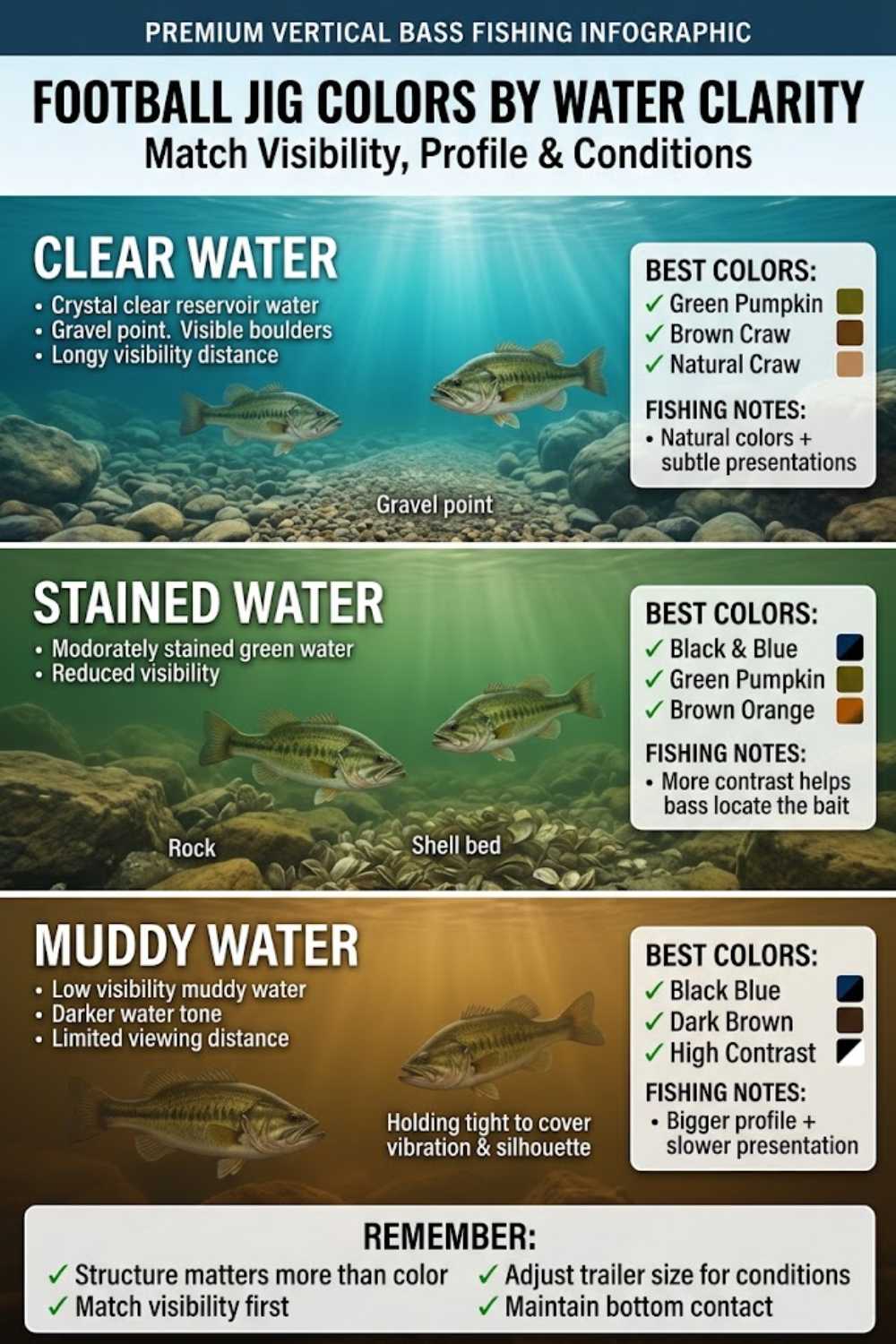
Water clarity influences nearly every football jig decision — color, trailer size, line size, and even where on the structure to focus. The most successful football jig anglers adjust all of these together rather than relying on color changes alone.
Clear water (3+ ft visibility) — Realism wins. Natural colors like green pumpkin, PB&J, and brown/purple excel because bass have time to inspect the bait. Drop to 12–15 lb fluorocarbon, lengthen casts, and pick subtle trailers (Yamamoto double-tail grub, small Speed Craw) over high-action options. Bass in clear water often position slightly deeper than in stained water — focus on the deeper edges of structure and the deeper sides of points.
Lightly stained water (2–3 ft visibility) — The football jig sweet spot. Bass are aggressive enough to commit yet willing to position around offshore structure. Classic green-pumpkin, brown-orange, and PB&J combinations produce. 15-lb fluorocarbon is the standard. Many tournament wins occur under these conditions because bass actively feed on the high-percentage offshore features football jigs were designed for.
Stained water (1–2 ft visibility) — Step up profile and contrast. Larger craw trailers help bass locate the bait visually. Brown/orange with an orange-dipped trailer tail, or a black/red flake combination, works well. 17-lb fluorocarbon adds durability around rougher structure.
Muddy water (under 12 inches) — A different mindset. Forget realism — emphasize silhouette and presence. Black/blue with a black/blue Rage Craw trailer is the standard. Slow the retrieve dramatically and make repeated casts to the highest-percentage areas rather than covering water. Bass in muddy water locate the bait by lateral-line input and silhouette against ambient light, not by color.
Water clarity also affects depth selection. In clear water, bass often hold deeper because they can locate forage from a distance. In stained water, they move shallower while remaining comfortable on the same structure. Understanding that relationship helps you pick which features to fish before making the first cast.
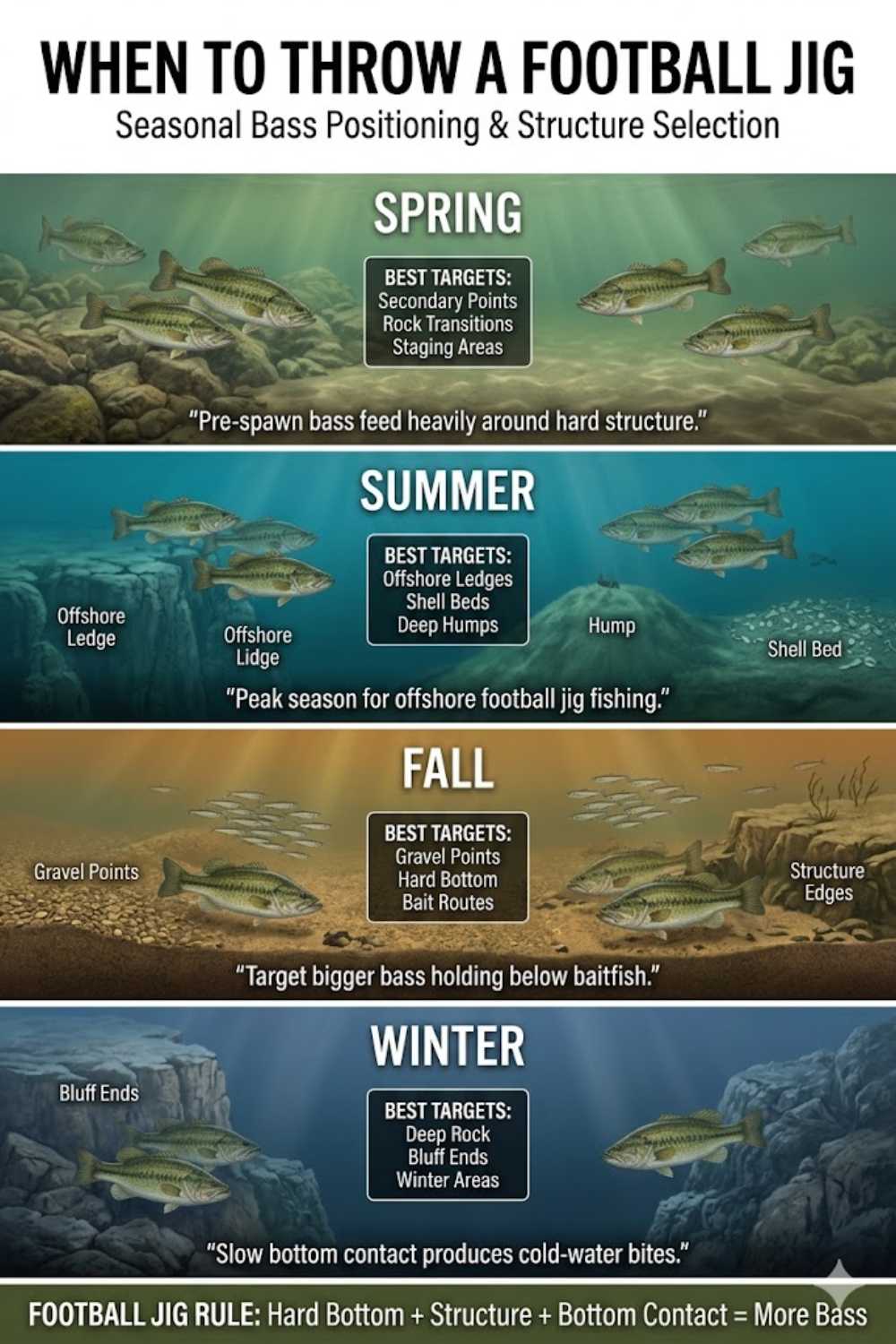
Football jigs catch bass every month of the year, but the structure type, retrieve, and trailer change dramatically with the calendar.
Prespawn (water 45–58°F) — One of the best windows for the technique. Bass stage on secondary points, channel swings, and rocky transitions before moving shallow to spawn. Crawfish become particularly important forage as they emerge from winter dormancy. Target staging areas with a 1/2 oz green-pumpkin or brown football jig dragged slowly across the structure. Bigger bites often come from the deep edge of the transition rather than the crown of the structure.
Spawn (58–68°F) — Secondary technique. Most bass on the spawn move shallow, but the larger females that stage deeper or recover offshore between bedding waves still eat football jigs around the first deep break adjacent to spawning flats.
Postspawn (68–75°F) — Productive but underutilized. Females recover on the first deep break — exactly the kind of secondary-point and channel-swing structure football jigs were built for. A 1/2 oz football jig with a bulky craw trailer worked slowly around these recovery areas often produces the biggest bass of the postspawn window.
Summer (75–88°F) — The marquee football jig season. Bass group on offshore structure — main-lake points, ledges, humps, shell beds, and isolated rock piles. Anglers studying summer bass patterns often discover that football jigs become one of the most reliable ways to catch quality fish throughout the day, even when topwater and reaction baits stop producing. Dragging remains the foundation, but stroking techniques — sharply lifting the rod to launch the jig off bottom — trigger aggressive reaction strikes on schooled-up fish. Deep-water structure fishing rewards patience and precision.
Fall (75–55°F) — Productive but easy to overlook. Most anglers focus on moving baits as bass chase shad, but football jigs continue producing around hard-bottom areas adjacent to bait migration routes. The technique often produces a larger average fish size during fall because the bigger, less-active bass hold near structure rather than chasing schooling shad. See the fall shad migration guide for context on where to position.
Winter (water under 50°F) — Cold water slows bass metabolism, but football jigs continue catching fish for anglers willing to fish slow. Target bluff walls, channel swings, and the deep edges of main-lake points. Long pauses (10–30 seconds) on every drop are critical — winter strikes often happen during the pause and feel like nothing more than added weight on the line.
Color receives more attention than it deserves in football jig fishing. Structure, depth, and presentation generally matter more — but a few proven color families consistently produce results and deserve a place in every box.
Green pumpkin — The most versatile football jig color and the right starting point for nearly any situation. It works in clear water, moderately stained water, and around almost every forage type bass eat around hard structure. If an angler could own only one football jig color, green pumpkin would be the safest choice.
Brown and brown/orange — Excel around rocky lakes with strong crawfish populations, particularly in spring when crawfish molt and display orange highlights. Pair with a brown craw trailer dipped in orange for the most accurate match.
PB&J (brown/purple/orange) — Underrated for clear-water smallmouth and pressured largemouth on hard-bottom reservoirs. The subtle color blend reads as multiple forage types and produces when conventional green pumpkin gets refused.
Black/blue — The stained-water and overcast-day standard. The darker profile is what bass actually see against low-visibility ambient light. Pair with a black/blue Rage Craw or chunk trailer.
Bluegill — The right call from late May through July when bass key on bluegill around shallow hard-bottom flats. A bluegill-pattern football jig fished slowly across the perimeter of bluegill colonies outproduces every shad pattern in the box.
Forage matching extends beyond skirt color. Trailer size, shape, and movement all influence how bass interpret the presentation. Bulky trailers imitate larger crawfish and bluegill — the right call for trophy hunting and prespawn/postspawn windows. Compact trailers create a finesse profile that produces on pressured fish and in cold water. Successful anglers observe local forage and adapt rather than blindly following color trends.
The biggest mistake anglers make with football jigs is moving them too quickly. Football jigs are designed to maintain bottom contact and spend time in the strike zone — every time the lure leaves the bottom unnecessarily, opportunities are lost.
The drag retrieve is the foundation. Cast beyond the target structure, allow the jig to reach bottom on a controlled fall, then slowly pull the rod sideways from the 9 o'clock to 11 o'clock position while feeling every change in bottom composition. Reel up slack as you lower the rod back to 9 o'clock and repeat. This presentation imitates a crawfish moving naturally across the bottom and is the highest-percentage retrieve in most situations. Pace: the jig should move 6–12 inches per pull, not 3–4 feet.
Hopping presentations work when bass are active. Small lifts (6–12 inches) followed by controlled falls back to the bottom trigger reaction bites while maintaining contact with productive structure.
Stroking is the aggressive variation. Sharply lift the rod two to three feet to launch the jig vertically off bottom, then drop the rod tip and let the jig fall on slack line back to the bottom. Stroking excels around deep offshore schools during summer and on isolated boulders where a vertical fall draws strikes from suspended fish holding above the cover.
Bottom composition is everything. Many of the best spots on any lake are surprisingly small. A shell bed the size of a truck, an isolated boulder on a featureless flat, a subtle hard-to-soft transition on a long point — these features concentrate multiple quality bass and become the most productive water in the system. Football jigs help identify those features better than almost any other lure category. Mark every transition you find with electronics or memory and revisit them — they will produce repeatedly across seasons.
Rod selection matters more than most anglers realize. A 7'3" to 7'6" medium-heavy or heavy-action fast-tip baitcasting rod is the standard. Length helps with long casts and bottom feel; fast action drives the hook through a bass's jaw on a long-distance hook-set in deep water. Pair with 15-lb fluorocarbon for the all-around setup. Fluorocarbon's low stretch and direct feedback are what let you distinguish a bite from a rock.
Football jigs were designed for offshore hard-bottom structure, and the technique reaches peak efficiency when you fish the right features. Five structure types consistently produce.
Main-lake and secondary points — The most universal football jig structure. Both main-lake points (extending from the bank into the main lake basin) and secondary points (inside coves and creek arms) hold bass year-round. The key features on any point are the bottom composition transitions: gravel to chunk rock, chunk rock to shell, shell to soft bottom. Bass position exactly on those transitions, particularly during prespawn, postspawn, and summer. See our dedicated bass fishing points guide for additional positioning detail.
Ledges and channel swings — Bass on summer ledges concentrate around any bottom irregularity: a hard spot on a clay ledge, a stump field on top of the ledge, a rock pile on the break. A 3/4 oz football jig dragged across these features is one of the most reliable summer techniques in the country, particularly on reservoirs.
Humps and offshore rises — Underwater islands and humps hold summer bass that feed on baitfish and crawfish around the hard-bottom crown. The most productive humps are those with hard-bottom tops (rock, gravel, shell) rather than soft mud crowns. Drag football jigs from the deep edge up onto the top and back down. Our offshore humps guide details how to identify and approach these features.
Shell beds and gravel patches — Subtle bottom-composition changes that often look like nothing on the surface but concentrate enormous numbers of bass. Shell beds in particular hold crawfish and bottom-oriented baitfish, both of which football jigs imitate perfectly.
Isolated rock piles and boulders — Single isolated pieces of cover on featureless flats become high-percentage spots because they concentrate fish that have no other cover nearby. A vertical-presentation football jig on isolated boulders consistently produces above-average fish. For deep-water rock approaches, see our deep water bass lures guide.
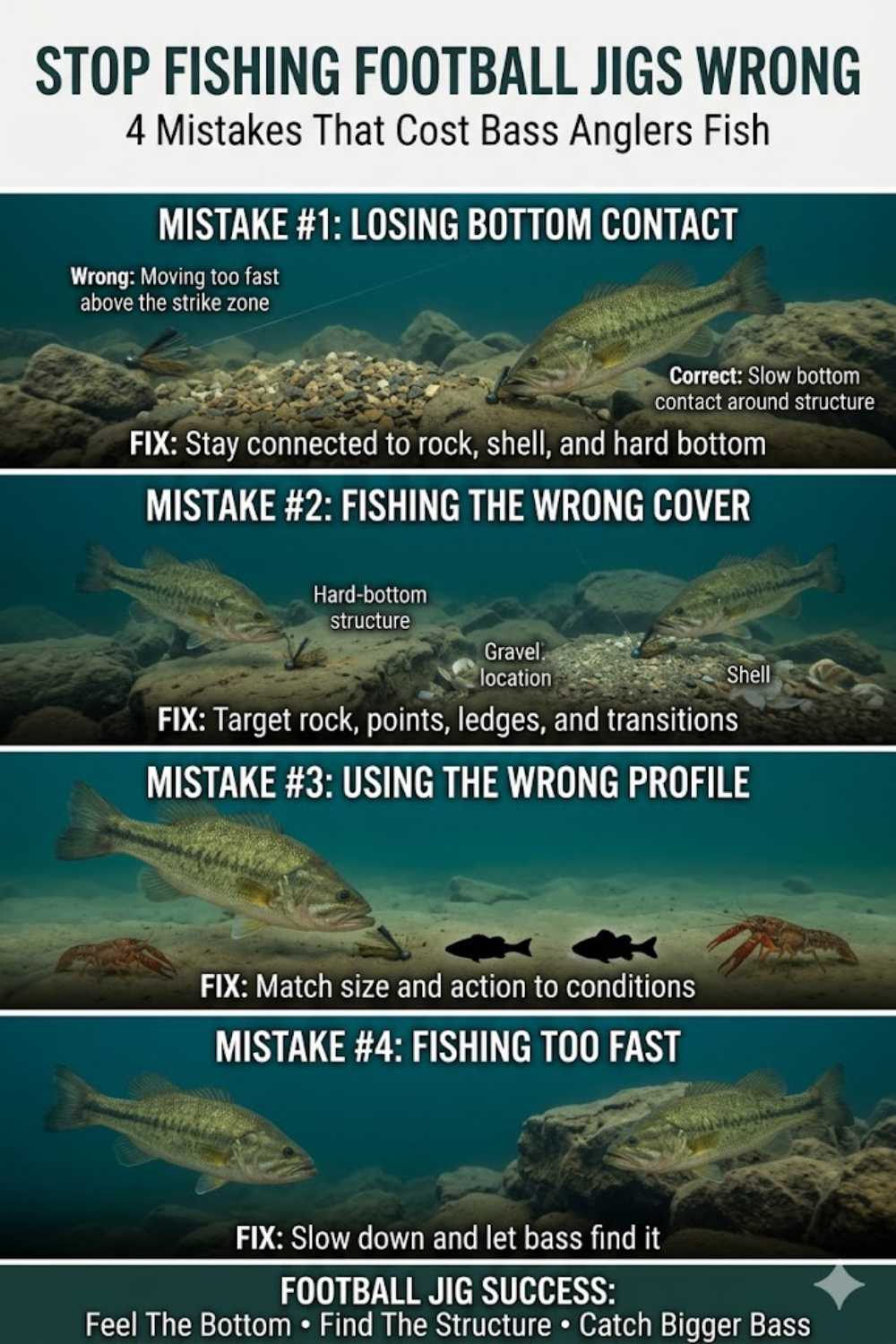
Five mistakes account for the majority of slow football jig days. Avoid them and the technique produces consistently.
Wrong cover — Football jigs are designed for rock, shell, gravel, and hard-bottom structure. Thick vegetation hangs the rounded head and exposes the open hook to grass. If you find yourself in heavy grass, switch to a flipping jig or swim jig.
Insufficient weight — Losing contact with the bottom eliminates every advantage the technique provides. Wind, depth, and current all require heavier jigs than anglers initially think. If you cannot feel the jig contact bottom on every retrieve, step up one weight size.
Ignoring trailers — The trailer controls profile, fall rate, and action. Anglers who default to a single trailer for every situation give up significant performance. Carry compact, medium, and bulky craw trailers in green pumpkin, brown, and black/blue, and pick based on conditions.
Impatience — Football jigs produce fewer bites per hour than moving baits but a substantially larger average fish size. Anglers who abandon the technique after 60–90 minutes of slow fishing frequently miss the trophy bite that comes when the right window opens.
Missing structure detail — Productive offshore areas usually contain small sweet spots that concentrate fish. Learning to identify the exact transition and repeatedly target that specific feature dramatically improves results compared to randomly fishing the entire structure.
The best football jig depends on how and where you fish, but several options clearly separate themselves from the field.
The Dirty Jigs Guppy Football Jig earns top honors as the Editor's Pick because it combines premium components, excellent sensitivity, and broad versatility into a tournament-grade tool. The Strike King Tour Grade Football delivers outstanding value and is the easiest recommendation for anglers building a deep football-jig arsenal without spending premium dollars on every weight and color. The Booyah Boo Football Jig adds heavy-wire trophy-class capability for anglers specifically hunting big fish on deep structure.
More important than brand selection, however, is understanding how football jigs fit into bass behavior. They excel around hard-bottom structure, reveal critical bottom transitions, and consistently produce larger-than-average fish. Anglers willing to slow down, maintain bottom contact, and focus on structure detail will discover why football jigs remain one of the most trusted tools in serious bass fishing.
Whether you are targeting offshore schools during summer, probing rocky points during prespawn, dragging shell beds during postspawn, or slow-rolling bluff walls in winter, a football jig deserves a permanent place in your tackle box.
Premium football head built for rock and gravel.
Offshore rock and gravel — slow drag with long pauses.
As an Amazon Associate I earn from qualifying purchases.
Temperature-by-temperature lure logic.
The prespawn temperature threshold.
Natural presentations and finesse profiles.
Vibration, dark silhouette, and visibility tactics.
Adjusting across the full clarity spectrum.
Topwater and reaction baits for the dawn window.
Plug in today's water temp, clarity, weather, and forage — the tool returns the highest-confidence presentations.
Build Today's Strategy →