Editor's Pick97%
Megabass Vision 110
French Pearl
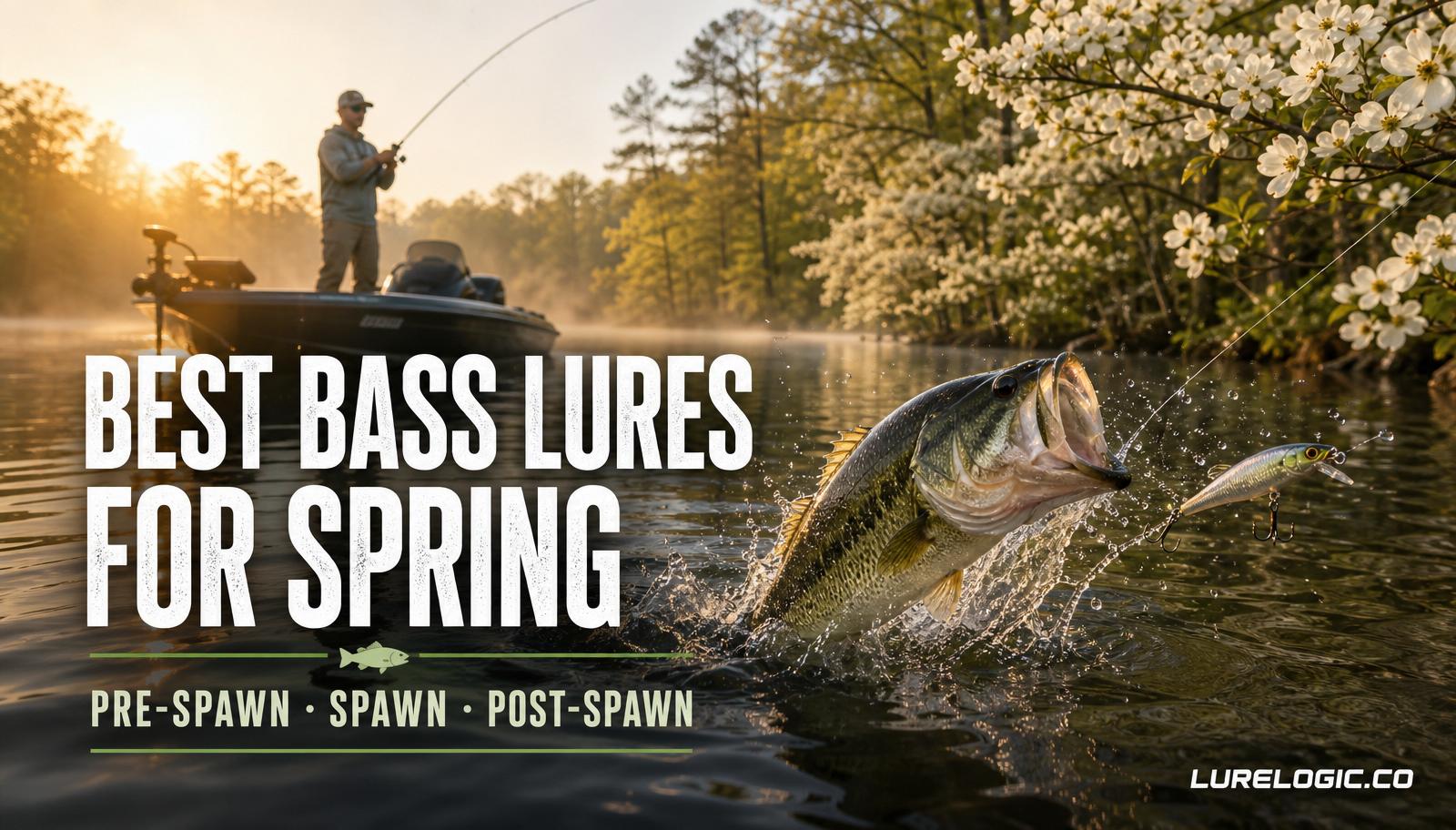
View Product →The best bass lures for spring — jerkbaits and lipless cranks for pre-spawn, wacky Senkos and swim jigs for the spawn, and squarebills and chatterbaits for post-spawn recovery. Complete pre-spawn, spawn, and post-spawn tackle strategy.
Affiliate Disclosure: As an Amazon Associate I earn from qualifying purchases. Recommendations reflect on-the-water testing and the LureLogic ranking engine — not paid placement.
The one-paragraph version: throw a jerkbait or lipless crankbait on staging structure in the pre-spawn, downsize to a wacky Senko or small swim jig on the beds during the spawn, and rotate to a squarebill, chatterbait, and topwater walking bait as bass slide back out for post-spawn recovery. Almost every productive spring day looks like some version of that three-stage rotation.
The Megabass Vision 110 is our Editor's Pick because it produces on the highest-value spring window (cold pre-spawn staging) on virtually every clear-water fishery in the country. Its suspending action and the long pauses it tolerates draw pre-spawn females that will ignore every faster-moving bait in the box. Pricey — but the fish it puts in the boat during the two-to-three-week staging window justify the line item.
The Rapala Shadow Rap is our Best Cold Water Action pick — a suspending jerkbait with a hard side-to-side snap and a nose-down suspend that outproduces the Vision 110 in the coldest part of pre-spawn (48–54°F) when bass want a bait that dies on the pause. A more accessible price point without sacrificing pre-spawn effectiveness.
The Berkley Stunna is our Best Value pick — a suspending jerkbait that delivers 85% of the Vision 110's action at roughly a third of the price. If you are building a pre-spawn box on a budget or need a bait you are willing to lose to shallow rock and laydowns, this is the one.
Round out a spring arsenal with a Strike King Red Eye Shad lipless (stained pre-spawn water), a Yamamoto Senko wacky-rigged for the spawn, a Strike King KVD 1.5 squarebill for post-spawn shallow cover, a Z-Man JackHammer ChatterBait for the first emerging grass, and a Heddon Super Spook for the first calm-morning post-spawn topwater bite. Those seven categories cover the entire spring decision tree.
Spring bass fishing is defined by a single biological event — the spawn — and the pre- and post-spawn phases that bookend it. Three realities drive every spring lure decision.
First, spring is three seasons in one. Pre-spawn, spawn, and post-spawn are biologically distinct phases that reward completely different presentations. A jerkbait that catches limits at 52°F on secondary points becomes useless at 66°F on spawning flats; a wacky Senko that catches bedding fish at 62°F does nothing on cold staging fish two weeks earlier. The mistake most anglers make is committing to one 'spring' technique instead of rotating through the three phases as water temperature climbs. See seasonal bass patterns and how to choose a bass lure.
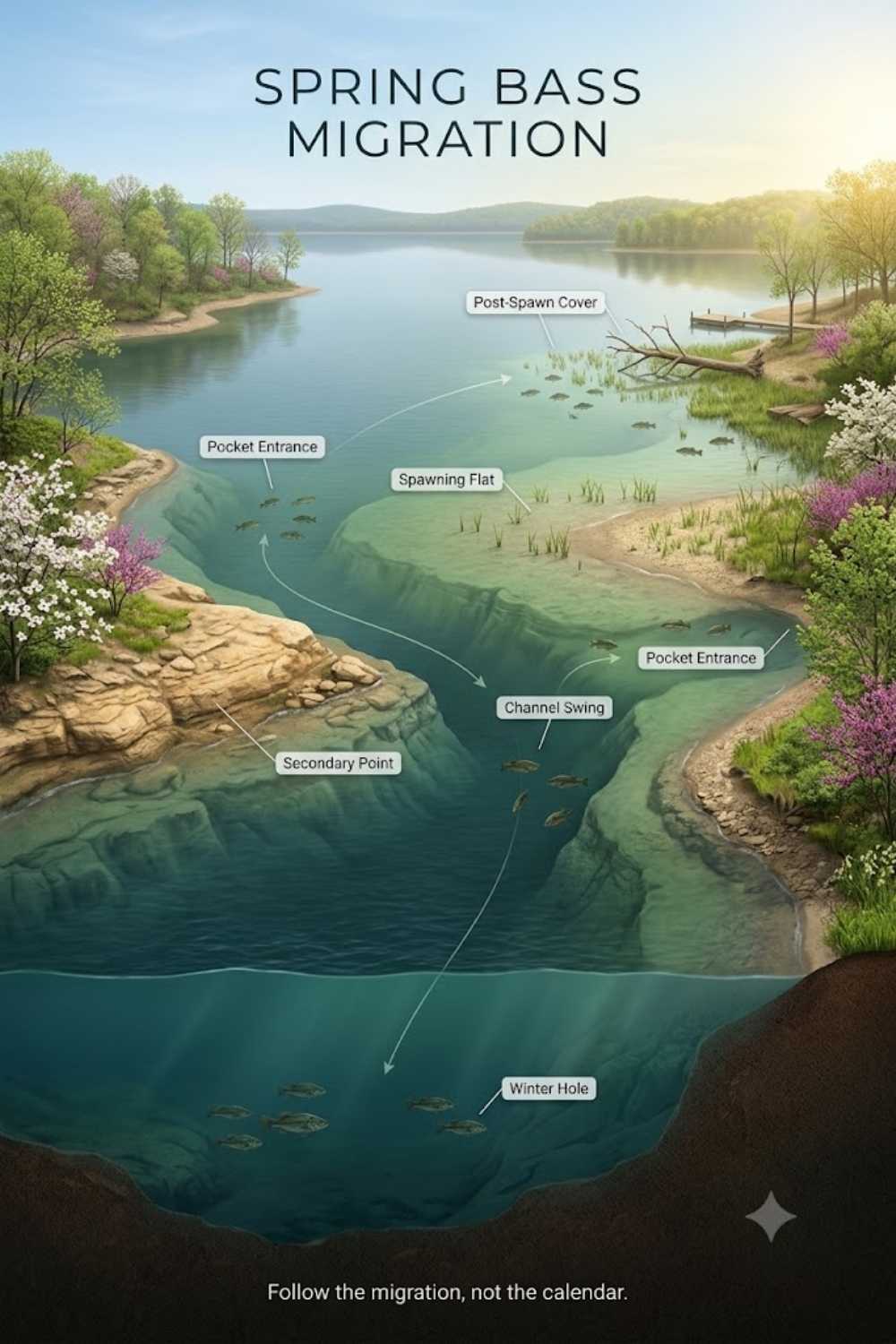
Second, bass move dramatically. In winter, bass live in a handful of predictable deep-water positions. In spring, that entire population migrates from deep winter holes through secondary points and channel swings to spawning flats and back out — often 500 yards to a mile of migration in six to eight weeks. Anglers who understand the migration route (winter hole → secondary point → creek channel swing → pocket entrance → spawning flat → first main-lake grass edge) and check the appropriate stage for the current water temperature find bass while everyone else fishes yesterday's location. See bass baitfish movement.
Third, weather whipsaws the bite. Spring weather is the least stable of any season — warming trends, cold fronts, thunderstorms, and muddy runoff can move bass one to two miles overnight. A great pre-spawn spot on Saturday can be empty on Monday because a Sunday cold front pushed the fish back to their winter positions. Successful spring anglers watch the seven-day forecast, not the current day, and time their trips for the second or third consecutive warming day after a front. See bass fishing after heavy rain, bass fishing before storms, and best bass lures after a cold front.
The practical translation: an angler who commits to one spring rig fishes with confidence for two weeks and misses the other four. An angler who rotates through pre-spawn jerkbaits, spawn Senkos, and post-spawn squarebills as water temperature climbs stays on active fish the entire spring.
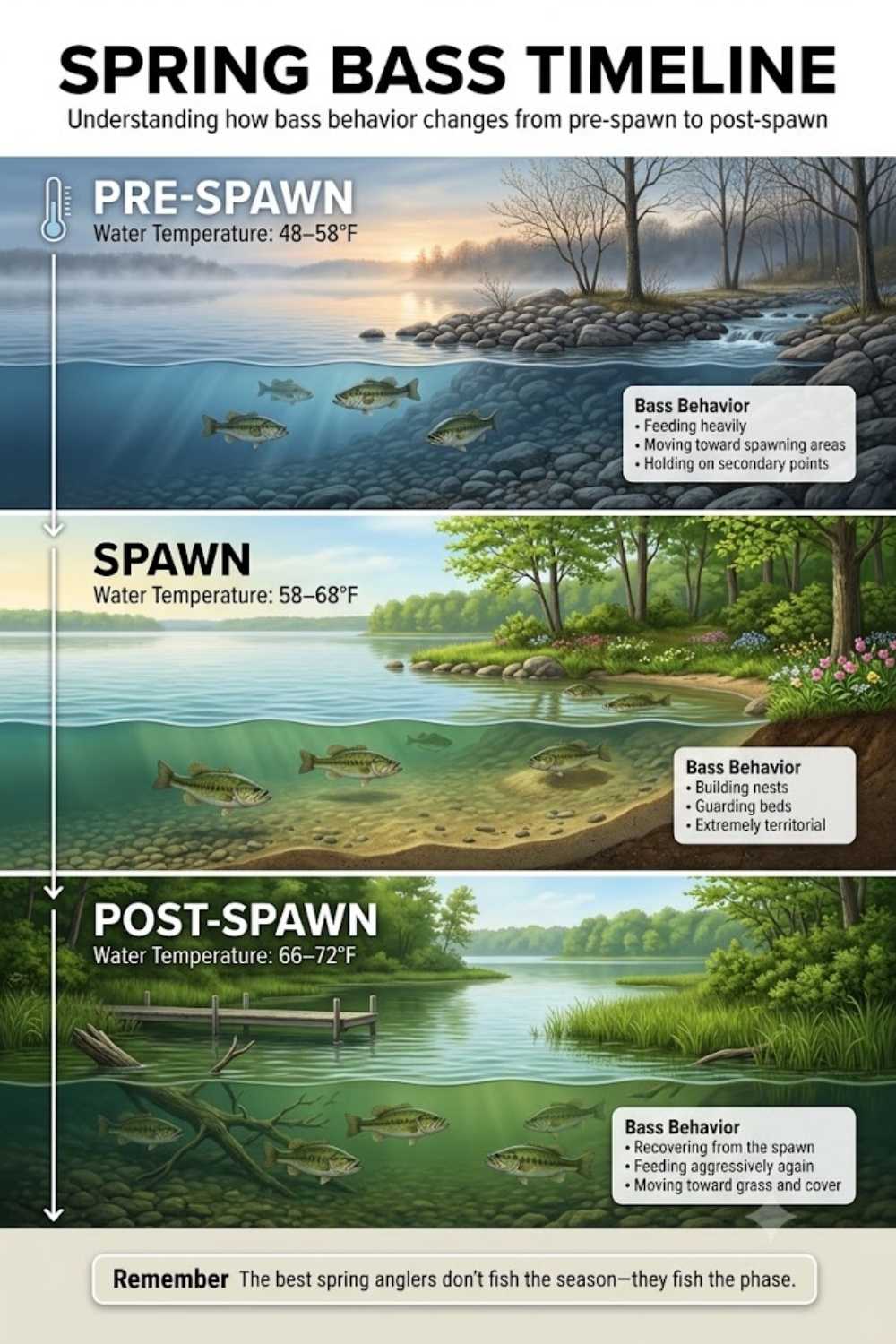
Pre-Spawn (48–58°F) — Suspending Jerkbaits and Lipless Cranks.
Megabass Vision 110 — Editor's Pick, pre-spawn staging. A 4-inch suspending jerkbait with the best cadence tolerance in the category. Fish it with 2 sharp jerks, then pause 5–15 seconds. Colors: French pearl, mat tiger, sexy shad. Fish it on secondary points, channel swings, and the outside edges of spawning pockets in 6–15 ft. See the jerkbaits buying guide.
Rapala Shadow Rap — cold-water snap. A nose-down suspending jerkbait that dies flat on the pause — the highest-percentage bait in the coldest pre-spawn window (48–54°F). Ghost, olive shad, and elite are the workhorse colors.
Strike King Red Eye Shad (1/2 oz) — stained-water pre-spawn. A lipless crankbait that yo-yoed over hard-bottom flats in 3–8 ft is unbeatable when clarity drops below 2 ft and bass ignore the jerkbait. Red craw and chrome-black-back are the two colors that matter. See the lipless crankbaits guide.
Bill Lewis Rat-L-Trap — the original lipless. A slightly slower fall than the Red Eye Shad, which matters when bass are sluggish in colder water. Rayburn red and chrome-blue are the pre-spawn colors.
Spawn (58–68°F) — Finesse and Small Presentations.
Yamamoto Senko (5-inch, wacky-rigged) — Best Spawn Bait. Nothing catches bedding bass more consistently than a 5-inch Senko dropped on a bed and left dead-sticked for 10 seconds. Green pumpkin, watermelon-red, and bubblegum (for visibility) are the go-to colors. See the finesse worms guide.
Missile Baits D-Bomb (Texas-rigged) — bed-fishing power finesse. A slightly larger, bulkier profile than the Senko that triggers reaction strikes from bass that ignore the smaller bait.
Strike King Hack Attack Swim Jig — cruising males. A 3/8 oz swim jig with a Rage Menace trailer picked apart from spawning bank to spawning bank catches the aggressive male bass cruising in 1–4 ft. See the swim jigs guide.
Strike King KVD 1.5 squarebill — pre-bed and post-bed cruisers. A 1.5 squarebill in bluegill, sexy shad, or red craw run over hard-bottom flats catches cruising bass moving to and from the spawn.
Post-Spawn (66–72°F) — Reaction Baits Return.
Strike King KVD 1.5 squarebill — Best Post-Spawn Reaction Bait. As bass slide back out of the pockets, a KVD 1.5 deflected off shallow rock, seawalls, and laydowns triggers post-spawn recovery bites. Sexy shad, chartreuse-black-back, and phantom shad are the workhorse colors. See the squarebill buying guide.
Z-Man JackHammer ChatterBait — first emerging grass. A 1/2 oz JackHammer with a Rage Craw trailer around the first grass beds and shallow wood is unbeatable in the two weeks after peak spawn. Bluegill and white shad are the primary colors. See the chatterbaits guide.
Heddon Super Spook — first topwater window. Once water crosses 68°F and morning surface temperatures stabilize, a walking topwater at dawn on shallow flats produces the first great topwater bite of the year. Bone, sexy shad, and okie shad. See the topwater lures buying guide.
War Eagle Spinnerbait — post-frontal post-spawn. A 3/8 oz double-willow spinnerbait slow-rolled through shallow cover triggers post-spawn bass that shut off to the squarebill after a spring cold front. See the spinnerbaits buying guide.
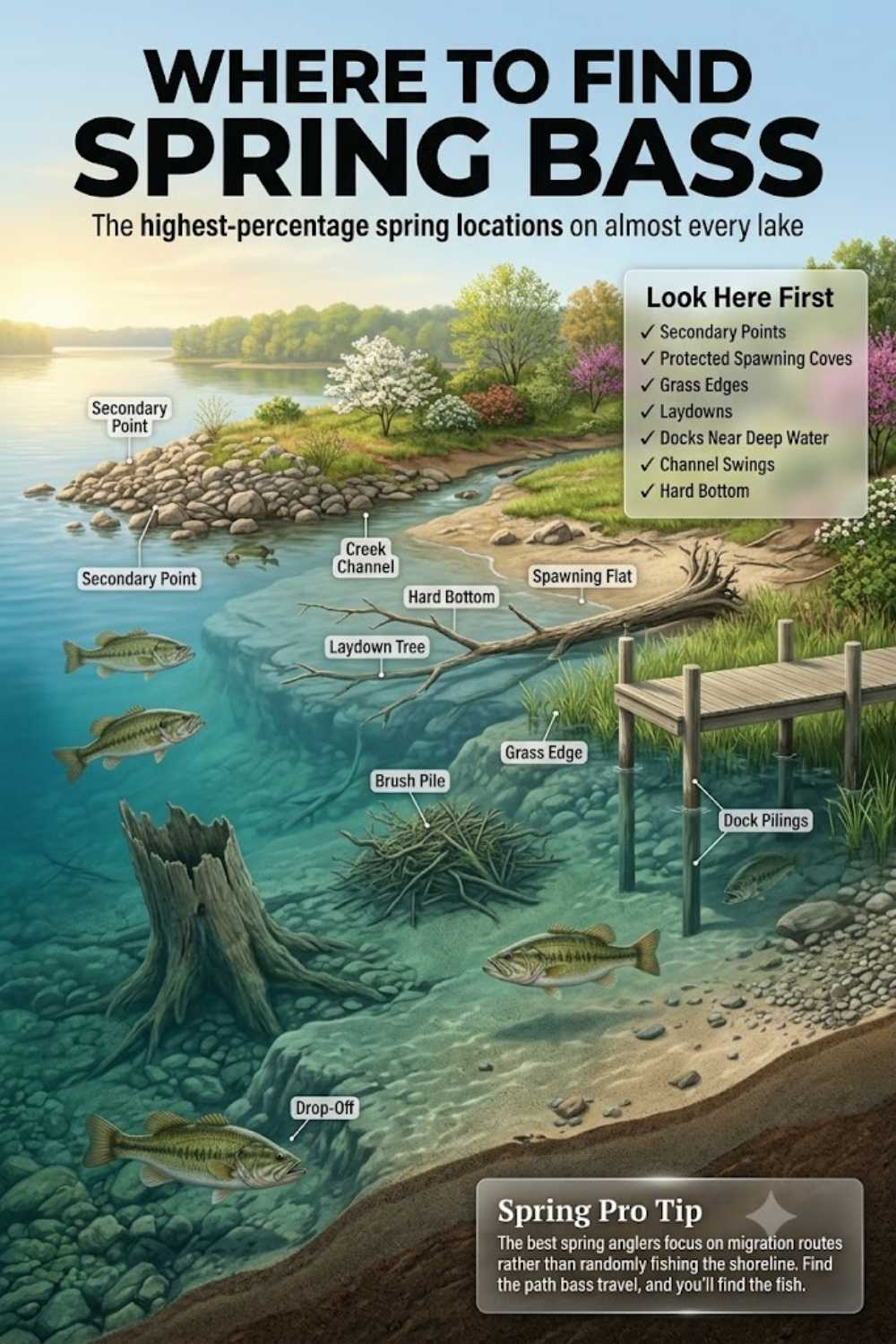
Four high-percentage spring positioning patterns, each tied to a phase.
Pre-spawn staging structure — Secondary points inside major creek arms, channel swings where the creek bends, and hard-bottom flats adjacent to spawning pockets in 6–15 ft. This is where pre-spawn bass hold for 2–4 weeks before moving to the beds. The single highest-value pre-spawn structure on most reservoirs is the last secondary point inside a large spawning creek — bass funnel past it on their way in and out. See creek channel bass positioning and bass fishing points.
Hard-bottom spawning flats — Gravel, chunk rock, chunk-rock-and-sand mix, and hard clay in 1–6 ft inside protected pockets. Bass want a bottom hard enough to fan a bed. Soft-mud flats hold almost no spawning bass; the same pocket with a hard-bottom shelf on one side will stack bass on the hard side. Look at satellite imagery before you launch — the color changes are usually visible from above.
Post-spawn recovery cover — The first main-lake grass edge, the first row of dock cover, and any laydown or brush pile within 100 yards of the mouth of a major spawning creek. Post-spawn females rest for 5–10 days after spawning and want cover with immediate access to deeper water. See bass fishing grass lines and post-spawn bass fishing.
Wind-blown pre-spawn banks — A 10–20 mph south or southwest wind on a rocky pre-spawn point in March or April can create a 60-minute midday bite window that outproduces the entire calm morning. Wind stacks plankton, plankton draws shad, shad pull staging bass shallow. Throw a lipless crank or chatterbait parallel to the wind-blown side.
Spring color decisions follow the forage cycle bass are keyed on at each phase.
Early pre-spawn (48–56°F) — Crawfish dominance. Water temperatures below 55°F favor crawfish because they emerge from winter dormancy in the same 48–52°F window bass become active. Red craw lipless cranks, red-craw squarebills, and green-pumpkin-and-orange jigs are the primary colors. Even on a jerkbait, mat tiger and orange-belly patterns can outproduce natural shad in the coldest part of pre-spawn. See the crawfish color cycle.
Late pre-spawn (56–62°F) — Shad and shad-belly whites take over. As shad move shallow to their own spawning banks, bass switch to a shad-focused feed. French pearl, sexy shad, ghost minnow, and pearl-belly jerkbaits become the primary colors. See threadfin vs gizzard shad.
Spawn (58–68°F) — Bluegill and bream. Bedding bass aggressively defend against nest-raiding bluegill. Green pumpkin with orange and blue accents, watermelon-red, and dedicated bluegill patterns on Senkos, swim jigs, and squarebills produce during the spawn. See post-spawn bluegill behavior.
Post-spawn (66–72°F) — Shad-belly whites and bones return. Post-spawn bass follow the post-spawn shad move to the first main-lake grass edges and want white-belly presentations. Bone topwaters, white chatterbaits, and shad-pattern squarebills are the workhorses.
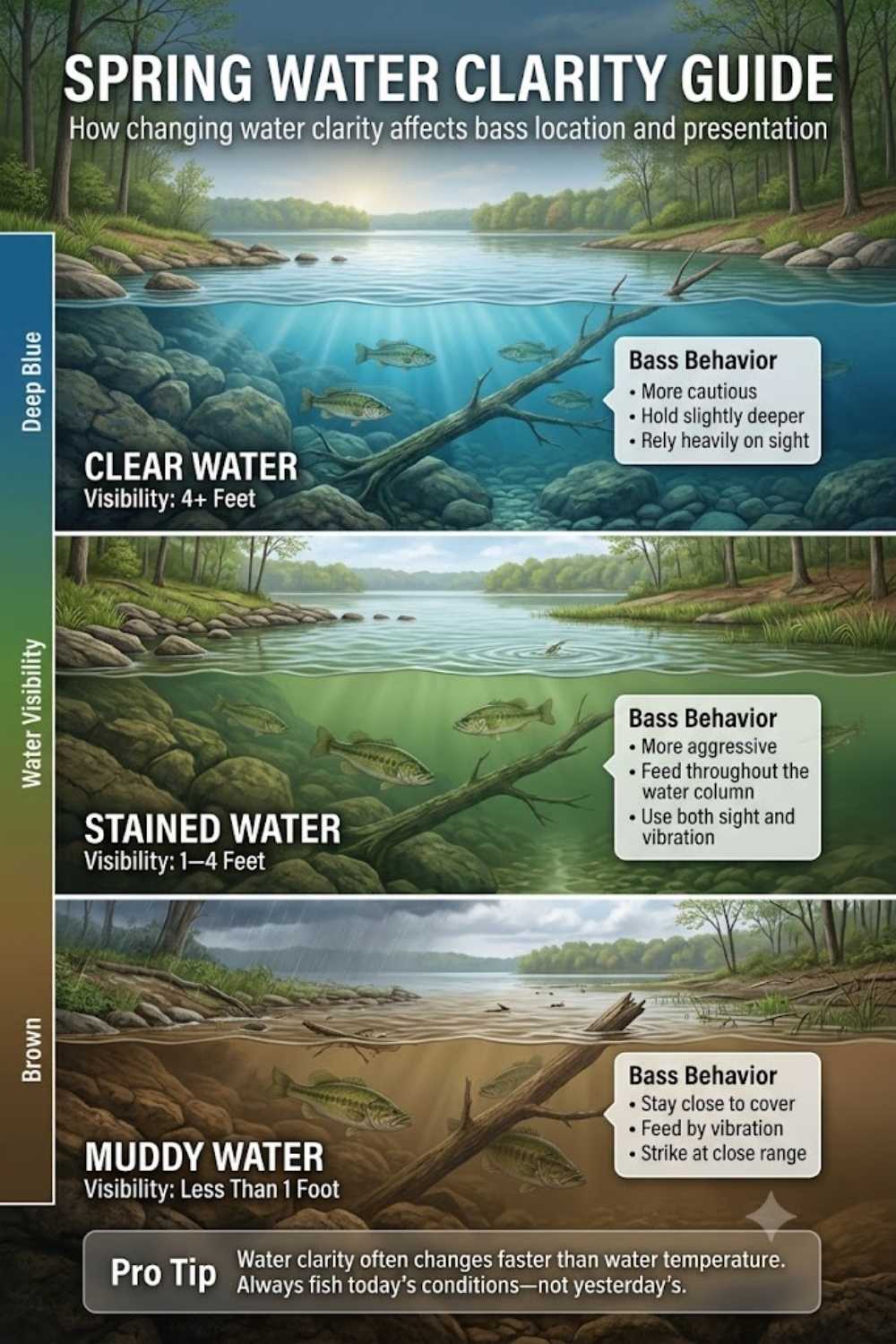
Water clarity overlay — Clear (4+ ft): natural, translucent, French pearl, ghost patterns. Stained (1–4 ft): brighter reaction colors — chartreuse-black-back, sexy shad with contrast, and red craw. Muddy (<12 in): dark silhouettes and heavy vibration — black-and-blue jigs, black chatterbaits, red lipless cranks. Spring runoff often muddies major creek arms while the main lake stays clear; that clarity break is one of the most productive locations of the entire year. See water clarity lure selection.
Retrieve mistakes are the biggest reason anglers miss spring bass. Three common errors — and the corrections.
Mistake 1 — Working the jerkbait too fast on cold pre-spawn fish. A suspending jerkbait at 48–54°F needs pauses of 8–15 seconds between jerks. Most anglers pause 2–3 seconds, get bored, and rip the bait. The strike almost always comes on the pause; if you cannot make yourself hold a 10-second pause, count Mississippis out loud. On warmer pre-spawn days (56–60°F) the pause can shorten to 3–6 seconds.
Mistake 2 — Reeling the lipless crank steady. A steady straight retrieve is the least effective way to fish a lipless crankbait in spring. The productive retrieve is yo-yo: cast, let it fall to the bottom, sharp lift with the rod tip to rip it up 2–3 ft, let it fall back to the bottom, repeat. Strikes come on the fall. On the coldest pre-spawn days, pause the bait on the bottom for 2–4 seconds before the next rip.
Mistake 3 — Fishing the spawn Senko too fast. A Senko dropped on a bed needs to sit dead-still for 10+ seconds before you even shake it. Bedding bass will sometimes pick the bait up on the second or third drop after ignoring it twice. Patience and repeat presentations to the same bed produce more bedding bass than moving to the next bed after one drop.
Other spring retrieve notes: swim jigs need to be reeled at the same speed as a chatterbait — steady with occasional twitches — not slow-rolled. Squarebills should deflect off cover; the bait triggers strikes when it changes direction after hitting a piece of wood or rock, not while running clean. Chatterbaits should be reeled at whatever speed keeps the blade thumping — usually medium-fast in early spring, slowing as the water warms.
When the bite dies during a spring cold front — See how to adjust when the bite dies. The most common spring adjustment is slowing the presentation dramatically and moving one depth contour deeper. If bass were biting at 6 ft on the outside grass edge the day before the front, they are usually at 10–12 ft on the same structure during and immediately after the front.
Fishing yesterday's location. Spring bass move fast — sometimes a hundred yards a day during the pre-spawn migration. The bank that produced Saturday is often empty on Monday because the bass moved 150 yards deeper into the same pocket. Cover water and re-locate fish every trip.
Committing to one 'spring' technique. Pre-spawn jerkbait, spawn Senko, and post-spawn squarebill are three completely different games. Anglers who commit to their favorite of the three catch fish for two weeks and grind for the other four.
Ignoring water temperature and trend line. The exact same 58°F reading means completely different things depending on whether the water is warming or cooling. Warming 58°F pulls fish shallow; cooling 58°F pushes fish back to the last stable structure. Check surface temperature on the graph and note whether it is 2°F above or below yesterday.
Skipping secondary points on the way in. The most productive pre-spawn structure on most reservoirs is the LAST secondary point inside a spawning creek — but most anglers idle past it on the way to the spawning flat itself. Stop at every secondary point in the last 300 yards before the pocket.
Bed-fishing too aggressively. A large-profile bait ripped past a bed 20 times will spook the fish off the bed. Bedding bass respond to slow, repeated presentations of the same small bait dropped in the same spot — not to progressively larger or more aggressive baits.
Quitting after a cold front. Spring cold fronts shut the bite down for 24–48 hours but rarely for a full week. The second post-frontal warming day is often the best fishing of the entire spring because staging fish move aggressively back into pre-frontal positions.
Why your lure isn't working — if you have moved through multiple spring categories and still cannot get a bite, the problem is often not the lure but the phase and location. See why bass won't hit your lure and when to change bass lures.
Ask three questions before you tie anything on.
1. What is the water temperature and phase? Below 58°F is pre-spawn — jerkbait or lipless crank. 58–68°F is spawn — Senko, swim jig, squarebill. 66–72°F is post-spawn — squarebill, chatterbait, topwater. The exact same lake needs different tackle on trips two weeks apart.
2. What is the water clarity? Clear water rewards translucent jerkbaits, natural squarebills, and finesse presentations. Stained-to-muddy water rewards lipless cranks, chatterbaits, and higher-contrast colors. Spring runoff often creates clarity breaks that are the highest-value spring locations of the year.
3. What is the weather trend? Two or three consecutive warming days push fish shallow and pull the bite forward through the phases. A hard cold front pushes fish deeper and back a phase for 24–72 hours. Match the presentation to the trend, not to yesterday's success.
The answers to those three questions almost always narrow the tackle-box decision to two or three legitimate categories. From there, cover type and casting distance make the final call. If you find yourself standing on the deck cycling through 10 rods without confidence, that is the signal to open Today's Fishing Strategy and let it filter the categories by current conditions.
Building a spring arsenal is where most anglers over-spend on the wrong categories. A few purchasing rules save money and improve results.
Buy the pre-spawn jerkbait once, and buy it right. The single highest-return lure purchase for the entire spring is a quality suspending jerkbait like the Vision 110 or a Shadow Rap. It produces the biggest bass of the year during the two-to-three-week pre-spawn staging window and lasts for years. Do not try to save money on the pre-spawn jerkbait; the fish it puts in the boat justify the price point.
Quality where it matters, value where it does not. Pre-spawn jerkbaits, squarebills, and chatterbaits earn their price through multi-year use. Value picks are perfectly fine for Senkos (they get destroyed every trip anyway), lipless cranks (they get lost on rocks), and backup rods.
Carry three colors of every spring category. Spring conditions change fast — French pearl on a clear morning, mat tiger under bright sun, sexy shad by mid-afternoon. Buy the same jerkbait in three colors rather than three different jerkbaits in one color each.
Spool line for the presentation. Pre-spawn jerkbaits and squarebills want 10–12 lb fluorocarbon for depth and stealth. Spawn Senkos want 6–10 lb fluorocarbon on spinning gear for the finesse presentation. Post-spawn chatterbaits want 15–17 lb fluorocarbon or 30–40 lb braid depending on cover.
Budget a pre-spawn jerkbait rod. A dedicated 6'8"–7'0" medium-fast rod for jerkbaits and squarebills is the single highest-return rod purchase for the entire year — it covers pre-spawn jerkbaits, post-spawn squarebills, and topwater walking baits.
Do not buy a giant chatterbait selection in spring. A single 1/2 oz JackHammer in bluegill and a single 1/2 oz JackHammer in white shad cover almost every spring chatterbait scenario. The color selection matters more in summer and fall than in spring.
Spring is dominated by the categories above, but a few situations call for tools this guide does not lead with.
After a spring cold front — Post-frontal bluebird-sky conditions during pre-spawn can shut down the jerkbait bite for 24–48 hours. When that happens, a small drop shot on the outside edge of staging structure, or a shaky-head worm crawled on the same points, outproduces every reaction bait. See drop shot baits and best bass lures after a cold front.
Extreme muddy runoff — Spring thunderstorms can drop clarity below 6 inches on the upper reaches of reservoirs. In those conditions a black-and-blue chatterbait, a red lipless crank, or a dark spinnerbait outproduces everything on this list. See best bass lures for muddy water.
Early-spring cold snap — When water temperature drops back below 48°F after a warming trend, spring bass revert to winter positions and want winter presentations — a jigging spoon, blade bait, or slow-fished small jerkbait on the deep end of the last stable structure. See best bass lures for 50°F water and blade baits.
Deep clear-water fisheries with delayed spawn — On deep, ultra-clear reservoirs (Table Rock, Cumberland, Ozarks), the pre-spawn staging depth can be 15–25 ft rather than 6–15 ft. In those conditions a jerkbait may not reach the fish, and a small hair jig, a jigging spoon, or a deep-diving jerkbait is often the better choice.
Heavily pressured tournament water — On heavily pressured spring water, drop shots and wacky Senkos on the outside edges of staging structure outproduce every reaction bait in this guide. See finesse worms.
Spring bass fishing is a three-phase rotation, not a single presentation. Suspending jerkbaits and lipless cranks in pre-spawn, wacky Senkos and small swim jigs on the beds, and squarebills, chatterbaits, and the first topwater walking baits in post-spawn — that three-way rotation catches spring bass on almost every reservoir in the country. Build a spring tackle box around a quality suspending jerkbait for pre-spawn, a bag of Senkos for the spawn, and a squarebill and chatterbait for post-spawn. Watch water temperature and weather trend, and let phase and clarity make your lure decision instead of habit.
For deeper dives into the individual spring phases, see pre-spawn bass fishing lures, post-spawn bass fishing, bass transition banks, the shad spawn, and herring spawn bass fishing. For the temperature-specific playbook see best bass lures by water temperature. For the framework behind lure choice see how to choose a bass lure.
And remember — the best spring lure is the one that matches today's conditions. This guide narrows your spring box down to the categories that actually produce; Today's Fishing Strategy tells you which of those categories is the highest-confidence choice for the exact water temperature, clarity, and weather in front of you right now.
Industry-standard suspending jerkbait for cold-water bass.
Cold, clear water — long pauses near rock and points.
As an Amazon Associate I earn from qualifying purchases.
Staging fish on transition banks and the baits that work.
Fry guarders and the recovery slowdown.
Walking baits, frogs, and poppers in heat.
Deep structure or shade — pick one.
Shade plus structure in the heat of the year.
Shad migration and aggressive pre-winter feeding.
Plug in today's water temp, clarity, weather, and forage — the tool returns the highest-confidence presentations.
Build Today's Strategy →