Editor's Pick97%
Megabass Vision 110
French Pearl
View Product →The best bass lures for 50°F water — the transition between winter survival mode and prespawn aggression. Jerkbaits, blade baits, jigs, and how to pick presentations by warming vs cooling trends.
Affiliate Disclosure: As an Amazon Associate I earn from qualifying purchases. Recommendations reflect on-the-water testing and the LureLogic ranking engine — not paid placement.
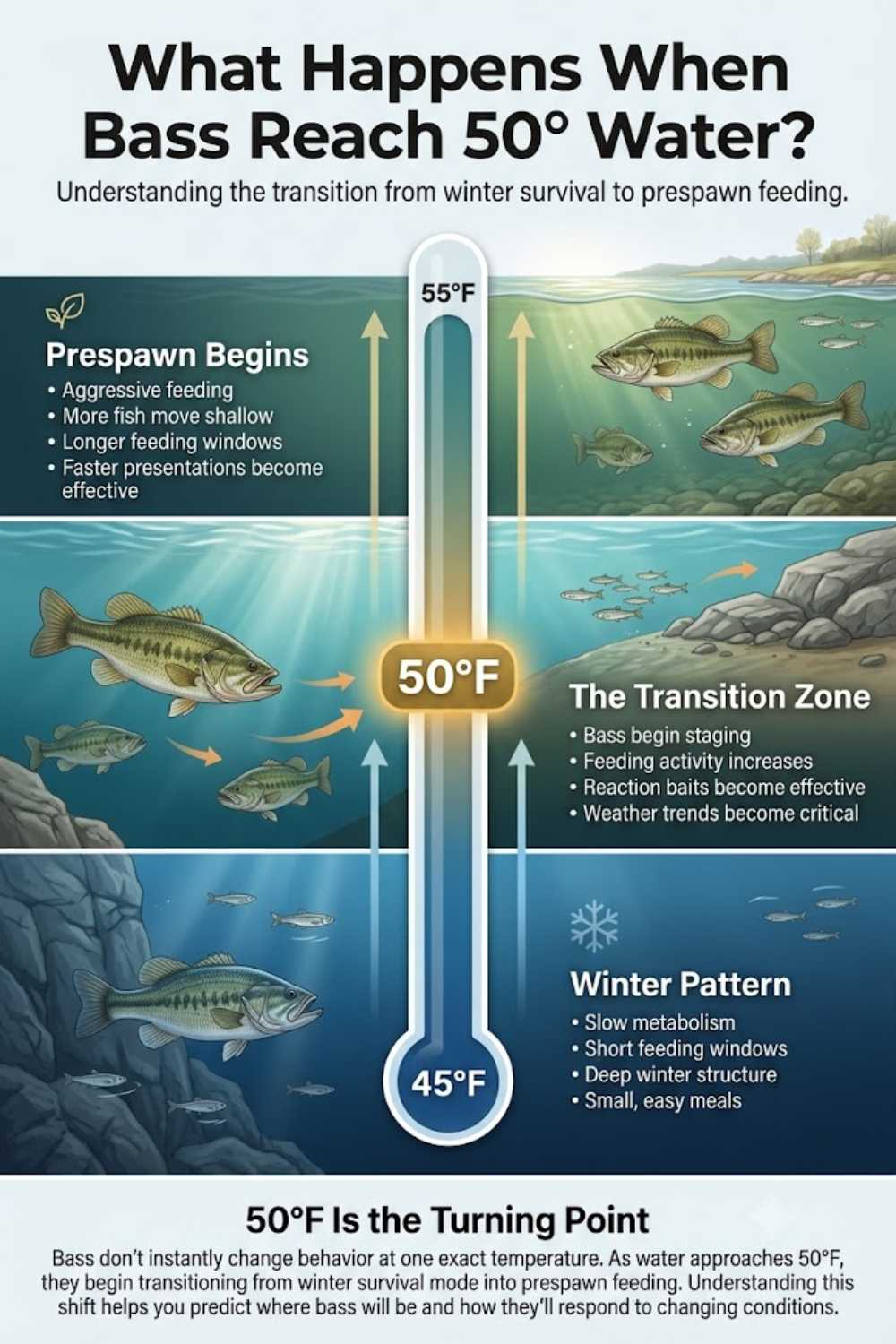
50°F water sits at the most important metabolic threshold in bass fishing — the boundary between winter survival mode and prespawn aggression. A bass at 45°F burns minimal energy and feeds in narrow infrequent windows on small high-calorie targets. A bass at 55°F has shifted into prespawn behavior — moving shallow, chasing reaction baits, and feeding aggressively during warming trends. At 50°F, the fish is somewhere between those two modes, and the right lure choice depends on which direction the water temperature is trending.
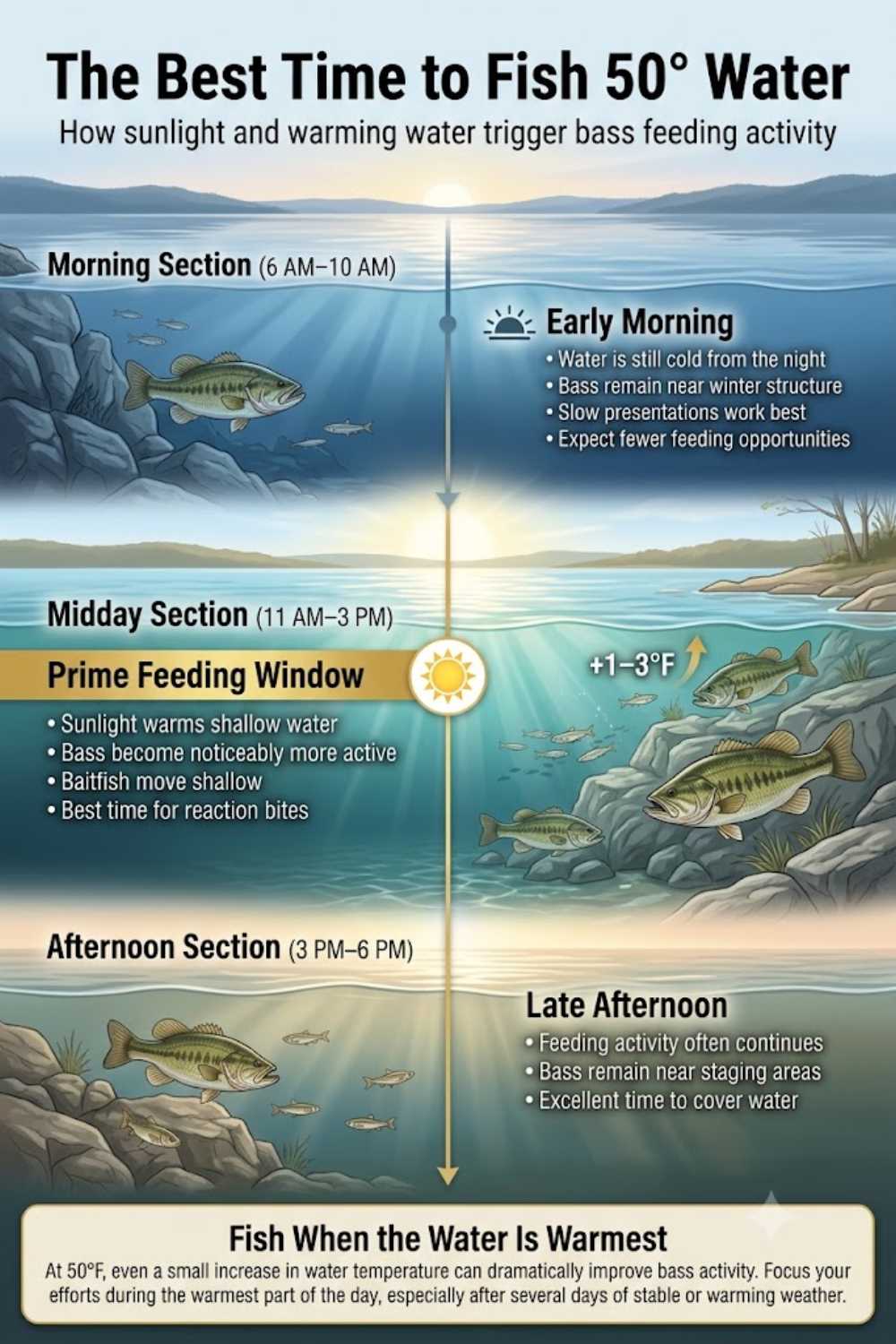
On a warming trend (water rising from the mid-40s toward the upper 50s over several days), 50°F bass behave more like 55°F fish. They move from deep winter holding into mid-depth staging areas, key on baitfish migrating shallow, and respond aggressively to suspending jerkbaits, slow-rolled blade baits, and lift-and-fall reaction presentations. The midday window (roughly 11 AM to 3 PM) becomes a primary feeding period as solar warming pushes water temperature up 1–2 degrees and triggers active feeding.
On a cooling trend (water dropping from the upper 50s back into the high 40s after a cold front), 50°F bass behave more like 45°F fish. They slide back to deep winter holding, hold tight to vertical structure, and feed in extremely narrow windows on the slowest possible presentations. Suspending jerkbaits still produce but require much longer pauses; blade baits and slow-rolled jigs become the higher-percentage choices on these days. Post-cold-front bass lures covers the cooling-trend playbook.
The single most important decision at 50°F is identifying which trend you are fishing. A 5-day temperature history tells you more about how the bass will behave than today's reading alone.
Megabass Vision 110 — Editor's Pick. The Vision 110 is the single most productive 50°F lure ever made. The suspending action sits perfectly horizontal on the pause, the baitfish profile matches threadfin shad and small herring, and the slight rolling action on the twitch triggers reaction strikes from cold-bass. Pair with 8–10 lb fluorocarbon and a moderate-action 6'10" to 7'0" rod. Fish with a jerk-jerk-pause cadence; pause length 8–15 seconds depending on water temperature trend.
Rapala Shadow Rap — Alternative Premium Jerkbait. Slightly different action than the Vision 110 — the Shadow Rap kicks sideways on the pause rather than suspending dead horizontal. That sideways kick triggers cold-water fish that have refused the Vision 110.
Damiki Vault Blade Bait — Best Reaction Bait. For deeper water (15–25 ft) and vertical structure presentations, a blade bait outproduces the jerkbait. Drop on bluff walls and channel swings, work with a slow lift-and-fall cadence. See the best blade baits guide for the full breakdown.
Strike King 6XD or Berkley Frittside — Cold-Water Crankbait. A tight-wobbling deep diver (6XD for deep, Frittside for mid-depth) worked extremely slowly across rocky transitions and channel-swing structure produces aggressive prespawn fish on the warmest 50°F days. The tighter wobble is critical — wide-wobbling cranks throw too much vibration for cold-water metabolism.
Dirty Jigs Compact Pitchin' Jig — Best Slow Presentation. The slowest reliable 50°F presentation. A 1/2 oz black/blue or brown/orange jig with a compact craw trailer dragged extremely slowly across staging structure produces some of the biggest 50°F bass of the year. Long pauses (10–30 seconds) on every drop are essential.
Z-Man Finesse TRD (Ned Rig) — Finesse Backup. For the toughest 50°F days when bass refuse every reaction presentation, a Ned rig dragged or dead-sticked on bottom near vertical structure produces. See the best Ned rigs guide.
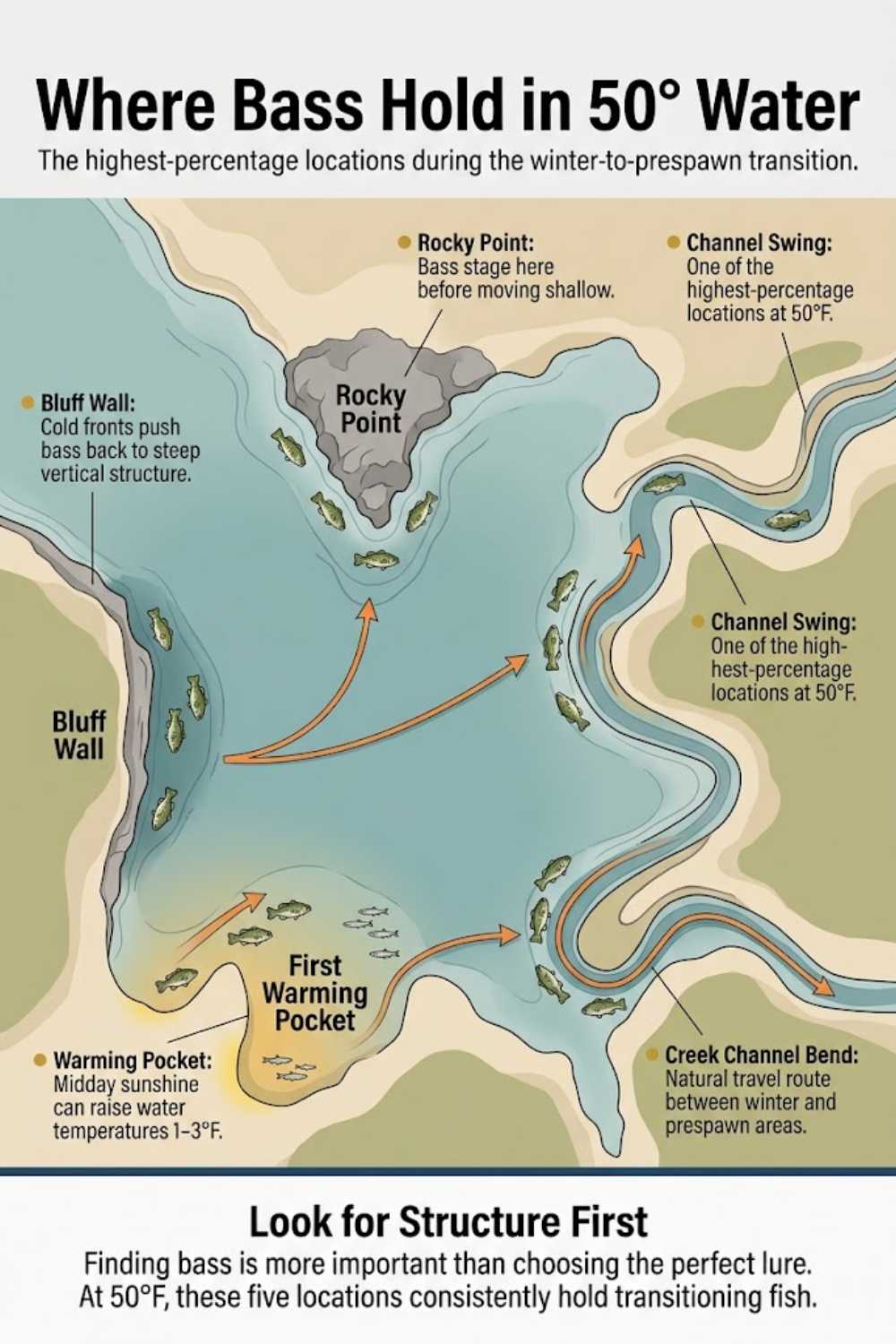
Bass positioning at 50°F divides into three high-percentage patterns.
Vertical structure adjacent to deep water — Bluff walls, channel swings, and the deep ends of main-lake points hold suspended bass in the 15–25 ft range. These fish are easiest to locate with electronics — suspended marks holding tight to vertical structure are the classic 50°F bass. Vertical-presented jerkbaits and blade baits target these fish efficiently.
First-warming areas — North-facing banks (receive the most direct winter sunlight), dark-bottom flats (absorb solar heat faster than light-bottom areas), shallow marina pockets, and any area protected from wind warm 2–4 degrees faster than surrounding water during a warming trend. Bass move into these areas during midday warming windows and feed aggressively. A jerkbait worked along the first 4–8 ft of these warming areas during midday produces concentrated 50°F bites.
Channel-current bends in creek arms — Where a creek channel makes a sharp turn against a hard-bottom bank in a major creek arm, current concentrates baitfish (and slightly warmer water) into a small zone. Winter-into-prespawn bass stack on these bends, particularly on the upstream side of the bend. Creek channel bass positioning covers the pattern in depth.
Reading conditions — Sunny days with stable barometric pressure and a warming trend produce the best 50°F bites, particularly in the 11 AM–3 PM window. Overcast days extend the productive window into early morning and late afternoon but reduce the midday warming effect. Post-front days push bass deep and tight to structure — fish slow vertical presentations on those days.
50°F presentations are all about slow. Every reliable cadence in this water temperature is dramatically slower than what produces at 60°F.
Jerkbait cadence — Jerk-jerk-pause with pause lengths of 8 to 15 seconds. The pause is when bass commit. Watch the line for any sideways movement or tick during the pause. Many cold-water jerkbait bites are felt as added weight rather than a hard strike — the bass comes up, inhales the suspended bait, and starts moving. Set the hook on any unusual line behavior during the pause.
Blade bait cadence — Lift the bait 2–3 ft on a sharp rod sweep, then let it fall back on a controlled slack line. Pause 3–5 seconds at the bottom before the next lift. Most bites happen on the fall. See the blade baits guide for full vertical-jigging technique.
Jig cadence — Drag 6–12 inches at a time with 15–30 second pauses between drags. The pause is the bite trigger. A 50°F jig should sit motionless on bottom for substantially longer than it moves.
Crankbait cadence — Steady but slow. Run the bait at approximately 60% of warm-water reel speed. On the warmest 50°F days, work a stop-and-go cadence with brief pauses every 5–7 cranks; the pause-and-resume triggers neutral fish.
Ned rig cadence — Dead-stick. Cast, let the bait fall, then do nothing for 30+ seconds. The buoyant TRD tail floats up in the natural feeding posture and bass commit to the motionless presentation when they refuse moving baits.
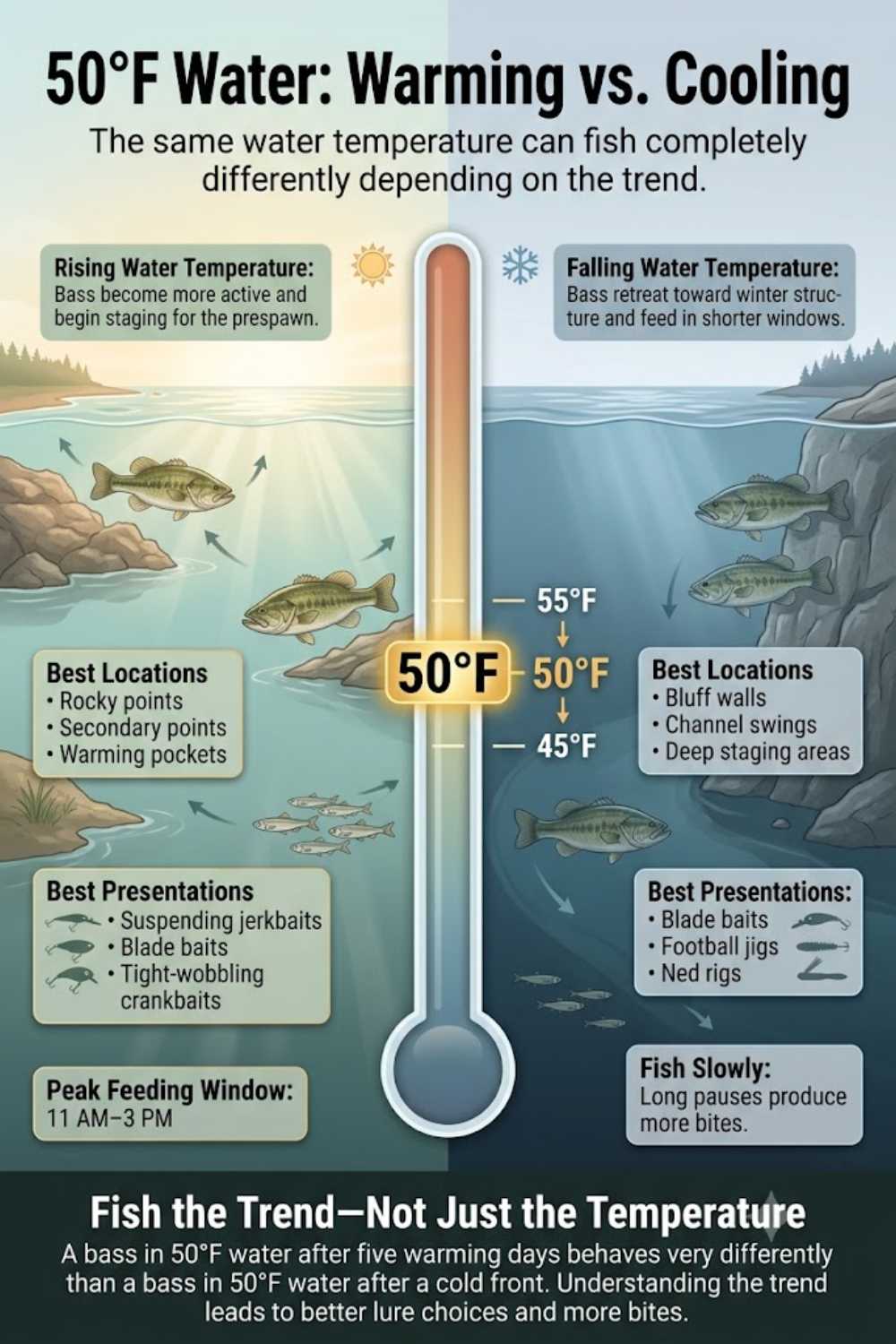
The single most important 50°F fishing skill is reading the temperature trend.
Five-day rising trend (45°F → 47°F → 49°F → 50°F → 51°F today) — Fish like 55°F water. Bass are moving from deep winter holding into mid-depth staging areas and feeding aggressively in midday warming windows. Jerkbaits, blade baits worked horizontally, and slow-rolled crankbaits all produce. Focus on first-warming areas and staging structures.
Five-day falling trend (54°F → 53°F → 51°F → 50°F → 49°F today, after a cold front) — Fish like 45°F water. Bass have slid back to deep winter holding and shut down. Vertical blade bait presentations on bluff walls and channel swings; jerkbaits with 20+ second pauses; jigs with long bottom pauses. Cold front bass fishing lures covers the post-front adjustment.
Stable trend (50°F → 50°F → 50°F across multiple days) — Fish like 50°F water exactly. Bass are pattern-locked on whatever positioning fits the current conditions. Identify the productive structure or area on day 1, then repeat the pattern on subsequent days until the temperature trend changes.
Sunny vs overcast — Sunny days favor warming-window patterns and shallow-to-mid-depth presentations during the 11 AM–3 PM window. Overcast days favor deeper vertical presentations across the full day. Sunny day bass fishing and overcast day bass fishing cover the daily-pattern adjustments.
Wind — Light wind on a warming day pushes warmer surface water into protected pockets and creates concentrated feeding zones on wind-blown banks. Heavy wind in cold water generally hurts the bite — switch to vertical presentations protected from the chop.
50°F is the transition temperature in bass fishing. The right lure choice depends on which direction the water is trending. On warming trends, fish jerkbaits, slow-rolled blade baits, and tight-wobbling crankbaits across first-warming areas and staging structures. On cooling trends, fish vertical blade bait and jerkbait presentations on deep vertical structure with extended pauses. Master the trend-reading skill and the lure decision becomes natural.
For the broader temperature playbook, see best bass lures by water temperature and best bass lures for 55-degree water. For the dedicated cold-water reaction-bait technique, see the best blade baits guide. For winter fishing more broadly, see winter bass fishing lures.
Industry-standard suspending jerkbait for cold-water bass.
Cold, clear water — long pauses near rock and points.
As an Amazon Associate I earn from qualifying purchases.
Staging fish on transition banks and the baits that work.
Fry guarders and the recovery slowdown.
Walking baits, frogs, and poppers in heat.
Deep structure or shade — pick one.
Shade plus structure in the heat of the year.
Shad migration and aggressive pre-winter feeding.
Plug in today's water temp, clarity, weather, and forage — the tool returns the highest-confidence presentations.
Build Today's Strategy →