Best Heavy Cover97%
Strike King Hack Attack Swim Jig
Bluegill
View Product →The best swim jigs for bass — bluegill and shad patterns, trailer pairings, grass and shallow-cover strategy, and how swim jigs outproduce spinnerbaits when bass want a tighter profile.

Affiliate Disclosure: As an Amazon Associate I earn from qualifying purchases. Recommendations reflect on-the-water testing and the LureLogic ranking engine — not paid placement.
A swim jig is a horizontal-presentation jig designed to be retrieved through the strike zone like a swimbait, not dragged on bottom like a football or flipping jig. The right swim jig combines a bullet head that comes through cover cleanly, a sharp heavy-wire hook, a balanced weed guard that protects the hook without killing hookup percentage, and a skirt that pulses on the retrieve.
Dirty Jigs Swim Jig — Editor's Pick. Combines all four design elements at a tournament-grade level. The hand-tied skirt holds shape through dozens of fish, the head shape glides through grass without fouling, and the hook drives home on a moderately-loaded rod.
Strike King Hack Attack Swim Jig — Best Heavy Cover. Designed for fishing the dense grass and reed cover that holds the largest swim-jig bass in any system. Heavier hook, stiffer weed guard, more aggressive head shape.
Siebert Outdoors Swim Jig — Custom Build. Boutique builder offering custom skirt blends and head finishes that produce when mass-produced jigs lose their edge on pressured waters.
Nichols Swim Jig — Premium Construction. Owner hook with a precision-molded head and a high-density skirt that creates a thicker, more meaningful profile. Ideal for big-fish hunting.
Santone Swim Jig — Finesse Specialist. Lighter wire, smaller profile — excels on pressured clear-water fish and around bluegill colonies where a smaller meal outproduces a full-size bait.
Z-Man ChatterBait FreedomCFL — Hybrid Pick. Bridges swim jig and chatterbait, adding a vibration blade to a swim-jig-style head. Worth carrying when bass want vibration along with the tighter baitfish profile.
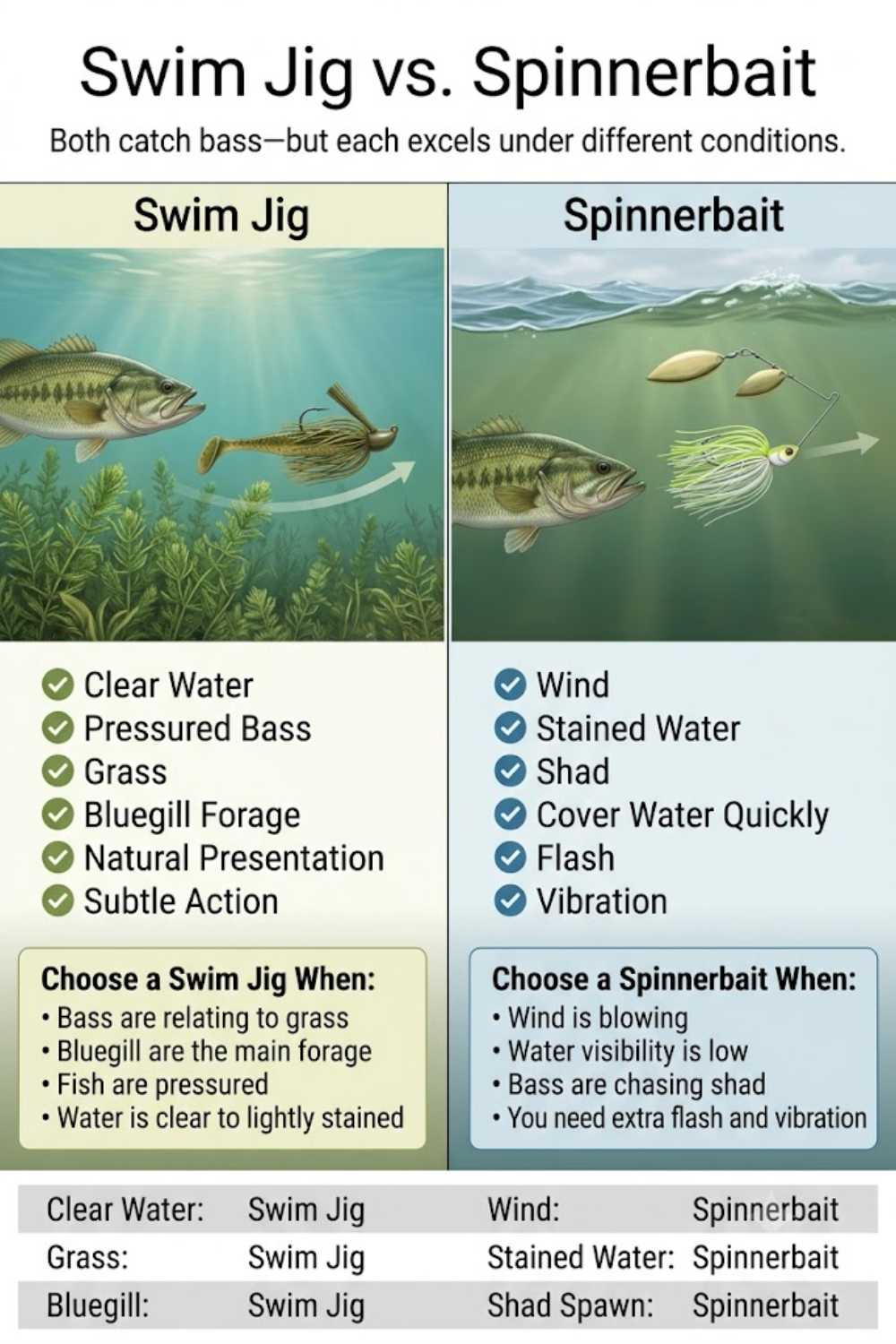
Swim jigs produce because they present a baitfish-shaped, baitfish-sized profile with subtle vibration and minimal flash — exactly what bass want when they are eating bluegill, herring, threadfin shad, and smaller baitfish in moderately clear water. A swimbait alone has no weed guard and snags in cover; a spinnerbait throws too much flash for pressured fish; a chatterbait throws too much vibration for selective fish. The swim jig sits in the middle of all three.
The second reason swim jigs work is their ability to fish cover other moving baits cannot. The compact head and weed guard let a swim jig swim through hydrilla, milfoil, lily-pad stems, dock cables, and laydown branches that would foul a spinnerbait or open-hook swimbait. That cover-penetration ability is what lets the swim jig reach the bigger bass holding inside the cover instead of cruising the edges.
Third, swim jigs are versatile across retrieve speeds and depths. A slow burn just under the surface during a shad spawn imitates spawning shad; a steady mid-column retrieve through grass mimics a bluegill cruising the canopy; a deeper retrieve along outside grass edges fishes a swim jig as a near-bottom reaction bait.
Finally, swim jigs are one of the highest-percentage big-fish baits in shallow water. A 4-lb-plus largemouth that has refused a spinnerbait three times will often crush a bluegill-pattern swim jig swum through the same cover. The combination of natural profile, cover penetration, and adjustable presentation triggers better-class fish that pressure has educated against more obvious moving baits.
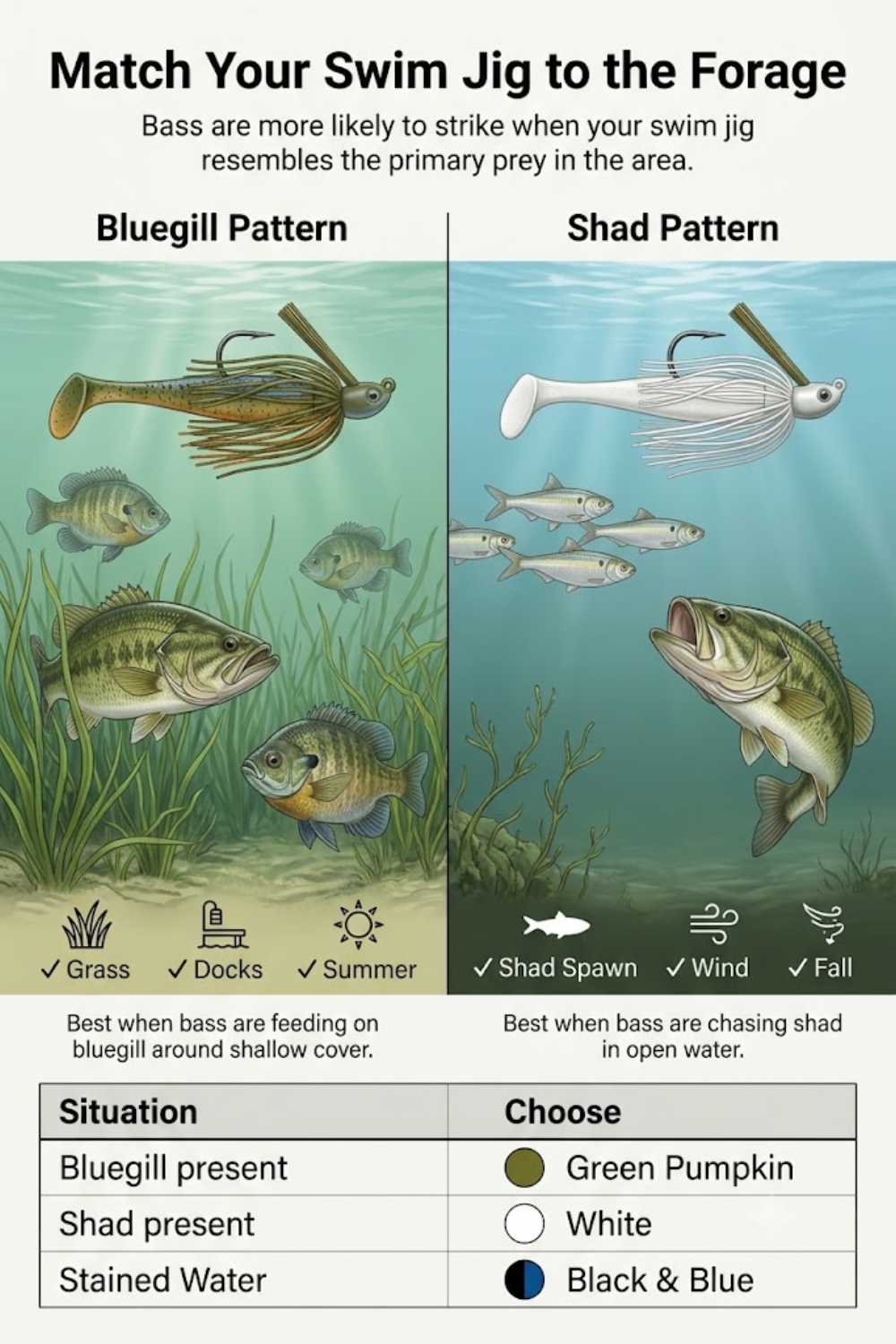
Swim jig color selection is more forage-driven than most jig categories because the bait is presented in the bass's primary feeding zone — the upper half of the water column where bait is most visible. Match the bait, not the bottom.
Bluegill patterns — The single most productive swim jig color family. Green pumpkin skirts with orange and blue strands match bluegill from late spring through fall in any lake with a strong bluegill population. Pair with a green pumpkin paddle-tail trailer or a flat-tailed plastic for a bluegill-shaped profile. Fish around shallow grass, dock cover, and shaded laydowns.
White and sexy shad — The shad-pattern family. Imitates threadfin shad, gizzard shad, and herring. Fish during the shad spawn (late May, water 65–72°F), during the fall shad migration into creek arms, and around windblown points where shad concentrate. The fall shad migration guide covers the seasonal timing.
Black and blue — The stained-water default. When visibility drops under 18 inches or skies are heavily overcast, bass cannot resolve natural colors — the dark silhouette of a black-and-blue swim jig becomes the only profile they can lock onto.
Fire craw — Productive in early summer when bass key on crawfish migrating shallow on rocky banks. A fire-craw swim jig swum slowly along riprap or chunk-rock outproduces dedicated crawfish presentations because the horizontal retrieve covers more water.
Bright colors — Chartreuse and pink swim jigs occasionally produce in extremely muddy water where black-and-blue refuses bites. The muddy water bass fishing guide covers this approach.
Trailer selection changes a swim jig more dramatically than skirt color. The right trailer affects fall rate, retrieve depth, profile silhouette, and the vibration signature bass key on.
Paddle-tail swimbaits — The default. A Keitech Swing Impact FAT (3.3 or 3.8 inch) is the universal starting point. Tight, fast kick generates a vibration profile bass associate with feeding baitfish; the paddle silhouette imitates threadfin shad, herring, and small bluegill simultaneously.
Split-tail and flat-tail plastics — The bluegill option. A Yamamoto Zako, Zoom Speed Worm, or flat-tailed Berkley trailer creates a flat, wider profile that matches a bluegill silhouette. Use specifically around bluegill colonies and postspawn bluegill flats.
Craw-style trailers — The cold-water and slow-retrieve option. A Zoom Z Craw or Berkley Pit Boss kicks slower than a paddle-tail and creates a craw-and-baitfish hybrid profile. Use in cool water or when bass key on mixed forage.
Double-tail grubs — The classic and still-effective option. A Yamamoto 4-inch double-tail grub creates a fluttering tail action that produces in clear water and on pressured fish.
Trailer rigging — Slide the trailer onto the hook so the paddle or split-tail sits parallel to the hook gap, not perpendicular. Use a small trailer keeper or a drop of super glue to keep the trailer in position. A trailer that slides down the hook on the second cast ruins the bait's action.
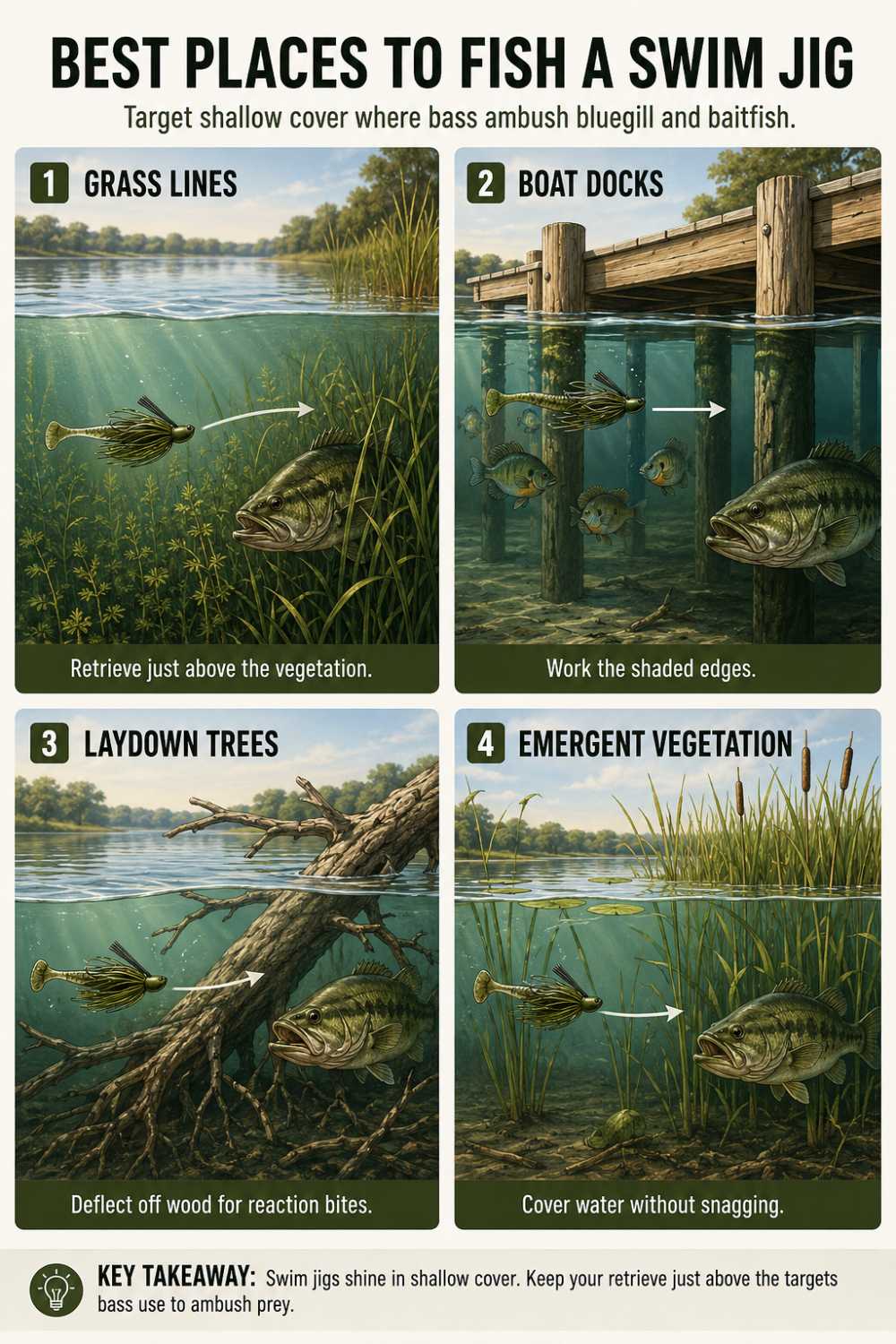
Swim jigs work in every type of shallow cover, but retrieve speed and depth change with cover and season.
Grass and submerged vegetation — The primary swim jig cover type. Bass position inside hydrilla, milfoil, and pondweed beds and ambush bait moving through the canopy. Swim a 3/8 or 1/2 oz bluegill swim jig at the top of the canopy on a steady retrieve, letting the jig tick the tops of the grass and occasionally pulling it free. Most bites happen as the jig comes free of contact. The grass line bass fishing guide covers the technique.
Docks — Skip a 3/8 oz compact swim jig deep under the dock and reel back at moderate speed. Floating docks in summer hold the biggest swim-jig fish in main-lake pockets — see summer dock bass fishing.
Laydowns and wood — Swim the jig parallel to the trunk and over major branches, letting it pause briefly when it ticks wood. Bass hold on the shaded side and at limb junctions — let the jig fall on slack line for one count after each wood contact. The laydowns guide details bass positioning.
Riprap and rocky banks — A 1/2 oz swim jig swum parallel to riprap at moderate speed produces from prespawn through summer. White or bluegill colors based on forage.
Shallow flats — Burn the jig just under the surface during low-light periods (early morning, late evening, overcast days) when bass push shad up onto flats. A white swim jig burned across a 2–4 ft flat in early morning often outproduces topwater on pressured lakes. See early-morning bass lures.
Swim jigs produce nine months of the year for anglers who adjust presentation to season.
Prespawn (water 55–62°F) — Bass move shallow on warming trends and stage on outside grass edges and rocky transitions. A 1/2 oz swim jig (sexy shad or bluegill) swum slowly along secondary points and the outside edge of emerging grass produces aggressive prespawn fish. The prespawn bass fishing guide covers the broader pattern.
Spawn (62–70°F) — Rarely the right answer. Flipping jigs, finesse plastics, and sight-fishing baits dominate. Swim jigs return to productivity at the tail end of the spawn as males begin guarding fry.
Postspawn through early summer (68–78°F) — The marquee swim jig window. Bass recover around shallow grass, dock cover, and laydowns and key heavily on bluegill. A bluegill-pattern swim jig swum through this cover at moderate speed outproduces almost every other technique. The postspawn bluegill behavior guide explains why.
Mid-summer (78–88°F) — The pattern splits. Early-morning and late-evening swim jig presentations produce on shallow flats and around shade lines; midday fish slide to docks, shaded grass mats, and offshore structure. A white or sexy-shad swim jig in the magic hours pairs with a bluegill or black/blue swim jig flipped into dock shade midday. Shade-line bass fishing covers the geometry.
Fall (75–55°F) — The second peak. Bass push shallow chasing shad migrating into creek arms. A white swim jig swum parallel to creek banks intercepts feeding fish. Match shad size: 3.3-inch trailer for threadfin-dominated lakes, 3.8-inch for gizzard-dominated lakes.
Winter (under 55°F) — Swim jigs lose to slower presentations (jerkbaits, blade baits, jigs). See winter bass fishing lures.
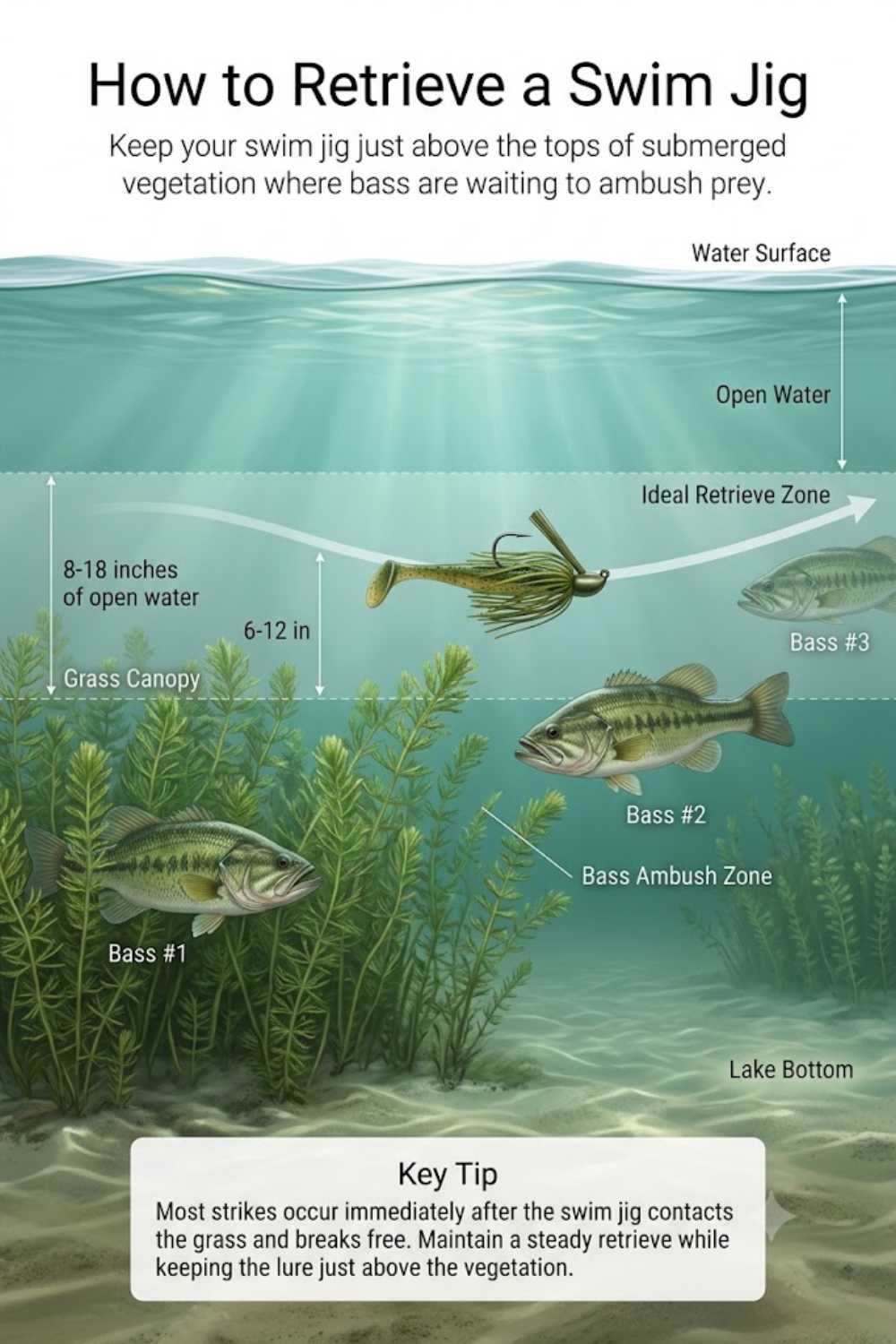
Swim jig presentation is about retrieve cadence, depth control, and triggering reaction strikes from cover contact.
Retrieve speed — Moderate is the default. A steady reel speed that keeps the jig at the desired depth without burning is correct for the majority of situations. Speed up around schooling fish and during shad-spawn windows; slow down in cool water and around pressured fish.
Depth control — Manage depth with rod-tip angle and reel speed, not jig weight. A 3/8 oz swim jig fished with a high rod tip and moderate retrieve stays in the upper 2–4 ft; the same jig with a lower rod tip and slower retrieve drops to 5–8 ft. Use a 1/2 oz jig for deeper presentations and rougher water.
Cover deflection — The single biggest swim jig trigger is deflection off cover. Make contact with grass tops, dock posts, laydown branches, and stumps, then let the jig come free and fall briefly. Most bites happen in the half-second after the jig comes free of cover.
The hookset — Reel down to remove slack, then sweep the rod hard to the side. With braided line (40–50 lb in cover, 30 lb in open water) and a sharp heavy-wire hook, hook penetration is rarely the issue. The side-sweep keeps the jig rotating into the corner of the bass's mouth instead of pulling straight out.
Reading the bite — Swim jig bites range from a hard thump to a sudden loss of pressure. When the jig stops kicking or feels lighter than it should, set the hook. If you feel taps without weight, slow the retrieve and let the trailer fall briefly before resuming.
Line selection — 40–50 lb braid around heavy cover; 17–20 lb fluorocarbon in open water and clear water where braid visibility hurts the bite.
Heavy hook and clean swim through grass.
Grass and docks — clean swim, mimic a cruising bluegill.
As an Amazon Associate I earn from qualifying purchases.
Temperature-by-temperature lure logic.
The prespawn temperature threshold.
Natural presentations and finesse profiles.
Vibration, dark silhouette, and visibility tactics.
Adjusting across the full clarity spectrum.
Topwater and reaction baits for the dawn window.
Plug in today's water temp, clarity, weather, and forage — the tool returns the highest-confidence presentations.
Build Today's Strategy →