Editor's Pick97%
Heddon Super Spook
Bone
View Product →The best bass lures for summer, matched to the three windows that matter: topwater at dawn and dusk, deep cranks and football jigs offshore at midday, and frogs over matted grass. Picks by depth, clarity, and water temp.
Affiliate Disclosure: As an Amazon Associate I earn from qualifying purchases. Recommendations reflect on-the-water testing and the LureLogic ranking engine — not paid placement.
The one-paragraph version: fish topwater at dawn and dusk, fish offshore structure with deep cranks and football jigs during the midday hours, throw a frog anywhere you see matted vegetation, and lean on a drop shot or wacky Senko when the offshore school gets pressured. Almost every productive summer day looks like some version of those four rotations.
The Heddon Super Spook is our Editor's Pick because it produces on the highest-percentage summer window (dawn and dusk topwater) across virtually every fishery in the country. It walks the dog with almost no effort, casts a country mile in wind, and lasts for years. If you had to fish the entire summer with one bait, this is the one.
The Strike King 6XD is our Best Offshore pick — a deep-diving crankbait that reaches 18–19 ft on 12 lb fluorocarbon and covers offshore structure faster than any other summer presentation. When you locate a ledge or hump loaded with bass, the 6XD will trigger reaction strikes when finesse baits get ignored.
The River2Sea Whopper Plopper (90 or 110 size) is our Best Prop Bait — a plop-plopping topwater that draws bass up from deeper water than a walking bait will. It is unbeatable in low-light conditions, on channel edges, and any time the bass are relating to slightly deeper water but still willing to look up.
Round out a summer arsenal with a SPRO Bronzeye frog for matted vegetation, a Dirty Jigs football jig with a Rage Craw for offshore rock, a 6-inch Roboworm on a shaky head or drop-shot for pressured deep fish, and a Gary Yamamoto Senko for shallow shaded cover. Those seven categories cover the entire summer decision tree.
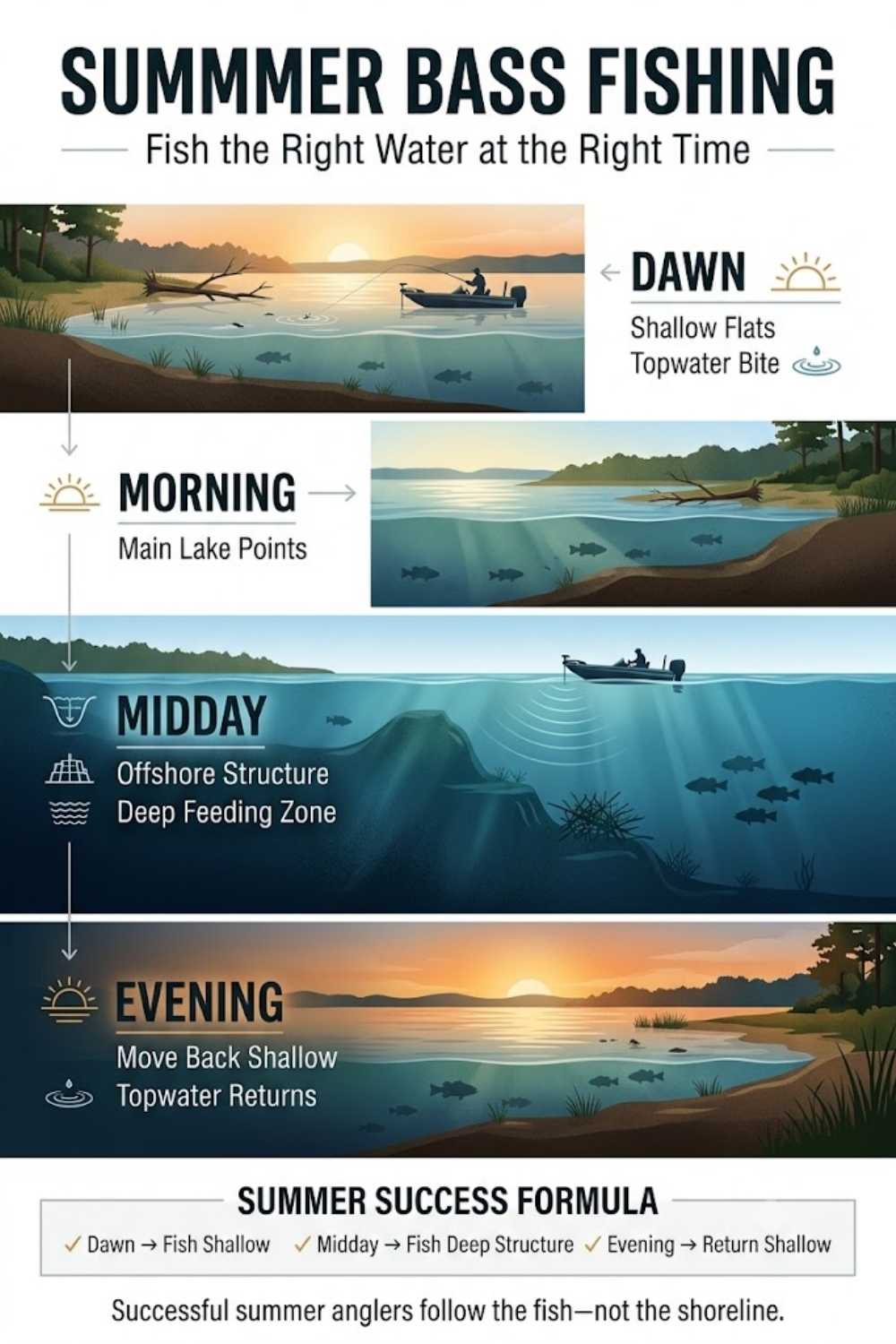
Summer bass fishing is a game of windows and depth zones, not a game of grinding one bank all day. Three biological realities drive every summer lure decision.
First, metabolism plateaus and then declines. Bass metabolism peaks at 72–78°F and starts declining above 82°F. Feeding does not stop, but it compresses into short windows when conditions align — low light, cooling temperatures, moving water, or a concentrated bait ball. Between those windows bass conserve energy and refuse to chase. This is why a summer angler catches five fish in 45 minutes at dawn and then goes three hours without a bite: the fish are still there, but the feeding window closed. See bass fishing during a heat wave for the extreme end of this pattern.
Second, thermal stratification changes where bass live. On lakes deep enough to stratify (roughly 25+ ft), a thermocline sets up in early summer and remains stable through August. Below the thermocline, dissolved oxygen drops sharply — often below 3 ppm, which bass cannot tolerate. Bass are effectively trapped in the water column above the thermocline. That means offshore summer bass are not scattered across 40 ft of water column; they are compressed into a specific depth band (often 12–20 ft) sitting just above the thermocline. Find that band on electronics and you find fish. See the thermocline productive depth layer.
Third, oxygen and current become bite drivers. Any oxygen-adding event — wind on a bank, hydroelectric current, a shad ball generating surface disturbance, a cool rain — turns on a bite window. Anglers who watch weather, wind direction, and generation schedules on regulated reservoirs put themselves on active fish. See reservoir current bass feeding and summer oxygen crash.
The practical translation: the angler who fishes 'the same way at 10 AM as at 6 AM' catches 20% of what an angler who rotates through the summer windows catches. The lure list below is organized around those windows, not around a single presentation.
Heddon Super Spook — Editor's Pick, Dawn and Dusk Topwater. A 4.5-inch walking bait that casts extreme distance, walks the dog without operator input, and draws violent strikes in the low-light windows. Prime colors are bone, sexy shad, and okie shad. Fish it over shallow flats, along shorelines with sparse cover, and around isolated laydowns. See the best topwater lures guide for the full topwater comparison and the summer topwater deep dive for the seasonal application.
River2Sea Whopper Plopper 90/110 — Best Prop Bait. A plop-plopping prop tail draws bass up from 8–10 ft in a way that a flatline walking bait cannot. Bone, blue-back herring, and munky-butt are the workhorse colors. Fish it slower than you think along channel edges, over deep grass beds, and around isolated cover in 4–10 ft.
Strike King 6XD — Best Offshore Cover-Water Bait. A deep-diving crankbait that reaches 18–19 ft on 12 lb fluorocarbon with a long cast. Sexy shad, citrus shad, and chartreuse-with-blue-back cover almost every clarity. Fish it on ledges, main-lake points, and offshore humps by pulling with the rod (not the reel) to keep it in the strike zone longer. See the crankbaits for bass guide.
Dirty Jigs Football Jig — Best Offshore Slow Presentation. A 3/4 or 1 oz football jig with a Rage Craw or Missile Baits D-Bomb trailer is the tool for slow-crawling offshore rock, gravel humps, and the deep ends of points. Green pumpkin and green-pumpkin-with-orange are the year-round colors. When the offshore school shuts down to the deep crank, the football jig fills the boat. See the football jigs guide.
SPRO Bronzeye Frog — Best Grass and Matted Cover. A hollow-body frog is the ONLY bait that fishes matted grass and lily pads efficiently. Fish it slow, use pauses in every open pocket, and set the hook only after the fish loads the rod. Black is the go-to color for silhouette; white and bluegill patterns work in bright, clear water. See the topwater frogs guide.
Roboworm Straight Tail on a Drop Shot — Best Pressured Offshore Fish. When the offshore school gets pressured and stops reacting to the 6XD, a 4.5–6 inch Roboworm on a drop shot with a 3/8 oz weight will still trigger bites. Morning dawn, aaron's magic, and prism shad are prime colors. See the drop shot baits guide.
Gary Yamamoto Senko — Best Shallow Shaded Cover. A 5-inch wacky-rigged Senko fished under overhanging trees, along shaded docks, and around laydowns catches midday bass that refuse anything moving. Green pumpkin and watermelon-red are the workhorse colors. See the finesse worms guide.
Z-Man ChatterBait JackHammer — Best Search Bait Around Grass. A 1/2 or 3/4 oz JackHammer around deep grass edges and offshore hydrilla points produces summer bass that no other reaction bait reaches. Bluegill and white shad are the primary colors. See the chatterbaits guide.
Booyah Buzz — Best Buzzbait for Early Summer. On dark early-summer mornings, a 3/8 oz black buzzbait around shallow cover outproduces every walking bait. Fish it just fast enough to keep it on the surface.
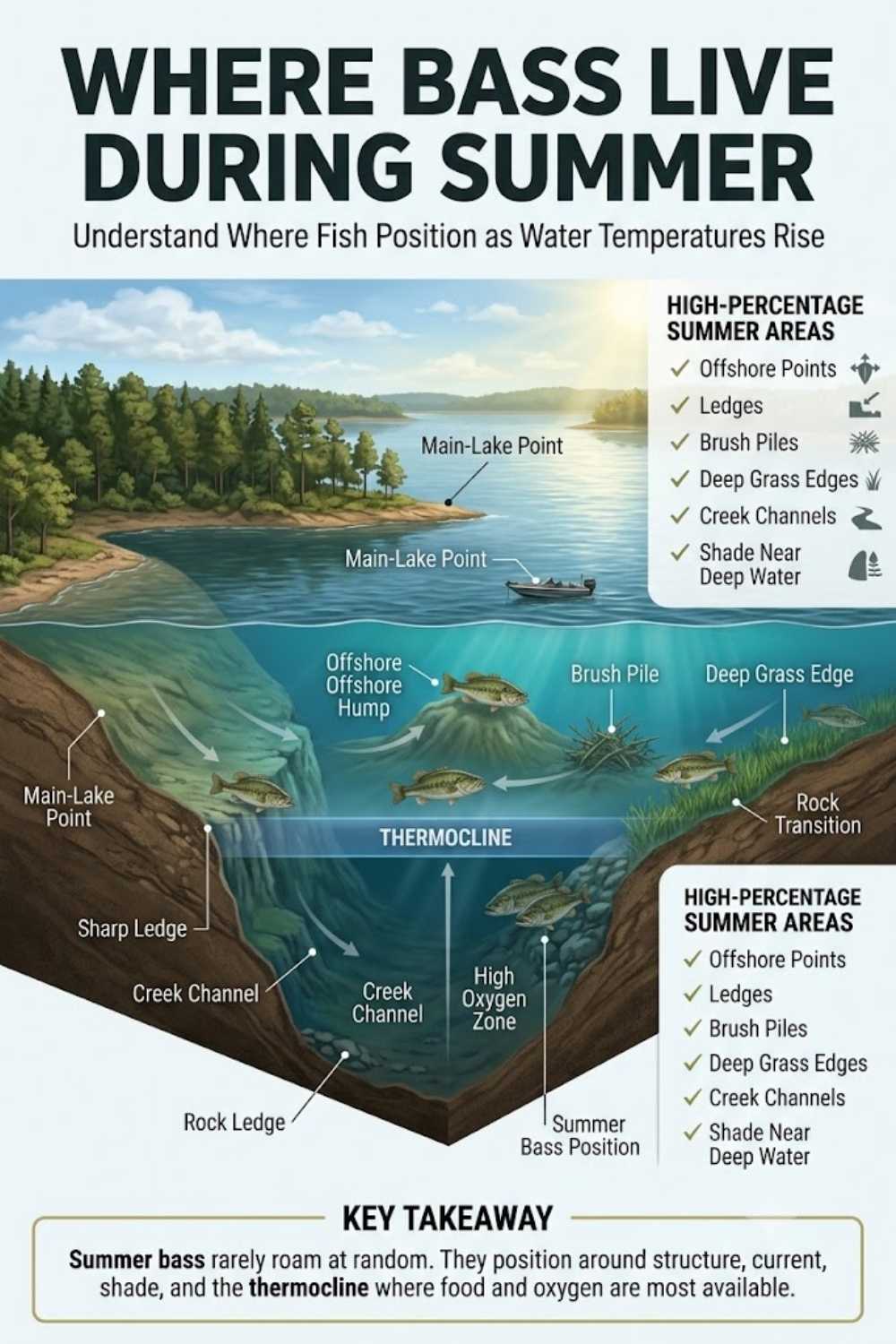
Four high-percentage summer positioning patterns.
Offshore structure — Main-lake ledges, points that drop into deep water, offshore humps in 12–20 ft, and brush piles adjacent to the channel. This is where the biggest bags of the summer come from. Look for structure that sits at or just above the thermocline depth (typically 15–20 ft on stratified southern reservoirs). Bass hold on the top or the deep edge depending on light and current. See offshore humps and the structure fishing guide.
Deep grass edges — On grass lakes (Guntersville, Okeechobee, many Texas fisheries), the outside grass edge in 8–14 ft is a magnet for summer bass. Fish it with a deep crank, a big worm on a Carolina rig, or a swimbait. When bass are locked inside the mats, transition to frog fishing.
Shaded shallow cover — During the midday hours a portion of the summer bass population stays shallow but relocates to the deepest available shade — under docks, laydowns on the north (shaded) bank, thick overhanging trees. These fish will not chase but will demolish a pitched jig, Senko, or Texas rig placed into the shade. See summer bass fishing docks and summer midday bass fishing.
Current-driven ambush zones — Hydroelectric generation, wind-blown points, creek inflows, and spillway tailrace areas concentrate summer bass because moving water oxygenates the column and delivers stunned baitfish. On regulated reservoirs, the bite often turns on within 30 minutes of generation and dies within an hour of shutdown. See hydroelectric current bass fishing, reservoir current, and bass current seams.
Wind-blown banks and points — A 10–20 mph wind on a rocky bank or point in summer can create a 45-minute midday bite window that outproduces the entire calm morning. Wind stacks plankton, plankton draws shad, shad draw bass. Throw a crankbait, chatterbait, or spinnerbait parallel to the wind-blown side.
Summer color decisions are dominated by the primary forage on your lake.
Shad-driven lakes — Most southern reservoirs are shad-dominated. Threadfin shad spawn in late spring and grow all summer, giving bass a steady 2–4 inch bait profile. Match with sexy shad, bone, white, chrome-black-back, and pearl. On lakes with gizzard shad add larger 4–7 inch profiles. See threadfin vs gizzard shad.
Bluegill and bream lakes — Shallow ponds and grass-heavy fisheries lean bluegill. Green pumpkin with orange and blue accents, watermelon red, and dedicated bluegill patterns produce all summer, especially around dock cover, shallow grass, and near visible bluegill colonies. See postspawn bluegill behavior.
Herring lakes — Blueback herring fisheries (many Southeast reservoirs) push bass deep and out onto main-lake structure. Match with bone, white, and blueback patterns on larger profiles. Herring bass often ignore small baits — err on the larger side. See herring spawn bass fishing.
Crawfish — Secondary summer forage on rocky lakes. Green pumpkin with orange highlights, brown craw, and green pumpkin candy on football jigs and Texas-rigged craws around rock and gravel banks.
Water clarity overlay — Clear (4+ ft): natural, translucent, and finesse. Stained (1–4 ft): brighter reaction colors and higher contrast. Muddy (<12 in): dark silhouettes and heavy vibration. See water clarity lure selection.
Topwater colors deserve their own note — the color that matters is the silhouette against the sky. Dark and black-bellied topwater and frogs outproduce brighter versions when the sky is bright, because they show up as a hard silhouette from below. Bone and white are the exceptions — they work in almost every light condition because they mimic the shad belly bass are keyed to.
Retrieve mistakes are the single biggest reason anglers miss summer bass. Three common errors — and the corrections.
Mistake 1 — Reeling topwater too fast at dawn. A walking bait is meant to walk the dog with small twitches, not race across the surface. Aim for one twitch per second in the calm early hours; add speed only when the sun climbs and the ripple picks up. Bass often follow a walking bait 6–8 ft before committing; a bait moving too fast never gives them the window.
Mistake 2 — Fishing deep cranks too fast. A deep-diving crankbait should be pulled with the rod, not the reel. Cast, let the bait dive on a slow steady reel, then transition to a rod-sweep-and-pause retrieve once you feel it hit the target depth. The pauses trigger strikes because the bait suspends momentarily and looks vulnerable.
Mistake 3 — Rushing the football jig. A summer football jig on offshore rock or gravel needs to look like a foraging crawfish, not a fleeing baitfish. Crawl it — literally lift and drop the bait an inch at a time — with 3-to-5-second pauses between hops. Big offshore bass often eat on the pause, not on the hop.
Other summer retrieve notes: hollow-body frogs need pauses on every open pocket (5–10 seconds is not too long); drop shots benefit from a shake-in-place retrieve rather than a hopped retrieve; buzzbaits should be reeled just fast enough to keep them on the surface, never faster.
When the bite dies — See how to adjust when the bite dies. The most common summer mid-day adjustment is downsizing (from a 6XD to a 5XD, from a 1/2 oz jig to a 3/8 oz), slowing dramatically, and moving one depth contour deeper. If bass were biting at 12 ft at 8 AM and the bite dies at 10 AM, they usually moved to 15–17 ft — not to a different structure.
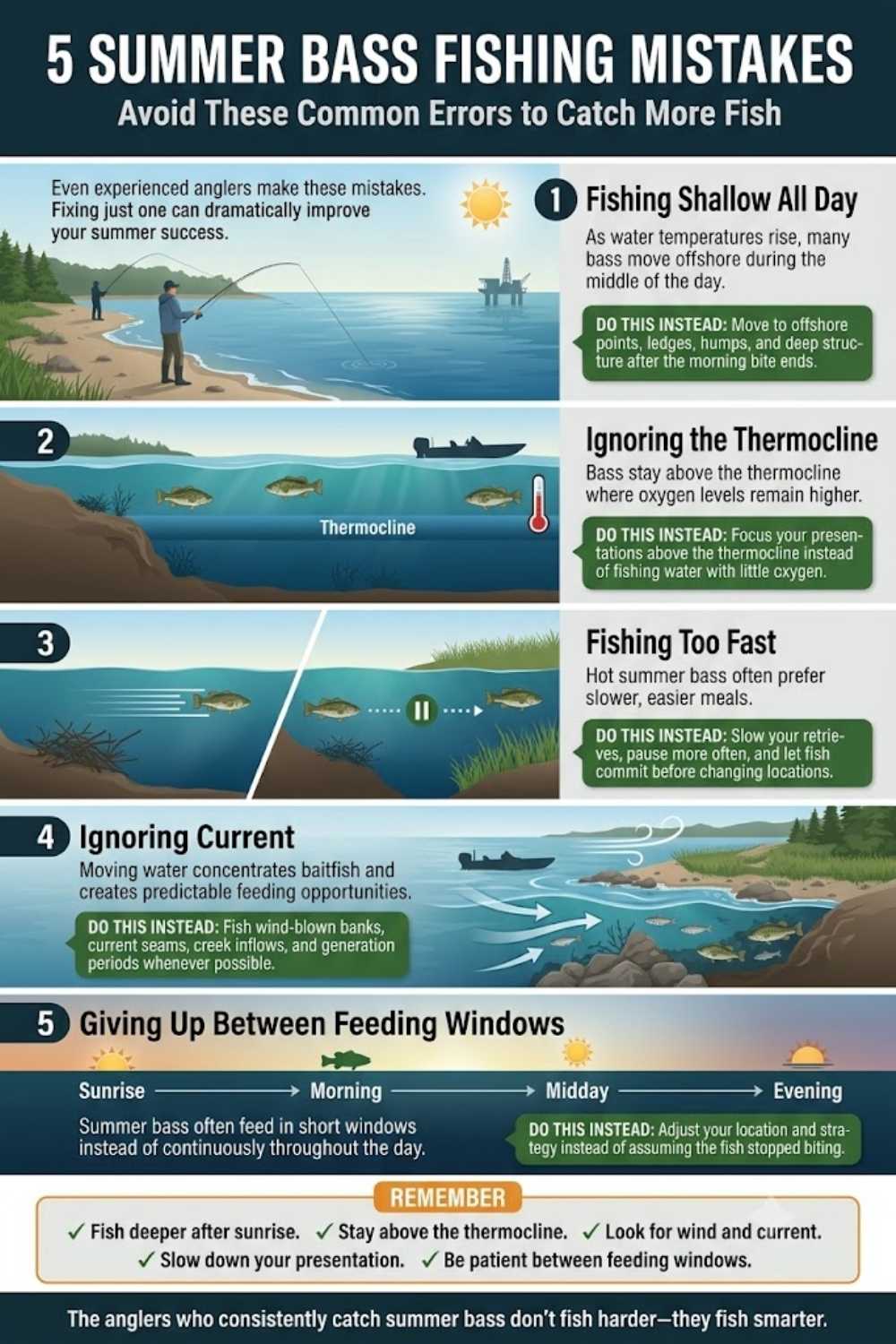
Fishing shallow all day. On most reservoirs the shallow bass are a small percentage of the summer population; the majority live offshore. Anglers who never leave the bank spend 6 hours competing for 20% of the fish.
Ignoring the thermocline. Fishing below the thermocline is fishing in dead water. Watch your electronics for the thermal band and keep your presentations above it.
Fishing the same water at 6 AM and at 1 PM. The dawn topwater fish and the midday offshore fish are frequently two completely different populations. The same bank that produced at first light will be dead at noon.
Overlooking current. A 30-minute midday bite window during hydroelectric generation is often the best 30 minutes of the entire day. Anglers who watch generation schedules and are on the correct current break when the water starts moving catch fish while everyone else grinds dead water. See reservoir current bass feeding.
Using too small a bait offshore. Summer offshore bass are calorie-focused. A 3-inch swimbait or 3/8 oz worm often gets ignored while a 6-inch swimbait or 3/4 oz football jig gets crushed. Size up.
Giving up between windows. Between the dawn topwater window and the midday offshore window there is often a 60–90 minute gap that produces almost no fish. Anglers who assume 'the bite is off' and leave miss the offshore turn-on that starts around 10 AM.
Why your lure isn't working — if you have moved through multiple summer categories and still cannot get a bite, the problem is often not the lure but the location. See why bass won't hit your lure and when to change bass lures.
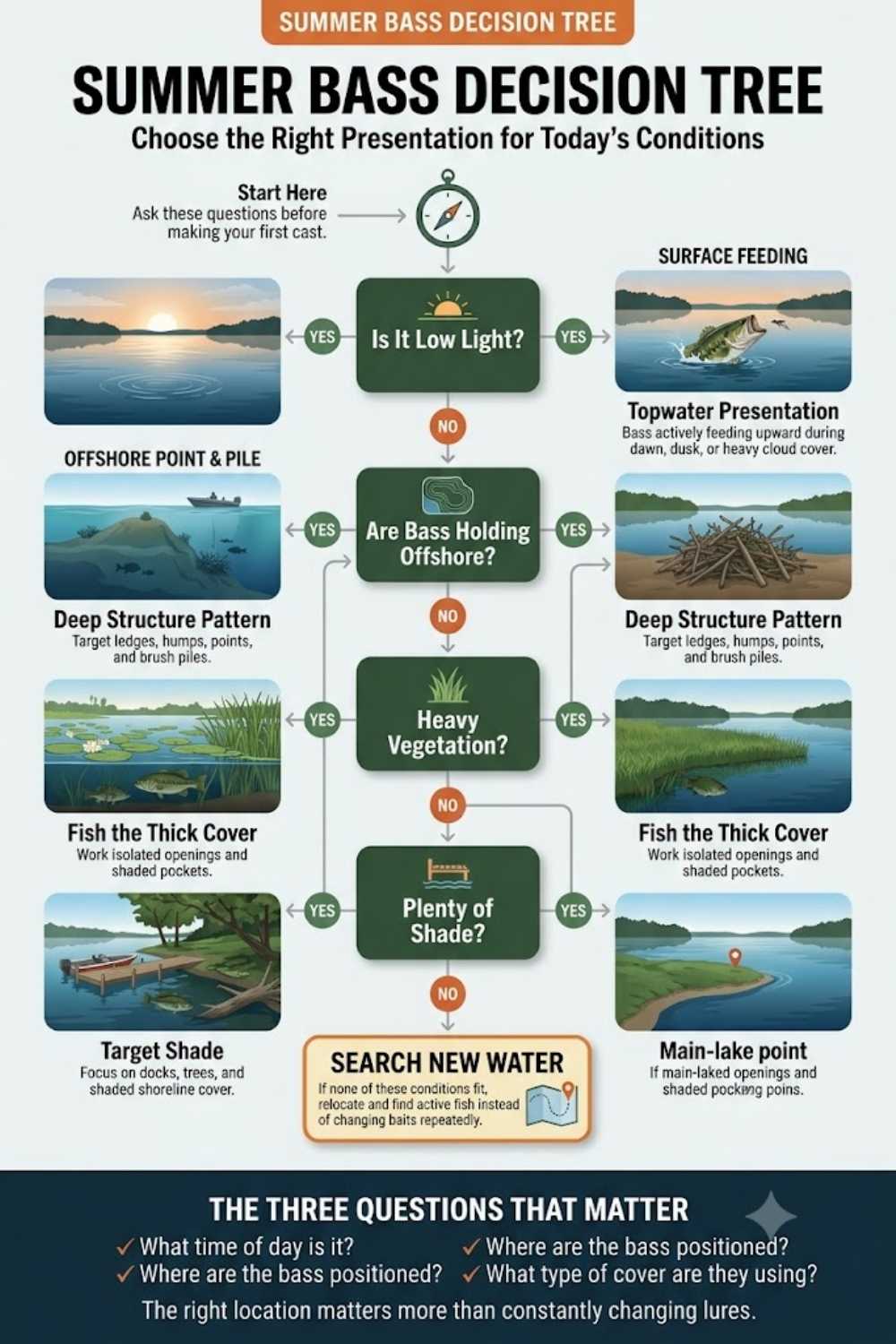
Ask three questions before you tie anything on.
1. What is the time of day and light level? Low light (dawn, dusk, heavy overcast, generation-driven current) points to topwater and reaction baits. High light and calm points to offshore structure with cranks, jigs, and finesse.
2. Where are the bass positioned? Shallow cover means frog, jig, or Texas rig. Offshore structure means deep crank, football jig, drop shot, or swimbait. Grass edges mean chatterbait, deep crank, or Carolina rig.
3. What is the primary forage and clarity? Match color and profile to whatever the local baitfish are doing at that moment. Clarity determines how bright or subtle the color needs to be.
The answers to those three questions almost always narrow the tackle-box decision to two or three legitimate categories. From there, cover-type and casting-distance requirements make the final call. If you find yourself standing on the deck cycling through 10 rods without confidence, that is a signal to open Today's Fishing Strategy and let it filter the categories by current conditions.
Building a summer arsenal is where most anglers overspend. A few purchasing rules save money and improve results.
Buy for the categories you actually fish. A 6XD is worthless if you fish exclusively shallow ponds; a frog is worthless if you fish exclusively main-lake herring reservoirs. Look at your last 20 summer trips and figure out where the bass actually lived.
Quality where it matters, value where it does not. The Editor's Pick in each summer category (Super Spook, 6XD, Bronzeye, JackHammer) earns its price by lasting through multi-year use. Value picks are perfectly fine for backup rods, kids-rig setups, and low-impact conditions.
Size up on offshore baits. The most common mistake anglers make when building an offshore summer box is buying baits that are too small. A 3-inch swimbait is a spring bait; summer offshore bass want 5–7 inch profiles.
Spool line for the presentation. Summer topwater wants monofilament (10–17 lb) because it floats and does not sink the nose of the bait. Deep cranks want 10–12 lb fluorocarbon for depth. Frogging wants 50–65 lb braid, no exceptions. Do not try to run one line for all summer techniques.
Carry more than one color of the same bait. On a summer day you may need to run a bone Whopper Plopper at 6 AM, a blueback Whopper Plopper at 10 AM, and a black Whopper Plopper at dusk. Buy the same model in the three prime colors — the loss of confidence from tying on a bait that 'used to work' in a different color is real.
Budget a frog rod. If you fish any water with grass or lily pads, a dedicated frog setup (7'3"–7'6" heavy fast, 65 lb braid) is the single highest-return purchase you can make for the summer.
Summer is dominated by the categories above, but a few situations call for tools this guide does not lead with.
After a summer cold front — Post-frontal bluebird-sky conditions in July or August can shut the offshore bite down for 24–48 hours. When that happens, a suspending jerkbait, a small drop shot, or a wacky Senko outproduces the standard offshore crank. See best bass lures after a cold front and best bass lures for high pressure.
Extreme muddy water — Summer thunderstorms can push heavy runoff into the upper reaches of reservoirs and drop visibility below 6 inches. In those conditions a black-and-blue chatterbait or a dark spinnerbait outproduces everything on this list. See best bass lures for muddy water.
Extreme heat wave shutdown — When surface temperatures push above 90°F for multiple consecutive days, even the offshore bite can dry up. In those conditions, night fishing with big worms and dark spinnerbaits, or ultra-deep drop-shotting just above the thermocline, are often the only productive options. See bass fishing during a heat wave, summer oxygen crash, and night bass fishing in summer.
Early summer transition — In the first two weeks after water crosses 75°F, bass are still in postspawn recovery and may respond better to swim jigs and shallow cover baits than to the full offshore playbook. See bass lures for 70°F water.
Highly pressured tournament water — On heavily pressured Sunday-afternoon water, drop shots, ned rigs, and wacky Senkos outproduce every reaction bait in this guide. See ned rigs and drop shot baits.
Summer bass fishing is a rotation, not a single presentation. Topwater at dawn and dusk, offshore deep cranks and football jigs during midday, frog over any matted vegetation, and finesse for pressured fish — that four-way rotation catches summer bass on almost every reservoir in the country. Build a summer tackle box around the Editor's Pick in each window, watch the thermocline and current, and let the time of day and cover type make your lure decision instead of habit.
For deeper dives into the individual summer windows, see summer topwater bass fishing, summer midday bass fishing, summer dock fishing, thermoclines and summer bass positioning, and low oxygen summer strategies. For the temperature-specific playbook see best bass lures by water temperature. For the framework behind lure choice see how to choose a bass lure.
The benchmark walking topwater — long casts and big bites.
Low-light, calm surface — walk the dog over open water.
As an Amazon Associate I earn from qualifying purchases.
Staging fish on transition banks and the baits that work.
Fry guarders and the recovery slowdown.
Walking baits, frogs, and poppers in heat.
Deep structure or shade — pick one.
Shade plus structure in the heat of the year.
Shad migration and aggressive pre-winter feeding.
Plug in today's water temp, clarity, weather, and forage — the tool returns the highest-confidence presentations.
Build Today's Strategy →