Editor's Pick97%
Z-Man Finesse TRD
Coppertreuse
View Product →The best Ned rigs for bass — TRD-style baits, mushroom heads, color selection, and how the Ned rig produces when every other finesse technique slows down.

Affiliate Disclosure: As an Amazon Associate I earn from qualifying purchases. Recommendations reflect on-the-water testing and the LureLogic ranking engine — not paid placement.
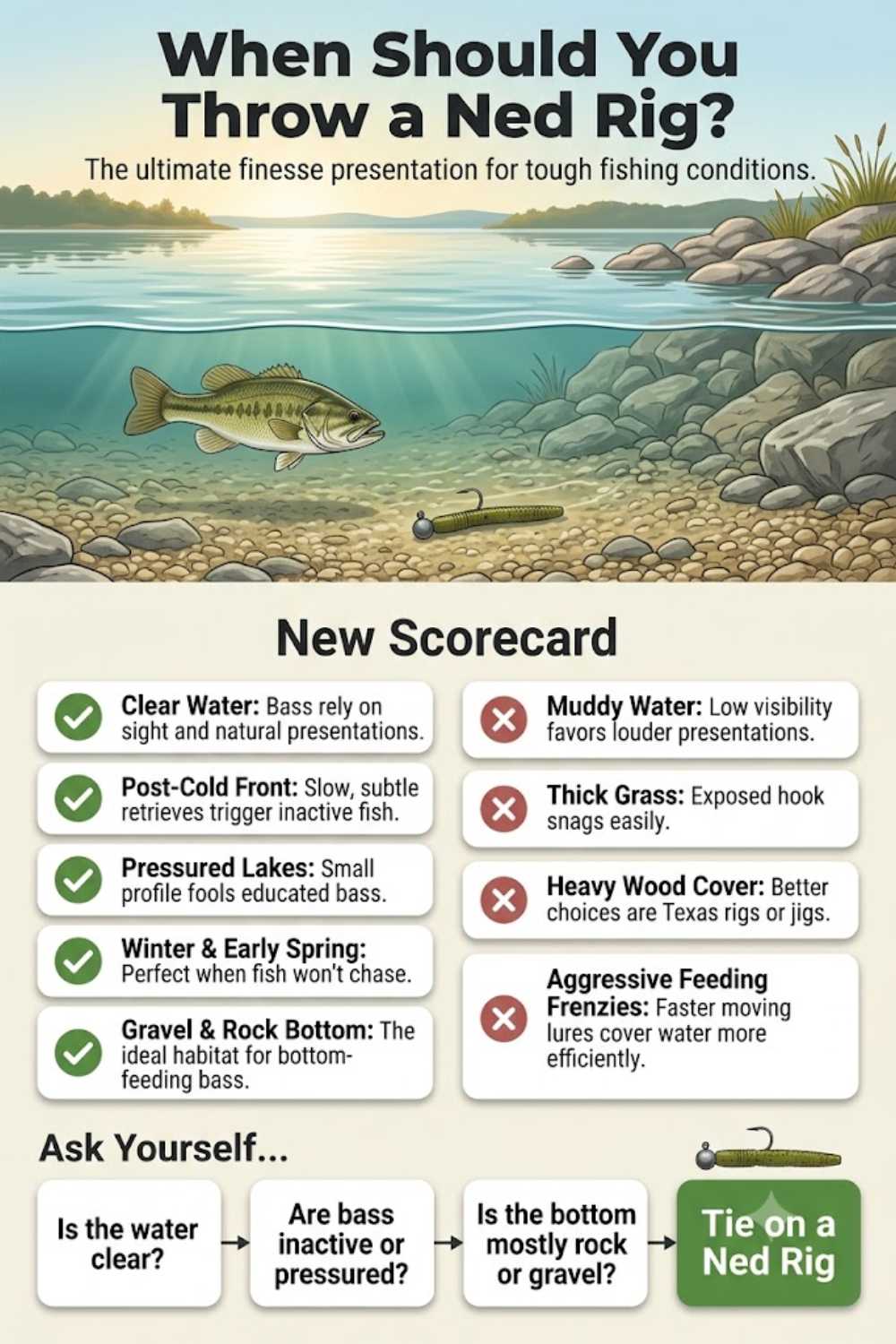
The Ned rig is the most productive finesse bass-fishing technique invented in the last 30 years. Created by Kansas angler Ned Kehde and popularized by Z-Man's ElaZtech material, the rig combines a small mushroom-head jig with a 2.5–3 inch buoyant soft plastic that floats tail-up at rest. The resulting bait posture — head on bottom, tail pointing upward — perfectly mimics a small baitfish or crawfish in a defensive feeding posture, triggering bites from bass that ignore every other presentation in the box.
Z-Man Finesse TRD — Editor's Pick. The original Ned rig bait and still the standard. The 2.75-inch ribbed body and ElaZtech material combination is what makes the rig work. Available in dozens of colors covering every clarity range and forage type.
Z-Man Finesse TRD CrawZ — Crawfish Profile. A craw-shaped Ned rig bait that excels on rocky banks during spring crawfish migrations and in any situation where bass key on small crawfish. The pincers create slight movement on the rod-tip shake that triggers bites.
Strike King Ned Ocho — Best Value. Strike King's take on the Ned rig at a working-angler price. Similar profile to the TRD with reliable color lineup. Pair with a Strike King Mr. Crappie jighead for a complete budget-friendly setup.
Missile Baits Ned Bomb — Premium Alternative. A slightly more compact profile with an aggressive head shape that produces on pressured fish that have seen too many TRDs.
Yum Ned Dinger — Stickbait-Style Ned. A slimmer, more stickbait-like Ned profile that excels on suspended-line presentations and around vertical cover.
Z-Man Finesse ShroomZ Jighead — Best Jighead. The original mushroom-head finesse jig and still the standard. The flat-bottomed head sits cleanly on any substrate and lets the bait point upward in the natural feeding posture.
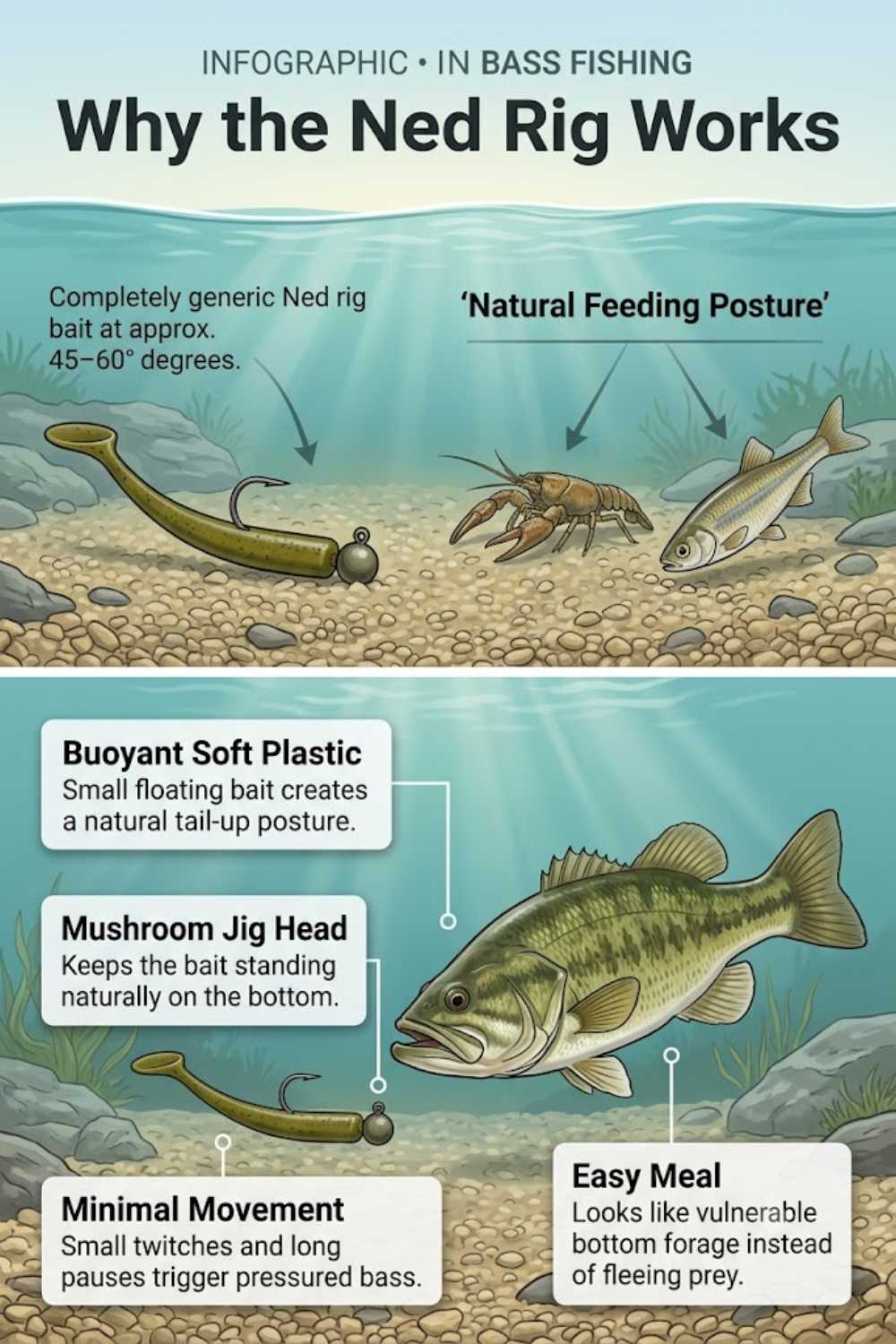
The Ned rig produces because it imitates the most common feeding posture of small bottom-oriented bass forage. A small baitfish or crawfish positioned head-down on the bottom — feeding on substrate, grazing on algae, hunting micro-prey — has its tail pointing upward into the water column. That tail-up silhouette is exactly what the Ned rig presents when the buoyant TRD tail floats up off the mushroom head at rest.
The second reason Ned rigs work is the action — or rather, the lack of obvious action. The Ned rig produces best when fished with minimal rod-tip movement. A gentle pop, a slow drag, or even simply letting the bait sit motionless on the bottom triggers bites. That subtle presentation produces on highly-pressured fish that have been educated against every aggressive bait in the box. A bass that refused a moving spinnerbait, jerkbait, and crankbait will often commit to a Ned rig sitting motionless 8 ft away.
Third, the Ned rig is one of the most versatile depth-and-condition baits in bass fishing. It produces in 2 ft of clear water on bedding bass, in 25 ft of water on offshore brush piles, in cold water during winter, and during the dog days of summer when nothing else works. Few baits fish so broadly across conditions.
Fourth, the hookup percentage on a Ned rig is exceptional. The exposed hook of the mushroom jighead and the soft ElaZtech material combine to drive the hook through the bait and into the bass on even the lightest hookset. Bass that 'mouth' a Ned rig — a common pressured-fish behavior — get hooked anyway because the small hook penetrates easily.
Finally, the Ned rig produces the bite when other techniques slow down. Post-front days, midday summer heat, deep-water winter conditions, and highly-pressured tournament water — all conditions that shut down most techniques — remain productive Ned rig windows. That reliability is why the Ned rig has become one of the most carried baits in tournament bass fishing.
Ned rig color selection follows finesse principles — natural in clear water, slight contrast bumps for stained water, and forage-matched colors when bait is obvious.
Green pumpkin — The universal starting color. Produces in clear and lightly-stained water on bluegill, crawfish, and small baitfish forage. If you carry one Ned rig color, make it green pumpkin.
The Deal — Z-Man's purple-black-orange blend. The pressured-water specialist. Outproduces green pumpkin on heavily-fished smallmouth lakes and on largemouth in highly-pressured reservoirs.
PB&J (peanut-butter-and-jelly) — A brown-purple-orange blend. The crawfish color for spring rocky-bank presentations. Pair with a Finesse TRD CrawZ for maximum crawfish profile.
Mud Minnow — A bluegill-and-shad pattern. Produces around bluegill colonies and in lakes with strong baitfish populations.
California Craw — A red-orange-brown blend for spring crawfish patterns and stained-water conditions. Produces on rocky lakes during March-May crawfish molts.
Hot Snakes — A pink-purple blend (similar to Roboworm Morning Dawn) for clear-water smallmouth and northern bass fisheries.
Match jighead color to bait color for the cleanest visual profile, though many anglers carry only natural-colored jigheads and let the bait color do the work.
The Ned rig setup matters as much as the bait choice.
Jighead — Z-Man Finesse ShroomZ in 1/10 oz (universal), 1/15 oz (shallow/calm), 1/6 oz (deep/windy), or 1/4 oz (very deep). Match jighead color to bait or use natural (green pumpkin) across the board.
Bait — Thread the TRD onto the jighead so the bait sits flush against the mushroom head. The bait should be perfectly straight on the hook — any curve kills the action and the hookset. ElaZtech material is durable; one TRD often produces 5–15 fish before being replaced.
Rod — Spinning rod, 7'0" to 7'3" medium-light with a fast tip. The fast tip transmits subtle bites and lets the angler impart slight rod-tip action without overloading.
Reel — 2500-size spinning reel with a smooth drag. Drag setting: just heavy enough to drive the hook home on a hookset (roughly 2–3 lb of pressure).
Line — 8–10 lb braid main line with a 6–8 lb fluorocarbon leader is the modern preferred setup. The braid sensitivity transmits every tick and tap; the fluoro leader provides invisibility near the bait. For traditional setups, straight 6–8 lb fluorocarbon works well.
Knot — Uni-to-uni or FG knot for the braid-to-leader connection; improved clinch or Palomar to the jighead.
Leader length — 6 to 10 ft. Long enough that the braid-leader connection doesn't pass through the rod guides during a normal cast.
The finished rig should feel sensitive in your hand — every tick of the bottom, every pebble the bait drags across, every soft tap of a bass should transmit clearly through the rod tip.
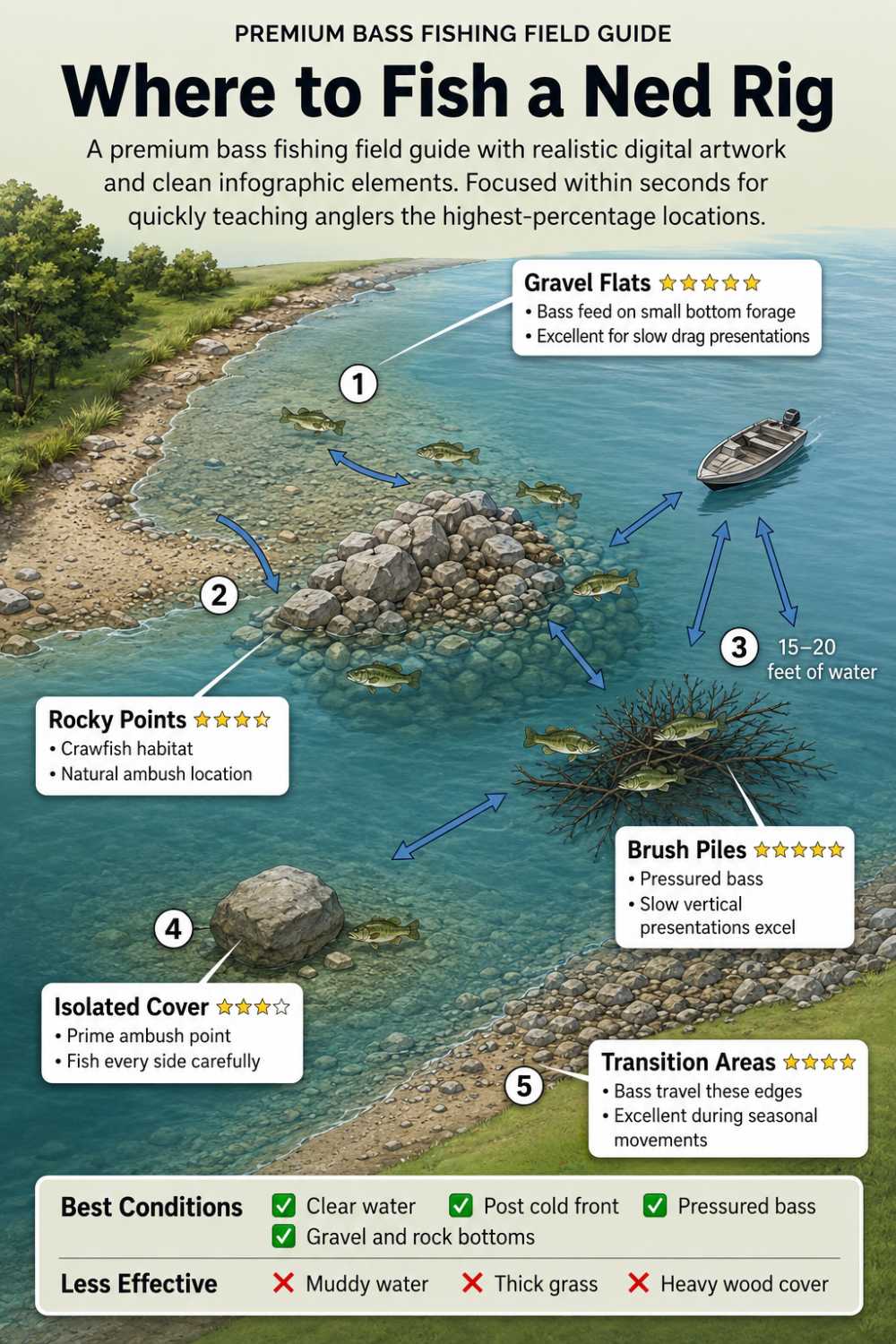
Five high-percentage Ned rig scenarios:
1. Clear-water flats and gravel banks — The home range. Bass cruise these areas hunting small forage and refuse most aggressive presentations. A Ned rig dragged or hopped slowly across the flat triggers bites from cruising fish. Clear water bass lures covers the broader pattern.
2. Post-cold-front days — When bass refuse moving baits and shut down on bottom-contact presentations, the Ned rig's subtle motionless presentation produces. Often the only technique that catches anything on a hard post-front day. The post-cold-front lures guide and cold front bass fishing guide cover the adjustment.
3. Deep offshore structure — Brush piles, isolated stumps, ledges, and humps in 12–25 ft of water often hold pressured bass that refuse jigs and Texas-rigs. A Ned rig dropped on top of these structures and worked slowly across them produces.
4. Cold-water bass — Water under 50°F slows bass metabolism. A Ned rig fished with minimal action — slow drags with long pauses — produces winter bites when most other techniques fail. Winter bass fishing lures covers the cold-water playbook.
5. Bedding bass and shallow spawning fish — A Ned rig dropped into a bed or onto a spawning flat draws aggressive strikes from territorial males. Lighter jighead weights (1/15 oz) let the bait fall slowly through the strike zone.
Ned rig is less productive in muddy water (where the subtle profile becomes a liability), in dense vegetation (where rigging snags), and during aggressive feeding windows (when faster techniques cover water more efficiently).
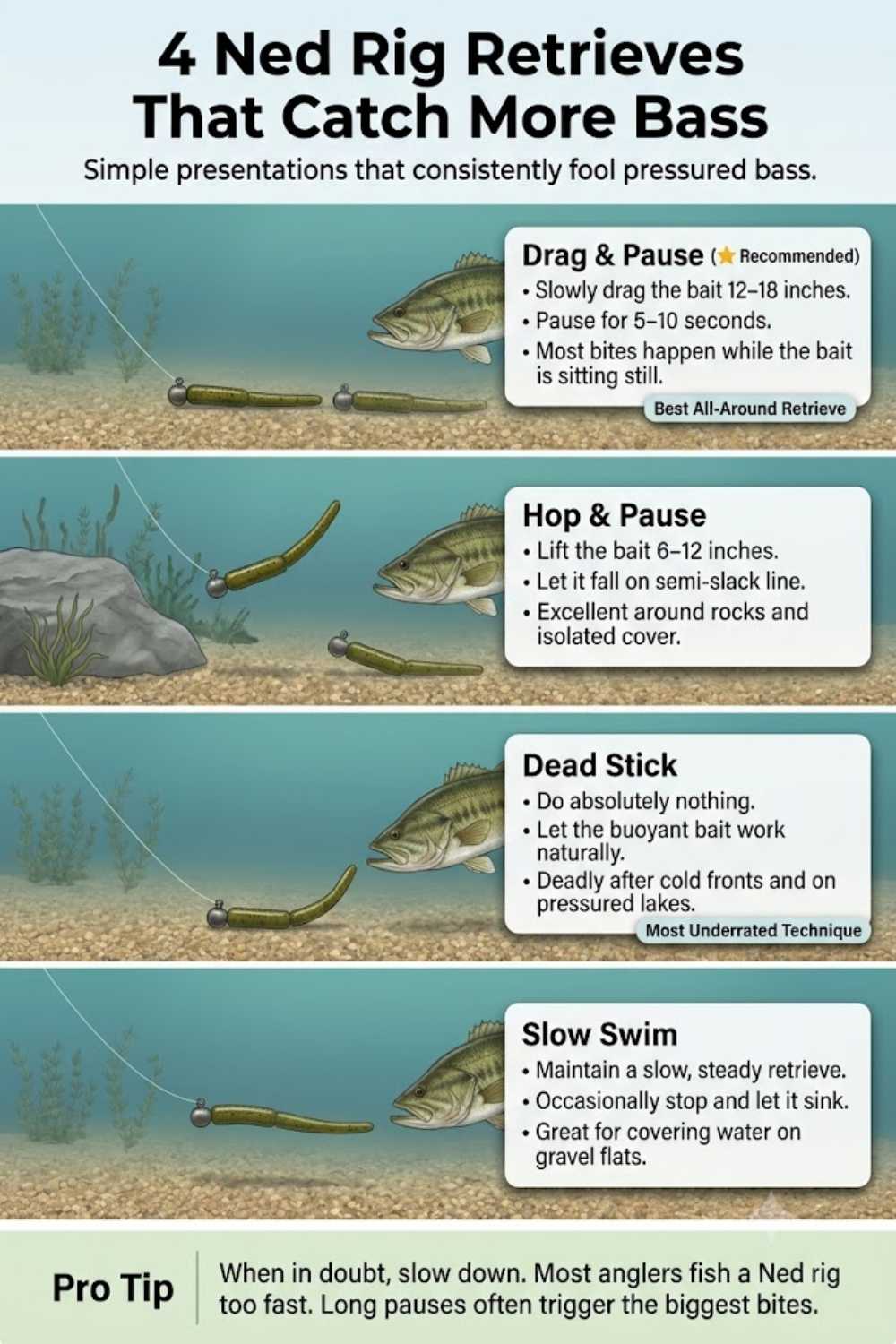
Ned rig presentation is the opposite of most bass techniques. Less movement produces more bites.
Drag and pause — The default. Cast, let the bait fall to bottom, then drag slowly across the bottom 12–18 inches at a time, pausing 5–10 seconds between drags. Most bites happen during the pause.
Hop and pause — The reaction presentation. After the bait sits on bottom for a 5-second pause, give a single sharp rod-tip pop to lift the bait 6–12 inches off bottom, then let it fall back on slack line. The fall on slack line is the bite trigger. Repeat after another 5–10 second pause.
Dead-sticking — The pressured-fish presentation. Cast to the target, let the bait fall, then do absolutely nothing for 30+ seconds. The buoyant ElaZtech tail floats up in the natural feeding posture, and bass that have refused moving presentations often commit to the motionless bait. This presentation requires patience but produces the toughest fish.
Swimming retrieve — The cover-search presentation. Reel the bait at a slow steady speed 1–2 ft above the bottom, occasionally stopping to let it fall and resume. Works in shallow water and on flats where bass are roaming.
Reading the bite — Ned rig bites range from a hard thump to a barely-perceptible tick. When in doubt, reel down slowly and set the hook. The exposed hook of the mushroom jighead and the soft ElaZtech material drive the hook through the bait on the lightest pressure, so most bites convert to hookups when you set on suspicion alone.
Line watch — Watch the line during pauses. A subtle line tick, a sideways line movement, or a sudden line slackening (a fish picked up the bait and swam toward you) all signal a bite.
The Ned rig is the most productive finesse bottom-contact bait in bass fishing. When pressured fish refuse aggressive presentations, when post-front conditions shut down the bite, when clear water demands subtle natural presentations, the Ned rig produces. Master the dead-stick presentation, build a small color arsenal covering clear-to-stained water, and the rig will catch fish in conditions where every other bait in the box has failed.
For the suspended-bait finesse counterpart, see the best drop shot baits guide. For the broader finesse-worm playbook including Texas-rig and shaky-head presentations, see the best finesse worms guide. For clear-water and post-front strategy, see clear water bass lures and post-cold-front bass lures.
The bait that defined the Ned rig — bites when nothing else does.
Tough bite, pressured fish — slow drag on hard bottom.
As an Amazon Associate I earn from qualifying purchases.
Temperature-by-temperature lure logic.
The prespawn temperature threshold.
Natural presentations and finesse profiles.
Vibration, dark silhouette, and visibility tactics.
Adjusting across the full clarity spectrum.
Topwater and reaction baits for the dawn window.
Plug in today's water temp, clarity, weather, and forage — the tool returns the highest-confidence presentations.
Build Today's Strategy →