
70°F — The Universal Feeding Window
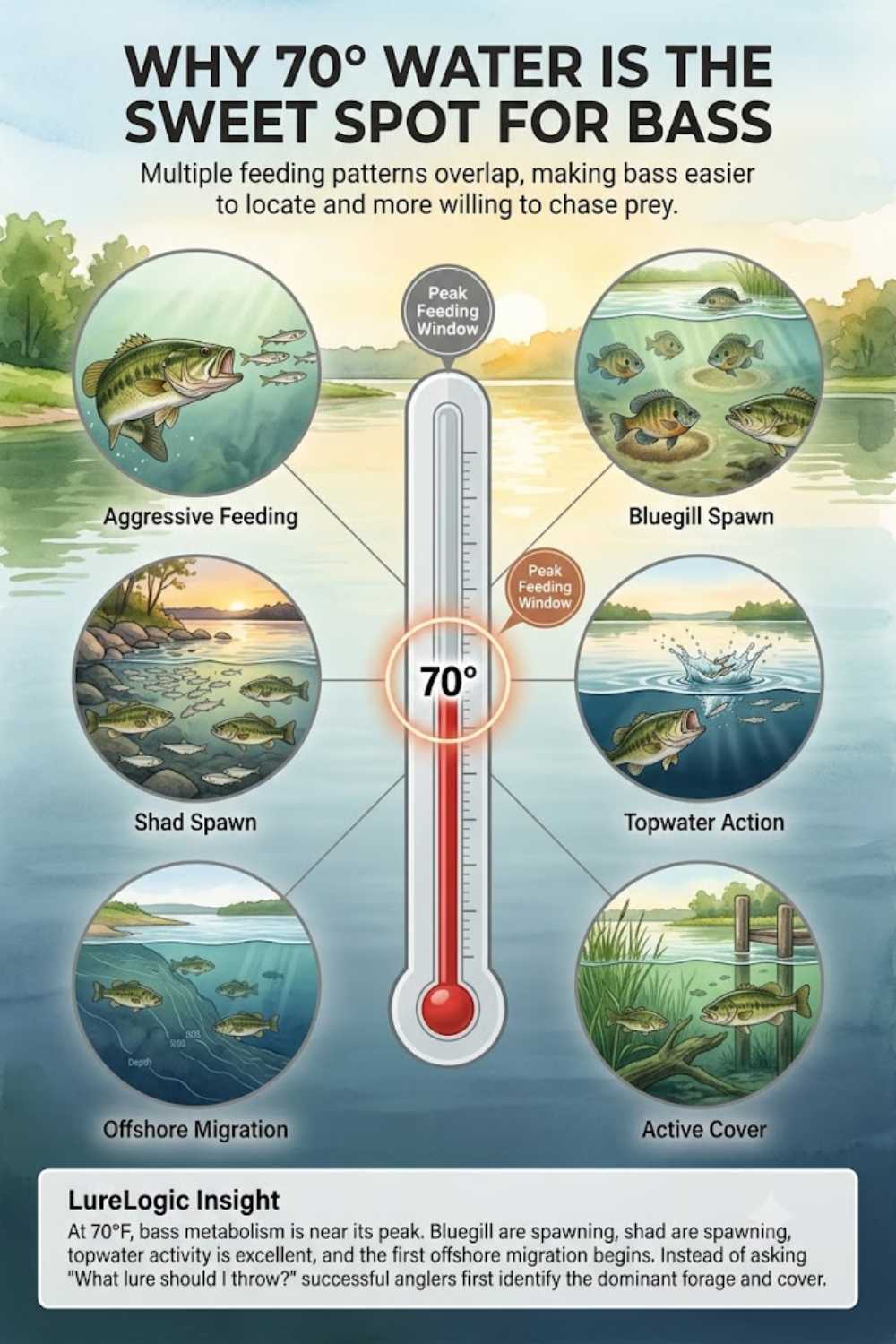
Short answer: at 70°F throw a bluegill-pattern swim jig around shallow grass and docks, a walking topwater early and late, and a chatterbait to find fish fast. At 70 degrees bass are postspawn-recovered and feeding all day, so the lure decision is driven by cover and clarity rather than metabolism — the opposite of the cold-water pages.
That is also what separates 70°F from its neighbors. At 65°F you are still reading spawning behavior and sight-fishing beds. At 60°F the prespawn reaction bite dominates. By 70°F the spawn is over, the bluegill spawn is starting, and the first wave of fish is sliding offshore — three patterns running at once.
70°F water represents the prime metabolic range for largemouth bass. Bass at 70°F are aggressively feeding, postspawn-recovered, and not yet pressured by the heat-related shutdown that begins at 78–80°F. Almost every bass lure category produces at 70°F — the lure decision shifts from 'what matches the metabolism' to 'what matches the cover and conditions.'
The biology is straightforward. Bass metabolism peaks between 65°F and 78°F, with the sweet spot at 72–75°F. At 70°F, fish have completed postspawn recovery, have rebuilt energy reserves spent during spawning, and are actively feeding to load weight for summer. Chase distances on moving baits extend to 8–15 ft, strike windows last from dawn through afternoon, and overall bite frequency is among the highest of the year.
Forage patterns matter at 70°F more than in colder water. The bluegill spawn typically peaks at 70–75°F and concentrates bass around bluegill colonies — shallow flats with hard bottom, dock cover, and sparse vegetation where bluegill make their bowl-shaped spawning beds. Postspawn-recovered bass key heavily on spawning bluegill as a high-calorie meal and respond aggressively to bluegill-imitating presentations. Postspawn bluegill behavior covers the pattern in depth.
The shad spawn (water 65–72°F) overlaps the early 70°F window and concentrates bass on hard-bottom banks where shad attach eggs to rocks. A white swim jig or shallow lipless crankbait fished along windblown rocky banks during the shad spawn produces explosive bites. See shad spawn bass fishing.
The 70°F window also begins the offshore migration. The first wave of postspawn-recovered bass moves out of shallow spawning areas onto offshore structure (ledges, humps, secondary points dropping into deep water). These offshore early-summer fish respond to deep-diving crankbaits, swimbaits, and football jigs.
Top Lures for 70°F Water
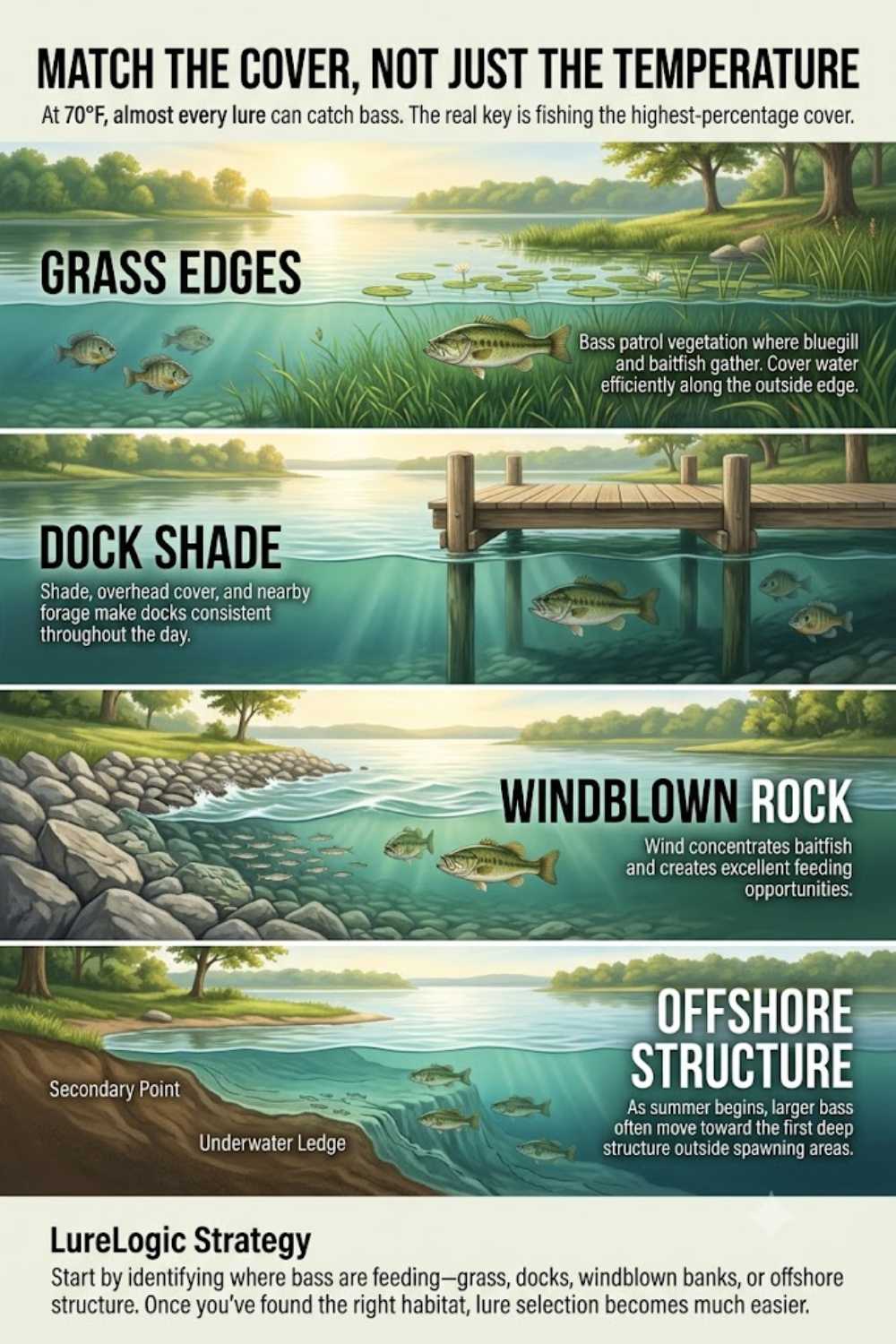
Dirty Jigs Swim Jig — Editor's Pick. A bluegill-pattern swim jig with a paddle-tail trailer (Keitech FAT 3.3 or 3.8) is the most universally productive 70°F lure. The bluegill profile matches the dominant 70°F forage, the swim jig covers water efficiently, and the cover-penetration ability lets it reach the bigger bass holding in shallow grass and dock cover. See the best swim jigs guide.
Heddon Super Spook or Spook Jr — Best Topwater. The 70°F window is one of the best topwater periods of the year. Walking baits produce throughout the day in shaded conditions and during magic-hour windows in sunny weather. Bluegill, bone, and sexy shad colors are all productive. See the best topwater lures guide.
Z-Man JackHammer ChatterBait — Best Search Bait. A 3/8 or 1/2 oz JackHammer with a Keitech FAT trailer covers shallow cover efficiently and finds active 70°F fish quickly. Bluegill and sexy shad colors are universal. See the chatterbaits guide.
War Eagle Spinnerbait — Cover Search. A 1/2 oz double-willow-blade spinnerbait around shallow cover produces in stained-water 70°F situations. Particularly effective on windblown banks and around bluegill colonies. See the spinnerbaits guide.
Strike King KVD 1.5 Squarebill — Reaction Bait. A squarebill bumped through shallow cover produces deflection-triggered reaction strikes. The 70°F window is one of the best squarebill periods. See the squarebills guide.
Dirty Jigs Compact Pitchin' Jig — Big-Fish Bait. A 1/2 oz green pumpkin or bluegill-pattern jig with a craw trailer pitched into postspawn-recovery cover produces the biggest bass of the 70°F window. See the flipping jigs guide.
Strike King 6XD or Rapala DT-10 — Offshore Reaction. A deep-diving crankbait worked across the first offshore structures (secondary points dropping into deep water, isolated humps in 10–15 ft) produces the early-summer offshore school. See the crankbaits guide.
Gary Yamamoto Senko — Versatile Pressured-Fish Bait. A 5-inch wacky-rigged Senko produces on the most pressured 70°F fish and around bluegill colonies. See the finesse worms guide.
Where to Find 70°F Bass
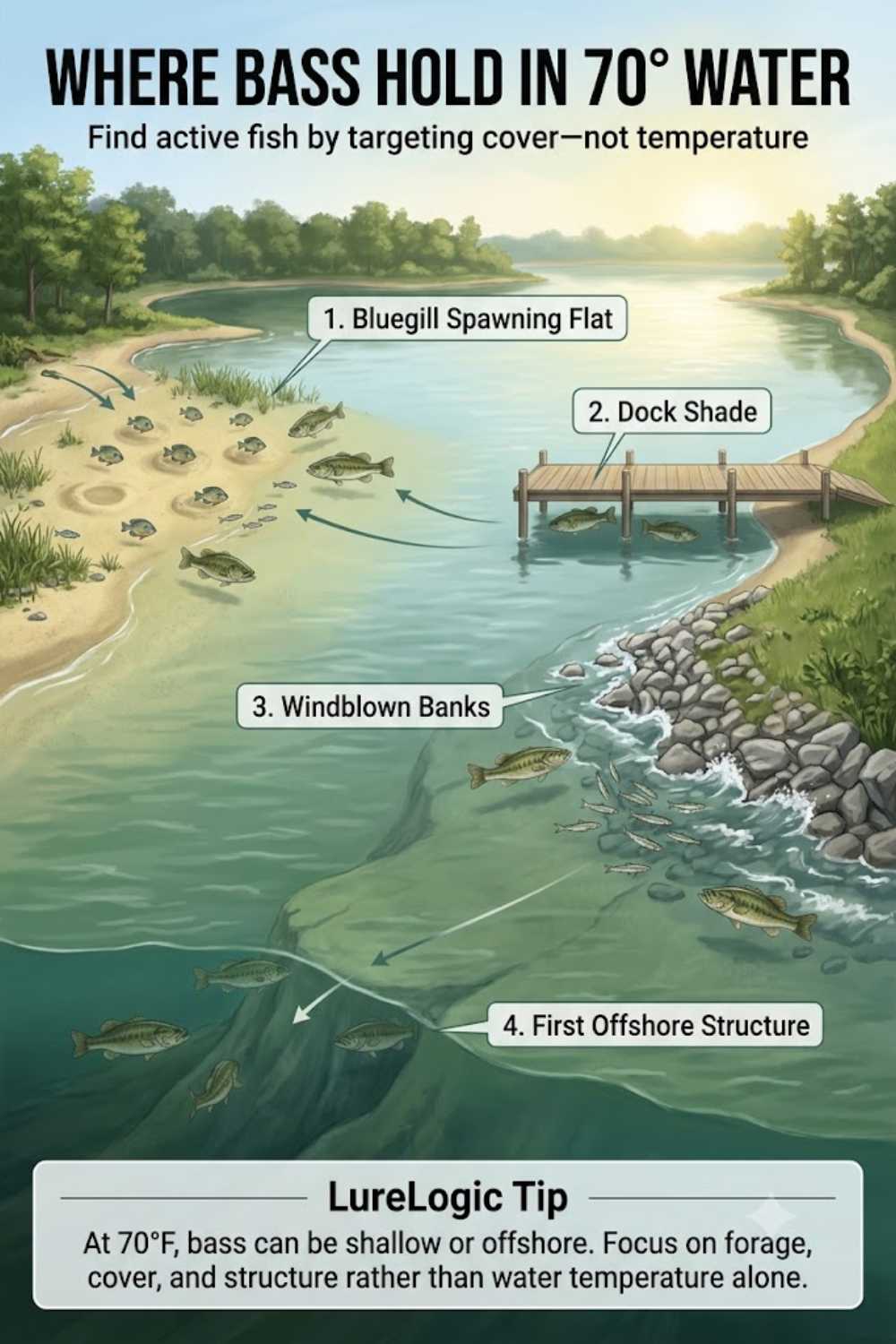
Four high-percentage 70°F positioning patterns.
Bluegill spawning colonies — Shallow flats with hard bottom (sand, gravel, hard mud), sparse cover, and proximity to deeper water. Bluegill make distinctive bowl-shaped beds in colonies of 10–100+ fish. Bass orient to the perimeter of bluegill colonies and ambush bluegill venturing away from the bed cluster. A bluegill-pattern swim jig, chatterbait, or topwater worked around bluegill colonies produces explosive bites.
Shallow cover adjacent to spawning areas — Postspawn-recovered bass spend the first 2–3 weeks after recovery in shallow cover (laydowns, brush piles, dock cover, shallow grass) near the spawning areas they left. A swim jig, flipping jig, or Texas-rig worked through this cover produces.
Windblown banks during shad spawn — Hard-bottom banks (riprap, gravel, rocky shoreline) windblown by prevailing winds during the shad spawn window concentrate spawning shad and feeding bass. A white swim jig or shallow lipless crankbait fished parallel to these banks produces aggressive bites.
First offshore structure — Early-summer bass beginning the offshore migration hold on the first deep structure adjacent to spawning bays: secondary points dropping into 10–15 ft, isolated humps, and the deeper edges of main-lake points. A deep-diving crankbait, swimbait, or football jig produces. Structure bass fishing covers the offshore pattern.
Reading conditions — Sunny days favor shallow cover and shaded areas during midday; overcast days extend the shallow bite into all-day production. Wind on bluegill spawning flats and shad-spawn banks concentrates bait and feeding bass; calm conditions favor the topwater bite. Overcast day bass fishing covers the cloudy-day pattern.
Forage Matching and Color
70°F forage patterns dictate color selection more than at most temperatures.
Bluegill — The dominant 70°F forage on most reservoirs. Green pumpkin with orange and blue accents, bluegill-pattern paint schemes (green back, orange belly, blue gill plate), and watermelon-and-red colors all match bluegill. Pair with paddle-tail or split-tail plastic trailers.
Shad — Secondary 70°F forage. Sexy shad (silver/blue/chartreuse white), white, and shad-pattern paint schemes match threadfin shad and herring. Particularly important during the shad spawn (early 70°F window) and on lakes with strong shad populations.
Crawfish — Secondary forage on rocky lakes. Brown craw, red craw, and orange craw colors produce on rocky banks and around crawfish-rich structure. Less dominant than at 55–60°F but still productive.
Darker colors — Black/blue and dark green pumpkin for stained-to-muddy water. Particularly effective in shallow cover where bass need contrast to locate the bait.
Bright colors — Chartreuse-and-blue-back and white-and-chartreuse for stained-water reaction baits. Particularly effective on overcast days and in stained water.
Water clarity adjustments — Clear water (4+ ft visibility) favors natural colors and finesse presentations; stained water (1–4 ft) favors brighter colors and reaction baits; muddy water (under 12 inches) favors dark colors with strong vibration profile. See water clarity lure selection for the broader logic.
Daily Pattern and Presentation
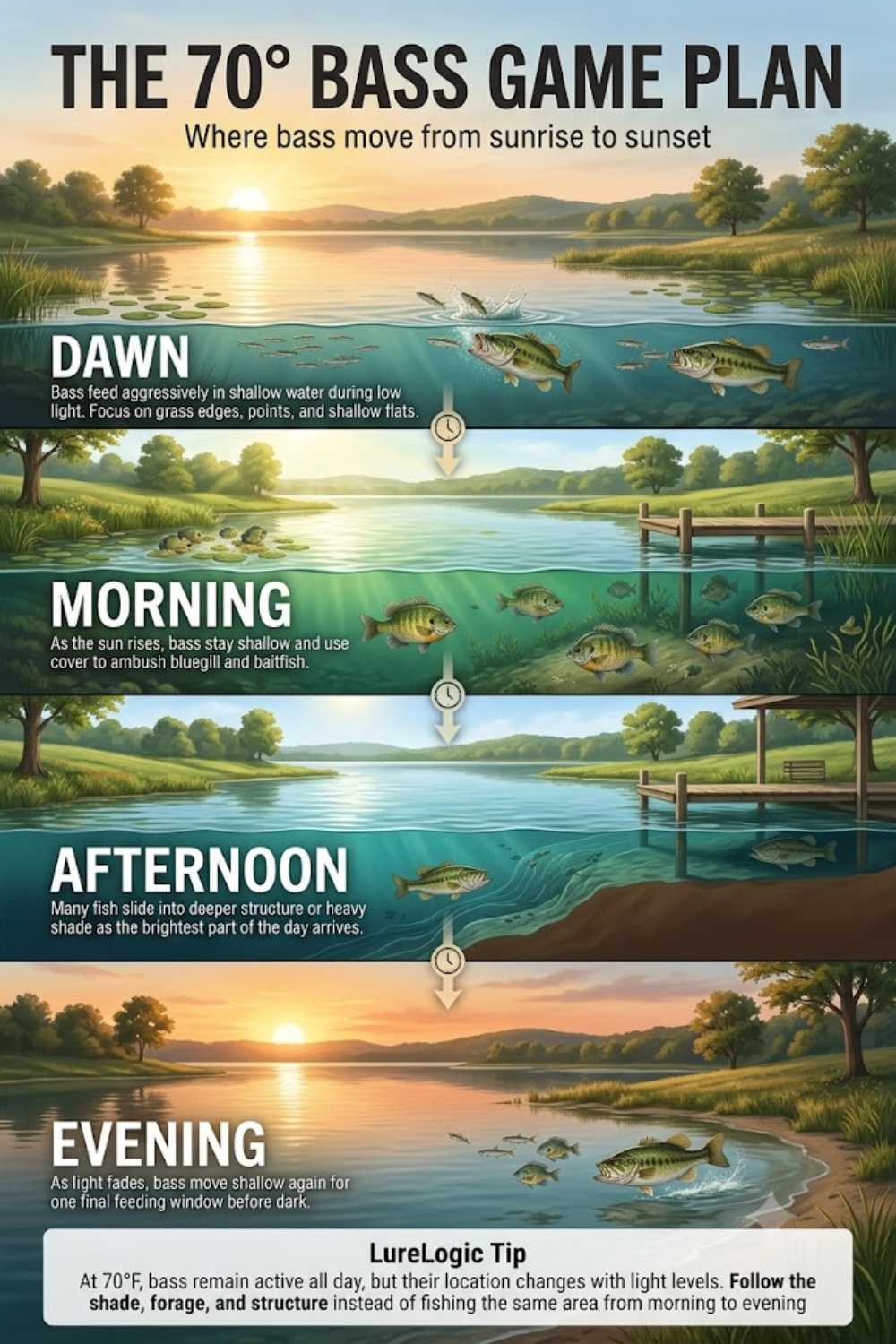
70°F supports active feeding across the full day under stable conditions.
Dawn through 9 AM — Topwater window. Walking baits, prop baits, and buzzbaits around shallow cover and over shallow flats produce explosive bites. The 70°F dawn topwater window is one of the best of the year. Early-morning bass lures covers the dawn pattern.
9 AM through 1 PM — Shallow cover window. Swim jigs, chatterbaits, spinnerbaits, and flipping jigs around shallow cover produce. Bluegill colonies hold concentrated fish; postspawn recovery cover holds the biggest females.
1 PM through 5 PM — Pattern split. Shallow bass slide deeper into shaded cover; offshore bass become more active on the first offshore structures. A deep-diving crankbait on offshore structure or a flipping jig in shaded shallow cover both produce.
5 PM through dark — Second topwater window. The afternoon topwater bite often outproduces dawn for big bass. Walking baits, prop baits, and frogs around shallow cover and over shallow flats produce.
Presentation speeds at 70°F are moderate to fast. Bass commit on aggressive retrieves and can chase down even fast-moving baits. The classic 70°F mistake is fishing too slowly — the metabolism supports faster retrieves than most anglers use.
Line selection — 12–17 lb fluorocarbon for most reaction baits; 50–65 lb braid for flipping jigs and topwater frogs into heavy cover; 10–15 lb braid mainline with 10–12 lb fluorocarbon leader for swim jigs and chatterbaits; 8–10 lb fluorocarbon for clear-water finesse presentations.
Wind — Generally beneficial. A 5–15 mph wind concentrates baitfish and feeding bass on wind-blown banks and the wind-blown side of structures. Heavy wind (20+ mph) becomes a challenge but produces big fish on windblown points and rocky banks.
Bottom Line
70°F is the universal feeding window — almost every reasonable bass lure produces. The decision shifts from 'what matches the metabolism' to 'what matches the cover and conditions.' Build presentations around the dominant 70°F forage (bluegill, shad, crawfish), match colors to water clarity, and cover the full daily pattern from dawn topwater through midday cover work to afternoon topwater. The 70°F window is one of the most productive and forgiving of the year — pick the right cover and the fish will commit.
For the warmer summer transition, see summer midday bass fishing and summer topwater bass fishing. For the cooler spawn window, see best bass lures for 65-degree water. For the broader temperature playbook, see best bass lures by water temperature.