Editor's Pick97%
War Eagle Spinnerbait
Bluegill
View Product →The best night fishing lures for bass — black Colorado spinnerbaits, big worms, dark jigs, and buzzbaits. Learn why silhouette, vibration, and slow retrieve speeds unlock the biggest bass bites of the summer.
Affiliate Disclosure: As an Amazon Associate I earn from qualifying purchases. Recommendations reflect on-the-water testing and the LureLogic ranking engine — not paid placement.
The one-paragraph version: fish a big-blade black spinnerbait as your default night bait, throw a 10-inch dark worm anywhere the spinnerbait bite dies, run a buzzbait on calm warm nights, and pitch a black jig into any specific piece of shoreline cover you can identify. That four-bait rotation catches night bass on almost every reservoir in the country.
The War Eagle Spinnerbait is our Editor's Pick because the components — the wire, the blade balance, the skirt density, and the hook — are dialed for slow-rolling a big single Colorado blade in low light. A 1/2 oz black War Eagle with a single #5 or #6 Colorado is the classic night spinnerbait; the willow-leaf combos are for daytime clear-water work. It runs true right out of the package, produces the low-frequency thump night bass key on, and lasts season after season.
The Booyah Covert Spinnerbait is our Best Value pick. The components are a notch below the War Eagle but the bait runs true, the black-and-blue and pure black skirts are exactly the colors you want at night, and at its price point you can carry three of them in the box without flinching when one gets buried in a laydown. Upgrade the trailer hook and you have a tournament-capable night bait for a fraction of the premium price.
The Strike King Hack Attack Heavy Cover spinnerbait is the right tool when your night bite is happening in thick shallow wood or grass. Its heavy 0.045-inch wire holds shape under load and the oversized hook gives you the leverage to horse a 5-pound night bass out of a laydown before it wraps. Any night you find yourself fishing shallow visible cover in the dark, this is the bait.
Round out a night arsenal with a Zoom Ol' Monster 10-inch worm on a 5/0 hook and 3/8 oz weight, a Booyah black buzzbait, a black-and-blue football or flipping jig, and a black Jitterbug or Whopper Plopper for surface work. Those six categories cover every legitimate night scenario. See our best bass spinnerbaits guide for the broader spinnerbait comparison.
Night bass fishing is not daytime fishing with darker colors. Three biological realities completely rewrite the lure decision at night, and anglers who fail to internalize them fish night the same way they fish noon and catch a small fraction of what is available.
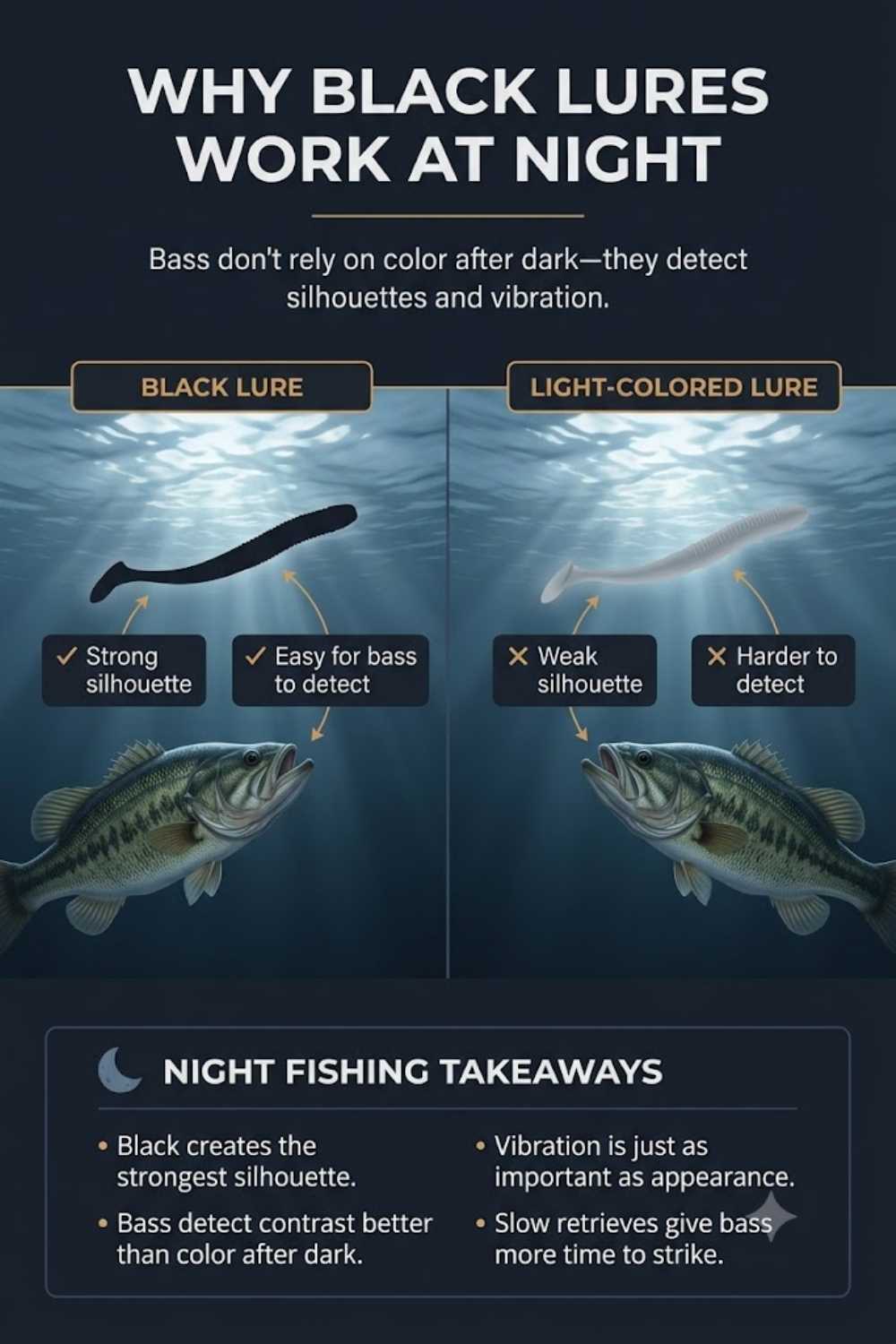
First, bass rely on their lateral line at night more than on vision. A bass's lateral line detects low-frequency water displacement — the pulse of a Colorado blade, the plop of a topwater, the drag of a worm across a rock. In daylight, vision drives most strike decisions; at night, the lateral line drives them and vision confirms at the last moment. Every productive night lure produces a strong, consistent low-frequency vibration bass can track from 10–20 ft away. A silent bait — a light-blade willow spinnerbait, a suspending jerkbait, a subtle drop shot — is nearly invisible to a night bass. This is why big Colorado blades outproduce willow blades at night, and why big worms outproduce finesse worms. Size and thump beat subtlety.
Second, bass silhouette lures against whatever ambient light exists above. Even on a dark night, some light — from moonlight, from stars, from distant boat lights and shorelines — filters down through the top few feet of water. A bass sitting on the bottom sees baitfish as dark shapes against that faint glow. A black or dark-blue lure creates the strongest possible silhouette against that glow; a white or chartreuse lure blends into it. This is why every serious night angler carries only dark colors. The only exception is the rare 'clear-moon-full' night on gin-clear water, where a white-bellied bait like a Jitterbug still works because the moon light is bright enough to produce color contrast.
Third, bass are ambush hunters at night, not chasers. Daytime bass will follow a bait 10–20 ft before committing; night bass hold in specific ambush positions and either eat or refuse within a couple of feet. This has enormous consequences for retrieve speed and cast placement. A night lure must move slowly enough that a bass sitting in an ambush lane has time to detect it, close the distance, and strike. A daytime retrieve speed at night usually gets zero bites, and anglers wrongly conclude 'the fish are not there.' They are there — the bait is moving through the strike zone too fast for a lateral-line-based ambush strike.
The practical translation: night lure selection is a game of vibration, silhouette, and speed — in that order. Get all three right and the summer night bite is often the largest-average-size bite of the year. See our night bass fishing in summer guide for the seasonal timing.
War Eagle 1/2 oz Black Spinnerbait, Single Big Colorado — Editor's Pick, Default Night Bait. The single most productive night bait on most reservoirs. A 1/2 oz head with a #5 or #6 hammered Colorado blade in nickel or copper (nickel for darker nights, copper for stained water or moonlit clear water) and a solid black skirt. Slow-rolled just fast enough to feel each blade thump, at 2–6 ft depth over points, secondary points, and shallow rocky banks. This bait replaces every other reaction bait on your rod holder from sunset to sunrise. See our bass spinnerbaits guide for the full spinnerbait comparison.
Zoom Ol' Monster 10-Inch Worm — Best Big-Bait Night Presentation. A 10 or 12-inch dark plastic worm — Zoom Ol' Monster, Berkley PowerBait Power Worm, or 6th Sense Bounce — on a 5/0 wide-gap hook with a 3/8 or 1/2 oz Texas-rig weight. Junebug, black-and-blue, plum-apple, and pure black are the workhorse colors. Cast to a specific piece of cover, let the bait fall, and crawl it back with 5-to-10-second pauses. The bites are subtle — often just a mushy feeling — set the hook on anything that does not feel like a rock. This bait wins night tournaments. See our finesse worms guide for smaller worm work.
Booyah Black Buzzbait — Best Night Topwater. A 3/8 oz black buzzbait with a black skirt and a single trailer hook is the highest-percentage night topwater. Fish it on the slowest possible retrieve that still keeps the blade sputtering, over shallow flats with sparse cover, along shorelines with laydowns, and around any surface bait activity. Prime conditions: surface below 88°F, wind under 5 mph, water temperature stable. When bass blow up and miss, keep the bait moving; do not stop the retrieve. Missed strikes on a night buzzbait are constant — many bass come back on the same cast or the next cast.
Strike King Bitsy Bug or Booyah Boo Jig, Black-and-Blue — Best Cover-Specific Night Bait. A 3/8 or 1/2 oz black-and-blue jig with a black craw trailer is the tool for pitching specific pieces of shallow cover — dock pilings, laydowns, isolated brush. Night bass hold tight to these features and refuse to chase; a jig placed within a foot of the cover, allowed to fall on slack line, and crawled painfully slowly produces the bites that a moving bait misses. Fish it heavier than daytime (1/2 oz over 3/8 oz) because you cannot see the fall and need to feel the bottom contact clearly. See our flipping jigs guide.
Jitterbug or Black Whopper Plopper — Best Sound-Signature Topwater. When the buzzbait bite goes cold on a calm night, a Jitterbug or a 90–110 size black Whopper Plopper produces a completely different sound signature — a slow gurgle and plop instead of a sputter — that triggers bass that quit responding to the buzz. Fish it dead slow. The bites are heart-stopping. See our best topwater lures guide.
Black Chatterbait with Colorado Blade — Best Vibration-Plus-Silhouette Bait. A 1/2 oz black or black-and-blue vibrating jig with a swimbait or craw trailer bridges the gap between the spinnerbait and the jig. Fish it around shallow grass edges, around isolated wood, and along transition banks. It produces a heavier thump than a willow-blade spinnerbait and covers water faster than a jig. Colorado-blade versions (rather than the standard hex blade) are the correct choice at night. See our chatterbaits for bass guide.
Black Square-Bill Crankbait — Best Reaction Bait Around Wood. A 3/8 oz black or black-and-red square-bill crankbait fished around visible wood and rocky banks at night generates reaction strikes when bass are relating to a specific depth (2–5 ft) and refuse to move up to the surface. Fish it slower than daytime — you should feel every deflection. See our square-bill crankbaits guide.
Black Football Jig — Best Deep Night Presentation. On nights when the shallow bite is weak (bright full moon on unstained water can push bass back down), a 3/4 or 1 oz black football jig with a black craw trailer crawled slowly across main-lake points and offshore rock in 8–15 ft produces bass that never came shallow. See our football jigs guide.
Night fishing is not the answer to every difficult summer condition. It shines in specific windows and disappoints outside them.
Prime night windows — Mid-summer through early fall (water 75–88°F) on stable weather, calm-to-light-wind nights, and any period when daytime surface temperatures exceed 88°F and shut down the daytime bite. The 3-to-7 day window on either side of a full moon is historically the highest-quality night bite of the summer, with the caveat that new moon and dark moon nights also produce well when bass position tight to specific ambush cover. Post-frontal high-pressure nights often outfish the daytime that follows.
When NOT to fish night — Cold water (below 65°F) turns off the night bite almost entirely; bass metabolism slows to the point where nocturnal feeding is not worth the calorie expense. Heavy rain or thunderstorm passage disorients bass and shuts down the bite for hours afterward. Falling barometric pressure ahead of a storm can either fire the bite or kill it, depending on how far ahead of the front you are; watch post-rain fishing and pre-storm fishing for the details.
The temperature threshold — On most reservoirs, night fishing becomes the highest-percentage summer strategy once daytime surface temperatures cross 88°F for multiple consecutive days. Below that threshold, the daytime bite is still viable and night is a lifestyle choice; above it, night is the correct answer for anglers who want to catch fish rather than sweat. See bass fishing during a heat wave.
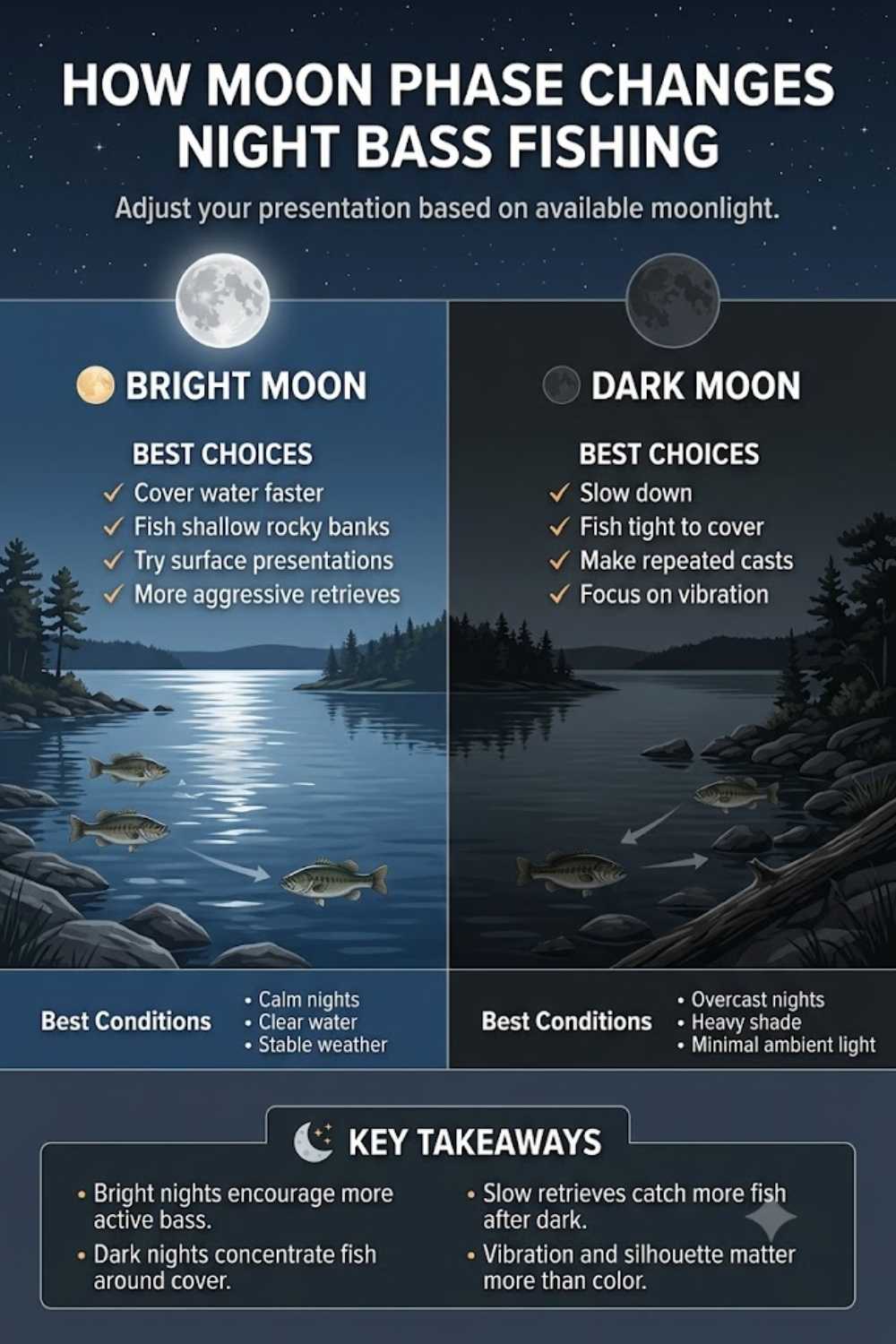
Moonlight vs no moonlight — Bright moonlit nights push bass shallow and reward more active retrieves and surface baits. Dark moonless nights concentrate bass on specific cover and reward slow, tight-to-cover presentations. Neither is 'better' — the tackle just changes. On a bright night, lead with the buzzbait and spinnerbait; on a dark night, lead with the big worm and the jig.
Stable weather — Night fishing rewards stable weather more than any other summer pattern. Two or three days of consistent barometric pressure and temperature produces the strongest nocturnal feeding pattern; a passing front or a sudden temperature change often collapses the bite for 24–48 hours. See bass positioning in stable weather.
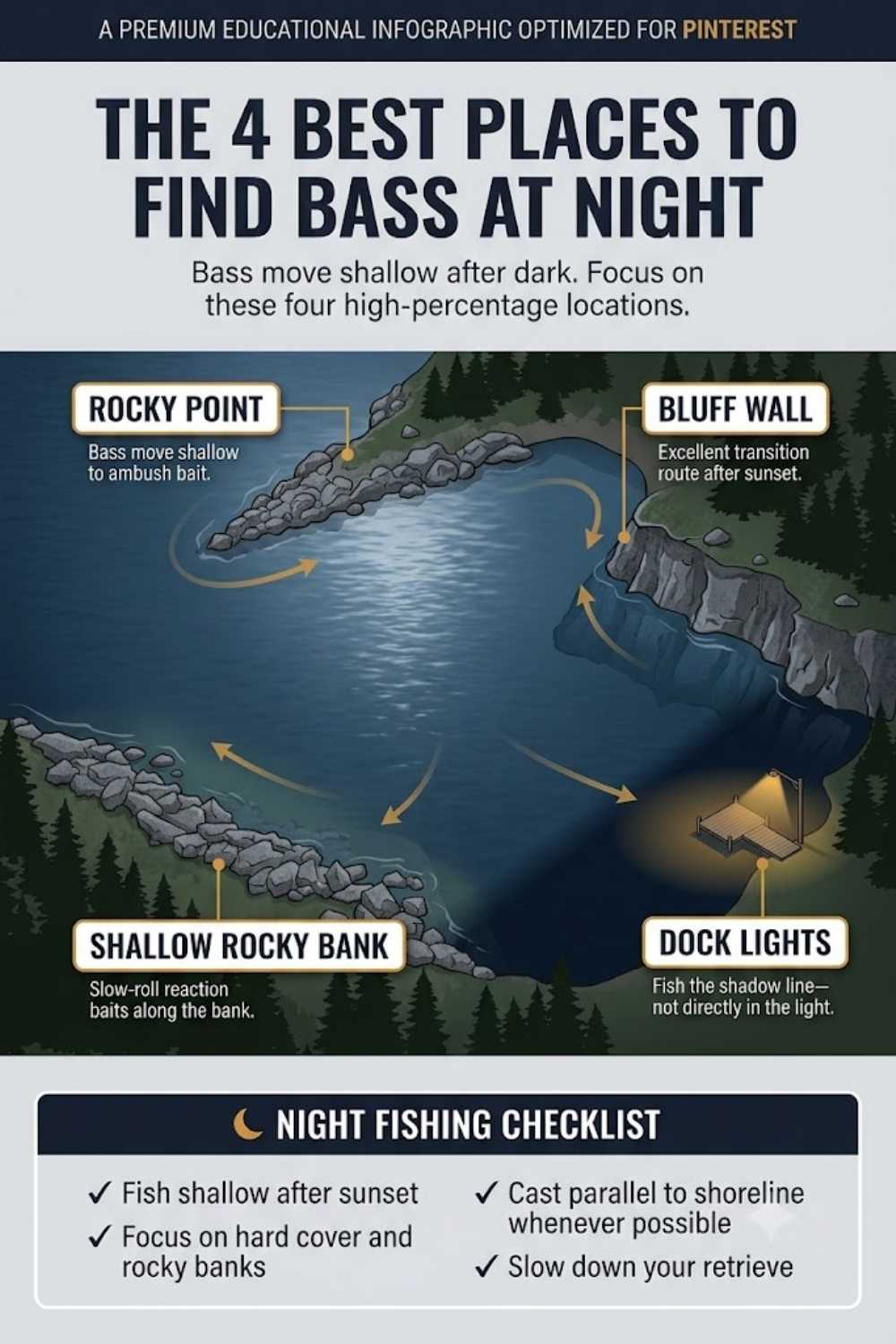
Four high-percentage night positioning patterns.
Main-lake rocky points — The most reliable night structure across almost every reservoir. Bass slide from the deep side of the point (10–15 ft daytime holding depth) up to the shallow top of the point (2–6 ft) to ambush baitfish and crawfish. Fish the point with a black spinnerbait cast parallel to the tapering side, then follow up with a big worm on any specific hard-cover feature. See bass fishing points.
Bluff walls and channel-swing banks — Vertical rock that drops from shallow to deep. Bass hold on the top step at night (0–4 ft) even when they held on the mid-depth (6–15 ft) portion during the day. Slow-roll a spinnerbait along the top of the bluff, then work a big worm along any horizontal seam or ledge on the wall.
Shallow rocky main-lake banks — Any main-lake bank with hard bottom (rock, gravel, chunk rock) and depths in the 2–8 ft range. Wind-blown banks are always better; even a slight breeze on a night bank stacks bait and turns on a bite. Fish the entire length with a spinnerbait and hit isolated wood and boulder pieces with a jig.
Docks with underwater lights — On lakes where dock lights exist, they are the highest-percentage night pattern of all. Light attracts bugs, bugs attract shad, shad attract bass. Fish the shadow line where the lit water meets the dark water — bass sit in the dark and ambush prey silhouetted in the light. A shaky-head worm, a small jig, or a swimbait worked slowly across the shadow line produces night after night. Do not fish IN the light; fish the shadow-to-light edge.
Where NOT to fish at night — Deep offshore structure (20+ ft main-lake humps, deep ledges) empties out at night. The bass that lived there in the day moved shallow. Do not waste night hours grinding the same offshore spots that produced at noon. See offshore humps and thermoclines and summer bass positioning for the daytime picture that inverts at night.
Color at night collapses to a very short list. Ignore the rainbow of daytime skirts and stock only what actually produces after dark.
Black — The default color for every night lure. Skirts, blades, worms, jigs, and topwater bellies all default to black. If you only carry one color of every night bait, make it black.
Black and blue — The classic night jig color. A pure black skirt with two or three blue strands produces a subtle color-shift silhouette that has caught night bass for fifty years. Works on jigs, spinnerbait skirts, and worm colors (junebug is essentially black-and-blue).
Junebug and plum-apple — Deep purple worm and craw colors. On stained-water fisheries and on nights with any moonlight, these produce as well as pure black and sometimes slightly better. Carry alongside black.
White — The only light color worth carrying at night, and only in one situation: a Jitterbug or a walking bait fished on a bright full-moon night over clear water. On those specific nights, a white belly against the moonlight produces a silhouette bass will strike. In every other situation, white is worse than black.
Blade selection — Colorado blades (round, high-thump, low-flash) are the correct choice for almost every night spinnerbait and chatterbait. Willow blades (long, low-thump, high-flash) are daytime blades. Big Colorado (#5 to #7) is the default night size. Painted-black blades work as well as nickel or copper — the color of the blade barely matters at night; what matters is the thump it produces. If forced to choose a finish, nickel produces slightly more visual signature on moonlit nights and copper produces slightly better on stained water and dark nights.
Trailer choice — Night spinnerbait trailers should be black or dark-purple soft-plastic craw or paddle-tail. Black-and-blue Rage Craw, plum-apple Zoom Speed Craw, or a solid black 3-inch paddle-tail. The trailer adds profile without breaking the silhouette. Skip white or chartreuse trailers on spinnerbaits at night.
See our water clarity lure selection guide for how clarity affects color even at night — clear-water fisheries reward slightly smaller profiles and more painted-blade finishes; muddy fisheries reward pure-black-everything and heavier profiles.
Retrieve speed is the single most common night fishing mistake. Three specific corrections.
Mistake 1 — Slow-rolling the spinnerbait too fast. A night spinnerbait should be retrieved so slowly that you can count each blade rotation on the rod tip. Cast, let the bait fall to your target depth (2–8 ft depending on the water), and reel just fast enough to keep the blade turning steadily. If you cannot feel each thump, you are moving too fast. When the bait hits any hard-cover contact (rock, wood), stop the retrieve for 2–3 seconds and let it flutter — a huge percentage of night spinnerbait bites happen on that flutter.
Mistake 2 — Hopping the big worm. A 10-inch night worm is not a shaky head. Drag it, do not hop it. Cast to your target, let it fall to bottom, and pull it 6 inches to a foot at a time with a slow rod sweep, followed by a 5-to-10-second pause. The bites almost always come during the pause. When you feel a mushy pressure or a sideways line movement, set the hook — do not wait for a hard thump.
Mistake 3 — Reeling the buzzbait too fast. A night buzzbait needs to run at the slowest possible speed that still keeps the blade sputtering above water. Most anglers reel it 30% too fast at night out of daytime muscle memory. Practice at the boat before you cast — reel just fast enough to feel the blade sputter, and hold that speed the entire retrieve.
Jig retrieve — A night jig on shallow cover is fished almost exactly like a big worm. Pitch, let it fall on slack line, and crawl it back with long pauses. The one exception: bluff-wall jigging, where a swimming retrieve at a slow, steady pace along the top of the wall outproduces a bottom crawl.
When the bite dies — See our how to adjust when the bite dies playbook. The most common night adjustment is either slowing down further or downsizing (from a 3/4 oz spinnerbait to a 1/2 oz, from a 12-inch worm to a 10-inch). Do not speed up. Do not change to a bright color. If bass were biting an hour ago and quit, they moved slightly deeper — extend your cast, let the bait fall an extra 2 ft, and continue with the same presentation.
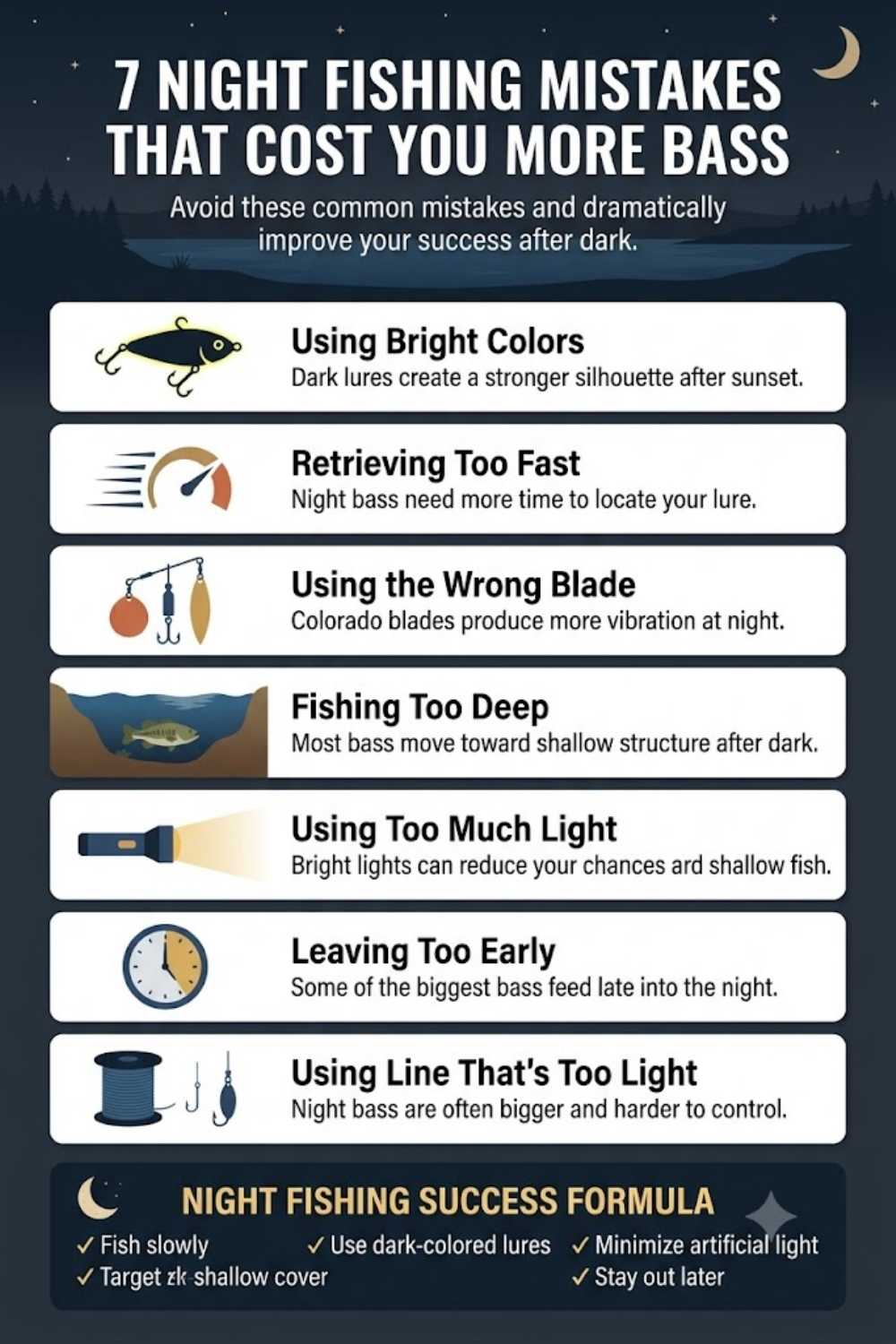
Using white and bright colors. The single most common night mistake. Even veteran daytime anglers instinctively reach for the white spinnerbait at night because 'it shows up.' In the water column, white blends into ambient sky glow and produces almost no silhouette. Stay dark.
Reeling too fast. Second most common. Night bass are ambush predators — they do not chase. A bait moving at daytime speed passes through the strike zone before the fish can commit.
Relying on willow-blade spinnerbaits. Willow blades are visual-flash blades — they work in daylight when bass are seeing the lure. At night, bass are feeling the lure through the lateral line. Big Colorado blades produce 3-5x the low-frequency vibration of willow blades. Change the blades.
Fishing deep offshore water at night. The daytime pattern inverts. Deep offshore bass move shallow at night. Do not spend night hours fishing the noon spots.
Overusing the flashlight. Every time you shine a light on the water you kill the bite for 15–30 minutes on that spot. Use the smallest, dimmest red or green light you can get away with, keep it pointed at the boat or the reel not the water, and never shine it at where you are about to cast.
Setting up in the wrong wind. Even a light breeze changes where night bass position. On a night with a north wind, fish the south-facing (wind-blown) side of a point or bank; on a still night, fish either side. Wind stacks bait; bait draws bass; bass draw you.
Quitting too early. The best night bite of the summer often happens between 11 PM and 3 AM, well after most anglers have gone home. If you commit to a night trip, commit to a full night.
Using too-light line. Night fish are bigger on average, and you cannot see cover. 12 lb fluorocarbon becomes 20 lb after dark; adjust up.
Why your lure isn't working — if you have cycled through multiple dark colors and multiple retrieve speeds and still cannot get a bite, the problem is almost always location, not lure. See why bass won't hit your lure and when to change bass lures.
Ask three questions before you tie anything on.
1. What is the moon and light level? Bright moonlit night on clear water points to more active retrieves and surface baits (buzzbait, walking bait, Whopper Plopper). Dark or overcast night points to slow-rolled Colorado spinnerbaits and big worms crawled tight to cover.
2. Where are the bass positioned? Wind-blown shallow banks point to a spinnerbait as the search bait. Isolated cover — laydowns, dock pilings, isolated brush — points to a jig or big worm. Bluff walls and channel-swing banks point to spinnerbait along the top and jig on the wall itself.
3. What is the wind and surface condition? Dead calm with warm water points to topwater. Any measurable wind or chop points subsurface. Cold surface (below 72°F) points away from topwater entirely.
The answers narrow the night decision to two or three legitimate categories. From there, cover density decides between the spinnerbait (open water) and the jig (specific cover pieces).
If you find yourself standing on the deck at midnight cycling through six rods without confidence, open Today's Fishing Strategy and let the current conditions do the filtering.
Building a night arsenal is where most anglers overspend on the wrong categories. A few rules.
Buy the right colors, not more colors. A night box needs pure black, black-and-blue, and junebug. That is it. Skip the shad patterns, the chartreuse skirts, and the bluegill colors — they do not produce at night and they take space you need for backup black baits.
Invest in the Editor's Pick where components matter. The War Eagle spinnerbait's price premium over the Booyah pays for itself in one season of night fishing because the wire, blade balance, and skirt density all directly affect the low-frequency thump signature. On the buzzbait, the difference between a $6 and a $12 bait is much smaller — buy the value option.
Big-worm hooks matter. Do not save money on the hook. A 5/0 or 6/0 wide-gap hook (Owner, Gamakatsu, VMC) is the only acceptable choice for night big-worm fishing. Cheap thin-wire hooks bend on 4-pound-plus bass; night fish are almost always bigger than average.
Stock backup rods, not backup lures. On a night trip you cannot re-tie in the dark efficiently. Bring three or four pre-rigged rods (spinnerbait, big worm, buzzbait, jig) so you can rotate presentations without fumbling with knots by headlamp.
Line weight rules. Never fish night with lighter line than you would use in daylight. Move up one class. 17–20 lb fluorocarbon for spinnerbait and big worm; 50–65 lb braid for buzzbait and jig. This is not a place to save money on light line.
A proper light setup. A red or green primary light (dimmer is better) plus a bright white flashlight kept in the box for emergencies. UV lights that make fluorescent line glow are the biggest edge in night fishing — line watching is how many night bites are detected. Budget for a UV setup if you fish night regularly.
A note on rod length — 7'2" to 7'6" medium-heavy fast is the workhorse night rod. Longer than 7'6" becomes awkward in the dark; shorter than 7' costs you casting distance and hook-setting leverage on big fish.
Night fishing is dominated by the categories above, but a few situations call for tools this guide does not lead with.
Cold-front nights — After a strong cold front pushes through and drops surface temperatures more than 6-8°F overnight, the reaction bite dies and finesse takes over even at night. A slow-rolled shaky head worm or a wacky-rigged Senko in green pumpkin (yes, a light color — the exception on cold nights) around specific cover often produces when the black spinnerbait bite dies. See bass lures after a cold front.
Daylight is a viable option — Not every hot summer day requires night fishing. If daytime surface temperatures are stable in the 80–86°F range and the offshore bite is producing, daytime fishing with a Strike King 6XD, a football jig, or a drop shot on offshore structure will usually outproduce night fishing for the same effort. See best bass lures for summer for the daytime playbook.
Extreme muddy water — Recent thunderstorms that push heavy runoff into a reservoir can drop visibility to under 6 inches, and at night that means bass cannot silhouette anything. Even a black spinnerbait becomes a low-percentage choice. In those conditions, a heavy black-and-blue chatterbait or a big black-and-blue jig with a rattling trailer are the only baits producing enough vibration for bass to locate. See best bass lures for muddy water.
Pre-spawn night fishing — The classic night pattern of black spinnerbaits and big worms is a warm-water phenomenon. In pre-spawn (55–65°F), night fishing can still produce but the presentation shifts toward slow-rolled jerkbaits, small jigs, and shaky heads. See pre-spawn bass fishing lures.
High-pressure tournament water — On heavily pressured Sunday-afternoon reservoirs where every bass has seen every reaction bait, night fishing shines exactly because most anglers have already gone home. If you are competing for pressure-free water, night fishing itself is the strategy — the specific lures matter less than the timing. See bass lures for high pressure.
Night bass fishing is a game of vibration, silhouette, and slow speed. A big-Colorado-blade black spinnerbait, a 10-inch dark worm, a black buzzbait on calm nights, and a black jig on specific cover — that four-bait rotation catches summer night bass on almost every reservoir in the country. Build the arsenal around dark colors, heavy line, and slow retrieves; fish main-lake rocky points, bluff walls, and shallow rocky banks; and commit to the full night rather than quitting early.
Night fishing is not the answer to every hard summer condition, but when surface temperatures push above 88°F and the daytime bite compresses into narrow dawn and dusk windows, night is often the highest-average-quality bite of the year. For deeper context on when night is the right choice, see night bass fishing in summer, bass fishing during a heat wave, summer oxygen crash, summer midday bass fishing, and the summer bass lures guide.
And remember — the best night lure is the one that matches the specific conditions tonight. This guide narrows your night box down to the categories that actually produce; Today's Fishing Strategy tells you which of those categories is the highest-confidence choice for the exact conditions in front of you.
Classic Colorado/willow combo for windy banks and stained water.
Windy banks and stained water — burn it parallel to cover.
As an Amazon Associate I earn from qualifying purchases.
Staging fish on transition banks and the baits that work.
Fry guarders and the recovery slowdown.
Walking baits, frogs, and poppers in heat.
Deep structure or shade — pick one.
Shade plus structure in the heat of the year.
Shad migration and aggressive pre-winter feeding.
Plug in today's water temp, clarity, weather, and forage — the tool returns the highest-confidence presentations.
Build Today's Strategy →