Editor's Pick97%
Megabass Vision 110
French Pearl
View Product →The best bass lures for winter cold water — suspending jerkbaits, blade baits, hair jigs, football jigs and finesse plastics. What to buy, when each one wins, and how to fish them below 50°F.
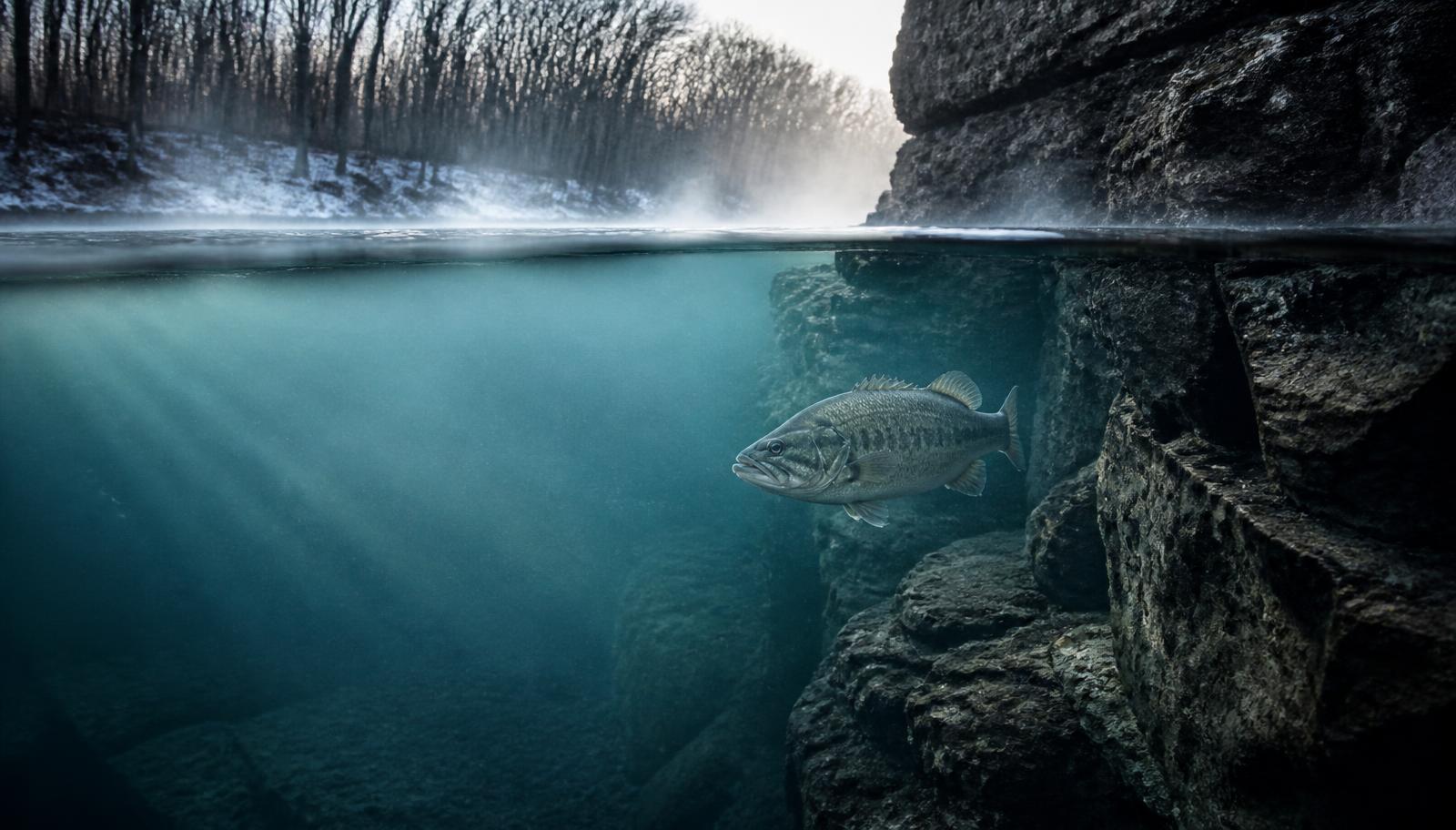
Affiliate Disclosure: As an Amazon Associate I earn from qualifying purchases. Recommendations reflect on-the-water testing and the LureLogic ranking engine — not paid placement.
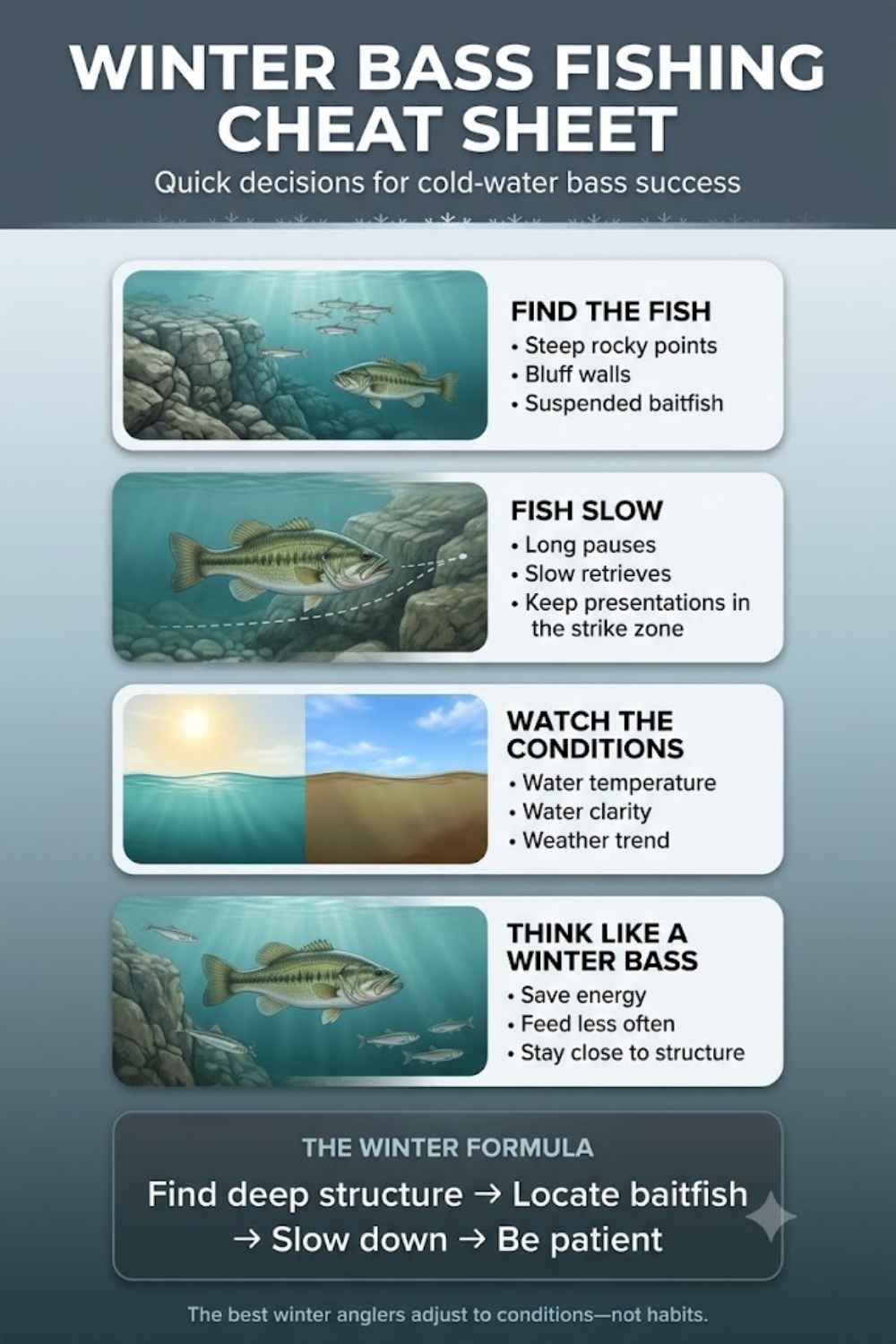
Winter is the one season where buying the right tackle genuinely changes your catch rate. In July a mediocre bait fished fast still gets bit. In January a bass may move eighteen inches to eat, once, in a five-hour day — so the bait has to be in the right place, at the right depth, doing almost nothing, for a long time. That is a specialized set of tools.
The core winter arsenal is short. A suspending jerkbait for bass holding off the bottom in clear water. A blade bait or a spoon for fish pinned to the bottom in 15–35 ft. A hair jig or a Ned rig for the pressured, ultra-clear, bluebird-sky days when nothing with a treble hook draws a strike. A football jig for the deep rock bite when a bigger profile still gets eaten. Everything else is a variation.
Our Editor's Pick is the Megabass Vision 110 because the suspending jerkbait bite covers more productive winter water than any other category, and the 110 is the benchmark for suspension quality — it holds its position on a long pause instead of slowly rising or sinking, which is the whole mechanism of the bait. The Rapala Shadow Rap earns Best for Ultra-Clear Water for its slow, nose-down fall and near-vertical stall on the pause, a subtlety that matters on 15-feet-of-visibility highland lakes. The Berkley Stunna is our Best Value because it suspends honestly out of the box at roughly half the price of a Japanese bait, which matters when a winter day costs you three baits to bluff-wall rock.
If you fish stained water, or your electronics show every fish sitting on the bottom, read the blade bait and hair jig sections before you buy a jerkbait — those two categories will out-catch it in that scenario. Not sure which describes your lake today? Run Today's Fishing Strategy with your actual water temperature and clarity before you tie anything on.
Bass are ectothermic — their body temperature, and therefore their metabolic rate, matches the water. At 80°F a bass may digest a meal in under a day. At 40°F that same meal can take a week. Everything anglers notice in winter follows from that single fact.
First, feeding frequency collapses. A bass does not need to eat daily, so instead of feeding whenever an opportunity appears, it feeds during short windows when conditions align — a warming trend, stable pressure, the warmest hours of the afternoon. Winter is far less about covering water and far more about being on the right spot when the window opens.
Second, strike distance shrinks. A summer bass will chase a spinnerbait fifteen feet. A winter bass may not move eighteen inches. That converts lure selection into a placement problem: the bait must pass through a small volume of water, slowly, and stay there. This is exactly why suspending baits and vertical presentations dominate the season.
Third, strike force drops. Winter bites are frequently nothing more than a pressure change, a tick, or line moving sideways. Many anglers who say "they weren't biting" were actually getting bit and never registered it. Fluorocarbon, sensitive rods, sharp hooks and paying attention to a slack line are not optional refinements in winter — they are the difference between a blank and a good day.
Fourth, bass group up tighter than any other season. Because only a small percentage of a lake meets their winter requirements, the fish concentrate. This cuts both ways: unproductive water is genuinely, completely empty, and productive water can be extraordinary. Winter rewards anglers who idle and look before they cast more than any other time of year.
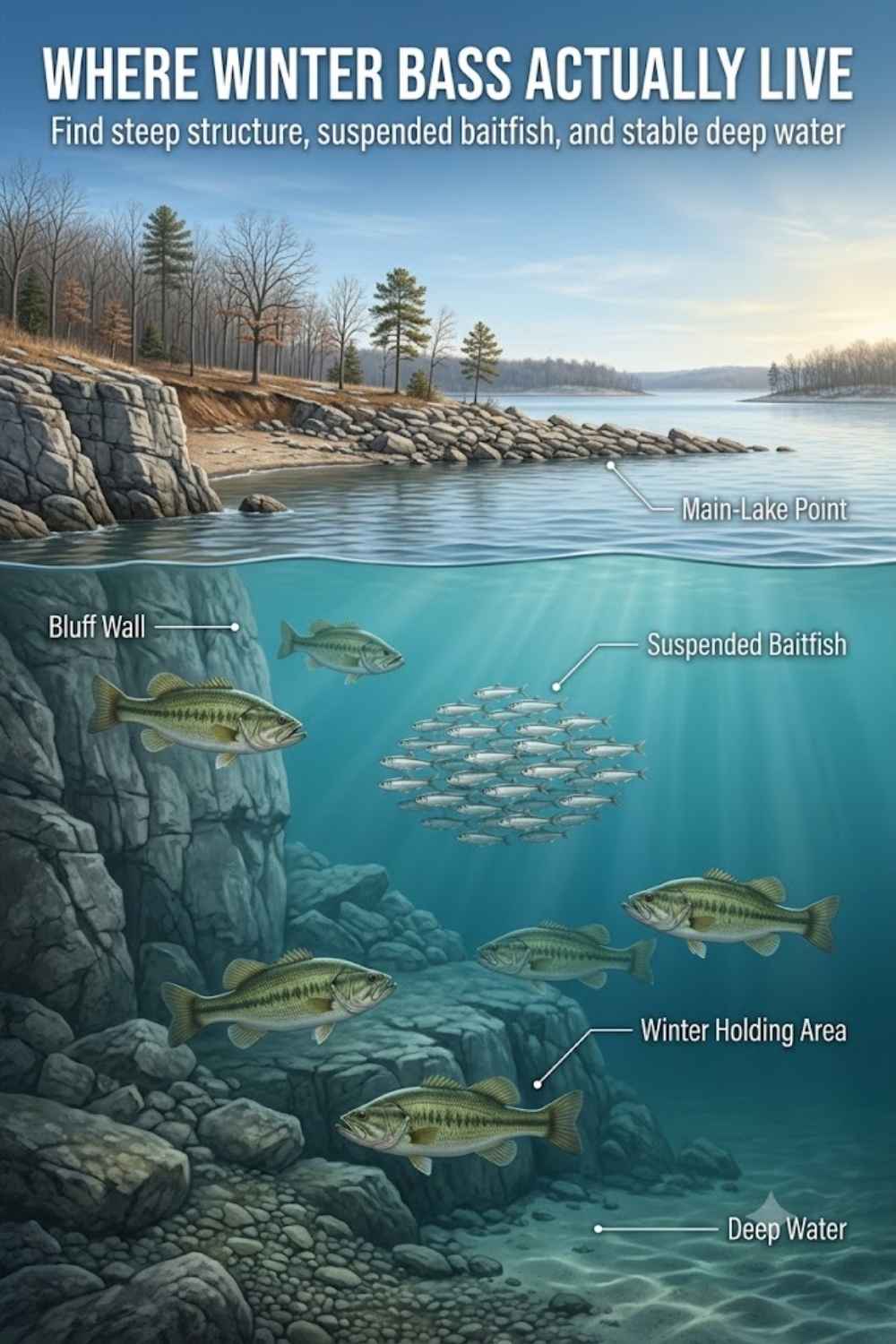
Three variables drive winter position: depth stability, vertical access, and forage. Depth stability means water whose temperature does not swing five degrees overnight — usually deeper water or water sheltered from wind. Vertical access means a piece of structure a bass can move up and down without traveling far, because winter fish adjust depth constantly and travel horizontally as little as possible. Forage means shad, which in cold water are themselves suspended over deep water and dying off in the coldest stretches.
On clear highland reservoirs — think Table Rock, Smith Mountain, Lake Wylie's steeper lower end — look at bluff walls, the transition where a bluff meets a chunk-rock bank, steep main-lake points, and channel swings against hard bottom. The classic setup is 25–60 ft of water with bass suspended 8–20 ft down, which is precisely the jerkbait's window. See the Lake Wylie guide for a regional example.
On flatland and lowland reservoirs there may be no true deep water at all. Winter fish there use the deepest third of the lake relative to everything around it: the outside edge of a creek channel, a hard-bottom ditch running through a flat, riprap along a causeway, and deep dock posts. Riprap is a specific winter gift — rock absorbs sun and warms adjacent water measurably on a bright afternoon.
On natural lakes and rivers, add current breaks and any remaining green grass. Living grass produces oxygen and holds forage even in cold water, and a green patch in an otherwise brown flat is a genuine spot on a spot. In rivers, bass leave heavy current entirely for eddies, deep outside bends, and marina basins.
The fastest way to short-circuit all of this: find the shad. Cold-water shad suspend over deep water in dense clouds and show clearly on electronics. Bass rarely sit far from them. See the winter shad die-off guide and creek channel positioning.
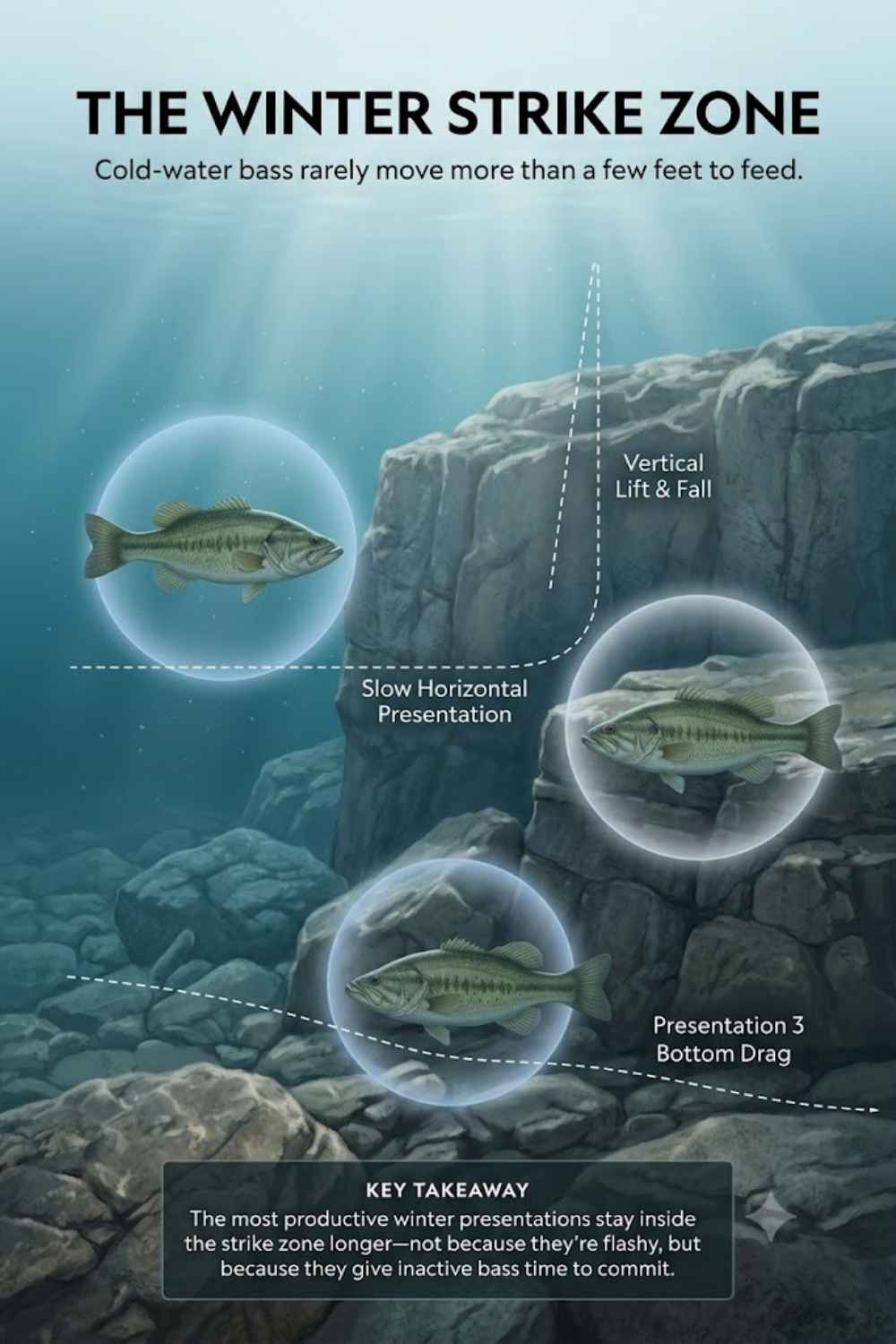
If you buy one winter lure, buy a suspending jerkbait. It is the only common bait that can stop dead in a bass's face and stay there. Everything else either sinks past the fish or rises away from it.
How it works: two or three sharp downward snaps pull the bait 3–6 ft below the surface and dart it erratically side to side, mimicking a dying shad. Then you stop. The bait hangs, motionless and horizontal, and the pause is when almost every winter strike happens. In 50°F water a three-second pause may be enough. At 45°F, count to eight. At 40°F and below, ten to twenty seconds is normal — a genuinely uncomfortable amount of time that most anglers cannot make themselves do, which is exactly why the technique keeps working.
What to buy. Suspension quality is the whole product. A cheap jerkbait labeled "suspending" often rises or sinks on the pause, which destroys the presentation. Look for a bait that holds depth in the water you actually fish, since water density changes with temperature — a bait that suspends perfectly at 70°F may slowly sink at 40°F. Serious anglers tune each bait with suspend dots or lead tape until it holds dead level.
The **Megabass Vision 110** is our Editor's Pick for a specific reason: its internal weight-transfer system gives it both long casting distance — critical on clear water where boat position spooks fish — and a genuinely neutral stall. It darts hard and unpredictably on slack-line twitches instead of swimming, which is what triggers reaction strikes from fish that are not actively hunting. Limitation: it is expensive, and losing three of them on a rock bluff is a real cost. Best for anglers who fish clear water often and want the highest-confidence bait available.
The **Rapala Shadow Rap** earns Best for Ultra-Clear Water because it behaves differently from a standard jerkbait: it turns almost 180 degrees on a twitch and then hangs with a slow, nose-down, almost vertical drift rather than a flat stall. On glass-clear, high-pressure days, that dying-minnow shimmy triggers fish that ignore a flat-suspending bait. Limitation: it is a lighter bait, so it casts shorter and struggles in wind. Best for clear-water finesse situations and pressured fisheries.
The **Berkley Stunna** is our Best Value pick. It ships with a genuinely reliable suspension, quality hooks, and a wide-searching dart, at a price point where you can carry three colors instead of one. Limitation: it lacks the extreme erratic snap of premium Japanese baits on a slack-line rip. Best for anglers building a first serious jerkbait selection, or anyone fishing rocky water where bait loss is routine.
Gear: a 6'6"–7' medium-power rod with a moderate action, a 6.4:1–7.1:1 reel, and 8–12 lb fluorocarbon. Lighter line lets the bait reach a slightly deeper running depth and disappears in clear water. Full details in the jerkbaits buying guide.
When your electronics show arches sitting on the bottom in 18–35 ft instead of suspended, the jerkbait is the wrong tool — you cannot get it deep enough or keep it there. This is blade bait territory.
A blade bait is a thin metal lure that sinks fast and produces a tight, high-frequency vibration on a short upward lift. It can be fished two ways. Vertically: drop it to the bottom directly under the boat over a marked school, lift it 6–12 inches, and let it fall on a semi-slack line. Nearly every bite comes on the fall, felt as a tick or as sudden weightlessness. Or on a cast: let it hit bottom, hop it once, let it fall back, and repeat down the slope of a point or riprap bank.
Blade baits excel in exactly the scenarios where jerkbaits struggle — deeper than 20 ft, stained water where vibration matters more than visibility, and windy days where boat control makes long horizontal presentations difficult. They also happen to be the most affordable serious winter bait, usually a fraction of a premium jerkbait's price, which makes them a natural best-for-beginners entry into the deep winter bite. The main limitations: exposed trebles snag in wood and rock, and the tight action produces fewer big-fish bites than a larger profile in some fisheries.
A flutter spoon or a jigging spoon covers the same water with a different signature — more flash, more erratic fall, and a slightly larger profile that tends to catch bigger fish when bass are actively feeding on shad. When you see a dense shad cloud on the graph with bass underneath it, a spoon dropped through the ball can be devastating.
Color here is simple: chrome and silver in clear water, gold in stained water, and any shad pattern when in doubt. Line: 10–12 lb fluorocarbon on a medium-power rod, with a slightly softer tip so the fish does not tear free of a treble hook on a headshake. More detail in the blade baits guide and deep water bass lures.
There are winter days where nothing with a treble hook gets touched: bluebird sky after a hard front, glass-clear water, high pressure, and no wind. On those days the answer is smaller, slower, and more subtle.
A **hair jig** — typically 1/8 to 3/8 oz with bucktail or craft-fur skirting — is the classic cold-water finesse bait on clear highland reservoirs. Hair breathes on its own in still water, so the bait looks alive while sitting completely motionless on a rock ledge. The retrieve is almost nothing: cast, let it fall on a controlled line, and drag it a few inches every fifteen or twenty seconds. It is the single best presentation available for a bass that has decided not to chase anything.
A **Ned rig** does the same job with modern soft plastic. A small stick bait on a 1/10–1/6 oz mushroom head stands up on the bottom and quivers with the smallest rod movement. It catches an enormous number of winter fish and is forgiving to learn, which is why it is the best beginner finesse option. Its limitation is size selectivity: it will catch every bass on the spot, not just the big ones. See the Ned rig guide.
A **drop shot** is the precision tool of the group. Because the weight sits on the bottom and the bait rides above it on a leader, you can hold a bait at a fixed height in front of a fish you are literally watching on electronics — for as long as it takes. On deep, clear winter lakes with suspended bass, a drop shot with a 4-inch straight-tail worm is often the highest-percentage bait in the boat. Limitation: it is slow, and it is the wrong choice when you still need to find fish. See the drop shot guide and finesse worms.
All three run on spinning gear: a medium-light to medium spinning rod, 10–15 lb braid with a 6–8 lb fluorocarbon leader, or straight 6–8 lb fluorocarbon. Green pumpkin, smoke, and natural shad shades cover almost every situation.
Finesse dominates the winter conversation, but the largest bass of the year are frequently caught on a comparatively large bait. A **football jig** dragged slowly across deep rock — main-lake points, channel swings, riprap, and rock transitions in 15–30 ft — is the classic big-fish winter presentation on rocky reservoirs.
The presentation is a genuine drag, not a hop: keep the rod low, pull the jig a few inches at a time along the bottom, pause for several seconds, and feel for anything that changes. The football head keeps the jig upright and telegraphs bottom composition through the rod, which matters because the strike zone is often a specific hard-to-soft transition, not the whole point. Pair it with a compact craw trailer with minimal appendage action — in cold water, a trailer that kicks too hard looks wrong.
Why carry it when everything else in this guide is smaller? Because bigger bass are more willing than smaller ones to eat one substantial meal rather than several small ones, and a slow-moving crawfish profile on rock is the most convincing single meal available in cold water. On fisheries with a strong crawfish population, the football jig quietly outproduces every finesse bait for size. See the football jigs guide and crawfish lures.
Two other big-bite options deserve a mention. A **slow-rolled spinnerbait** with a large Colorado blade, crawled just fast enough to feel the blade thump along a 45-degree chunk-rock bank, still catches quality fish in the 45–52°F range — especially in stained water where a jerkbait cannot be seen. And an **oversized swimbait** worked with an agonizingly slow retrieve is a legitimate trophy tactic on clear western and southern lakes in the dead of winter, where a small number of anglers accept very few bites in exchange for the biggest fish in the lake. Neither is a numbers pattern; both are worth having when a big bite matters more than a limit. See the spinnerbaits guide and the swimbaits guide.
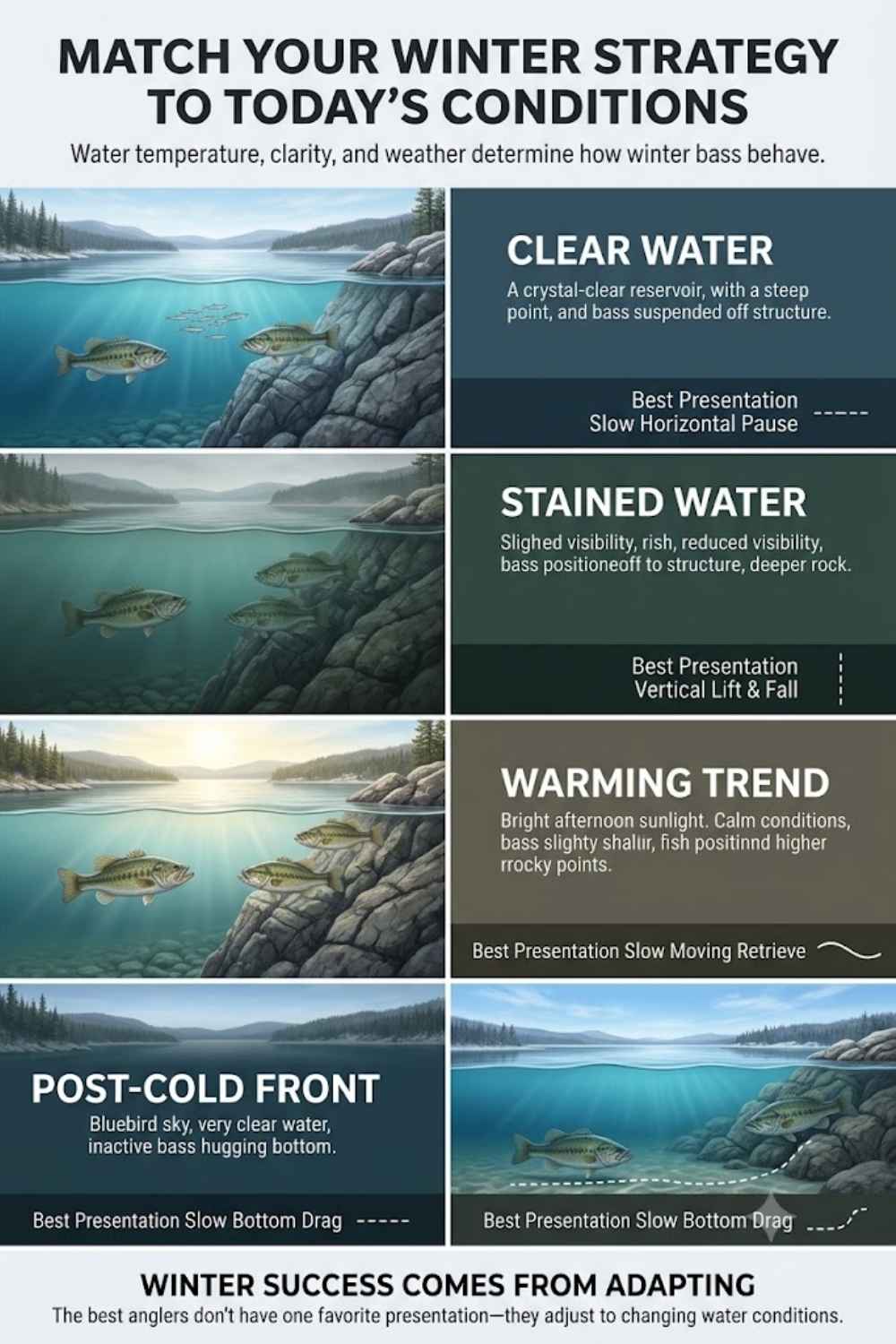
The best winter anglers do not have a favorite bait, they have a decision process. Four inputs settle nearly every choice.
**Water temperature.** 52–47°F: bass will still chase. Jerkbait with 3–6 second pauses, blade bait on a cast, slow-rolled spinnerbait in stain, football jig on rock. 47–42°F: the heart of the jerkbait season. Pauses to ten seconds, blade baits vertically over marked schools. Below 42°F: pause length becomes extreme and finesse takes over — hair jig, Ned rig, drop shot, spoon. Cross-reference 50-degree water for the transition period.
**Water clarity.** Clear (6+ ft visibility): translucent jerkbaits, hair jigs, drop shots, natural colors, longer casts, lighter line. Stained (2–5 ft): blade baits, chartreuse-shad jerkbaits, gold blades, spinnerbaits — vibration and contrast outrank realism. Muddy (under 2 ft): winter mud is the toughest combination in bass fishing. Move to the clearest water you can find, usually the main lake, rather than trying to solve it with a bait. See water clarity selection.
**Where the fish are in the column.** This is what electronics are for. Suspended fish over deep water: jerkbait or drop shot. Fish on the bottom: blade bait, spoon, hair jig, football jig. Getting this wrong is the most common reason a good winter spot produces nothing.
**Weather trend.** Two to three stable or warming days is the best winter window there is, and it can push fish surprisingly shallow into sun-warmed pockets and onto riprap in the afternoon. The bluebird day immediately after a hard front is the worst, and that is when you downsize to the finesse presentations above rather than continuing to grind a moving bait. See the weather guide and cold front lures.
**Fishing too fast.** By an enormous margin the number one error. Anglers slow down mentally but their hands do not. If your pauses do not feel absurd, they are too short. A useful drill: count out loud.
**Fishing summer water.** Shallow flats, backs of creeks, and isolated grass that produced in June are frequently empty in January. Winter water is a small fraction of a lake, and if you have not found bait or structure in the first two spots you should be idling, not casting.
**Starting at dawn.** Winter's best window is usually the warmest part of the afternoon, especially on the second or third sunny day of a stable stretch. A 10 a.m. to 4 p.m. trip often outproduces a full day that starts in the dark.
**Line that is too heavy.** Fifteen-pound fluorocarbon kills jerkbait action, reduces running depth, and is visible in clear winter water. Drop to 8–12 lb for treble baits and 6–8 lb leaders for finesse.
**Dull or factory hooks.** Cold-water strikes are soft. A hook that would land a hot August fish frequently fails on a bass that simply closed its mouth on the bait and sat there. Sharpen or replace trebles.
**Ignoring the graph.** Winter is the one season where blind casting is genuinely inefficient. The fish are grouped, they show up clearly on electronics, and knowing their depth dictates the entire bait selection.
**Setting the hook too hard.** Long pauses mean slack line and light contact. A hard cross-body hookset on 8 lb fluorocarbon with trebles pulls the bait away or tears the hook free. Reel down, then sweep.
**Giving up on a spot too early.** Winter fish feed in windows. Sitting on a proven school for an hour and catching nothing for fifty minutes and five fish in ten is a completely normal winter day. See how to adjust when the bite dies and why bass won't hit your lure.
This guide exists to help you fish winter well, not to argue that winter baits are always the answer. A suspending jerkbait is one of the best lures ever made from roughly 40–55°F, and a mediocre choice at 70°F when bass will chase something faster and larger.
If your water is climbing through the mid-50s toward 60°F, you are leaving winter and entering prespawn — the moving-bait season begins and lipless crankbaits, squarebills and chatterbaits start beating everything in this guide. See the spring guide and lipless crankbaits.
If you fish a shallow, stained lake with no meaningful deep water, most of the jerkbait advice here does not apply to you. Focus your budget on blade baits, a chatterbait, and a compact jig, and fish riprap, deep docks and channel ditches instead. See the chatterbait guide and stained water lures.
If you are fishing a river in winter, current position matters more than lure choice. Bass will be out of the current entirely, and a hair jig or blade bait worked in an eddy will beat a long-cast jerkbait presentation you cannot control. See current seams and moving water.
And if the water is above 60°F where you fish — some southern and western fisheries never truly get cold — buy from the summer guide or the fall guide instead. Buying winter tackle for water that never gets cold is the most common way anglers waste money on the recommendation of a national article written for a different climate.
If you are building a winter box from nothing, buy in this order. First, one quality suspending jerkbait in a natural shad pattern and one in a chartreuse-shad pattern — this is the most productive winter category on the majority of reservoirs. Second, two blade baits (1/2 oz chrome and 1/2 oz gold) for the deep, bottom-oriented bite that jerkbaits cannot reach. Third, a small pack of Ned rig heads and stick baits in green pumpkin for the bluebird post-front days. Those three purchases cover a genuine majority of winter scenarios for under the price of a single rod.
Step two, once you know your lake: add a hair jig if you fish clear rocky highland water, a football jig if your lake has deep rock and a crawfish population, a drop shot if your bass suspend over deep water, and a jigging spoon if you regularly mark shad balls with fish underneath them.
The **Megabass Vision 110** remains our overall pick for anglers who want the single most reliable winter bait available and fish clear water regularly. The **Rapala Shadow Rap** is the specialist's choice on ultra-clear, heavily pressured lakes. The **Berkley Stunna** is the best value in a genuinely good suspending jerkbait and the right first purchase for most anglers.
Buy fewer, better baits. Winter fishing is not a numbers game where more variety helps — it is a precision game where a bait that suspends correctly, on line that is light enough, fished slower than feels sane, in the specific water where the fish actually are, catches everything.
This guide will help you buy the right winter lure within a category. It cannot tell you whether that category is the right choice on the day you are actually going. Water temperature, clarity, wind, sky, pressure trend and forage all shift the answer — and in winter, the margin between the right and wrong presentation is wider than in any other season.
That is what Today's Fishing Strategy is for. Enter your current conditions and it will tell you whether a suspending jerkbait is genuinely the highest-confidence choice for your trip, or whether a blade bait, a hair jig, or something outside this guide entirely fits the day better — along with the color and the reasoning behind it.
Buy for the season. Fish for the day.
Industry-standard suspending jerkbait for cold-water bass.
Cold, clear water — long pauses near rock and points.
As an Amazon Associate I earn from qualifying purchases.
Staging fish on transition banks and the baits that work.
Fry guarders and the recovery slowdown.
Walking baits, frogs, and poppers in heat.
Deep structure or shade — pick one.
Shade plus structure in the heat of the year.
Shad migration and aggressive pre-winter feeding.
Plug in today's water temp, clarity, weather, and forage — the tool returns the highest-confidence presentations.
Build Today's Strategy →