Editor's Pick97%
War Eagle Spinnerbait
Bluegill
View Product →The best bass lures for stained water (1–4 ft of visibility) — the sweet-spot clarity that fishes the widest variety of lures. Chatterbaits, spinnerbaits, squarebills, swim jigs, and color rules.
Affiliate Disclosure: As an Amazon Associate I earn from qualifying purchases. Recommendations reflect on-the-water testing and the LureLogic ranking engine — not paid placement.
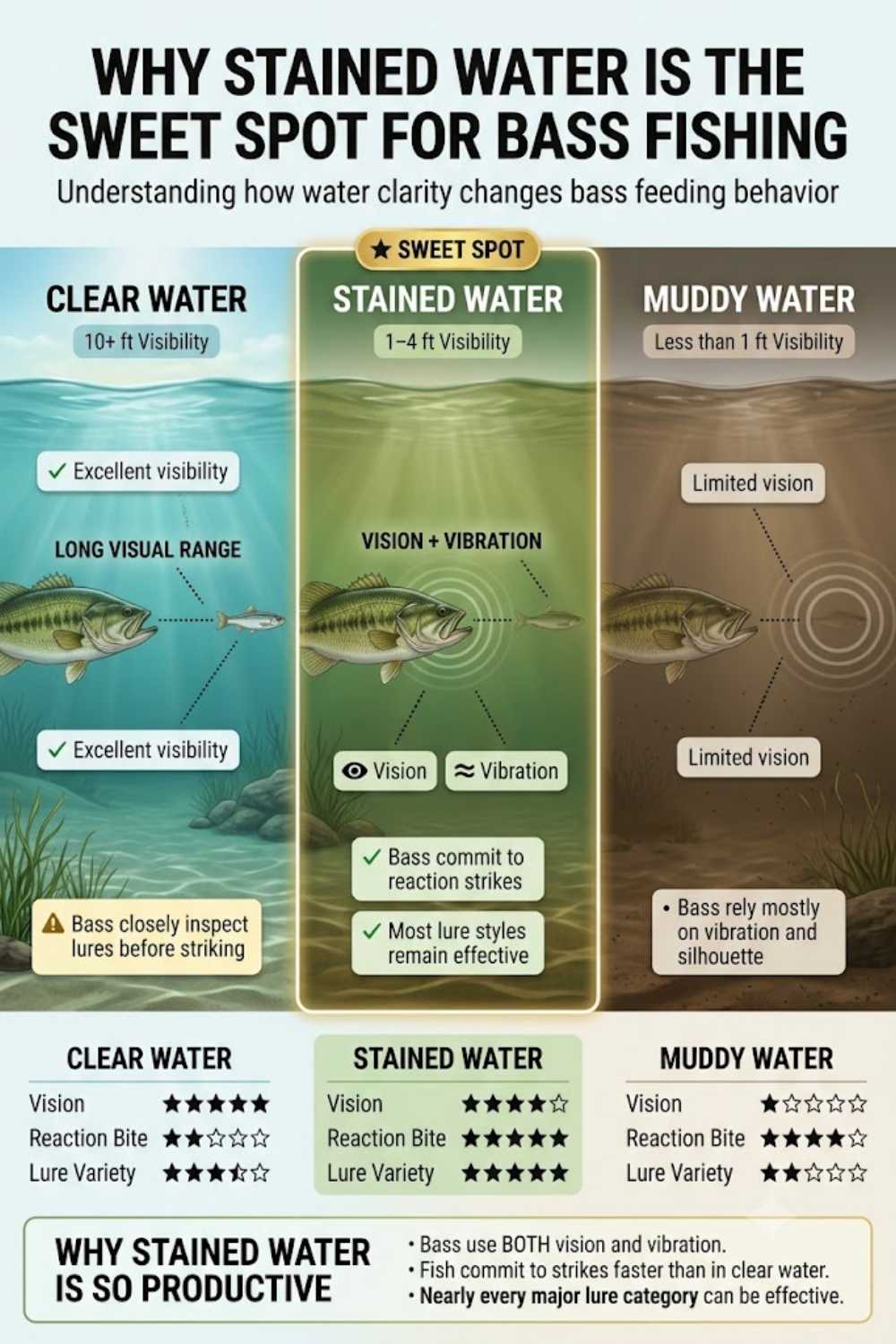
Stained water — 1 to 4 feet of visibility — is the sweet-spot bass-fishing clarity. Both visual and lateral-line feeding modes are operational, almost every lure category produces, and bass are aggressive enough to commit to reaction baits but selective enough to reward technique. Most productive U.S. reservoirs are stained-water systems most of the year, and the standard tournament-angler lure box is built around stained-water presentations.
The biology is straightforward. Stained water provides enough visibility for bass to track and commit to moving baits at distance (chase ranges of 3–8 ft are typical) while limiting the prolonged visual inspection that pressures bass into refusing baits in clear water. The bite frequency in stained water is generally higher than in clear water, and the strike commitment rate is higher than in muddy water — a productive combination.
The stained-water lure decision is the easiest of the clarity spectrum. Rather than picking from a narrow muddy-water shortlist or a finesse-heavy clear-water shortlist, the stained-water angler picks from almost the full lure catalog. Reaction baits (chatterbaits, spinnerbaits, squarebills, lipless crankbaits, swim jigs, walking topwater) all produce. Cover baits (flipping jigs, Texas-rigs, Senkos) produce in the shallow cover that stained water pushes bass toward. Even finesse baits (drop shots, ned rigs) produce in deeper stained water on pressured fish.
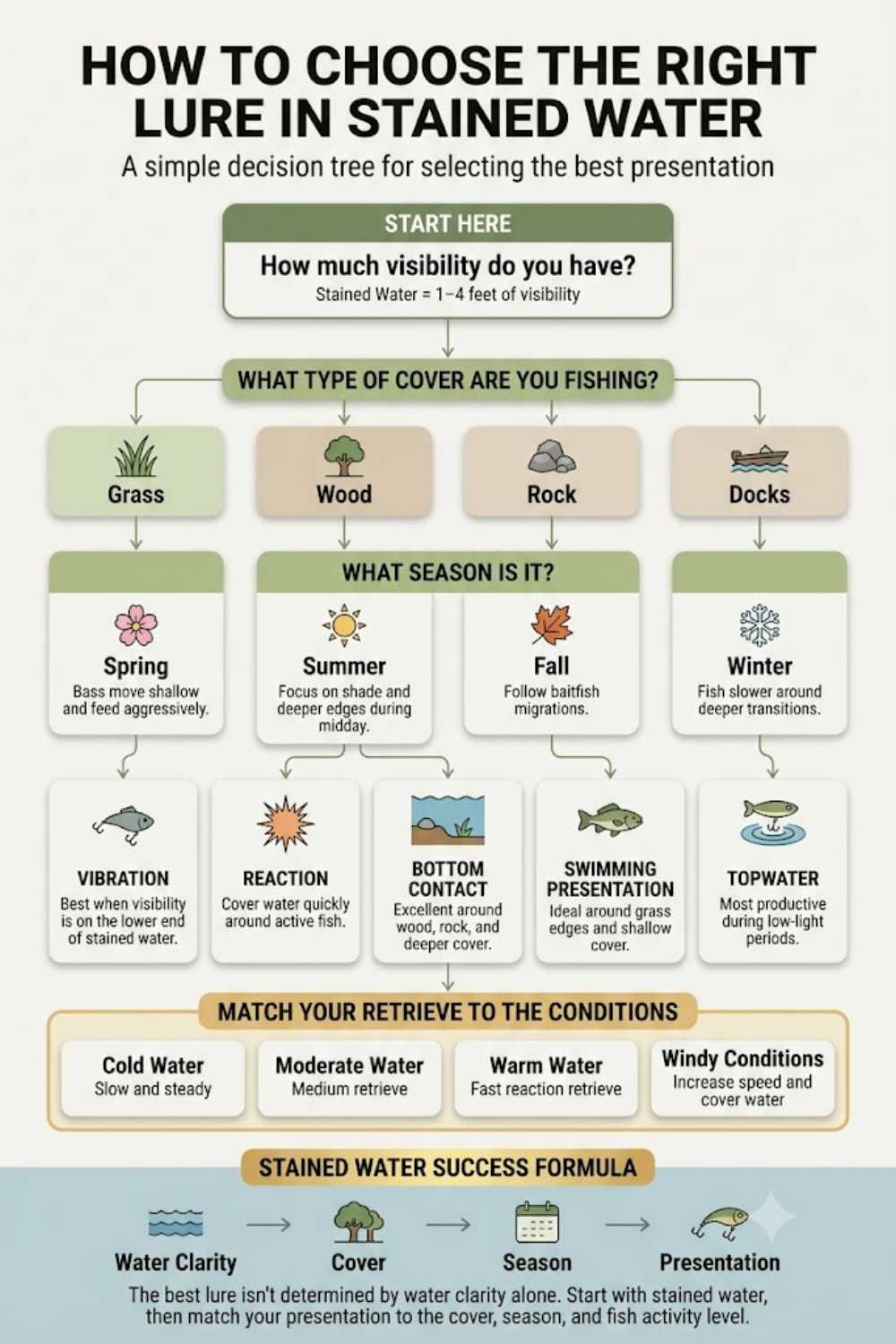
The stained-water decision tree is therefore: pick the technique that matches the cover type, temperature, and season, then tune the color and speed for the stain level. For the broader framework see water clarity lure selection.
War Eagle Spinnerbait — Editor's Pick. A 1/2 oz double-willow-blade spinnerbait in white-and-chartreuse or bluegill is the universal stained-water starter. Slow-rolled along shallow cover, burned over grass tops, or yo-yo'd through brush, the spinnerbait produces across season and temperature. The combination of flash, vibration, and silhouette is perfectly matched to 1–4 ft visibility. See the spinnerbaits guide.
Z-Man JackHammer ChatterBait — Best Search Bait. A 1/2 oz JackHammer with a Keitech FAT 3.8 trailer in bluegill or sexy shad covers stained-water flats efficiently. Particularly effective around grass edges and over shallow flats. The blade vibration locates fish that visual baits can't. See the chatterbaits guide.
Strike King KVD 1.5 Squarebill — Best Reaction Bait. A 1.5 squarebill in chartreuse-with-black-back or sexy shad ticked through shallow wood, rock, and grass produces deflection-triggered strikes. The squarebill is the most productive stained-water reaction bait around discrete cover targets. See the squarebill crankbaits guide.
Dirty Jigs Swim Jig — Best Cover Search. A 3/8 or 1/2 oz bluegill-pattern swim jig with a paddle-tail trailer through stained-water grass and around dock cover produces the biggest stained-water bass. See the swim jigs guide.
Rapala Rippin' Rap — Best Lipless. A 1/2 oz lipless crankbait in red-craw or chrome-and-black yo-yo'd over grass tops and along shallow flats produces explosive reaction bites. See the lipless crankbaits guide.
Dirty Jigs Compact Pitchin' Jig — Best Cover Bait. A 1/2 oz green-pumpkin or black-and-blue jig pitched into stained-water laydowns, brush, and dock cover produces big stained-water bass. See the flipping jigs guide.
Heddon Super Spook — Best Topwater. A walking bait worked across stained-water flats at dawn and dusk produces aggressive strikes. The walking action is the most universal stained-water topwater. See the topwater lures guide.
Gary Yamamoto Senko — Best Pressured-Fish Bait. A 5-inch wacky-rigged Senko in green pumpkin or watermelon-red flake produces on pressured stained-water fish. See the finesse worms guide.
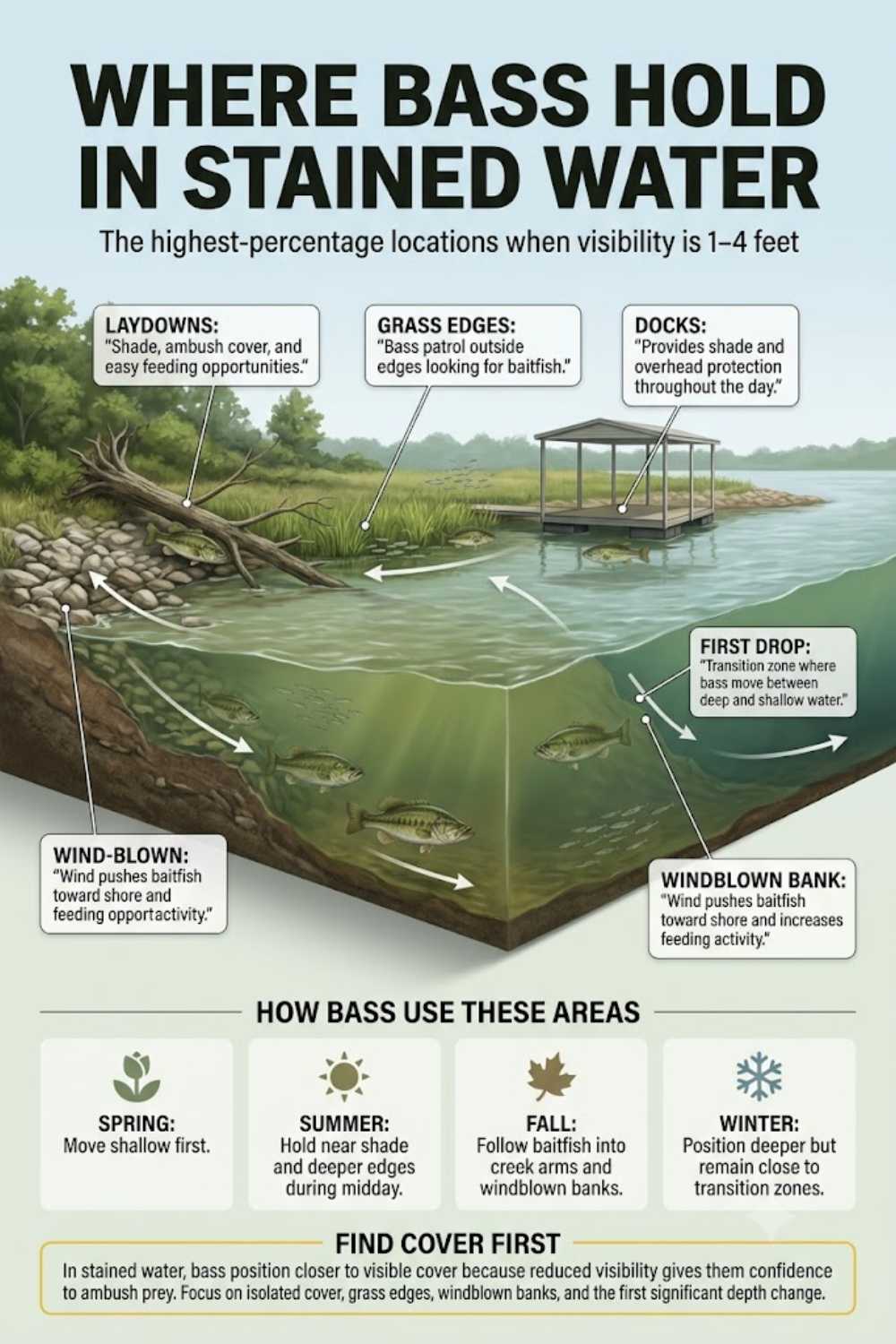
Stained water concentrates bass in the upper-mid water column and on shallow-to-mid cover.
Shallow cover (1–4 ft) — Stained-water bass relate strongly to shallow cover: laydowns, brush piles, dock cover, grass edges, rock piles. The first cover bass encounter on a productive bank holds the most fish. Bass fishing laydowns and bass fishing grass lines cover the shallow-cover patterns.
Mid-depth cover (5–10 ft) — Secondary cover (brush piles on points, deeper laydowns, deep dock pilings) holds the next wave of stained-water bass. Particularly productive during midday and in summer when shallow water heats up.
Windblown banks — Wind concentrates baitfish on stained-water banks even more than on clear-water banks because the stained water already has reduced visibility — wind-stirred turbidity actually helps bass-feeding conditions by reducing visual inspection time. See wind-blown banks bass positioning.
First-deep transitions — Where shallow cover meets the first significant depth break (channel-swing banks, points dropping into deeper water), stained-water bass stack at the transition. Particularly productive in postspawn and fall.
Seasonal adjustments — In prespawn, stained-water bass push into the warmest available shallow cover (north banks, dark-bottom areas, channel-swing banks). See prespawn bass fishing lures. In summer, they slide to mid-depth cover during midday and shallow at dawn/dusk. In fall, they follow shad migrations into creek arms — see fall shad migration.
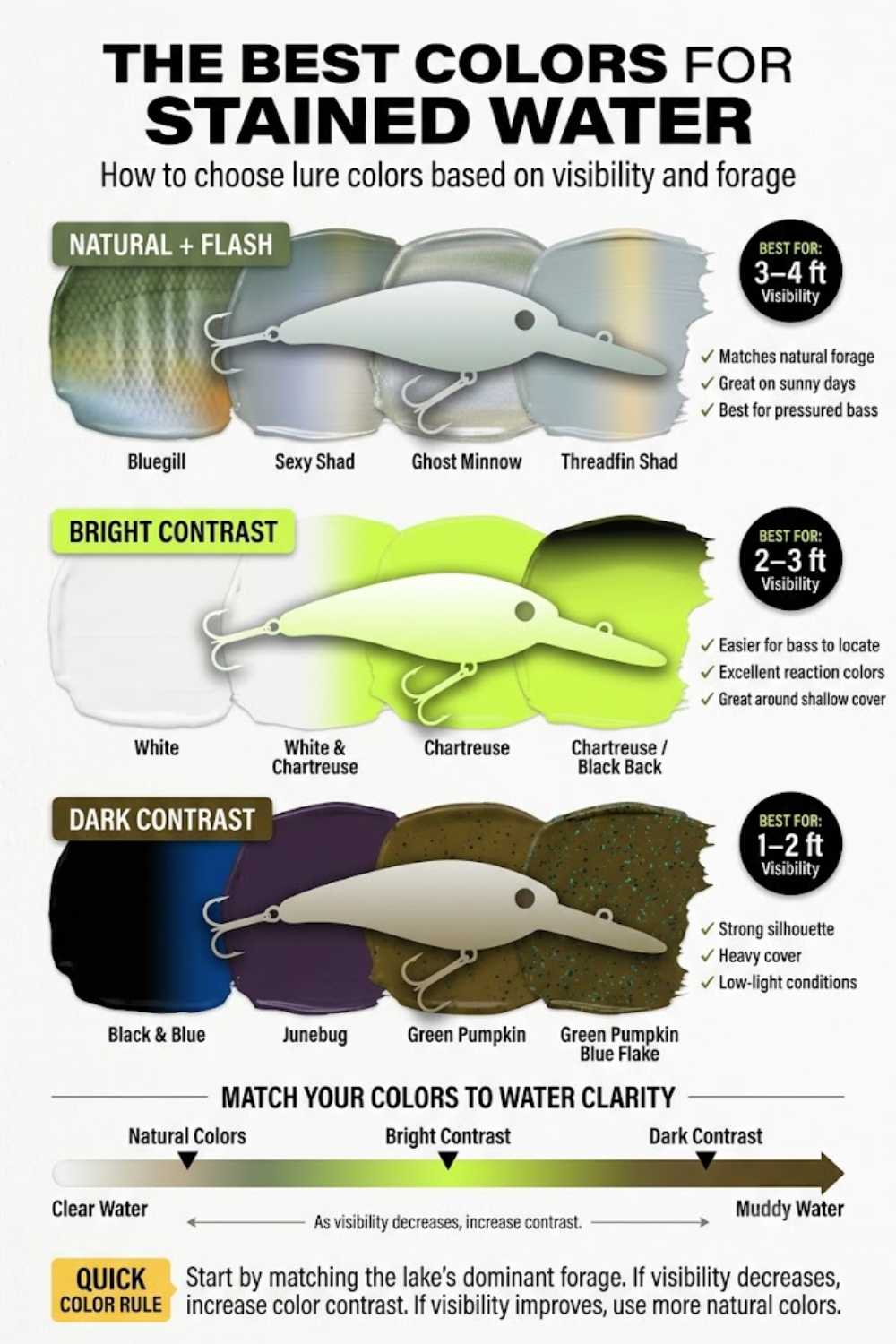
Three productive color families for stained water.
Natural-with-flash — Bluegill, sexy shad, ghost minnow, threadfin shad. These match dominant forage with enough flash and contrast to be visible in 1–4 ft. The most universal stained-water family. Bluegill pattern for bluegill-dominant lakes; sexy shad and ghost minnow for shad-dominant lakes.
Bright accent — White, white-and-chartreuse, chartreuse-and-black-back, hot-pink. These provide high visibility in stained water and produce best as reaction-bait colors (squarebills, chatterbaits, lipless crankbaits, spinnerbaits). White-and-chartreuse is the universal stained-water spinnerbait color.
Dark-with-contrast — Black-and-blue, junebug, green-pumpkin-with-blue-flake. These produce in stained water leaning toward muddy (1–2 ft visibility), in heavy cover, and on pressured fish. Particularly effective for flipping jigs and Texas-rigs.
The color decision tree: identify the dominant forage first, then pick the family that matches; if water is leaning muddy (under 2 ft visibility), shift toward bright accents or dark-with-contrast; if water is leaning clear (over 3 ft visibility), shift toward natural-with-flash; if fish are pressured, shift toward natural colors with subtle profiles.
For the muddier end of the spectrum see best bass lures for muddy water; for clearer water see best bass lures for clear water.
Stained water + prespawn — Highest-percentage combination of the year. Stained water warms faster than clear water, pulls bass shallow earlier, and supports aggressive reaction-bait feeding. Spinnerbaits, chatterbaits, and lipless crankbaits in shallow stained water during prespawn produce trophy-class fish. See prespawn bass fishing lures.
Stained water + spawn — Blind-casting reaction baits across spawning flats produces cruising males and aggressive bedding fish that wouldn't be sight-fishable in clear water. See the 65°F water guide.
Stained water + summer — Mid-depth cover and grass edges produce most consistently. Topwater windows extend further into the day than in clear water. The stained-water summer bite is generally more forgiving than the clear-water summer bite. See summer bass fishing docks.
Stained water + fall — Shad migration into creek arms drives the pattern. Stained-water creek mouths and the first-deep cover inside creeks produce the biggest fall bass. Spinnerbaits, chatterbaits, and lipless cranks dominate. See fall bass fishing bait guide.
Stained water + winter — Suspending jerkbaits, jigs, and slow-rolled spinnerbaits produce. Stained water is more productive than muddy water in winter because visual feeding is still partially operational. See winter bass fishing lures.
Stained water + cold front — More forgiving than clear-water cold fronts. The reduced visibility shortens visual inspection time and reduces the post-front shutdown effect. See cold-front lure guide.
Stained water is the most versatile clarity in bass fishing — almost every lure category produces. The decision is which technique matches the cover, season, and temperature, not which technique works at all. Build a stained-water tackle box around the universal reaction baits (spinnerbait, chatterbait, squarebill, swim jig, lipless), the cover baits (flipping jig, Texas-rig, Senko), and a single topwater (walking bait). Match colors to forage and stain level, and stained water will produce more consistently than any other clarity.
For the muddier end see best bass lures for muddy water. For the clearer end see best bass lures for clear water. For temperature-specific guidance see best bass lures by water temperature.
Classic Colorado/willow combo for windy banks and stained water.
Windy banks and stained water — burn it parallel to cover.
As an Amazon Associate I earn from qualifying purchases.
Temperature-by-temperature lure logic.
The prespawn temperature threshold.
Natural presentations and finesse profiles.
Vibration, dark silhouette, and visibility tactics.
Adjusting across the full clarity spectrum.
Topwater and reaction baits for the dawn window.
Plug in today's water temp, clarity, weather, and forage — the tool returns the highest-confidence presentations.
Build Today's Strategy →