Why Crawfish Are One of the Most Important Bass Forage Sources
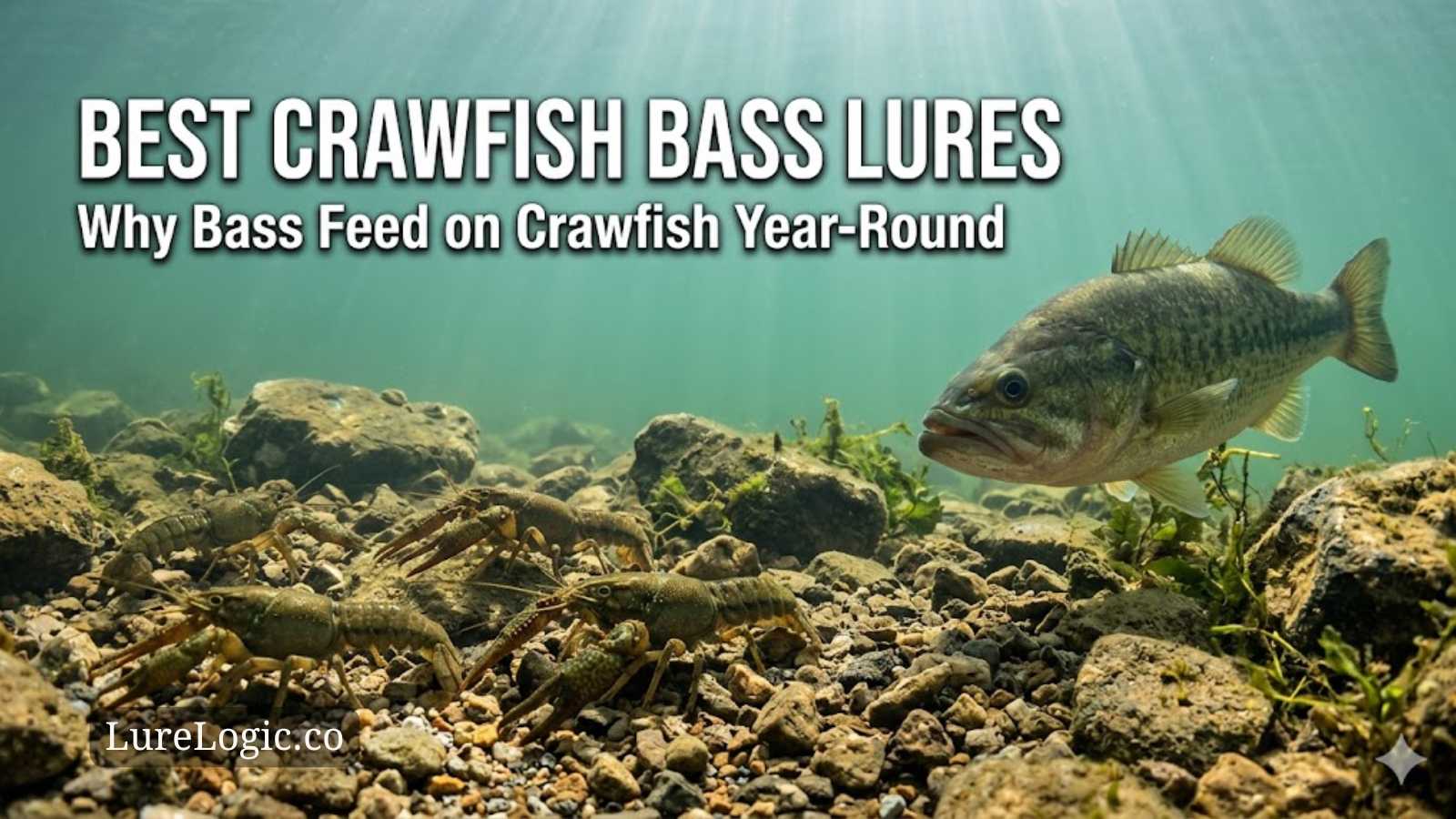
If you could only imitate one forage category throughout an entire bass fishing season, crawfish would arguably be the safest choice. Across reservoirs, natural lakes, rivers, and ponds, crawfish remain one of the most consistent food sources available to largemouth and smallmouth bass.
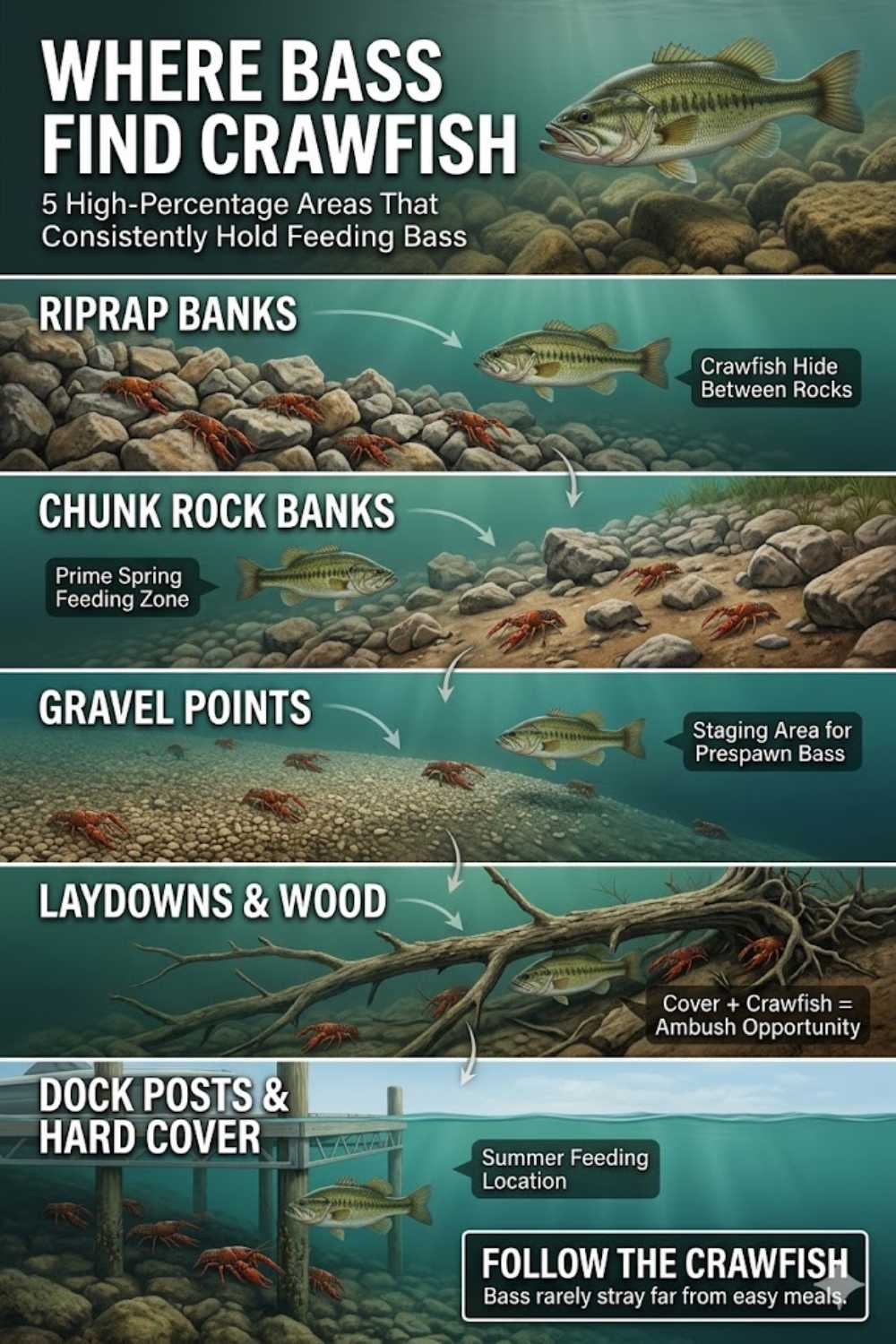
Unlike baitfish populations that often migrate, suspend, or become difficult for bass to target, crawfish spend most of their lives associated with bottom-oriented cover. Rocks, riprap, gravel, chunk rock, laydowns, seawalls, and hard-bottom transitions all provide ideal habitat. Because bass regularly position near these same structures, crawfish become an easy and reliable food source.
Many anglers underestimate just how often bass consume crawfish. Fisheries biologists frequently find crawfish remains in stomach samples throughout the year. During certain periods, crawfish can represent the dominant forage source available to bass, especially in lakes with extensive rocky habitat.
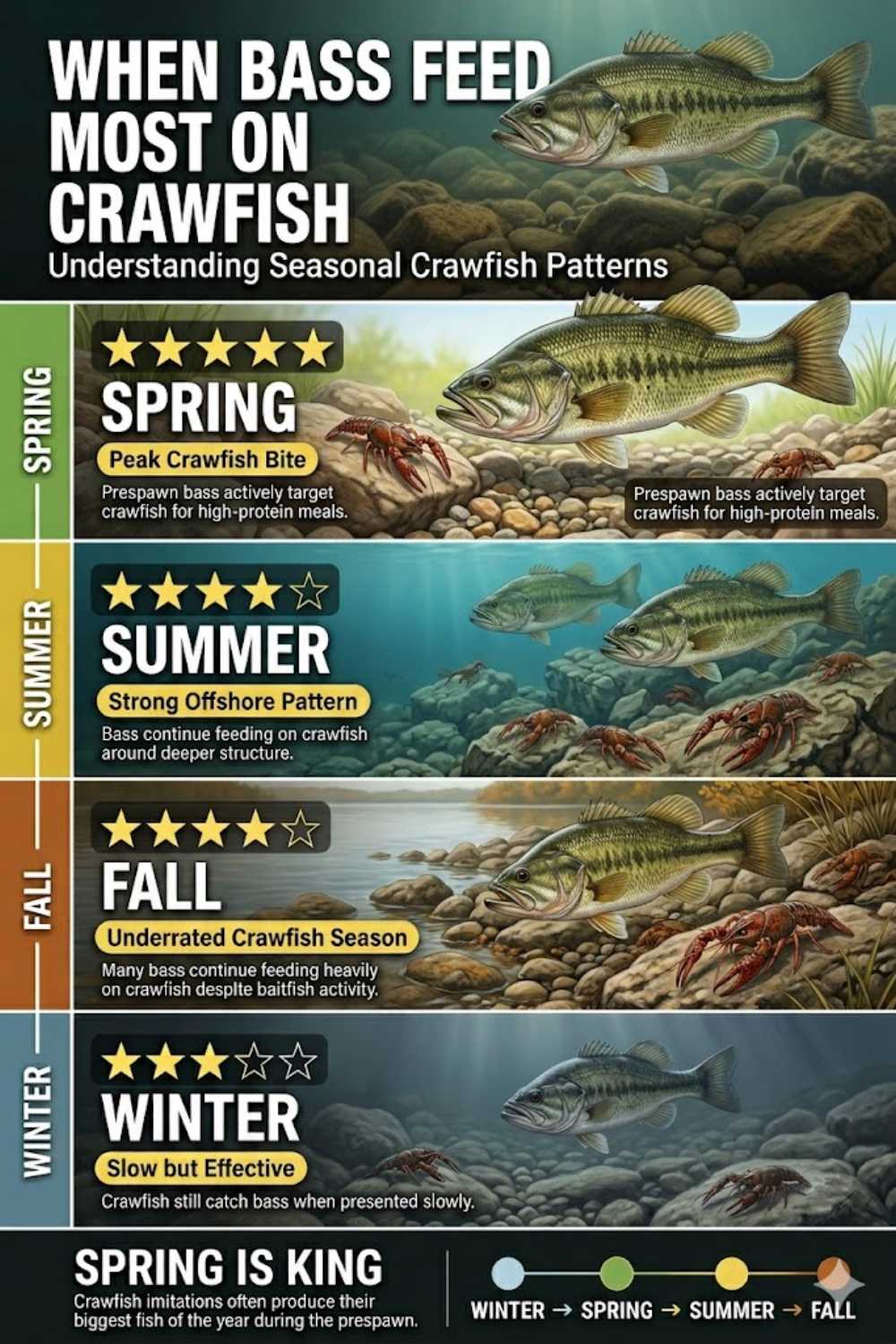
This becomes particularly important during the spring. As water temperatures begin rising, crawfish activity increases significantly. Bass emerging from winter patterns often focus heavily on crawfish because they provide a calorie-dense meal that is easy to capture. This feeding behavior is one reason why anglers experience tremendous success with crawfish-style soft plastics during the prespawn period.
If you want a deeper understanding of how bass use crustaceans throughout the year, the seasonal feeding patterns covered in our crawfish color cycle guide explain why crawfish often become a primary target forage before, during, and after spawning periods.
The effectiveness of crawfish lures also extends beyond largemouth bass. Smallmouth bass are especially known for their preference for crawfish in rocky environments. In many northern fisheries, crawfish represent the primary forage source for quality smallmouth populations.
Perhaps most importantly, crawfish imitators can be presented slowly. When bass become pressured, inactive, or negatively affected by weather changes, they often refuse fast-moving presentations. Crawfish lures allow anglers to maintain bottom contact while keeping a bait in the strike zone longer than almost any other lure category.
When Crawfish Lures Outperform Every Other Bass Bait
One of the biggest mistakes anglers make is treating crawfish baits as spring-only lures. While crawfish presentations certainly shine during prespawn periods, they remain effective throughout the entire year.
The most obvious example occurs during the prespawn. As bass transition from wintering areas toward spawning flats, they often stop on secondary points, channel swings, rocky banks, and staging structure. These locations frequently hold active crawfish populations. The combination of increased crawfish movement and feeding bass creates one of the most productive crawfish-lure windows of the year.
This is why anglers targeting staging fish often rely heavily on crawfish presentations discussed in /prespawn-bass-fishing. During this period, bass are actively feeding to prepare for spawning and frequently prefer bottom-oriented meals that require minimal energy expenditure.
Summer provides another excellent opportunity. Many anglers immediately reach for worms or shad imitators once water temperatures climb, but bass continue eating crawfish throughout hot-weather periods. Offshore rock piles, ledges, bluff transitions, and hard-bottom structure frequently hold both crawfish and bass during summer months.
Fall is often overlooked. As crawfish molt and remain active around shallow hard cover, bass continue feeding on them. In lakes lacking large baitfish populations, crawfish can remain a dominant forage source even as water temperatures begin cooling.
Weather also plays a significant role. Post-front conditions often make bass reluctant to chase moving lures. Crawfish baits excel because anglers can slow presentations dramatically while maintaining bottom contact. A subtle drag, hop, or crawl frequently outperforms reaction-style presentations after weather changes.
Crawfish lures also dominate around rocky habitat. Riprap, chunk rock, gravel banks, and transition areas naturally concentrate crawfish. Anglers looking to maximize these opportunities should understand the positioning concepts covered in /rocky-bank-bass-fishing, where bass often use rocks as both feeding and ambush locations.
How Water Clarity Changes Crawfish Lure Selection
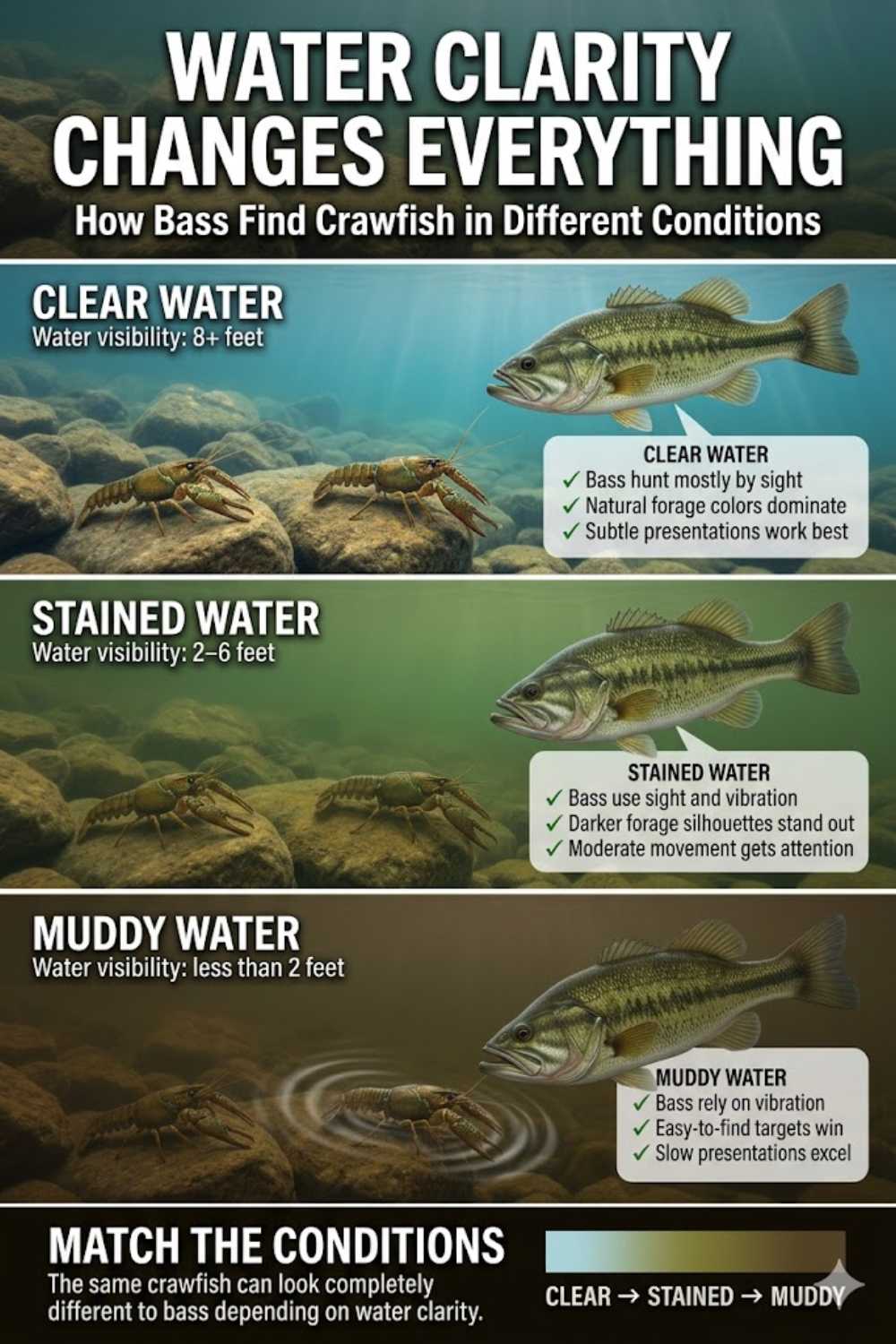
Many anglers focus almost exclusively on lure color when discussing water clarity, but clarity influences far more than appearance. Water visibility affects profile size, vibration level, retrieve speed, and even the type of crawfish imitation that produces best.
In clear water, bass typically rely heavily on sight feeding. Natural colors become extremely important because fish have more time to inspect a lure before committing. Green pumpkin, watermelon red, green pumpkin blue, and subtle brown patterns consistently outperform brighter options in clear conditions. The goal is to imitate natural crawfish coloration rather than trigger reaction strikes.
Profile selection also matters. Clear-water bass often respond better to realistic, moderately sized craws such as the Zoom Ultra Vibe Craw or Yamamoto Flappin Hog. Excessive vibration can actually reduce effectiveness because fish can closely evaluate the bait.
Retrieve speed should generally slow down as visibility increases. Bass in clear water frequently track a bait for several feet before striking. Dragging, shaking, and subtle hops often outperform aggressive presentations.
Stained water creates an entirely different situation. Reduced visibility forces bass to rely more heavily on vibration and lateral-line detection. This is where high-action baits like the Rage Craw and Netbait Paca Craw separate themselves.
Larger profiles become advantageous because they create a bigger target. Black and blue, Okeechobee craw, black neon, and darker green pumpkin variations often outperform more subtle colors. These darker shades provide stronger silhouettes that bass can detect more easily.
In muddy water, anglers often make the mistake of fishing too quickly. Even though visibility is limited, bass still need time to locate a lure. A bulky craw with strong vibration moved slowly along bottom structure frequently generates more bites than faster presentations.
Water clarity should also influence rigging decisions. Clear-water bass may respond better to lighter Texas rigs, finesse jigs, or football jigs. In stained water, heavier flipping presentations often produce more consistent results because they allow anglers to target high-percentage cover where bass position tightly.
The Best Ways to Rig Crawfish Lures for Bass
One reason crawfish-style soft plastics remain so productive is their versatility. The same bait can be rigged several different ways depending on conditions, cover, and bass behavior.
The Texas rig remains the most popular option. Its weedless design allows anglers to fish around wood, grass, docks, brush piles, and shoreline cover without constantly snagging. A Texas-rigged Rage Craw or Ultra Vibe Craw excels when bass are relating to shallow cover or isolated targets.
Weight selection matters. Lighter weights create a slower fall that often triggers bites in clear water or around pressured fish. Heavier weights allow anglers to penetrate vegetation, reach deeper structure, and maintain bottom contact in wind or current.
Jig trailers represent another highly productive application. In fact, many anglers purchase crawfish plastics primarily for use behind jigs. The combination of a football jig and craw trailer creates one of the most realistic crawfish presentations available.
Bass feeding heavily on bottom forage often respond exceptionally well to this setup. The trailer adds profile, movement, and realism while helping the jig imitate a fleeing crawfish. Anglers wanting to maximize this presentation should understand the concepts covered in our jig trailer buying guide, where trailer selection frequently determines whether a jig receives follows or strikes.
Football jigs particularly excel on rocky structure because they maintain bottom contact while mimicking crawfish movement. Dragging a football jig paired with a Rage Craw across gravel points, chunk rock, or offshore structure closely resembles natural crawfish behavior.
Flipping rigs become valuable when targeting heavy cover. The Yamamoto Flappin Hog shines in this role because its larger profile appeals to bigger fish while still resembling natural forage.
Carolina rigs offer another overlooked presentation. Crawfish baits dragged behind a Carolina rig cover water efficiently while maintaining bottom contact. This approach works particularly well on offshore structure during summer and fall.
No matter which rigging style you choose, maintaining bottom contact is critical. Real crawfish rarely swim long distances through open water. Successful anglers keep their lure where crawfish naturally live: near the bottom and around structure.
Rage Craw Review: Why It Earns the Best Overall Spot
The Rage Craw has earned its reputation through consistency rather than hype. Across a wide range of fisheries, seasons, and water conditions, it simply catches bass.
Its defining characteristic is claw action. Even at extremely slow speeds, the claws produce noticeable movement and vibration. This allows the bait to attract bass without requiring aggressive retrieves.
The Rage Craw excels as both a standalone bait and a trailer. As a Texas-rigged presentation, it performs exceptionally around docks, wood cover, grass edges, and shoreline targets. As a jig trailer, it creates one of the most effective crawfish imitations available.
Prespawn periods are where the bait truly shines. Bass staging around rocky banks, secondary points, and transition areas often feed heavily on crawfish. The Rage Craw's action helps fish locate the bait while maintaining a realistic profile.
Summer applications are equally strong. Offshore structure, hard-bottom areas, and ledges frequently hold bass feeding on crawfish. The bait's ability to create movement at slow speeds becomes especially valuable when fish are positioned deep.
Color selection remains straightforward. Green pumpkin consistently produces nationwide because it resembles numerous crawfish species. Black and blue becomes a strong option in stained water, while watermelon red often excels in clearer fisheries.
The biggest mistake anglers make with the Rage Craw is fishing it too aggressively. Because the bait already produces substantial movement, excessive rod action often creates an unnatural presentation. Slow drags, subtle hops, and controlled movements typically generate the best results.
Its versatility across multiple presentations ultimately separates it from competitors. Few crawfish plastics can function effectively as a jig trailer, flipping bait, pitching bait, Texas rig, and Carolina rig while maintaining consistent productivity.
Zoom Ultra Vibe Craw Review: The Most Versatile Craw on the List
The Zoom Ultra Vibe Craw occupies an interesting position among crawfish lures. It lacks the extreme vibration of the Paca Craw and the bulk of the Flappin Hog, yet that balance is exactly why it remains productive in so many situations.
Its moderate profile allows it to imitate a broad range of crawfish sizes. This becomes particularly important on fisheries where bass regularly encounter smaller forage.
The Ultra Vibe Craw excels around vegetation. Grass lines, hydrilla edges, lily pad fields, and submerged weeds often hold bass that feed on both crawfish and bluegill. The bait's compact shape moves through cover efficiently while maintaining enough action to attract strikes.
Another strength is adaptability. The bait can be flipped, pitched, dragged, hopped, swum, or used as a trailer. Anglers who prefer simplifying tackle selections often appreciate having one craw that handles multiple tasks effectively.
Watermelon red remains one of the strongest color options because it matches many natural crawfish populations while remaining effective around vegetation. Green pumpkin continues to be the safest all-around choice.
During postspawn and summer periods, the Ultra Vibe Craw often outperforms larger crawfish imitators because bass frequently target smaller forage. A compact profile can generate more bites without sacrificing fish quality.
The bait also performs exceptionally well under fishing pressure. Highly pressured bass often become conditioned to oversized or highly aggressive presentations. The Ultra Vibe Craw provides a more natural alternative that still creates enough movement to attract attention.
Its primary limitation appears when targeting extremely dirty water or heavy-current environments. In those situations, anglers may benefit from the additional vibration produced by larger-profile options.
For anglers seeking one crawfish bait capable of handling virtually every common bass-fishing situation, the Ultra Vibe Craw remains among the safest choices available.
Yamamoto Flappin Hog Review: The Big-Fish Crawfish Option
The Yamamoto Flappin Hog consistently earns a place in tournament anglers' boats because it appeals to larger bass without sacrificing realism. While technically a creature-style bait, its overall profile closely resembles a bulky crawfish and excels whenever bass are feeding on larger bottom-oriented forage.
The biggest advantage of the Flappin Hog is profile size. In lakes where bass routinely consume mature crawfish, bluegill, and larger forage species, a substantial presentation often attracts higher-quality fish. Anglers targeting five bites rather than twenty bites frequently prefer larger craw-style baits for exactly this reason.
Heavy cover is where the Flappin Hog truly shines. Boat docks, flooded bushes, standing timber, laydowns, brush piles, and thick vegetation all create situations where bass have limited time to evaluate a lure. The bait's larger profile increases visibility while still presenting a natural appearance.
Prespawn fishing represents one of the strongest applications. Female bass preparing to spawn often prioritize larger, calorie-rich meals. Pitching or flipping a Flappin Hog around staging cover can produce some of the biggest fish of the year.
The bait also excels during summer when bass position beneath docks and shade. Larger fish frequently use these areas as ambush locations and respond well to a slow-falling, bulky crawfish presentation.
Green Pumpkin Black Flake remains the safest starting point. In stained water, black-blue combinations often increase visibility while maintaining a natural forage appearance.
One common mistake is using the Flappin Hog everywhere. Because of its larger profile, it may reduce overall bite numbers during difficult conditions or when bass are focused on smaller forage. In those situations, downsizing to a Rage Craw or Ultra Vibe Craw often produces more consistent action.
However, when your goal is finding bigger bass around heavy cover, few craw-style plastics offer a better combination of realism, bulk, and fish-catching potential.
Berkley Craw Fatty and Netbait Paca Craw: Situational Specialists That Shine
Not every crawfish lure needs to be an all-around performer. Some excel because they solve specific fishing situations more effectively than general-purpose options. The Berkley Craw Fatty and Netbait Paca Craw both fall into this category.
The Berkley Craw Fatty is at its best when bass become pressured or cautious. Its compact body profile closely resembles smaller crawfish that bass encounter naturally. Because the bait lacks excessive bulk, fish can inhale it easily, making it particularly effective during tough bites.
Spring and fall often produce the strongest results. During these periods, bass frequently feed aggressively on smaller crawfish populations inhabiting shallow cover. The Craw Fatty provides a realistic profile without overwhelming fish.
It also serves as an excellent option for anglers fishing smaller ponds, reservoirs, and lakes where forage size tends to remain relatively small.
The Netbait Paca Craw occupies the opposite end of the spectrum. Its oversized claws generate substantial vibration and water displacement. Bass can detect the bait from greater distances, making it especially effective in stained water.
Windy conditions, muddy inflows, and low-visibility environments frequently favor the Paca Craw. When fish struggle to locate visual targets, vibration becomes critical. The Paca Craw excels in these circumstances.
As a jig trailer, it remains one of the most productive crawfish-style plastics available. The large claws activate with very little movement, creating a lifelike fleeing action whenever the jig is dragged or hopped along the bottom.
The biggest mistake anglers make with both baits is using them interchangeably. The Craw Fatty excels when subtlety matters. The Paca Craw excels when visibility is limited and bass need additional vibration cues.
Understanding which situation calls for which tool is often the difference between average and exceptional results.
Common Crawfish Fishing Mistakes That Cost Anglers Bass
Many anglers purchase excellent crawfish lures but never unlock their full potential because of a few common mistakes.
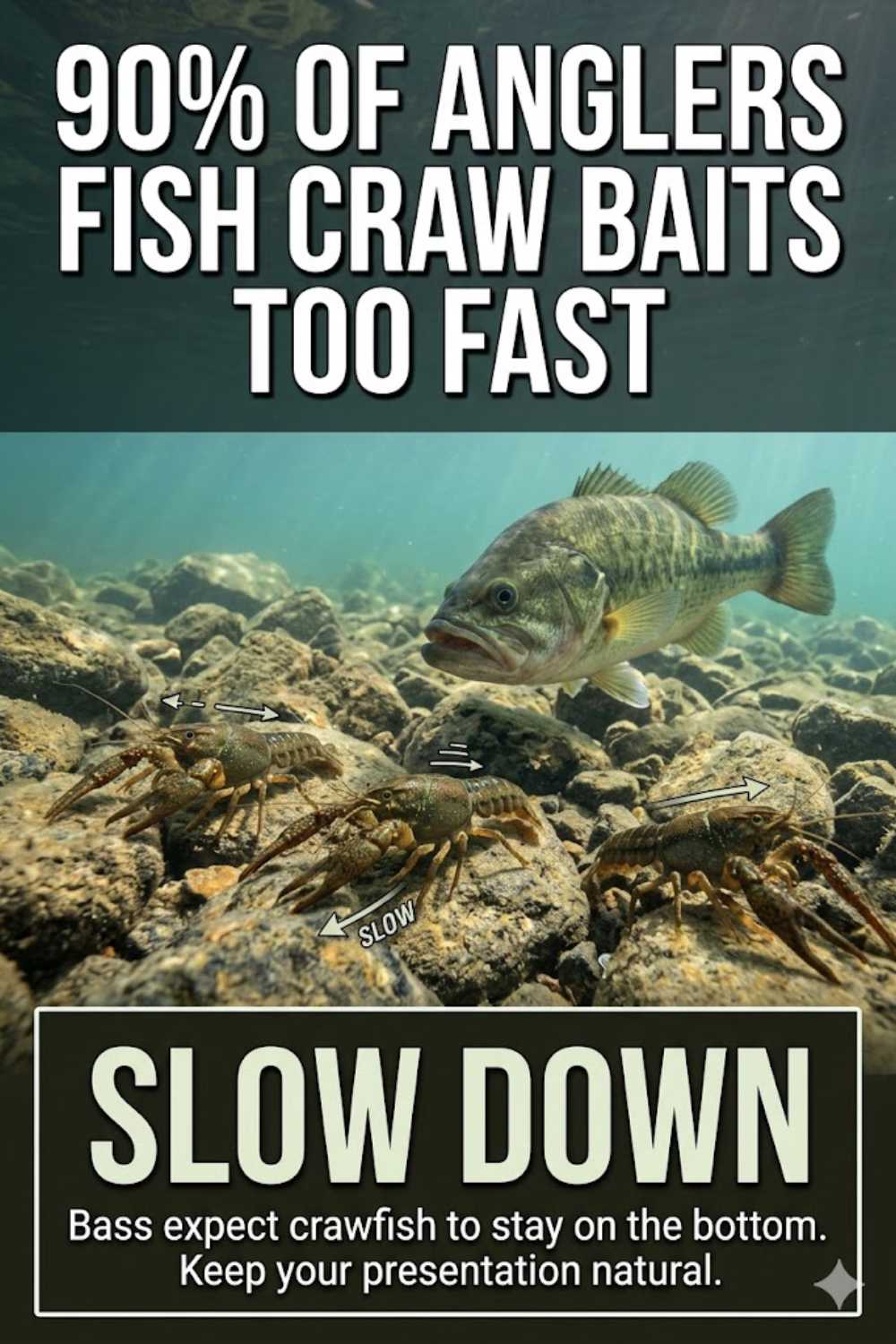
The first is fishing too fast. Real crawfish spend most of their time moving slowly along the bottom. They rarely sprint long distances continuously. Bass expect crawfish to behave this way, and unnatural retrieve speeds often reduce strikes.
The second mistake is fishing too high in the water column. Crawfish are bottom-oriented forage. While exceptions exist, most successful crawfish presentations maintain frequent bottom contact.
Another major error involves ignoring seasonal transitions. Crawfish remain important throughout the year, but bass position differently as seasons change. A productive spring bank may become far less effective during summer when fish move offshore.
Many anglers also overcomplicate color selection. While color matters, location and presentation matter far more. Green pumpkin catches bass nationwide because it generally resembles a wide variety of natural crawfish. Constantly switching colors often distracts anglers from more important adjustments.
Using the wrong size bait is another issue. Large-profile baits often excel when targeting quality fish or fishing heavy cover. Smaller craws frequently outperform bulky presentations when fish become pressured or forage size decreases.
Failing to match water clarity creates additional problems. Clear-water bass usually prefer natural appearances and subtle movement. Stained-water bass often require stronger vibration and darker colors.
Finally, many anglers abandon crawfish baits too quickly. Crawfish presentations frequently produce fewer bites than reaction baits but generate larger average fish. Tournament anglers understand this tradeoff and often commit to crawfish presentations longer than recreational anglers.
Patience, bottom contact, and seasonal awareness remain the keys to maximizing crawfish lure effectiveness.
How to Choose the Best Crawfish Bass Lure for Your Fishing Conditions
Choosing the best crawfish bass lure ultimately comes down to matching the bait to current conditions rather than searching for a universal answer.
If you want the most versatile option available, the Rage Craw deserves the top spot. It performs across multiple rigging styles, seasons, water clarities, and forage situations. Most anglers could fish an entire year with a Rage Craw and never feel limited.
If versatility is your primary goal but you prefer a slightly more subtle profile, the Zoom Ultra Vibe Craw becomes an outstanding choice. It excels across diverse fisheries and handles fishing pressure particularly well.
When targeting larger bass around heavy cover, the Yamamoto Flappin Hog offers a larger profile capable of producing tournament-caliber fish. Its strengths become most apparent around docks, timber, bushes, and flipping cover.
Budget-conscious anglers should strongly consider the Berkley Craw Fatty. It provides excellent fish-catching ability without requiring premium pricing while remaining effective during difficult bites.
For stained-water fisheries, few options outperform the Netbait Paca Craw. Its vibration allows bass to locate the bait more easily when visibility decreases.
Remember that location remains more important than lure selection. The best crawfish lure in the world cannot catch bass where bass are absent. Focus first on identifying productive structure, seasonal patterns, and forage-rich areas. Then choose the crawfish bait that best matches current conditions.
When anglers combine proper location selection with realistic crawfish presentations, these five lures consistently rank among the most reliable bass-catching tools available.