Editor's Pick97%
Booyah Pad Crasher
Green Pumpkin
View Product →The best bass lures for lily pads — hollow-body frogs, swim jigs, punching rigs, buzzbaits and weightless follow-up plastics. What to buy, when each wins, and how to convert missed blowups.
Affiliate Disclosure: As an Amazon Associate I earn from qualifying purchases. Recommendations reflect on-the-water testing and the LureLogic ranking engine — not paid placement.
Lily pads look like grass from the boat and fish nothing like it. A pad is an individual plant: a thick, rubbery stem rooted in soft bottom, topped by a broad flat leaf that floats on the surface. Fifty of them together create a shaded ceiling with almost completely open water underneath. That single fact drives every lure decision on this page.
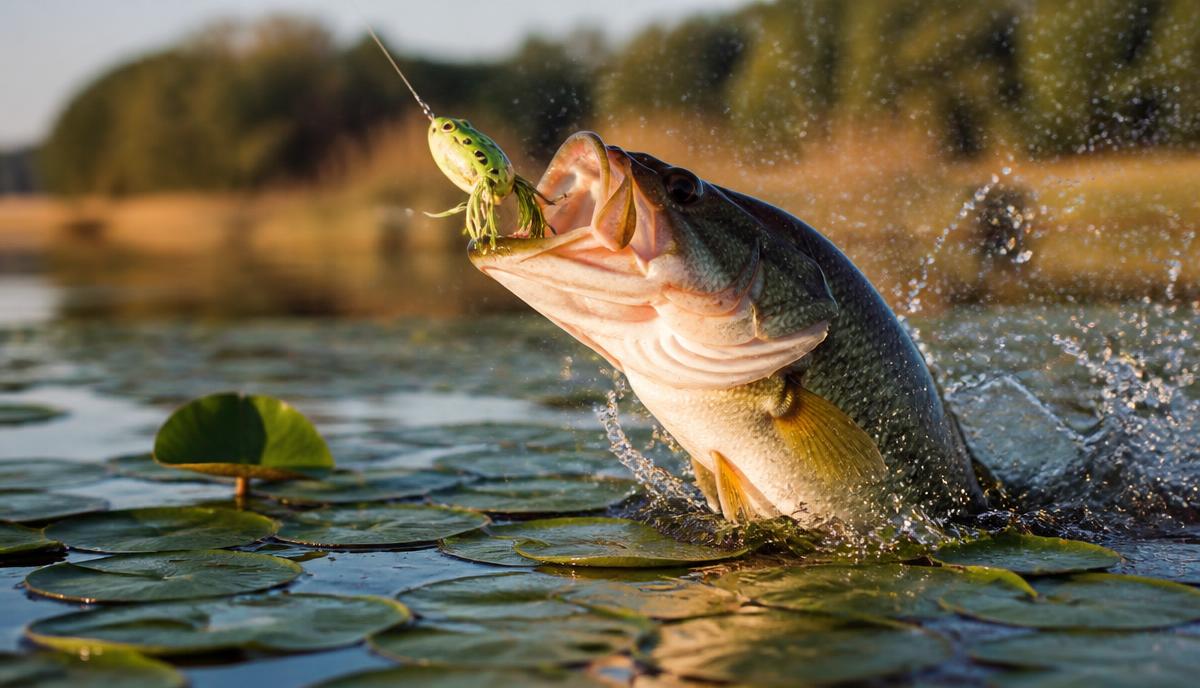
Because the water column under pads is open, bass are usually suspended a foot or two below the surface with their eyes up, watching the ceiling for anything that moves across it. They can see a silhouette from several feet away and cover that distance in an instant. This is why pads produce the most violent topwater strikes in freshwater, and it is also why they produce so many misses — a fish coming up through a leaf often hits the pad rather than the bait.
Pads also concentrate food better than most cover. Bluegill graze the stems, frogs move along the leaf edges, insects fall onto the surface, and shad slide along the outer edges. In a healthy pad field a bass never has to leave to eat, which is why the same fields hold fish year after year and why local anglers guard them.
The presentations that matter are therefore quite specific: baits that ride on top of the leaves, baits that swim between the stems, baits that fall through holes, and baits that punch down through matted sections. Our Editor's Pick overall is the Booyah Pad Crasher, a compact frog built precisely for slipping through stems, but read the swim jig and follow-up sections before you buy — many pad days are won by the second bait, not the first. If you are not sure whether pads are even today's pattern, run Today's Fishing Strategy with your real conditions first.
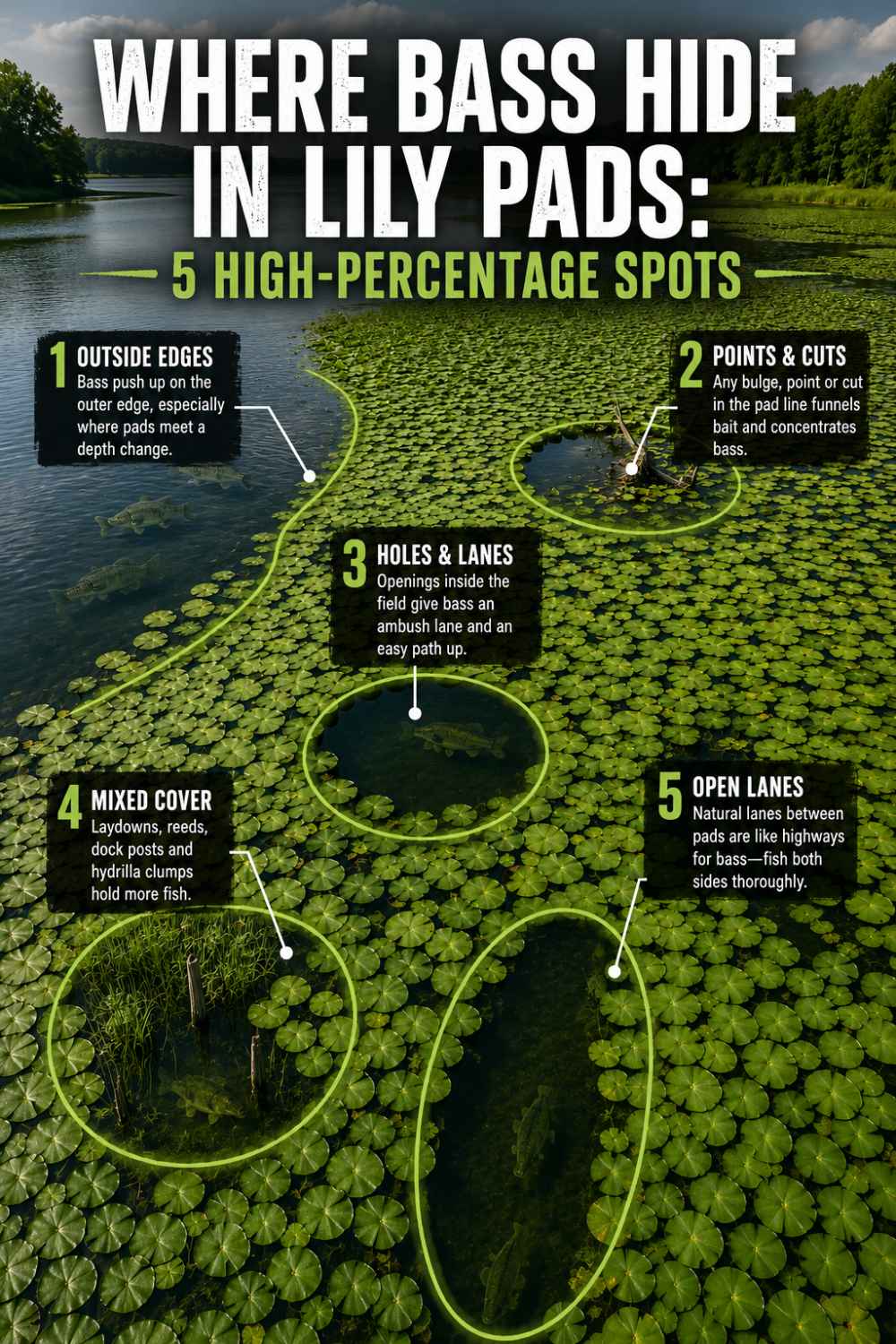
The biggest mistake in pad fishing is treating the whole field as equal water. It is not. A pad field is a structure map, and bass position on the same irregularities they use everywhere else in a lake.
Outside edges are the highest-percentage starting point, especially where the pads meet a depth change or a subtle drop. Bass sit just inside the last row of pads and ambush anything moving along the edge. Fish it parallel rather than casting straight in.
Points and cuts in the pad line concentrate fish the way a point on a bank does. Any place the pad field bulges out, notches in, or forms an isolated finger deserves multiple casts from multiple angles.
Holes and lanes inside the field are where the biggest fish often live. An opening the size of a car hood in the middle of a big field is a magnet: it gives a bass an unobstructed ambush lane and an easy path up. Pause the frog over every one.
Mixed cover always beats pure pads. A laydown inside the pad field, a dock post, a clump of reeds or a patch of hydrilla growing among the stems is an isolated target inside an already good area. If you catch one fish in a pad field, look hard at what was different about that specific spot and then go find three more like it.
Stem density tells you what to throw. Sparse pads with visible open water between leaves are swim jig and buzzbait water. Moderate density with a broken canopy is frog water. Matted pads with slop, duckweed or hyacinth layered on top are punching water and nothing else. See the structure guide for how vegetation edges interact with depth.
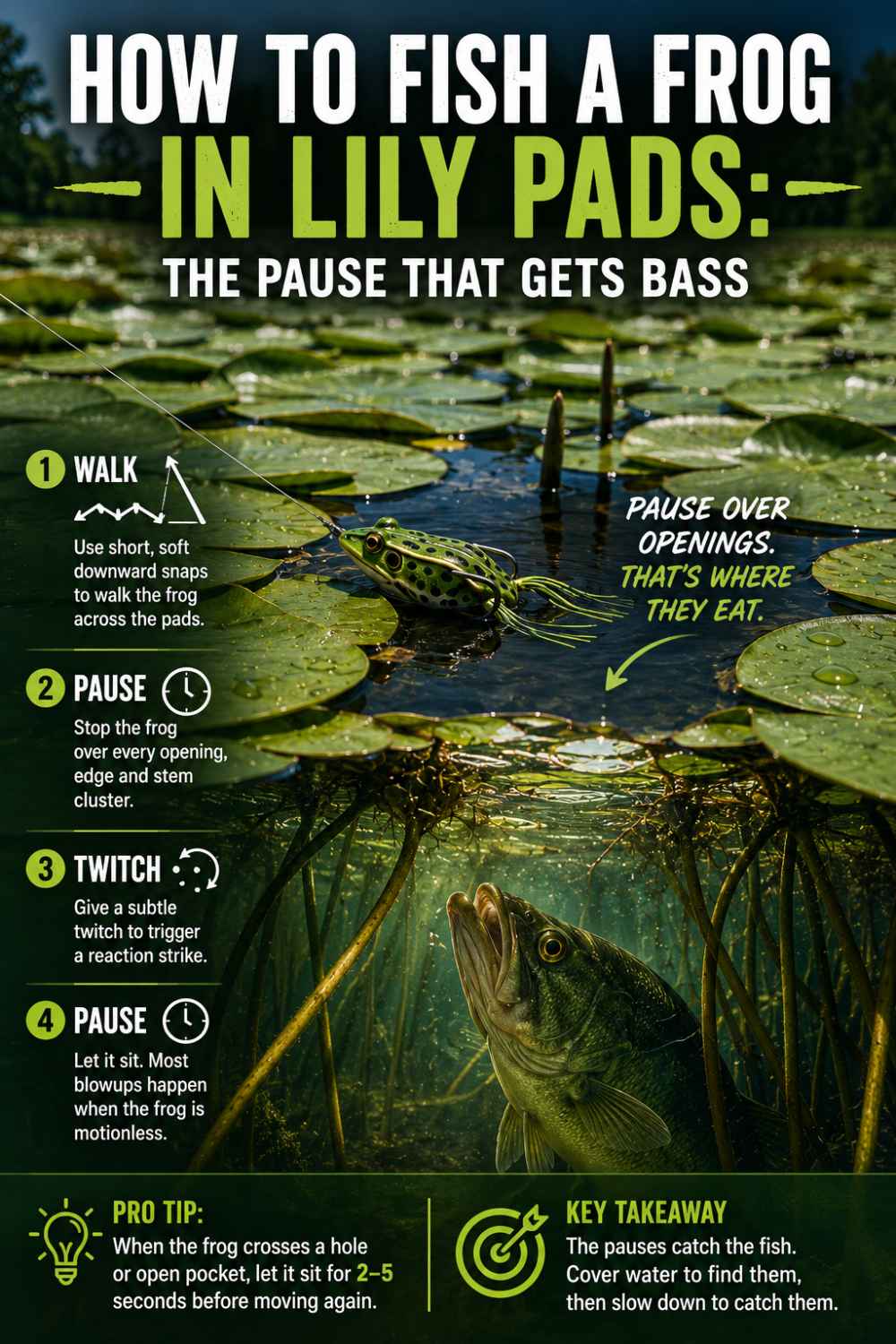
If you buy one lure for pads, buy a hollow-body frog. It is fully weedless, it rides on top of the leaves, and it lets you cover an entire field efficiently and then slow down when you find fish. Nothing else combines that coverage with that hook-up potential in this cover.
How to fish it. Cast past your target, walk the bait with short, soft downward snaps of the rod tip, and stop it over every opening, stem cluster and edge. In pads, the pauses catch the fish. A frog dragged steadily across the leaves will get followed; a frog that walks, stops, twitches and sits will get eaten. When the frog crosses a hole, let it sit two to five seconds before moving it again.
Our Editor's Pick for pads specifically is the Booyah Pad Crasher. The narrow, compact body is the reason — it slips between stems and off leaf edges instead of hanging on them, which lets you keep a natural cadence in dense pads where wider frogs stall. It walks well once you find the rhythm, and the low price matters more than anglers admit: pad fishing costs you baits, and a frog you are afraid to throw into the thickest part of the field is worthless. Limitations: the stock hooks are softer than premium frogs and are worth sharpening or upgrading, and the body absorbs water faster over a full season. Who should buy it: beginners learning the technique, and anyone who fishes real pad fields often enough to lose baits.
Our pick for experienced anglers is the SPRO Bronzeye Frog 65. The wide, flat-bottomed body walks with almost no wrist effort, which is a genuine advantage across a four-hundred-cast day, and the Gamakatsu double hook and collapsing body give it the best hook-up ratio of the three. It is the frog to reach for when the fish are big enough that landing them matters more than the occasional stall on a stem. Limitations: the wider body catches slightly more often in very dense pads, and it costs noticeably more. Who should buy it: anglers who already have the cadence down and fish pads for quality rather than numbers.
Our Premium Pick is the LiveTarget Hollow Body Frog. On clear, pressured pad fields where bass get a long look at the bait, its realistic profile, leg detail and natural posture convert followers into biters. It sits slightly tail-down, which looks right to a fish coming up from below. Limitations: it is the most expensive option and losing one to a pad stem stings. Who should buy it: anglers on clear water or heavily fished public pad fields who need refinement more than volume.
Hook-up ratio adjustments. Reel down until you feel the weight of the fish before setting — the sound is not the bite. If the frog sits too high and fish keep pushing it aside, add a few BBs or a small amount of water inside the body to lower the sit. And check your hook points constantly; pad stems dull them fast.
Frogs are for the interior. On the outside edge, the inside bank line and the open lanes, a buzzbait covers water faster and calls fish from farther away. It is the best tool for finding out quickly whether a pad field is worth an hour of your day.
Run the buzzbait parallel to the outside edge with the blade just clipping the last row of leaves. The sound and the wake pull fish out of the pads, and because the strike happens in open water your hook-up ratio is far better than it is on top of the canopy. Early morning, overcast skies, and light chop are the conditions where a buzzbait genuinely outfishes a frog.
Walking baits have a narrower but real role. In pad fields with wide open lanes or a defined outer edge over three to six feet of water, a walking topwater worked along that seam draws bass that will not commit to a bait sitting directly over cover. It is a poor choice inside the pads — treble hooks and pad stems are a bad combination — but excellent alongside them. See the topwater buying guide.
A practical routine: start with a buzzbait on the outside edge to locate active fish, switch to a frog once you know where they are, and finish with a pitching bait on the specific targets that produced.
A swim jig is the most underused lure in a pad field and often the best one when the surface bite is inconsistent. Pads leave the water column open, so a compact weedless jig can be swum a foot under the leaves right through the middle of the field — an option that simply does not exist in hydrilla.
The presentation is straightforward: pitch or cast into the field, engage the reel immediately, and swim the jig with a steady retrieve broken up by short pops of the rod tip. Deliberately make contact with stems and rip the bait free. That sudden acceleration imitates a bluegill bolting out of cover and triggers reaction strikes from fish that would ignore a bait moving predictably.
The Strike King Hack Attack Swim Jig is the standout. Its pointed head slides through stems rather than collecting them, and the heavy-wire hook is what gets a good fish out of pads and into the boat — a light-wire jig will straighten on a serious hookset with braid. Pair it with a paddle-tail trailer to add thump and slow the fall, or a compact craw trailer when the fish are eating bluegill off the stems. Limitations: the heavy wire requires a heavy rod to drive home, so this is not a light-tackle bait. Who should buy it: anglers who fish pads and wood in the same day and want one bait that handles both.
Weight selection matters more here than lure choice. Use 3/8 oz to swim just under the leaves in shallow pads, 1/2 oz for average conditions and a slightly faster fall into holes, and 3/4 oz when wind or deeper outside edges require you to keep the bait down. Full details in the swim jig buying guide.
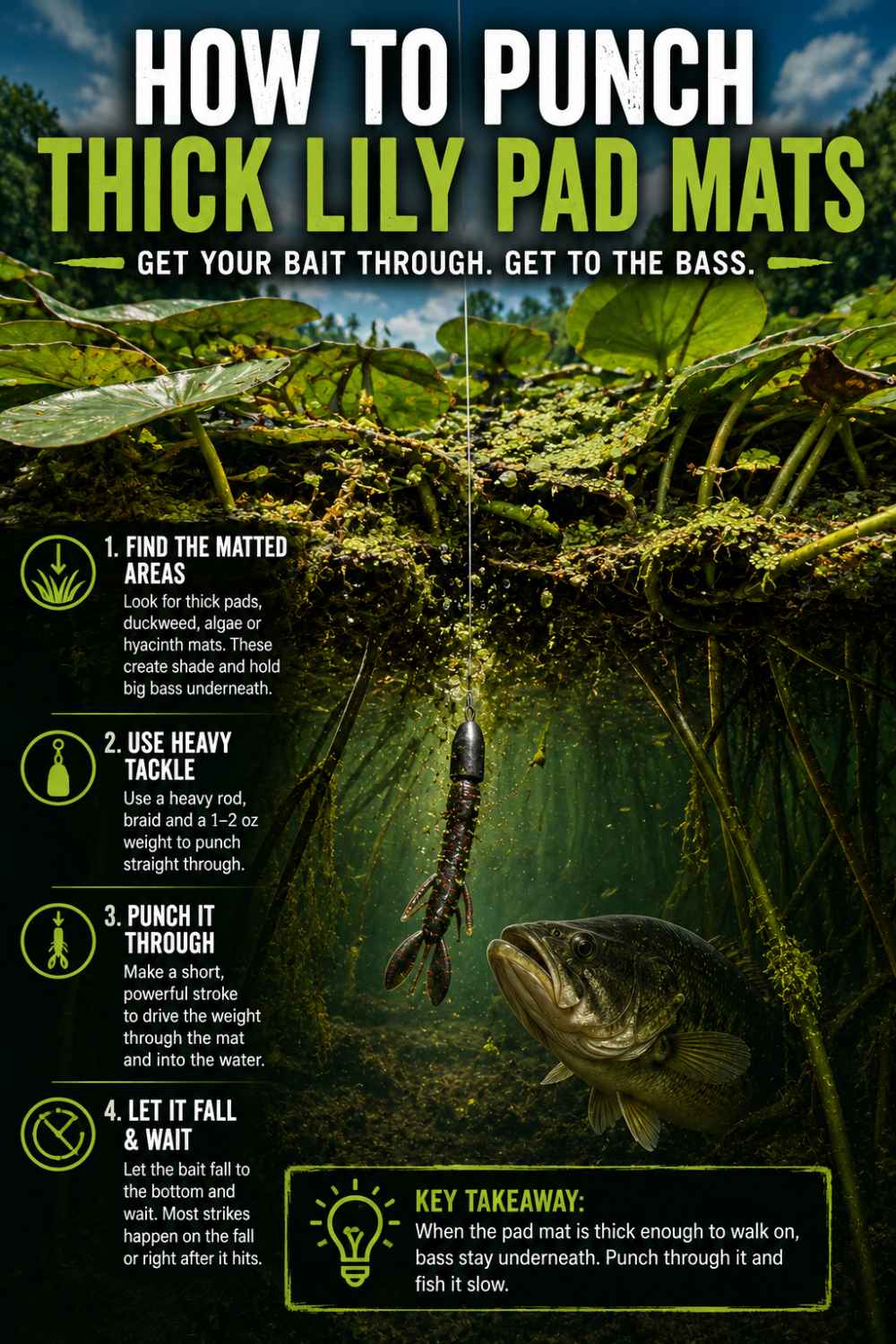
Late in the summer, pad fields rarely stay clean. Duckweed, filamentous algae, hyacinth and matted grass collect between the leaves until the whole field becomes a solid ceiling. When that happens the surface bite dies, and the fish do not leave — they sit underneath in the dark, cool, oxygenated shade and refuse to come up.
Punching is how you reach them. The rig is a pegged tungsten weight, a heavy straight-shank flipping hook, and a compact soft plastic. Punch the hole, let the bait fall on a controlled slack line, and pay attention to the first two seconds — that is when almost every bite happens. If nothing eats, shake it once at the bottom, pick up, and punch again a foot and a half away. It is a repetition technique.
Profile beats brand here. The Strike King Rage Craw is the best punching plastic in our lineup for pads: compact enough to follow the sinker cleanly through the hole, with flapping claws that give the bait life on a slack-line fall. Bulky creature baits with wide appendages slow the fall and hang in the canopy.
Weight selection: start at 1 oz and go heavier until you penetrate cleanly on the first attempt. Punching the same hole twice announces your presence to the fish you were trying to catch. Genuinely thick pad-and-slop combinations can require 1 1/4 to 1 1/2 oz. Tungsten is worth the cost because it is smaller for the same weight and slips through instead of collecting vegetation.
Gear is non-negotiable: 7'6" to 8' extra-heavy rod, 65–80 lb braid, and a reel with enough power to move a fish immediately. When a five-pounder eats under matted pads, your only chance is to get her head up before she wraps a stem. See the crawfish baits guide and the flipping jig guide.
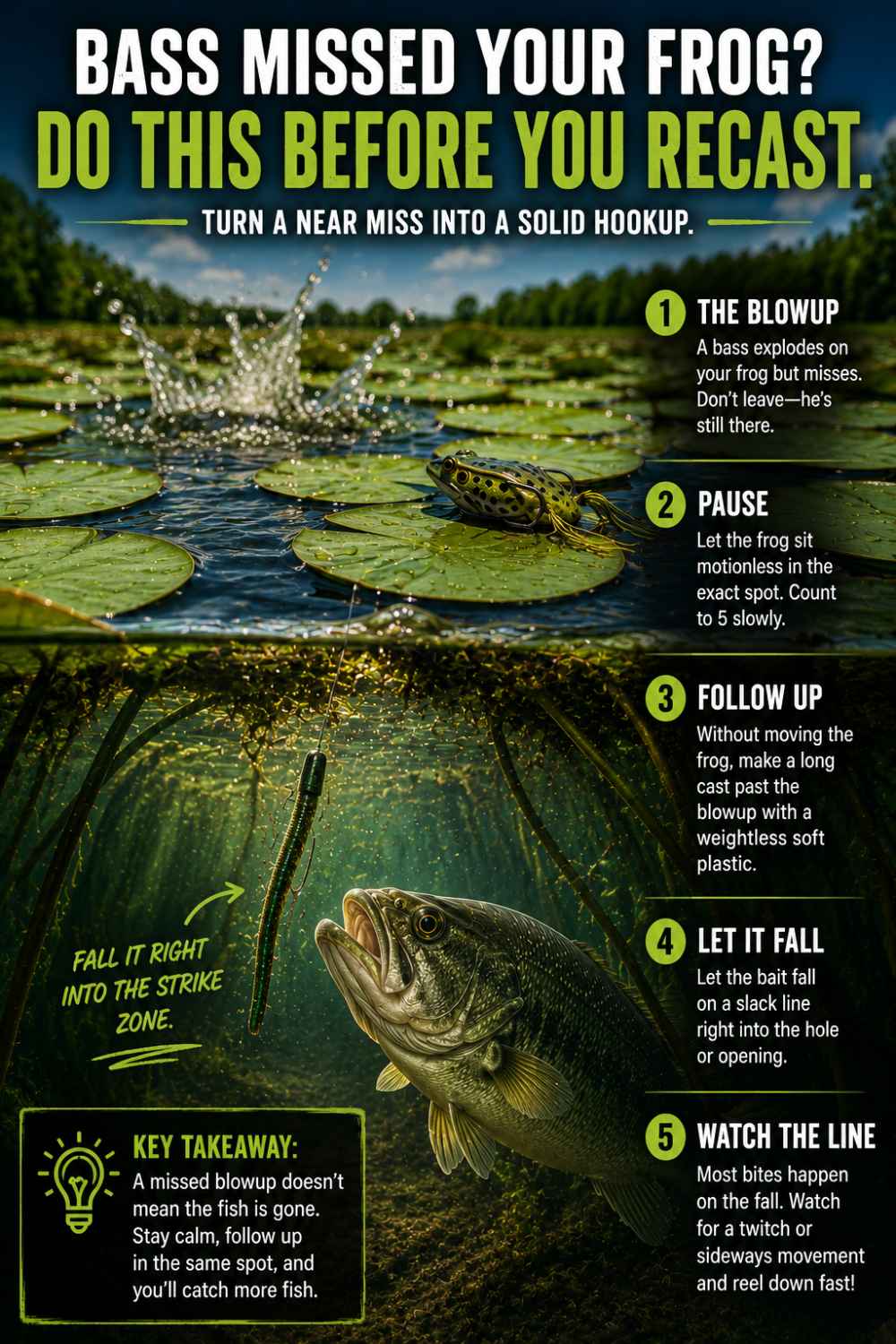
No cover in bass fishing produces more missed strikes than lily pads, and no adjustment adds more fish to your day than having a follow-up rod ready. A bass that blows up and misses is a located, feeding, catchable fish. Most anglers waste that information; good pad anglers cash it in.
The drill: when a fish blows up and you come back empty, do not immediately recast the frog across the whole field. Leave the frog sitting still for a five count and twitch it once. If she does not return, pick up a second rod and pitch a weightless soft plastic into the exact hole she made. The slow, horizontal, defenseless fall is a completely different look, and the fish is still sitting there.
The Yamamoto Senko is the definitive follow-up bait. Its dense body pitches accurately without weight, and the shimmering fall converts refusals better than anything else. Rig it weedless on a 3/0 or 4/0 EWG hook and let it sink on semi-slack line. The Zoom Trick Worm is the better choice in dense pads because the thinner profile slides past stems more easily, and it can also be twitched on the surface as a subtle topwater when fish are boiling but will not commit to a frog.
For a heavier, more purposeful presentation into specific holes, a 1/4 to 3/8 oz Texas-rigged craw fished on the same braid setup gives you a faster fall and better bottom contact when bass are holding low. Keep the weight unpegged when you want the bait to glide away from the sinker, and pegged when it needs to enter the cover as a unit.
Set up two rods before you start: a frog rod and a pitching rod. The seconds you save not re-rigging are exactly the seconds that fish is still sitting under the pad she just broke. Full details in the finesse worms guide.
Pads have a defined season, and knowing where you are in it prevents wasted trips.
Spring, water below roughly 62°F. Last year's pads are gone and the new ones have not emerged. Bass use the pad flats — soft bottom, shallow, protected — to spawn, but the cover itself is not there yet. Fish the flat with a lipless crankbait, a swim jig or a Texas rig rather than looking for a surface bite. See the prespawn lure guide.
Post-spawn and early summer, 68–78°F. Pads emerge and bass move in as the leaves reach the surface. Bluegill spawn along the inside edges and in the pockets, and bass gorge on them. This is the best big-fish window of the pad season, and a frog or swim jig with a bluegill-toned trailer is the pattern. See post-spawn bass fishing and bluegill spawn positioning.
Summer, above 80°F. Peak pad season. The canopy is fully developed, shade and oxygen make the field one of the most livable places in the lake, and bass hold there all day. Frog low light, punch or pitch midday, buzzbait the edges at dawn and dusk. See the summer buying guide.
Early fall, cooling into the 70s. The pads are still green and the bite stays strong, but shad begin pulling toward the creeks and some fish leave the pads for the outer edges and adjacent points. Moving baits along the edges start to outproduce interior presentations. See the fall buying guide.
Late fall and winter. The pads brown, lay over and decay, consuming oxygen instead of producing it. The fish leave. Do not fish dead pads out of habit — go to rock, docks and channel swings. See the winter buying guide.
Water temperature sets the pace. Below about 65°F the surface bite in pads is unreliable, and subsurface presentations do the work. From 68 to 80°F the frog bite is at its best with a moderate, rhythmic walk. Above 85°F bass are still there but less willing to chase, so slow the frog dramatically, lengthen pauses, and expect more of your bites to come from holes and shade rather than open leaves.
Clarity changes what the bass uses to find your bait. In clear pad fields with three or more feet of visibility, fish see the silhouette early and get a long inspection window — use natural colors, longer casts, quieter entries and more realistic frogs. In stained water, contrast and sound dominate: dark bellies, a buzzbait on the edges, and a chatterbait or swim jig with a bulkier trailer through the sparse sections. In muddy water the pad field itself may be a poor choice; bass typically pull to the shallowest, tightest cover and a slow vibrating bait along the edge beats anything worked on top. See water clarity lure selection and the stained water guide.
Wind is genuinely useful in pads. A light chop breaks the surface, hides your line and boat, and makes bass less able to inspect the bait — hook-up ratios go up on breezy days. Heavy wind, on the other hand, pushes pads together and makes accurate casting difficult; move to the protected side of the field. See wind and bass positioning.
Retrieve adjustments worth more than any lure swap: pause longer than feels natural, fish the frog slower as the sun climbs, rip the swim jig free of stems deliberately, and let every falling bait fall on a semi-slack line so the bass never feels resistance.
Setting the hook on the sound. This is the single most common pad mistake. The blowup is not the bite. Reel down, feel weight, then set hard and immediately start moving the fish.
Fishing too fast. A frog that never stops gets followed. In pads, the pause over an opening is the presentation, not a break from it.
Covering the whole field evenly. Pad fields have high-percentage spots — edges, points, cuts, holes, isolated cover — and a lot of dead water between them. Fish the irregularities hard and move through the rest.
Using tackle that is too light. Braid, a heavy rod and strong hooks are requirements. A bass that wraps two pad stems on 15 lb fluorocarbon is already gone.
No follow-up rod. Every missed blowup is a free second chance you can only take if a weightless plastic is already rigged and within reach.
Staying after the pads die. Brown, laid-over pads late in the year hold almost nothing. Recognize it early and move to hard cover.
Ignoring what is under the pads. A pad field over hard bottom near a depth change fishes far better than one over deep muck. Idle the area once and note where the bottom changes; that line will produce repeatedly. See how pros break down a new lake.
Body shape first. In pads, narrow beats wide. A compact frog slips between stems and keeps its cadence where a broad-bodied frog stalls. Save the wide-bodied walkers for open mats and slop.
Hook quality second. The hook is what actually converts the strike, and it is where budget baits cut costs. If you buy a value frog, plan on sharpening the hooks before the first trip and replacing baits once the points roll. On premium frogs, the hook is a large part of what you are paying for.
Body collapse third. Squeeze the frog. A body that compresses easily lets the hook points reach the fish; a stiff body acts as a bumper and costs you hookups. This is the most overlooked spec on the package.
Weight and sit. A frog that rides too high gets pushed aside. Some models come weighted; others benefit from a few BBs or a small amount of water added inside. Aim for a bait that sits with its back at the surface, not perched on top of it.
Buy quantity in the categories you will lose. Frogs, punching plastics and soft-plastic follow-ups are consumables in pads. Buy a few of the cheaper ones and one of the good ones, rather than one of everything.
What not to buy for pads: treble-hook baits of any kind for the interior, light-wire jigs, and anything requiring monofilament or fluorocarbon in the cover. They all fail in the same way at the worst possible moment.
Pad baits are specialized, and there are plenty of situations where the money is better spent elsewhere.
If your lake has submerged grass rather than pads, buy for that instead — hydrilla and milfoil fill the water column and demand punching gear and baits that run above the tops. See the grass buying guide.
If your lake has little vegetation at all, shallow wood and rock are the equivalent cover. A squarebill crankbait deflecting off laydowns and a flipping jig pitched to stumps will out-earn a frog by a wide margin. See the squarebill guide.
If a cold front just pushed through and the sky is bluebird, bass in pad lakes typically slide to the outside edge and go inactive on top. A slow jerkbait or a drop shot on the edge is the better play that day. See the cold front guide and the drop shot guide.
If you fish clear, deep highland reservoirs, pads may not exist in meaningful quantity and offshore structure will always matter more. A deep crankbait and a jerkbait belong in that boat before a frog does. See the crankbait guide and the jerkbait guide.
And if the pads on your lake have browned out for the season, no frog technique will bring the fish back. Follow the shad and the hard cover instead.
If you are buying one lure for lily pads, buy the Booyah Pad Crasher. Its compact body is genuinely better suited to pad stems than most premium frogs, and the price lets you throw it into the thickest part of the field without hesitation — which is exactly where the fish are.
If you are building a complete pad setup, buy four things: a Pad Crasher, a 1/2 oz Strike King Hack Attack Swim Jig with a paddle-tail trailer, a bag of Yamamoto Senkos for follow-ups, and a 1 oz tungsten weight with Strike King Rage Craws for punching matted sections. That covers the surface, the water column under the leaves, the missed-strike conversion, and the midday mat bite.
If you fish pads for quality rather than numbers, upgrade to the SPRO Bronzeye Frog 65 for its hook-up ratio, and add the LiveTarget Hollow Body Frog if your water is clear or heavily pressured.
And if you are new to pad fishing, spend your first few trips learning the two habits that matter most: waiting to feel weight before setting the hook, and keeping a rigged follow-up rod on the deck. Those two adjustments will change your pad catch rate more than any purchase on this page.
This guide helps you choose the right product within the lily pad category. What it cannot tell you is whether the pads are the right pattern on your lake this morning. That depends on water temperature, clarity, wind, sky, pressure trend and season — and all of those change from trip to trip.
Before your next outing, run Today's Fishing Strategy. Enter your actual conditions and it will tell you whether a frog over the pads, a swim jig under them, or something entirely outside the vegetation is the highest-confidence choice for the day — including the color and the reasoning behind it. Buy the right gear here; decide what to tie on there.
Walks easily, casts a mile, and clears the pads.
Matted vegetation and lily pads — walk it slowly across openings.
As an Amazon Associate I earn from qualifying purchases.
The classic ambush structure.
Main-lake highways that concentrate bass.
Edge ambush, inside vs outside grass.
Wood structure and ambush angles.
Micro-positioning to the shadow edge.
Ambush positioning in moving water.
Plug in today's water temp, clarity, weather, and forage — the tool returns the highest-confidence presentations.
Build Today's Strategy →