Elimination Beats Exploration
The single mental shift that separates tournament-level lake breakdown from casual approach is the direction of the search. Casual anglers ask: where are the fish? Pros ask: where are the fish not? The first question is unbounded; the second is fast. Every stretch of bank you can confidently eliminate is a stretch you no longer need to think about.
A 15,000-acre reservoir has hundreds of miles of shoreline, dozens of creek arms, several main-lake basins, and an infinite number of possible spots. You cannot fish it all in three days. You can, however, reject 60% of it in three hours of map study and another 30% of it in the first day on the water — leaving the remaining 10% for careful pattern refinement on days two and three. That is how the compression works.
This guide describes the elimination process a pro runs on a new lake. It's the practice-week version of the day-of framework in how to build a bass fishing game plan. If a game plan is the trip-day hypothesis, lake breakdown is how you build the hypothesis in the first place.
Phase 1: Map Study Before You Launch
A pro's practice week starts at a kitchen table with a lake map, a laptop, and a notebook — never at the ramp. Two hours of map study is worth a full day of aimless fishing.
Split the Lake Into Three Sections
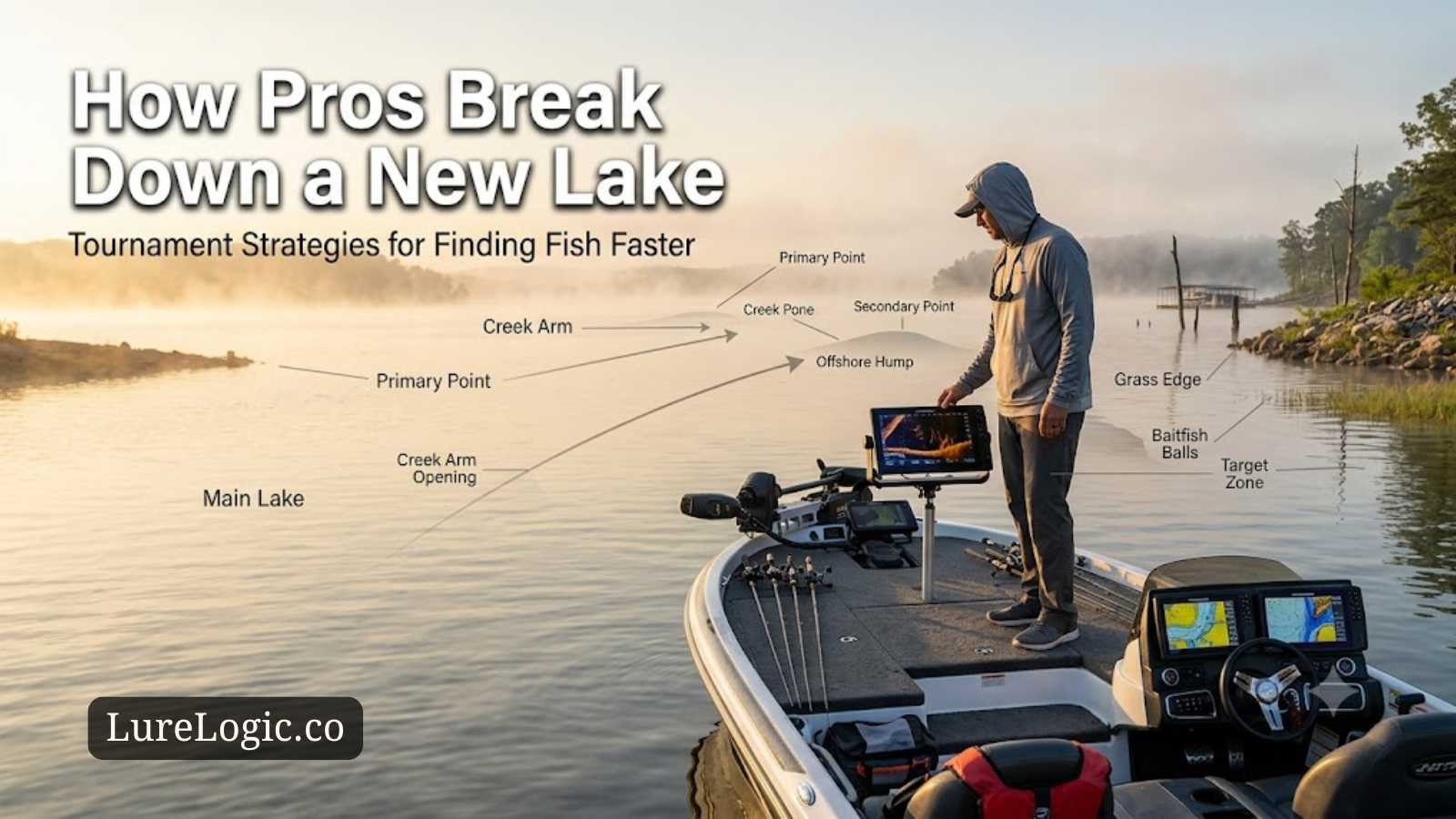
Almost every reservoir divides naturally into three fishing sections:
- Lower section (near the dam). Deepest, cleanest, most main-lake structure. Fish spawn latest here. Best in postspawn through summer for offshore patterns, and again in cold winter conditions.
- Mid-lake section. The compromise. Mixed depths, mixed clarity, most balanced structure. Usually the safest all-around section in prespawn, spawn, and fall.
- Upper section (rivers and headwaters). Shallowest, dirtiest, most current influence. Fish spawn earliest here. Best in early prespawn, spawn, and after heavy rain.
For today's conditions — season, water temperature, weather trend, recent rain — one of those three sections is almost always the highest-percentage bet. Pick it before you launch. If you're wrong, you'll know by lunch on day one, but starting somewhere directed beats starting nowhere.
Identify Structure Types Present
Different lakes have different dominant structures. Some are grass lakes. Some are chunk-rock lakes. Some are laydown-and-timber lakes. Some are offshore-hump lakes. From the map and Google Earth you can identify which the target lake actually offers. Then match structure to season and conditions:
- Points and secondary points → prespawn staging, summer offshore, fall transition. See bass fishing points.
- Creek channels and channel bends → prespawn, postspawn, winter deep holds. See creek channel bass positioning.
- Grass lines → summer daytime, low-oxygen refuge, ambush cover. See bass fishing grass lines.
- Laydowns and shallow wood → prespawn, spawn, postspawn, high-water events. See bass fishing laydowns.
- Offshore humps → summer core structure. See offshore humps bass fishing.
Mark the top 20–30 structural targets in each of the three sections. You won't fish all of them, but you'll want them plotted when day-one signals push you one direction or another.
Read Recent Water and Weather Data
Before launching, gather:
- Current lake surface temperature (marina cams, guide reports, generation schedules).
- Lake level trend (rising, stable, falling — huge on impoundments).
- Last 14 days of weather (fronts, warming trends, rain events).
- Generation schedule if it's a hydro lake — current affects everything. See reservoir current and bass feeding.
These four data points frame every decision the rest of the week. If the lake dropped two feet in the past week, the shallow pattern is compromised and fish likely pulled to the first main breakline. If a warm front is sitting over the region for three days after a hard cold snap, the shallow bite is about to explode. You want to know these things before you rig a rod.
Phase 2: Day-One Elimination on the Water
Day one is not for catching fish. Day one is for eliminating water. If you finish day one with a limit and no pattern, you had a good day fishing and a bad day of practice. If you finish day one with two fish and a confirmed pattern, you had a great day of practice.
Run and Gun with Search Baits
A pro on day one has 3–5 rods rigged with search baits — the lures designed to cover water fast and force reactions out of active fish:
- Chatterbait or spinnerbait — shallow moving-bait signal. See best spinnerbait colors.
- Squarebill crankbait — cover deflection, shallow reaction. See best squarebill crankbaits.
- Lipless crankbait — grass, flats, fall migration signal. See best lipless crankbaits.
- Swimbait or jerkbait — column-search bait for mid-depth active fish. See best jerkbaits.
- Deep crank or football jig — offshore signal for summer or postspawn. See best deep crankbaits and best jigs.
These are elimination tools. They are not for catching every fish in a section — they're for catching or seeing one, which tells you the section is worth returning to.
Fifteen Minutes Per Section
Set a mental timer: 15 minutes per stretch of bank or piece of structure. Not per fish. Per stretch.
- Cover the highest-percentage cover — the wind-blown corners, the isolated targets, the channel-swing points.
- Cast a search bait through the zone.
- If you don't get a bite, follow, or graph mark in 15 minutes, leave.
- If you do, mark it and keep moving — you'll come back and refine after the sample.
The temptation to fish a spot "just a little longer" is the single largest time-waster on a new lake. Fifteen minutes is enough to know if the pattern is here. Discipline on this one rule is what compresses three days into two.
Sample Across Depth and Structure Types
Within your chosen section, sample multiple structure types and depth zones on day one. Don't spend the whole day on wind-blown chunk rock — you'll never know if the fish were on grass. A rough day-one route might sample:
- Two main-lake points (different depths)
- One wind-blown chunk-rock bank
- Two creek arm mouths (one main-lake side, one back)
- One grass line if the lake has grass
- Two isolated offshore targets if season allows
By day's end you'll know which structure types produced signals and which didn't. That eliminates half of the remaining lake without ever fishing it.
Phase 3: Day-Two Pattern Confirmation
Day two takes the strongest day-one signals and tests whether they repeat. A signal is not a pattern until the same specific detail produces multiple times in a row.
If day one produced two fish on wind-blown chunk-rock points in 8–12 feet with a chatterbait, day two starts by running to five more wind-blown chunk-rock points in 8–12 feet with the same chatterbait — but different areas of the lake. If four of the five produce, the pattern is real and generalizable. If only the original one produced, that's not a pattern — that's a spot with fish on it, and it'll be overfished by the tournament.
Refinement rules on day two:
- Confirm the pattern in a second section of the lake.
- Test one lure adjustment (color or size), not five.
- Note what the fish look like — pre-spawn, post-spawn, feeding on shad, on bluegill? See bass forage guide.
- Note the weather during the productive window. Pattern + weather = repeatability.
When you can predict the next bite before it happens — same cover, same depth, same retrieve — the pattern is confirmed. Save the fish. Do not keep fishing the pattern once you've confirmed it. Every fish caught in practice is a fish not available tournament day.
Phase 4: Day-Three Refinement and Backup Pattern
Day three has two purposes: refine the primary and find a backup pattern in case day-of conditions change.
Refinement:
- Locate 10–15 pieces of cover that match the pattern, spread across sections.
- Sequence them into a milk run — the order you'll fish them tournament day.
- Test the pattern at different light windows (first light, midday, last light) to know when it's hottest.
Backup:
- What if the wind flips? Find a wind-adjustable backup — an area that works on any wind direction.
- What if a front pushes through? Have a slower, tighter-to-cover backup pattern. See best bass lures after a cold front.
- What if the water level moves overnight? Have a plan for rising or falling water. See rising water bass fishing.
The backup is not a color change on the primary. It's a genuinely different pattern (different depth, different speed, different location type) that assumes the primary fails.
Case Study: Breaking Down an Unfamiliar 20,000-Acre Reservoir in Late April
A pro draws a 20,000-acre reservoir he's never fished. Late April. Surface temp: 66°F. Lake is 1 foot below full pool and stable. Weather: warming trend for a week, no fronts scheduled during practice.
Map study (Tuesday night). 66°F with a warming trend puts most fish post-spawn on this latitude. Backs of pockets probably still hold spawners; secondary points and channel swings hold post-spawners feeding. Mid-lake section is the highest-percentage bet for a mix of both. He identifies 25 secondary points, 15 pocket backs with hard bottoms (likely bluegill spawn cover in a week or two — see bluegill spawn bass positioning), and 10 main-lake points for postspawners transitioning out.
Day one — elimination. Launches at mid-lake ramp. First stop: three secondary points in a row. Chatterbait, squarebill, and swimbait rotation, 15 minutes each. Point one: nothing. Point two: two keepers on the chatterbait, both in 6–8 feet on the shady side. Point three: one short strike on the chatterbait, same depth. Signal is real. Moves to two pocket backs — bluegill are visible on beds. Notes that but doesn't fish them yet; they'll matter more later in the week. Runs to the lower section that afternoon to sample deeper postspawn structure. Nothing on main-lake points 15–20 feet with the deep crank or football jig. Deep pattern is not yet developed. Ends day one with a strong secondary-point signal and a rejected deep pattern.
Day two — pattern confirmation. Runs a completely different creek arm's secondary points with the same chatterbait presentation. Four of six produce a keeper or a short strike on the shady side in 6–8 feet. Pattern is confirmed and generalizable. Notes the bite is best from 9 a.m. to noon as sun climbs and pins fish to the shaded side. Stops fishing the confirmed pattern early to protect the fish.
Day three — refinement and backup. Maps 14 secondary points that match the pattern across three creek arms, sequences them by shade angle at 9 a.m. Tests one bluegill-imitation color on the chatterbait — better bites than the shad pattern he started with. Confirms the color adjustment. Backup pattern: a jig flipped into shady laydowns in the same pockets, for a post-front slowdown if one materializes. Backup is a different depth (2–4 feet vs. 6–8), different speed (slow flip vs. moving bait), and different cover type (wood vs. rock). Real backup, not a color change.
On tournament day he runs the 14 points in shade-angle order from 8:30 to 1 p.m. and fills a limit by 10:30. The lake wasn't magic. The process was.
Common Lake-Breakdown Mistakes
- Fishing to catch during practice. Every fish caught in practice is one less on tournament day. Practice is for locating, not catching.
- Falling in love with one area. Anglers who find a good spot early usually stop eliminating and never test whether the pattern generalizes.
- Ignoring the calendar. A 66°F lake in April fishes very differently from a 66°F lake in October, because bass are in different life-cycle stages. Temperature is a clue; stage is the answer. See water temperature guide.
- Overfishing local intel. Reports are lagging indicators. What worked three days ago probably works with adjustments today, but assuming it still works exactly is how anglers finish 30th.
- Refusing to eliminate a section. If a whole section shows no signal after honest sampling, it's out. Don't return to it hoping.
- Skipping the backup pattern. Weather doesn't care about your primary. A real backup on different variables saves days that would otherwise blank.
Applying This to Your Home Lake
The elimination framework isn't only for unfamiliar water. It's how you should approach your home lake every time the season changes or the weather resets. Most locals fish the same 10 spots year-round because those spots produced once. A pro-style breakdown at each seasonal transition — early spring, prespawn, spawn, postspawn, summer, fall, winter — builds a rotating library of confirmed patterns instead of a static list of memories. Do this on your home lake for one full year and you'll fish it better than anglers who have been on it for decades.
The Framework and the Application: Today's Fishing Strategy
Breaking down a new lake is how tournament anglers turn unfamiliar water into a confirmed pattern in three days: map study, section split, day-one elimination, day-two confirmation, day-three refinement and backup. Learn the process and you'll stop wandering on new water — and start eliminating.
The framework teaches how to locate. Applying it to a specific trip's conditions is what Today's Fishing Strategy does in under 30 seconds. Once you've located the section and depth zone that fits the day, the tool returns the primary presentation and the finesse fallback matched to water temperature, clarity, weather, and wind — the exact top-of-the-milk-run decision this framework drives you toward. Learn the framework here; apply it there.