Editor's Pick97%
SPRO Bronzeye Frog 65
Leopard Frog
View Product →The best bass lures for grass — hollow-body frogs, punching rigs, swim jigs, lipless cranks and Texas rigs for hydrilla, milfoil and eel grass. What to buy, when each wins, and how to fish vegetation.
Affiliate Disclosure: As an Amazon Associate I earn from qualifying purchases. Recommendations reflect on-the-water testing and the LureLogic ranking engine — not paid placement.
If a lake has healthy submerged vegetation, that vegetation almost certainly holds more bass per acre than anything else in it. Grass does four things at once that no other cover does: it produces oxygen, it moderates temperature, it provides overhead shade and ambush structure, and it grows the food chain from the bottom up. Insects, crawfish, bluegill and shad all live in and around it, and bass simply follow.
That abundance comes with a cost, and the cost is presentation. Vegetation is the most snag-hostile cover an angler can fish. A treble-hook bait that is deadly on rock becomes useless in hydrilla within two casts. The entire grass tackle category exists to solve one problem: how do you get a realistic bait in front of a bass that is living inside a wall of plant matter, and then get the fish out.
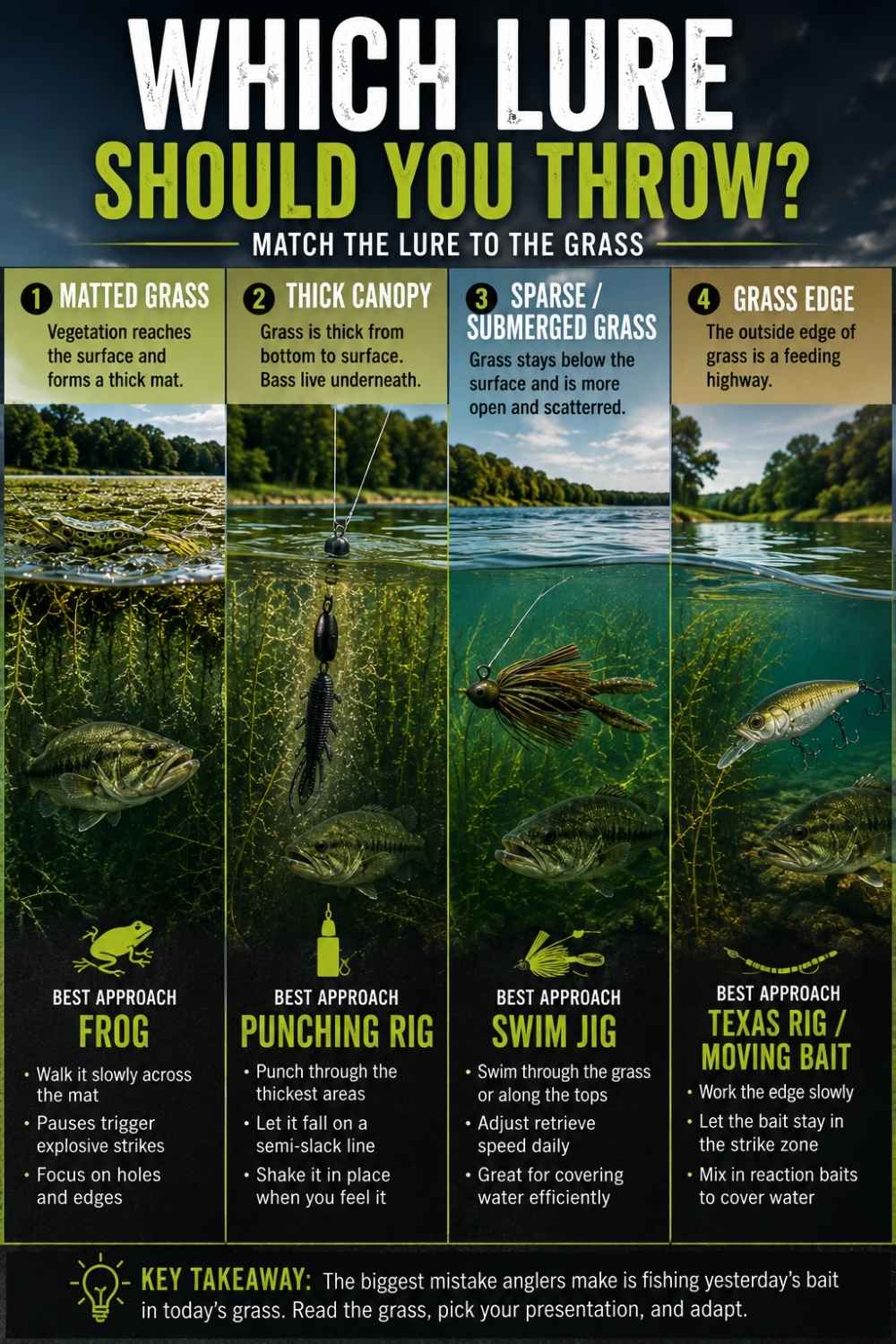
This guide is organized around that problem rather than around brand rankings. The four presentations that matter are surface baits fished on top of the canopy, punching rigs fished through it, weedless swimming baits fished inside and along it, and moving baits fished above and outside it. Buy at least one from each family and you can fish any grass lake in the country.
Our Editor's Pick overall is the SPRO Bronzeye Frog 65, because the mat and canopy bite is where grass fishing pays its biggest dividends and the Bronzeye is the most complete hollow-body frog available. But read the punching and swim jig sections before you decide — on a lake where the grass never reaches the surface, a frog will be the wrong tool no matter how good it is. If you are unsure which pattern fits your lake today, run Today's Fishing Strategy with your real water temperature, clarity and wind before you spend money.
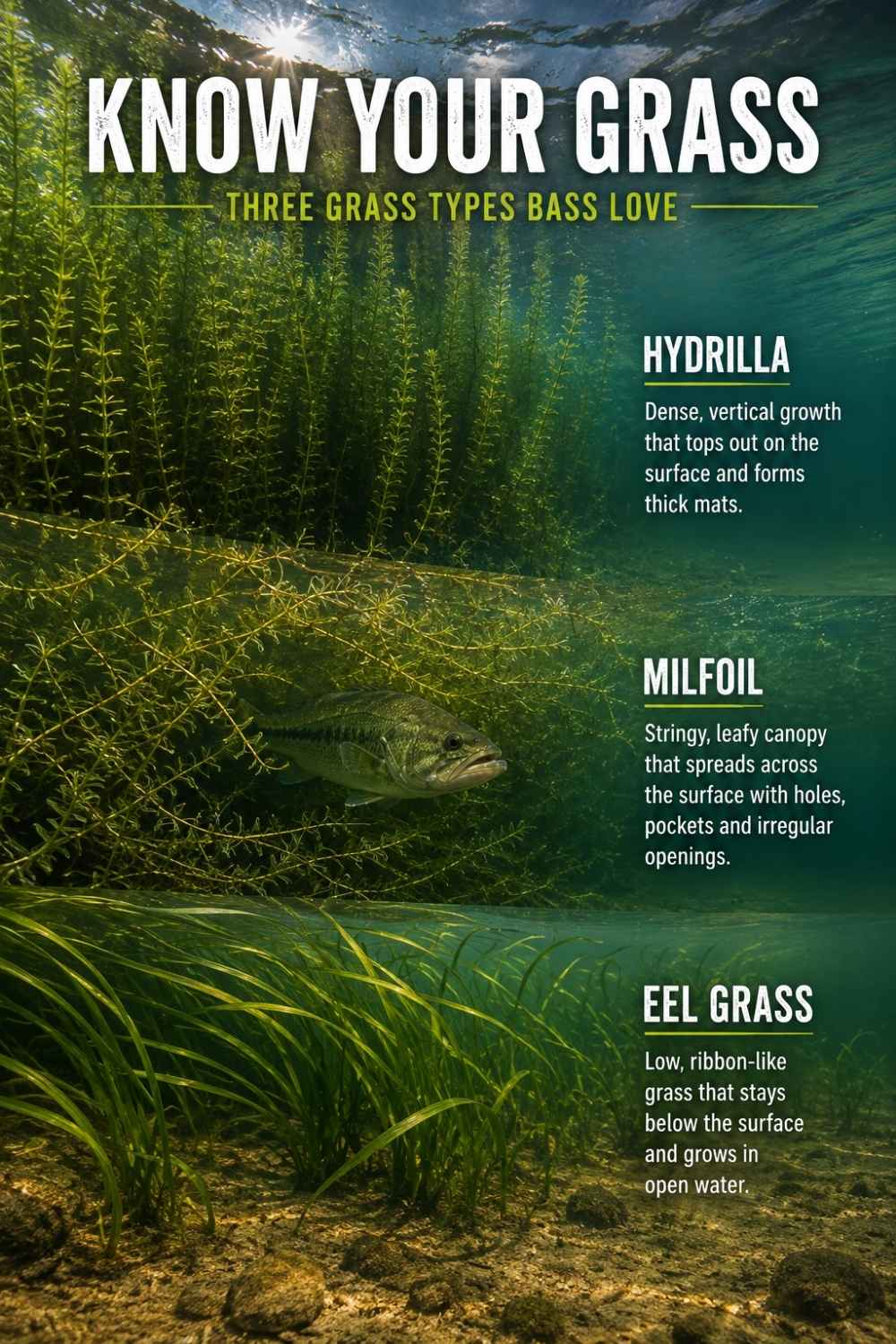
Anglers who consistently catch bass in vegetation are reading the plants, not just the water. The species tells you the density, the growth pattern, and therefore the bait.
Hydrilla is the premium grass. It grows in dense vertical columns from the bottom, tops out on the surface in mid to late summer, and forms firm mats that bass live under all day. Hydrilla holds oxygen well, stays green late into the fall, and creates hard, well-defined edges. It is the best punching grass and the best frog grass, and its outside edge is one of the most reliable summer structure elements in bass fishing.
Milfoil is stringier and leafier, with a canopy that spreads across the surface but rarely feels solid. It fouls treble hooks instantly and grabs jigs by the skirt, but it is riddled with holes, cuts and irregular pockets that concentrate fish. Weedless plastics, swim jigs, and frogs walked across the loose top all shine. Milfoil edges are messier than hydrilla edges, so fish irregularities rather than trying to run the whole line.
Eel grass, tape grass or vallisneria grows in low ribbons that lay over in current and rarely top out. It is common in rivers and current-influenced reservoirs. Because it stays below the surface, this is where baits that run just above the grass tops earn their keep: lipless crankbaits, swim jigs, spinnerbaits, and swimbaits. A frog fished over eel grass is usually a wasted cast.
Lily pads and coontail deserve mention as the transitional covers. Pads are sparse enough that you can fish a frog, a swim jig, or a Texas rig through them, and the stems themselves hold bluegill. Coontail is dense but brittle and breaks off easily, so heavier moving baits can rip through it in a way they cannot with hydrilla.
One last piece of reading: the color of the grass. Green, standing grass is producing oxygen and holds fish. Brown, laid-over, decaying grass consumes oxygen and generally does not. On a lake with mixed conditions, finding the green stuff is more important than any lure decision you will make that day. See the structure guide for how grass edges intersect with depth changes.
When vegetation reaches the surface, a hollow-body frog becomes the most efficient tool in bass fishing. It is completely weedless, it can be worked slowly over a surface a bass cannot see through, and it produces the most exciting strikes in the sport. Just as importantly, it lets you cover an enormous amount of matted water quickly and then slow down when you find a concentration.
How it works: cast past the target, walk the frog with short downward rod snaps, and pause it over every hole, edge, and irregularity. Bass under a mat detect the bait by sound and by the shadow it casts, then crash through the vegetation to eat it. The single most important adjustment is pause length — the frog should stop and sit over any opening for two to five seconds before continuing.
What to buy. A good frog does three things: it walks side to side without excessive effort, its body collapses on the strike so the hook points reach the fish, and it sits low enough in the water to look real without swamping. Hook quality and body durability separate the price tiers.
The **SPRO Bronzeye Frog 65** is our Editor's Pick because it does all three better than any frog at its price. The wide, flat-bottomed body walks with almost no wrist effort, which matters when you are making four hundred casts across a mat. The Gamakatsu double hook is stout enough to drive through soft plastic-thick vegetation, and the body collapses cleanly rather than acting as a bumper. Its limitation is that the wide body sometimes hangs slightly on very thin, stringy milfoil, and the price is above entry level. Best for anglers who fish mats regularly and want the most complete frog available.
The **LiveTarget Hollow Body Frog** is our Premium Pick and the specialist for clear water and pressured fisheries. Its realistic profile, leg detail and subtle color patterns matter when a bass in three feet of visibility gets a good look at the bait before committing. It also sits with a slightly more natural, tail-down posture. Its limitation is the same as most detailed baits: it is the most expensive of the three and you will not enjoy losing them. Best for clear grass lakes, sight-oriented fish, and heavily fished water.
The **Booyah Pad Crasher** is our Best Value pick and a genuinely good frog, not just a cheap one. The compact, narrow body slides through slop and pad stems easily, it walks acceptably once you get the cadence, and it costs roughly a third of a premium frog. Its limitation is that the hooks are softer and worth upgrading, and the body takes on water faster over a season. Best for beginners learning the technique, and for anyone fishing thick slop where bait loss is routine.
Gear and hook-up ratio. Use 50–65 lb braid, a 7'0"–7'4" heavy rod with enough tip to walk the bait, and a high-speed reel to pick up slack. Reel down until you feel weight before setting the hook — do not swing at the sound. If you are getting blowups and no hookups, slow the retrieve, lengthen the pause, and consider adding a small amount of weight inside the body to lower the sit. Full details in the topwater frogs buying guide.
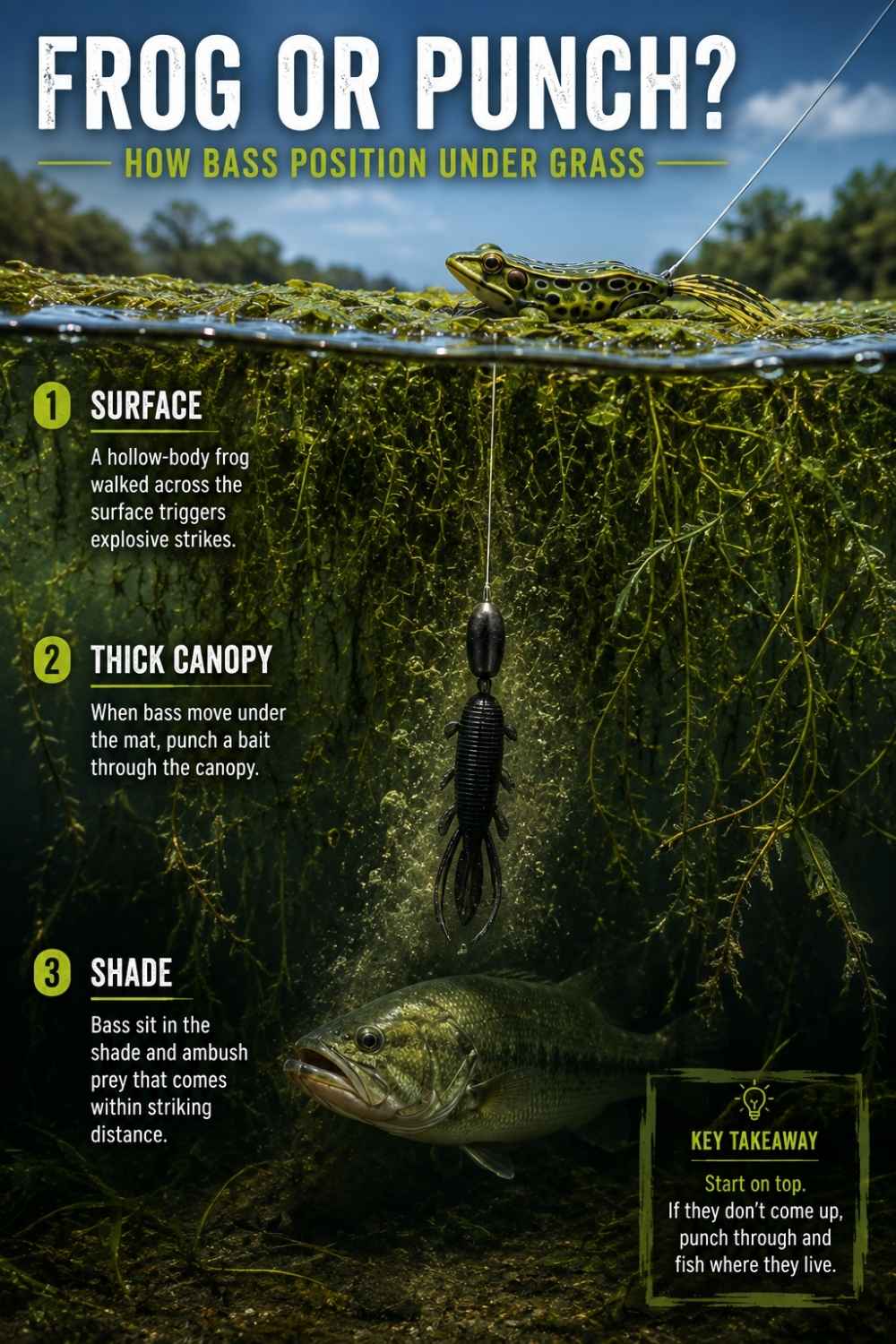
Some days the fish will not come up. Bright sun, high pressure, thick mats and hot water all push bass down into the coolest, shadiest part of the vegetation, and they will sit there for hours without moving. Punching is how you reach them.
The rig is simple: a heavy pegged tungsten weight, a straight-shank or heavy flipping hook, and a compact soft plastic with a small profile. The weight punches a hole through the canopy, the bait follows through the same hole, and the strike almost always comes in the first one to two seconds of the fall. If nothing happens by the time the bait reaches the bottom, shake it once, pick up, and punch again eighteen inches away. This is a repetition technique — a hundred punches an hour is normal, and one of them is the bite.
Bait choice matters less than most anglers think, but profile matters a great deal. Compact creature baits and beaver-style plastics penetrate best and give bass a craw-like target. Bulkier plastics with big appendages slow the fall and hang in the canopy. Keep the plastic streamlined and let the weight do the work. From our Texas-rig lineup, the **Strike King Rage Craw** is the best punching profile — the flapping claws give the bait movement on a slack-line fall, and the body is compact enough to follow the sinker cleanly.
Weight selection: start with 1 oz, and go up until you punch through consistently on the first attempt. If you have to punch twice at the same spot, you are too light. If your bait blows straight through the entire water column with no fall, you are too heavy for the depth. Tungsten is worth the money because it is smaller and harder than lead, so it slips through vegetation and telegraphs bottom composition.
Gear is non-negotiable here: 7'6" to 8' extra-heavy rod, 65–80 lb braid, and a strong reel with a fast gear ratio. When a five-pound fish eats under a mat, your only chance is to get her head up immediately and keep her coming. Anything lighter and you will lose the fish you came for.
When to punch instead of frog: bright, calm, high-pressure conditions; water above roughly 80°F; heavily matted canopies with layered algae; and any time you get blowups on a frog that will not commit. Many strong grass days follow the pattern of frogging early, punching midday, and returning to the frog in the evening. See the crawfish-imitating baits guide and summer midday bass fishing.
A swim jig fills the gap between a frog and a punch rig. It is weedless enough to come through most vegetation, it swims at any depth from just under the surface to the bottom, and it presents a bluegill or shad profile rather than a frog or crawfish. On lakes with sparse grass, mixed cover, or grass that has not topped out, it is frequently the best bait in the boat.
How to fish it: cast to an edge, hole, or grass line, engage the reel immediately, and swim it with a steady retrieve punctuated by short pops of the rod tip. The strike often comes when the jig tears free of a stalk of grass — that sudden acceleration mimics a fleeing baitfish and triggers reaction strikes. Rather than avoiding contact with the vegetation, seek it out deliberately and rip the bait free.
The **Strike King Hack Attack Swim Jig** is the standout here. Its pointed head design and heavy-wire hook are built specifically for pulling fish out of grass, and the head shape sheds vegetation better than round or football profiles. Pair it with a paddle-tail or craw trailer sized to control fall rate. Its limitation is that heavier wire needs a heavy rod to drive home, so it is not a light-tackle bait. Best for anglers who fish mixed grass and wood cover and want one bait that handles both.
The **Berkley Swim Jig** is a strong value option for building a spread of colors and weights, and the **Dirty Jigs No-Jack Swim Jig** is the choice when you want a compact, cleanly finished bait for clearer water and pressured fish.
Select weight by depth and grass density: 3/8 oz for shallow, sparse grass and a slow presentation; 1/2 oz for most situations; 3/4 oz when you need to keep the bait down along a deep grass edge or fish it in wind. Full details in the swim jig buying guide.
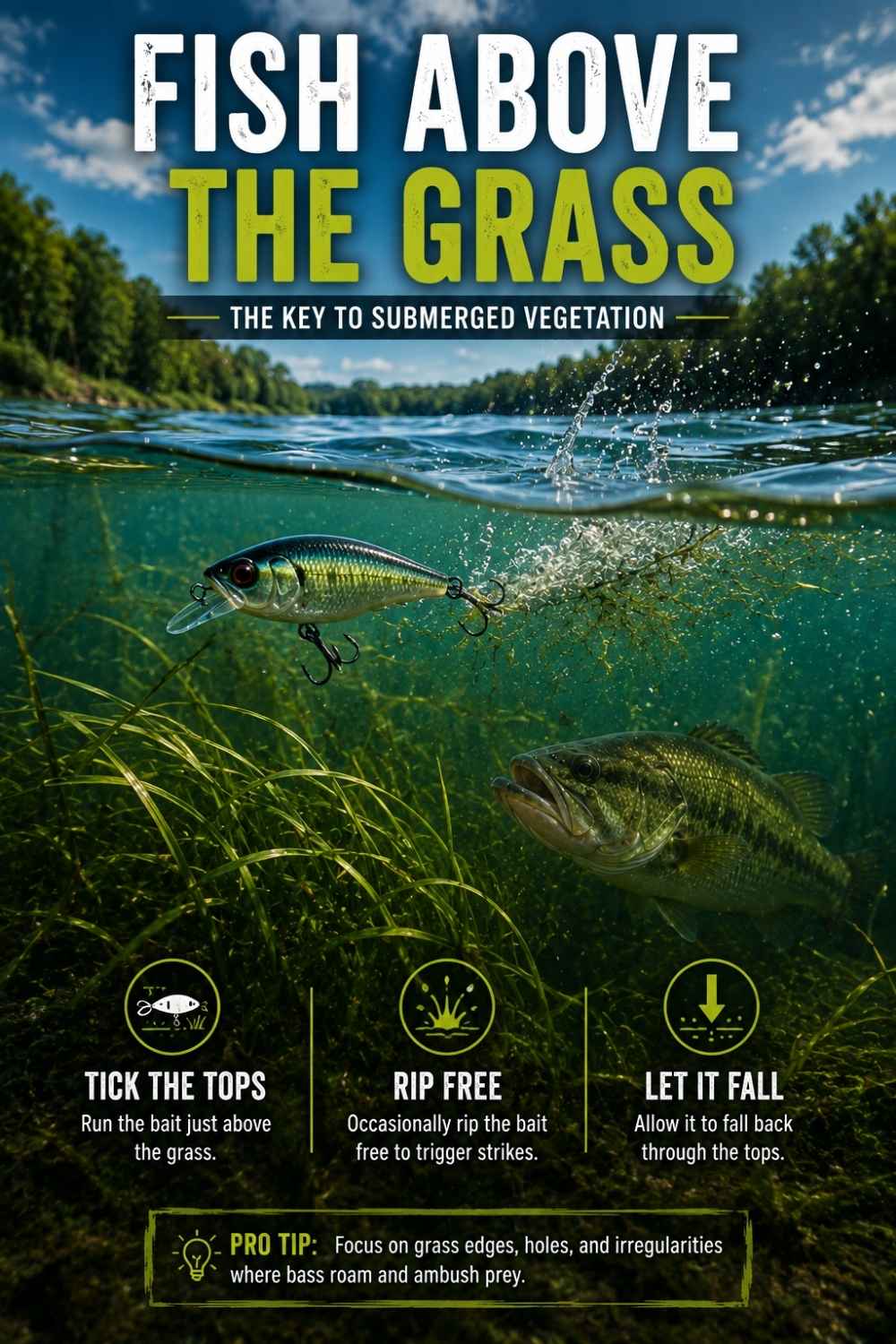
When the vegetation is submerged with a foot or more of open water above it, the fastest way to find bass is a bait that runs just above the tops and periodically rips through them. The lipless crankbait is the classic tool for this and the reason it has a permanent place in the grass conversation.
The technique is deceptively specific. Cast across the grass flat, reel until the bait ticks the tops, then rip it free with a sharp upward snap of the rod and let it fall on semi-slack line. The strike comes on the fall roughly ninety percent of the time. Anglers who steadily retrieve a lipless over grass and never rip it will catch a fraction of the fish available.
The **Strike King Red Eye Shad** is our first choice for grass because its lively wobble and the way its hooks kick out on the fall produce strikes on the drop. The **Bill Lewis Rat-L-Trap** remains a benchmark for its louder rattle in stained water, and the **Rapala Rippin' Rap** has the tightest, hardest vibration and cuts through grass with less fouling than most. Treble hooks are the trade-off in vegetation — expect to clean grass off the bait regularly, and expect to leave one hung up occasionally. Best for prespawn and fall grass flats, and for stained water where sound helps bass locate the bait.
Spinnerbaits and chatterbaits also belong in this section. A spinnerbait slow-rolled over eel grass or through sparse hydrilla is nearly snag-free and calls fish in dirtier water, while a chatterbait ripped through grass produces the same free-and-flee reaction that makes lipless cranks work. On windy days in stained water, a chatterbait over grass may be the single best bait on the lake. See the lipless crankbait guide, the chatterbait guide and the spinnerbait guide.
Every grass day produces fish that show themselves and refuse the bait that found them. A blowup on a frog with no hookup, a swirl behind a swim jig, a fish that boils on the edge and disappears. The follow-up bait converts those refusals into a fish in the boat, and in vegetation that means a Texas rig.
A weightless or lightly weighted soft plastic pitched into the exact spot where a fish showed itself falls slowly, looks defenseless, and gives the bass a second, easier decision. The **Yamamoto Senko** is the definitive follow-up bait for exactly this reason — its dense body casts well without weight and its shimmering horizontal fall is the closest thing to an automatic bite in bass fishing. The **Zoom Trick Worm** is the better choice when you need a longer, thinner profile that slips through grass stems more easily, and it can also be fished as a topwater on a light weightless rig over submerged grass.
For a heavier, more purposeful presentation along grass edges and inside holes, a 1/4 to 1/2 oz Texas rig with a craw or creature bait dropped into isolated cover is one of the most consistent big-fish presentations in vegetation. Peg the weight when you need it to enter cover as a unit, and leave it unpegged when you want the bait to glide away from the sinker on the fall.
Rig everything weedless and use braid or heavy fluorocarbon. A grass stalk will part light line under load, and a bass that eats a plastic inside vegetation will wrap in it immediately. Full details in the finesse worms guide and the crawfish baits guide.
Grass changes across the calendar, and so should your bait selection.
Early spring, water in the high 40s to high 50s. Last year's grass is mostly brown and new growth has not started, but the surviving green patches in protected pockets are magnets. Bass stage on the outside edges. A lipless crankbait ripped over the remaining tops and a swim jig along the edge are the two highest-percentage options; a frog is far too early.
Prespawn and spawn, roughly 58–68°F. New grass grows fast, and bass move to the inside edges and sand holes inside the beds to spawn. This is one of the best big-fish windows of the year in vegetation. Slow-falling Texas rigs, creature baits and swim jigs pitched to isolated holes dominate. See the prespawn lure guide.
Early summer, 70–80°F. Grass approaches the surface and the frog bite begins. Bass are recovering from the spawn and feeding aggressively on bluegill in and around the vegetation. This is peak swim jig season and the start of the frog season. See best lures for 70-degree water.
Summer, above 80°F. The grass tops out and mats form. Frog early and late, punch through the middle of the day. Living grass is one of the few oxygen-rich areas in a hot lake, which is why bass tolerate the heat there when open water becomes uninhabitable. See the summer buying guide and low-oxygen strategies.
Fall, cooling from the 70s into the 60s. Shad migrate toward creeks and bass follow, often abandoning the interior of the grass for the outer edges and adjacent points. Moving baits over the tops — lipless cranks, swim jigs, spinnerbaits — outproduce mat presentations for most of the fall. See the fall buying guide.
Winter, below 50°F. Most vegetation dies back. Any remaining green grass is genuinely special and can hold a disproportionate number of fish, but the productive presentation shifts to slow finesse baits. In most systems, a rock or channel pattern beats a grass pattern outright. See the winter buying guide.
Clarity dictates whether bass find your bait by sight or by sound. In clear grass lakes with four or more feet of visibility, bass see a frog well before it arrives, which means natural colors, longer casts, quieter presentations and lighter line matter. Realistic frogs, compact swim jigs and slower retrieves are the adjustment. In stained water with one to three feet of visibility, sound and vibration take over: louder lipless cranks, chatterbaits, spinnerbaits with Colorado blades, and dark high-contrast frog bellies. In muddy water, grass often becomes secondary cover — bass move shallower and tighter to hard objects and a vibrating bait fished slowly along the outside edge is the pattern. See water clarity lure selection.
Cover density dictates weight and hook strength. Sparse grass with visible open water calls for lighter weights, treble-hook baits and faster retrieves. Moderate grass with a broken canopy is prime swim jig and frog water. Fully matted, layered canopy requires punching gear and nothing else. The most common mistake is fishing yesterday's bait in today's density.
Retrieve adjustments that matter more than lure choice: pause the frog longer than feels natural; rip the lipless crank free rather than reeling through the grass; let the punch rig fall on slack line; and vary swim jig depth by counting the bait down before starting the retrieve. Wind is your friend in grass — a wind-blown grass edge pushes bait against the vegetation and turns neutral fish into feeders. See wind and bass positioning.
Fishing brown grass. Decaying vegetation consumes oxygen and repels bass. If the grass on your electronics or on your bait comes back brown and slimy, move until it comes back green and crisp. This one adjustment separates good grass anglers from frustrated ones.
Using gear that is too light. Every part of grass fishing punishes undersized tackle. Braided line, heavy rods and strong hooks are not preferences, they are requirements. A bass that buries in hydrilla with 12 lb fluorocarbon is a lost fish.
Fishing the whole grass line instead of the irregularities. Grass edges are long, and most of the fish sit on a small percentage of them — points in the grass, inside cuts, isolated clumps outside the main line, and any place where the grass meets a depth change, hard bottom, or a laydown. Idle the edge and mark the irregularities before you fish. See bass fishing grass lines.
Setting the hook too early on a frog. Sound is not a bite. Weight is a bite. Wait for the rod to load.
Using a punching weight too light for the mat. Two attempts to penetrate the same hole spooks the fish you are trying to catch. Go heavier and punch cleanly the first time.
Abandoning a productive area after one bite. Grass concentrates bass. If you catch one on an isolated clump, fish that clump from three more angles with two more baits before you leave it.
Grass baits are specialized, and there are plenty of days when they are the wrong purchase.
If your home lake has little or no submerged vegetation, buy a squarebill and a jig instead — shallow wood and rock are the equivalent cover, and the deflection bite replaces the grass bite. See the squarebill guide and the flipping jig guide.
If you primarily fish clear, deep highland reservoirs, the grass season is short and offshore structure matters far more. A deep crankbait, a drop shot and a jerkbait will out-earn a frog by a wide margin. See the crankbait guide and the drop shot guide.
If a cold front just pushed through and the sky is bluebird with a hard north wind, bass in grass lakes often pull to the outside edge and suspend or slide to adjacent hard bottom. A slow jerkbait or a drop shot on the edge will beat a frog on the mat that day. See the cold front guide.
And if the vegetation is dying back in late fall or winter, do not force it. The fish have moved and no amount of good frog technique will bring them back. See the blade bait guide.
If you are buying one bait for grass, buy the **SPRO Bronzeye Frog 65**. The mat bite is the highest-reward pattern in vegetation and the Bronzeye is the most complete frog available at a price most anglers can justify losing one of.
If you are building a full grass arsenal on a budget, start with a **Booyah Pad Crasher**, a 1 oz tungsten weight with a **Strike King Rage Craw** for punching, a 1/2 oz **Strike King Hack Attack Swim Jig**, and a **Strike King Red Eye Shad**. That is four purchases that cover surface, subsurface, interior and edge presentations, and it will handle almost any grass lake in the country.
If you fish clear, pressured vegetation and want the highest-refinement option, the **LiveTarget Hollow Body Frog** and a compact **Dirty Jigs No-Jack Swim Jig** are the two baits that most consistently convert fish that refuse everything else.
And if you are new to grass fishing, spend your first three trips learning to read the vegetation rather than accumulating tackle. Finding green grass on an irregular edge next to a depth change will do more for your catch rate than any product on this page.
This guide helps you choose the best product within the grass category. It cannot tell you whether grass is the right pattern on your lake this morning. That depends on water temperature, clarity, wind, sky, pressure trend and season — and those change every trip.
Before your next outing, run Today's Fishing Strategy. Enter your actual conditions and it will tell you whether a frog, a punch rig, or something outside the vegetation entirely is the highest-confidence choice for the day, along with the color and the reasoning behind it. Buy the right gear here; decide what to tie on there.
Walks easily, casts a mile, and clears the pads.
Matted vegetation and lily pads — walk it slowly across openings.
As an Amazon Associate I earn from qualifying purchases.
The classic ambush structure.
Main-lake highways that concentrate bass.
Edge ambush, inside vs outside grass.
Wood structure and ambush angles.
Micro-positioning to the shadow edge.
Ambush positioning in moving water.
Plug in today's water temp, clarity, weather, and forage — the tool returns the highest-confidence presentations.
Build Today's Strategy →