Editor's Pick97%
Dirty Jigs Compact Pitchin' Jig
Bluegill
View Product →The best bass lures for dock fishing — skipping jigs, wacky rigs, squarebills and finesse baits. What to buy, how to skip it, and which docks actually hold bass.
Affiliate Disclosure: As an Amazon Associate I earn from qualifying purchases. Recommendations reflect on-the-water testing and the LureLogic ranking engine — not paid placement.
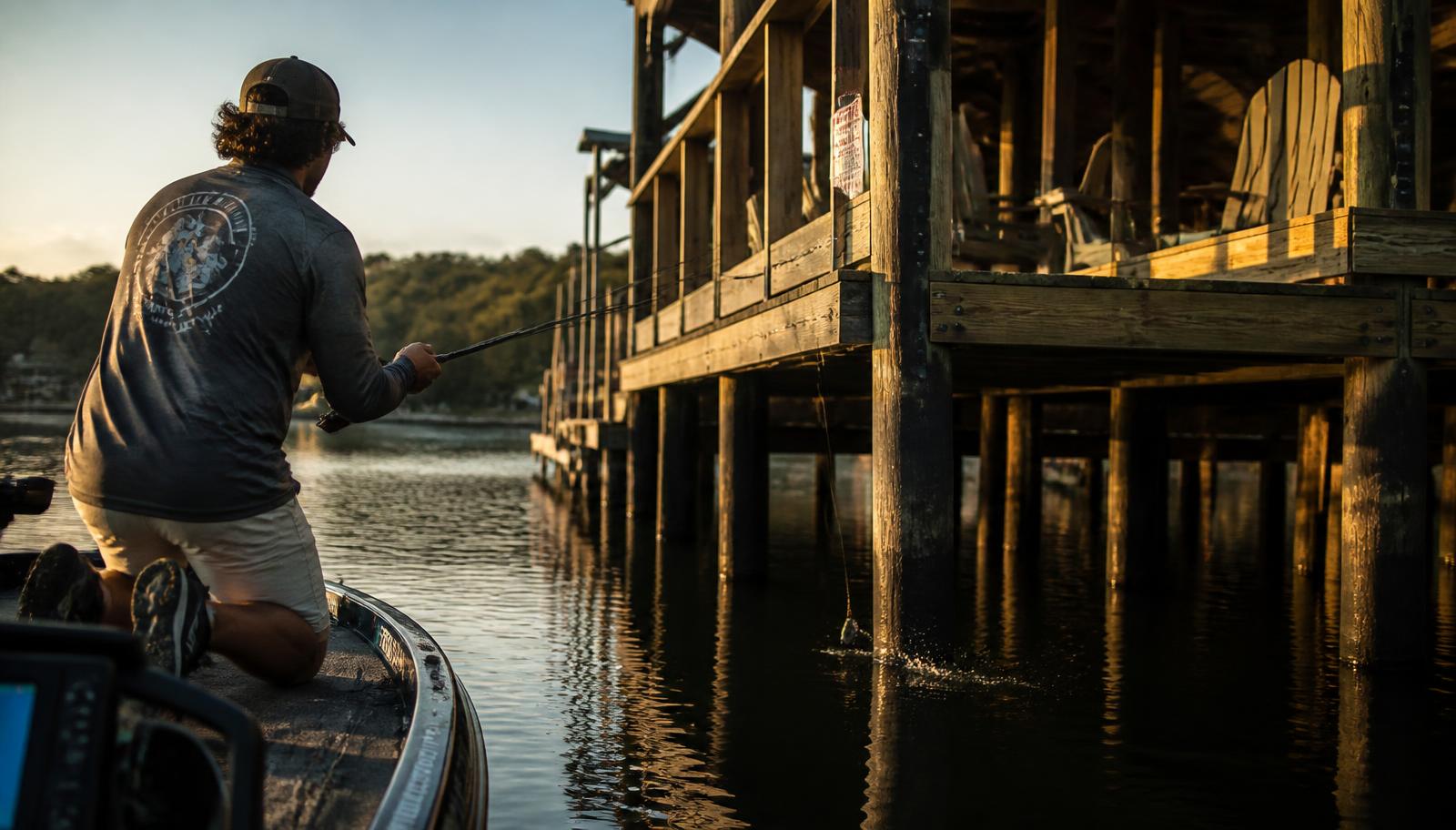
Boat docks solve several problems for a bass at the same time, which is exactly why they hold fish 12 months a year on almost every reservoir in the country. A dock provides overhead cover that breaks up the light and hides an ambush predator from above. It provides vertical structure in the form of posts and pilings that concentrate bait. It grows algae, which grows bluegill and shad fry, which brings in every predator in the neighborhood. And on most lakes it comes with human-added cover — brush piles sunk by the owner, cables, ladders, boat lifts and cinder blocks — that turns an ordinary piece of wood into a genuine fish magnet.
What separates good dock anglers from average ones is not the lure. It is the understanding that docks are not interchangeable. A hundred docks on a creek arm might have twelve that consistently hold quality bass, and the other eighty-eight are scenery. Once you learn to read which is which, dock fishing becomes one of the most dependable patterns in bass fishing, because unlike grass or offshore schools, docks do not move, die back or scatter.
This guide covers the tackle side of that equation: what to buy, why each family of baits exists, and when one is a better purchase than another. Our overall pick is a compact skipping jig, because it catches both numbers and size and it is the bait that reaches the water most fish are actually sitting in. But the finesse and moving-bait sections matter just as much, and on a pressured clear-water lake they can flip the ranking entirely.
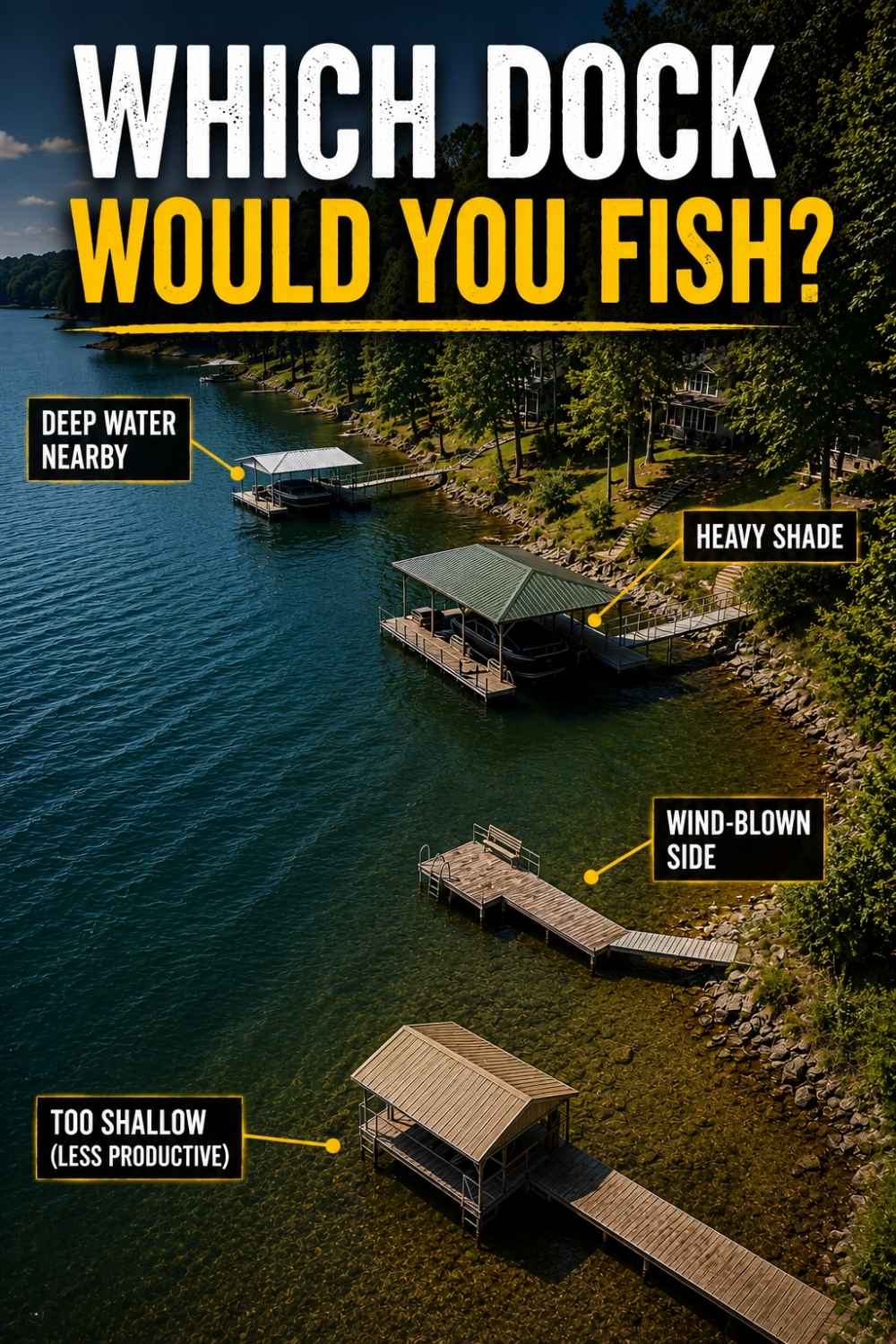
Every dock gives you information for free if you slow down and look. Start with depth. A dock sitting over two feet of water on a flat is a spring and early-summer dock; a dock with eight to fifteen feet under the outside posts holds fish nearly year-round. If you can only fish half the docks in a creek, fish the ones with the steepest drop nearby.
Next, look at construction. Floating docks resting on foam or plastic barrels create a hard, unbroken shade line and are typically the best summer targets because the shade never leaks through. Fixed docks on pilings let light through the slats, which means the shadow is broken and less useful at midday — but they also usually sit in shallower water and can be excellent in spring. Covered boat houses with walls are the premium target on any lake: they are dark, cool and hard to reach, so they are under-fished and full of fish.
Then look for the extras. Cables running at an angle from the walkway to the shore create a shade line of their own and often mark where brush was sunk. Ladders and swim platforms hold fish. Styrofoam floats scarred with algae hold bluegill. A dock with a well-used boat lift means an owner who fishes, and an owner who fishes usually has brush down there.
Finally, read the sun and the wind. On bright, high-pressure days, bass push to the shaded corner tight to a post. On overcast days they roam the outside edges and are far easier to catch on a moving bait. A little wind blowing into a dock stacks bait against it and generally improves the bite. See the structure guide for how dock placement interacts with channel swings and points, and the summer dock article for the warm-weather version of this read.
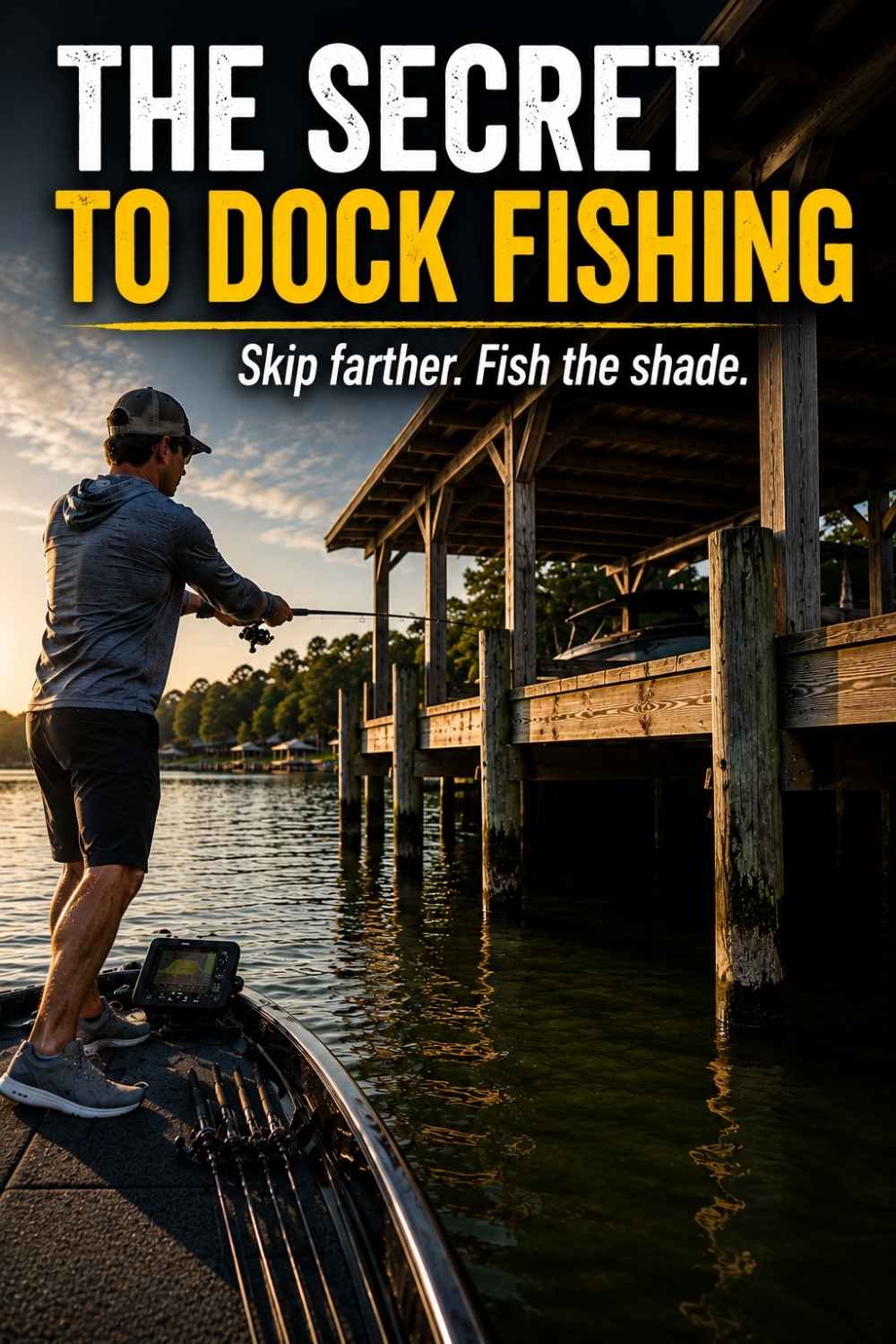
If you buy one thing after reading this guide, buy a compact skipping jig. It is the highest-percentage dock bait because it accomplishes the two things that matter most: it reaches the darkest water under the structure, and it draws bites from the largest fish on that structure.
A true skipping jig is different from a flipping jig or a football jig. The head is compact and either flat-bottomed or ball-shaped so it slaps and rides across the surface instead of digging in. The skirt is trimmed short and full enough to slow the fall but not so long that it parachutes and kills the skip. The weed guard is moderate — enough to walk over a cable without hanging, light enough that a hook point drives home on a sideways hookset. Weight is the key variable: 3/8 oz is the do-everything size, 1/4 oz for shallow docks and clear pressured water, and 1/2 oz when you need to punch down through fifteen feet quickly or fish in wind.
Our Editor's Pick is the Dirty Jigs Compact Pitchin' Jig. The compact head profile skips as well as anything on the market, the hook is heavy enough for 20 lb fluorocarbon, and the skirt is tied to a length that falls at a rate bass commit to instead of following. Best use cases: any dock with reachable shade, brush-laden docks, and postspawn through fall. Advantages: elite skip, strong hook, versatile trailer options. Limitations: it is not the finesse answer on ultra-clear pressured water, and the compact profile means less bulk than a full flipping jig for punching heavy cover. Who should buy it: any angler who fishes docks more than a few times a year and wants one jig that does everything.
The Strike King Structure Jig is our Best for Experienced Anglers pick. It has a slightly different head geometry that excels once the fish are deeper on the dock — it holds bottom contact better on the outside posts and on brush hanging in eight to fifteen feet of water, which is where dock bass live in summer and winter. It rewards anglers who can feel a bite on a slow drag rather than a free fall. Limitations: it is not the easiest skipper of the three, so a beginner will make more mistakes with it. Who should buy it: anglers already comfortable skipping who want a deeper-water dock jig for main-lake and brush-pile targets.
The Booyah Boo Jig is our Best Value pick and, for many anglers, the right first purchase. It skips well, the price allows you to keep four in the box and lose them without hesitation, and the hook is adequate for typical dock weight class fish. Losing jigs is not optional in dock fishing; you will leave some on cables and brush, and a jig you are afraid to lose is a jig you will not skip far enough back. Limitations: the hook and skirt materials are a step below the premium options and it fishes best on lighter line. Who should buy it: beginners, high-volume anglers, and anyone fishing docks with heavy brush where break-offs are routine.
Trailer selection changes the jig more than the jig brand does. A craw trailer with wide flapping claws slows the fall and imitates a crawfish along the bottom; a compact chunk falls faster and keeps the profile small for pressured fish; a small paddle-tail or a twin-tail grub makes it a bluegill imitation you can swim slowly past a post. Match the trailer to the fall speed you want, not to the color of the skirt. Our jig trailers guide breaks this down in detail.
On clear water and on any lake with heavy fishing pressure, a weightless wacky-rigged stick worm will out-produce a jig for bites, and it will out-produce it by a wide margin. The reason is fall speed. A jig drops at a rate that says predator; a weightless Senko shimmies down at a rate that says helpless and forces even a neutral bass to react. On a Tuesday-afternoon dock that has seen five boats since sunrise, that difference is the whole game.
The rig is simple: a 5-inch stick worm on an O-ring with a 1/0 or 2/0 wacky hook, or a weedless wacky hook when the dock has brush. Skip it as far back as you can reach, watch the line, and let it fall on complete slack. Most bites happen on the first fall and show up as the line jumping or simply swimming sideways. If nothing happens, one small lift and a second fall covers the rest of the water column.
When you need the bait to fall a little faster or to swim rather than shimmy, a weightless fluke or a soft jerkbait is the better tool. It skips even further than a Senko, it stays higher in the water column, and it imitates a shad or a small bluegill fleeing under the shade line. A 3/16 oz shaky head or a light Texas rig with a straight-tail worm fills the same role on windy days when a weightless bait will not cast accurately.
Our finesse worms guide and Ned rig guide cover the specific plastics worth buying here. The short version: own a bag of green pumpkin stick worms and a bag of a natural shad-colored fluke, and you have the finesse side of dock fishing covered for less than the price of two premium jigs.
Skipping is precision fishing, and precision is slow. When you have fifty docks to check and three hours of daylight, a moving bait is the honest answer. Bass positioned on the outside pilings, the corners and the shade line will eat a bait that swims past at speed, and you will identify the productive stretch of the lake in a fraction of the time it takes to skip every dock.
A squarebill crankbait is the classic choice. Run it into the outside posts, let it deflect, and hang on. The deflection off wood is the trigger, and a squarebill's wide wobble in the two-to-five-foot range covers exactly the depth band bass use on the outside of shallow docks. It is a prespawn and fall bait more than a midsummer bait. See the squarebill guide.
A chatterbait is the better pick in stained water and when there is grass mixed into the dock area. It comes through cables far better than a treble-hook bait and the hard vibration pulls fish out from under the dock. A spinnerbait fills a similar role and is the superior tool in wind or where line contact with wood is unavoidable, because the wire arm shields the hook. See the chatterbait guide and the spinnerbait guide.
A small swim jig deserves mention as the hybrid. It swims like a bladeless chatterbait, it skips reasonably well, and it can be dropped into a hole and fished vertically when a fish shows itself. On heavily pressured lakes where bass have seen every blade in the tackle shop, a quiet swim jig swum along the shade line is a genuinely underused pattern.
The practical workflow: use a moving bait to locate the docks holding fish, then slow down and pick those docks apart with a jig or a wacky rig. Anglers who only skip catch fewer fish per hour than anglers who alternate.
Once water temperature falls below the mid-50s, or once summer pushes bass to fifteen feet and deeper on main-lake docks, the game changes from skipping to vertical presentation. Bass on deep docks are usually relating to brush piles hung off the ends of the walkway or to the pilings themselves, and they will not chase a bait far.
A drop shot with a straight-tail worm fished directly over brush hanging under a dock is one of the highest-percentage cold-water dock presentations there is. It keeps the bait in the strike zone indefinitely, which is exactly what a 45-degree-water bass needs. A Ned rig on the same brush accomplishes something similar with a bottom-oriented, crawfish-style profile. See the drop shot guide.
A jig still works in cold water, but the retrieve changes completely. Instead of skipping and hopping, drag it and shake it in place. Some of the largest dock bass caught every winter come from an angler leaving a jig sitting on a brush limb for thirty seconds before moving it an inch.
Electronics matter more here than anywhere else in dock fishing. If you can see the brush and see the fish, you can position the boat to make the presentation vertical instead of dragging your line across the walkway. If you are fishing without forward-facing sonar, methodically fan-cast the ends and corners of the dock and note the depth at which you hang brush — then come back and fish that spot properly.
Prespawn. As water climbs through the upper 40s into the 50s, bass stage on docks in the mid and lower sections of spawning creeks, particularly docks with deep water within twenty feet. A jig dragged slowly on the outside posts and a squarebill run down the outside edge are the two most productive presentations. This is a big-fish window; the largest dock bass of the year are often caught in 52-degree water.
Spawn. Bass move under and beside the shallowest docks and use the shade of the walkway and the base of the posts as bedding sites. A weightless wacky rig skipped tight to the post and left alone catches these fish. Handle spawning fish quickly and put them back.
Postspawn. This is the classic dock season. Recovering fish use dock shade and brush while they refeed on bluegill. A jig with a bluegill-colored trailer or a swim jig swum past the posts is the pattern. This period overlaps with the bluegill spawn on most lakes, and docks near shallow bluegill beds are the best water on the lake. See the postspawn guide.
Summer. Shade becomes the controlling factor. Fish floating docks and boat houses with all-day shade, and fish deeper docks with brush. Skip early and late; go vertical on brush at midday. Night fishing around lighted docks can be spectacular — see the night fishing guide.
Fall. Dock fishing gets streaky because bass follow shad. Docks in the backs of creeks near shad schools hold fish; the same docks that produced in July may be empty in October. A moving bait to find the bait, then a jig or fluke to pick apart the productive docks, is the correct sequence. See the fall guide.
Winter. The deepest main-lake docks on channel swings and points hold the population. Slow everything down, use finesse presentations on brush, and expect three or four bites in a day rather than fifteen. Those bites are often quality fish. See the winter guide.
Clarity drives three decisions around docks: bait size, color and line.
In clear water — three feet of visibility or better — go smaller and more natural. A 1/4 or 3/8 oz green pumpkin jig with a compact trailer, or a weightless stick worm, will out-fish a bulky profile. Use 12 to 15 lb fluorocarbon on a baitcaster or a 10 lb leader on spinning gear. Clear-water dock bass see the line, and they see the bait land. Skip further back and make the first cast count, because the second cast to the same dock rarely produces.
In stained water — one to three feet of visibility — this is jig country. A 3/8 oz black-and-blue or green pumpkin jig with a bulkier craw trailer, 15 to 20 lb fluorocarbon, and a slightly more aggressive presentation is right. Bass are less line-shy and more willing to move a few feet for a bait.
In muddy water, the dock itself becomes less important than the shallowest, most visible cover, and vibration takes over from profile. A chatterbait or a Colorado-bladed spinnerbait run tight to the posts, or a heavy dark jig with a bulky trailer dropped right against the wood, is the play. See the muddy water guide and the clarity selection article.
On line, the general rule for docks is to fish the heaviest line the clarity allows. You are fishing next to posts, cables and brush with fish that immediately run for the nearest obstruction. Braid to a fluorocarbon leader on spinning gear is the best all-around compromise; straight fluorocarbon on a baitcaster is the standard for jigs. Straight braid around docks is only worth it in truly dirty water — it will spook clear-water fish and it will saw on barnacle-crusted floats.
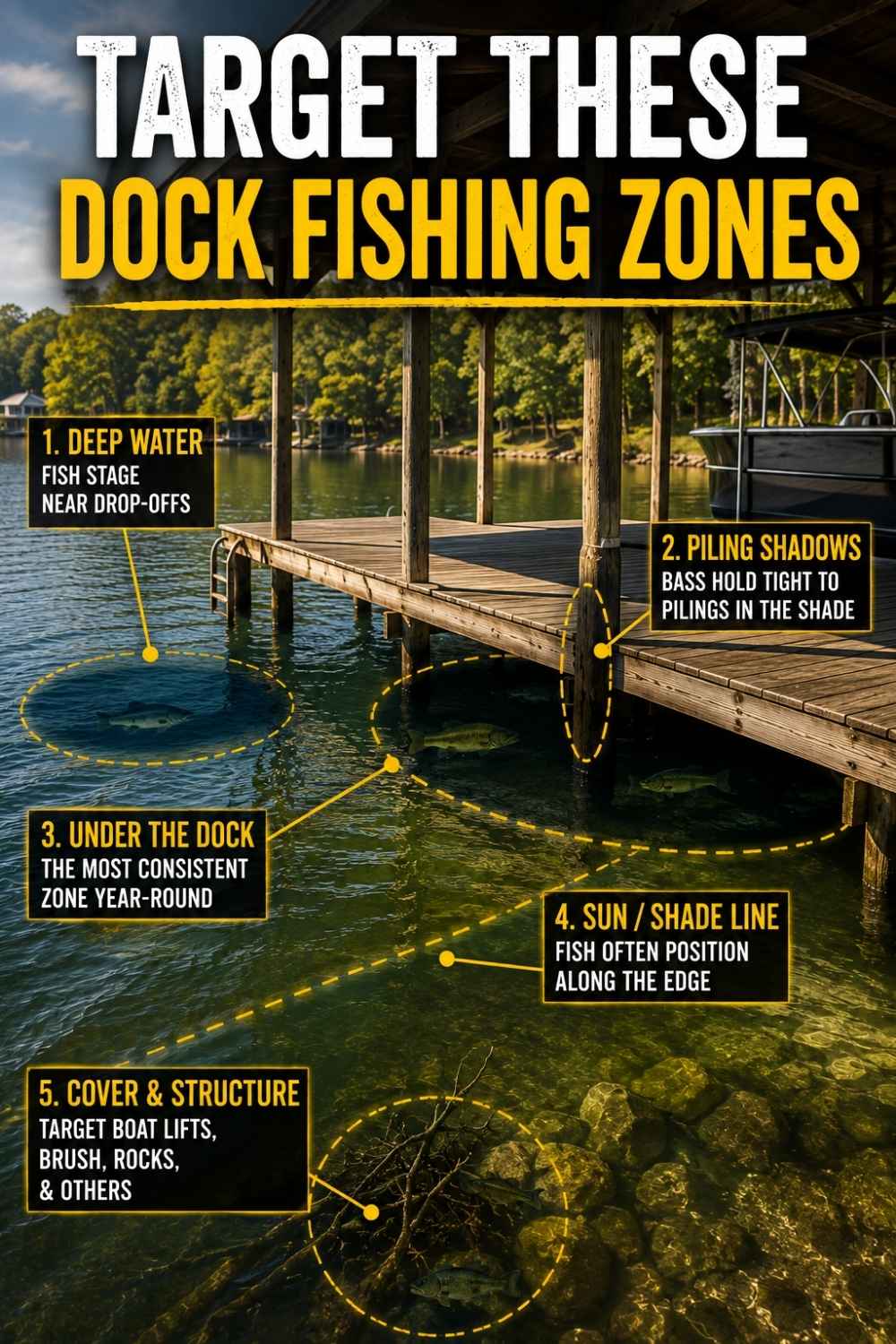
The skip and drop. Ninety percent of dock bites come on the initial fall. Skip the bait as deep under the structure as you can, then let it fall on slack line while watching the line for a tick or a jump. If you fall with tension on the line, the bait pendulums back toward you and out of the strike zone — the most common technical error in dock fishing.
The two-hop exit. If the initial fall does not produce, give the bait two short hops and reel in. Repetition is more valuable than thoroughness on a dock. Ten docks fished with a good first cast will out-produce three docks fished exhaustively.
The post-to-post pitch. Work the shaded posts individually rather than casting at the dock as one object. Each post is a piece of vertical structure with its own fish. On a bright day, the two posts on the shaded corner hold most of the bass on the dock.
The swim-by. With a swim jig or a chatterbait, run the bait parallel to the outside edge at the exact depth of the shade line, and speed up slightly as it passes each post. The change of speed at the corner is the trigger.
The deadstick. When you know a fish is there and it will not commit, skip a wacky rig in and do nothing for thirty seconds. On pressured lakes this converts more fish than any amount of extra action does.
Fishing every dock. The single biggest mistake. Most docks on a lake do not hold bass. Learn the three or four characteristics that define a good dock on your body of water and fish only those.
Not skipping far enough. Bass under a dock are usually as far from open water as the dock allows. An angler who can only reach three feet under a walkway is fishing water three other boats already covered. Practice skipping in open water until it is automatic.
Too heavy a jig. A 1/2 oz jig falls fast, and fast falls get followed rather than eaten by pressured fish. Start light and add weight only if you need depth or wind resistance.
Hooksetting on slack. Reel down first. Line lying across a cross beam absorbs everything.
Oversized trailers on compact jigs. They look good in the box and they cover the hook point. Trim them.
Ignoring the sun. The shaded side matters. If you always start on the side closest to the boat lane, you are fishing the wrong side half the time.
Staying too long. Dock fishing is a rhythm. Two or three good casts per target, then move.
Fishing docks when the fish are somewhere else. Docks are visual and comfortable to fish, which makes them a trap on days when the bass have pulled offshore or moved into grass. If two dozen good docks produce nothing, believe the water and change patterns.
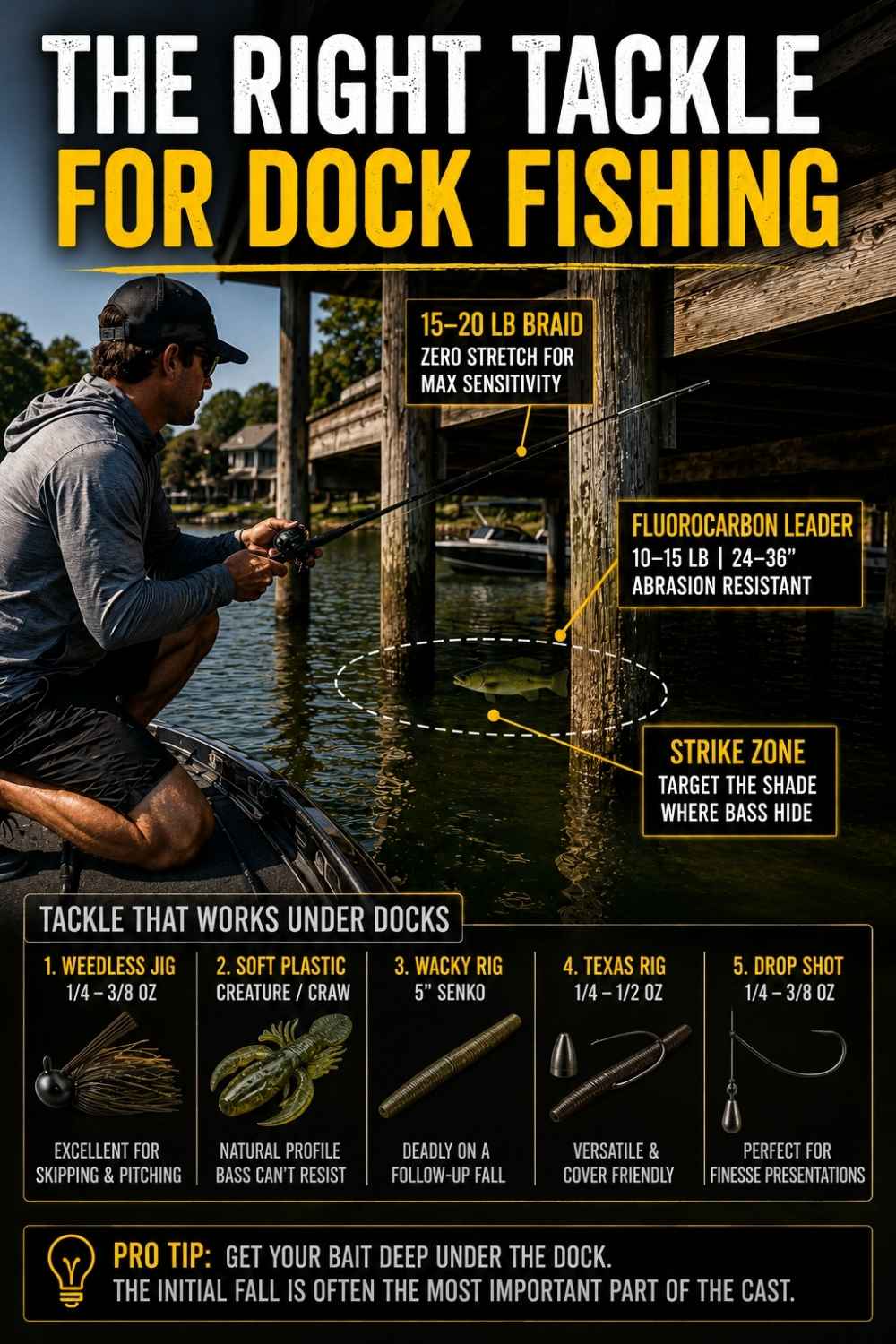
Rod. A 6'10" to 7'2" medium-heavy with a moderate-fast tip is the ideal dock rod. Long, stiff rods do not skip. If you plan to fish finesse baits under docks, add a 7' medium spinning rod. This is the piece of equipment most likely to improve your dock fishing, more than any lure purchase.
Reel. For baitcasting, a reel with a good braking system and a 7.1:1 to 8.1:1 gear ratio lets you pick up slack fast when a fish eats deep under a dock. Backlashes are part of learning to skip; a reel with adjustable brakes shortens that learning curve considerably.
Hook quality. In dock fishing you set the hook at odd angles with line running over obstructions. A heavy-wire, chemically sharpened hook is not a luxury. This is the main practical difference between a $4 jig and a $9 jig, and it is a real one.
Jig weight range. Buy 1/4, 3/8 and 1/2 oz in green pumpkin and black-blue. That is six jigs and it covers nearly every dock condition.
Trailers. Buy one craw-style and one compact chunk-style bag. Two colors each. Do not over-buy plastics before you know which fall rate your lake's fish prefer.
Quantity over exotica. You will lose baits on cables and brush. Three affordable jigs you will skip aggressively beat one premium jig you protect.
LureLogic's position is that no lure category is always the right answer, and dock baits are no exception.
If your lake has healthy submerged vegetation, grass will usually hold more bass than the docks. Buy a frog and a punch rig first — see the grass guide and the lily pad guide.
If you fish clear highland reservoirs where bass suspend off bluff walls and points, a jerkbait and a drop shot will produce more than a skipping jig for most of the year. See the jerkbait guide.
After a hard cold front, dock bass often pull just off the cover and refuse a bait presented tight to the wood. A slow, suspending presentation adjacent to the dock beats skipping. See the cold front guide.
In the peak of the fall shad migration, bass may abandon docks entirely to chase bait in open water, where a lipless crank or a topwater is the right tool. See the lipless guide.
And on offshore-driven lakes in midsummer, the docks hold small fish while the population sits on ledges. A deep crankbait or a football jig is the correct purchase there — see the crankbait guide and the football jig guide.
If you are buying one bait: the Dirty Jigs Compact Pitchin' Jig in 3/8 oz, green pumpkin, with a compact craw trailer. It skips, it catches quality fish, and it fits nearly every dock scenario from prespawn through fall.
If you are buying two: add a bag of 5-inch green pumpkin stick worms and a pack of weedless wacky hooks. That finesse presentation covers the pressured and clear-water days when the jig gets refused.
If you are buying three: add a moving bait — a squarebill for clear-to-lightly-stained water in spring and fall, or a chatterbait for stained water and mixed grass. You need something to find the productive docks quickly.
If you fish deep main-lake docks in summer and winter, add the Strike King Structure Jig and a drop shot setup. If you fish heavy brush and lose tackle constantly, the Booyah Boo Jig lets you fish aggressively without flinching.
Match the fall rate to the mood of the fish, fish the shaded side, and skip further back than feels necessary. Those three habits will out-perform any upgrade in gear.
This guide helps you choose the right product within the dock fishing category. What it cannot tell you is whether the docks are the right pattern on your lake this morning. That depends on water temperature, clarity, wind, sky, pressure trend and season - and all of those change from trip to trip.
Before your next outing, run Today's Fishing Strategy. Enter your actual conditions and it will tell you whether a skipped jig, a finesse presentation or something entirely away from the docks is the highest-confidence choice for the day - including the color and the reasoning behind it. Buy the right gear here; decide what to tie on there.
Premium skirt and head shape for pitching tight cover.
Pitch to docks, laydowns, and isolated cover for big fish.
As an Amazon Associate I earn from qualifying purchases.
The classic ambush structure.
Main-lake highways that concentrate bass.
Edge ambush, inside vs outside grass.
Wood structure and ambush angles.
Micro-positioning to the shadow edge.
Ambush positioning in moving water.
Plug in today's water temp, clarity, weather, and forage — the tool returns the highest-confidence presentations.
Build Today's Strategy →