How to Choose the Best Jig Trailer for Bass Fishing
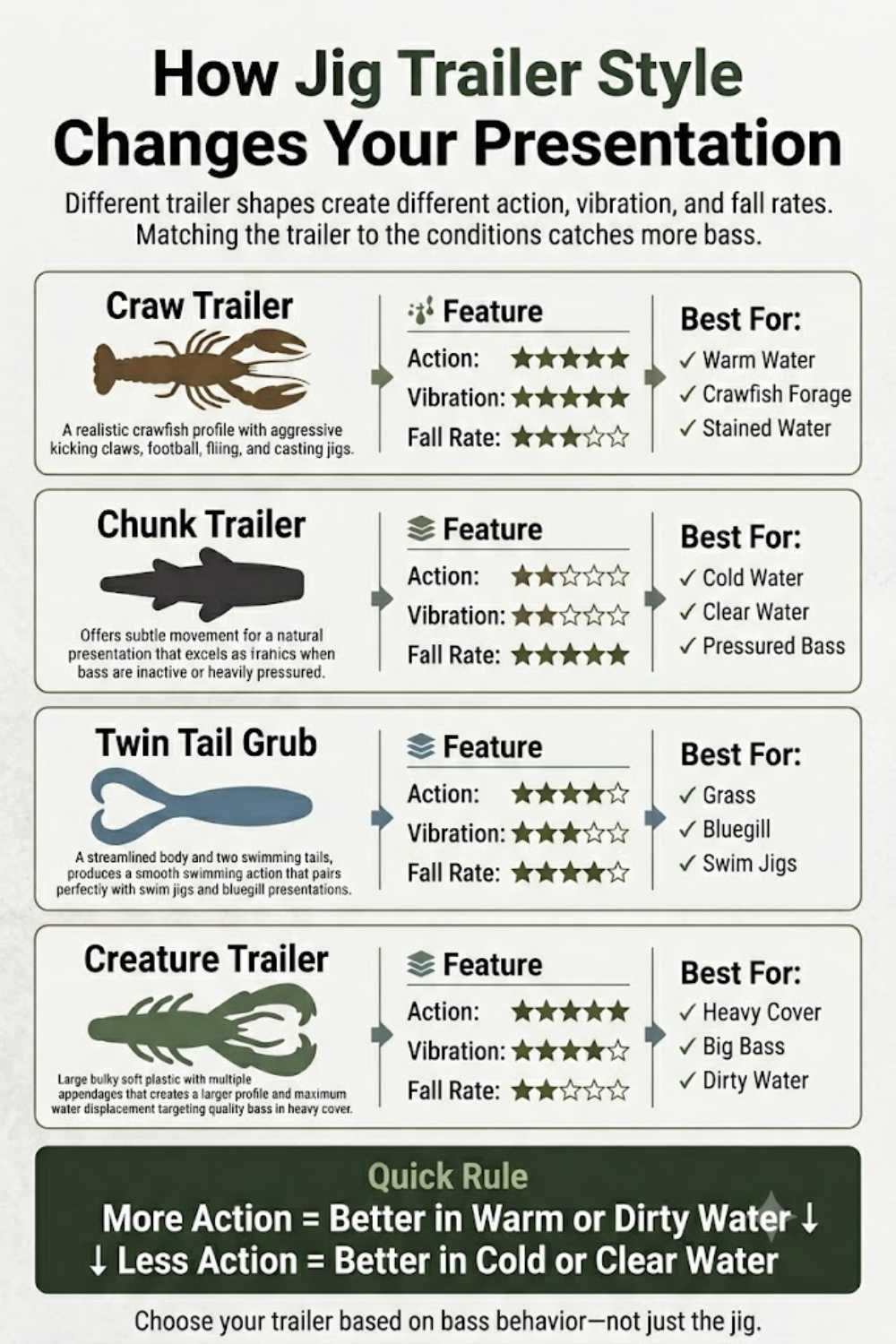
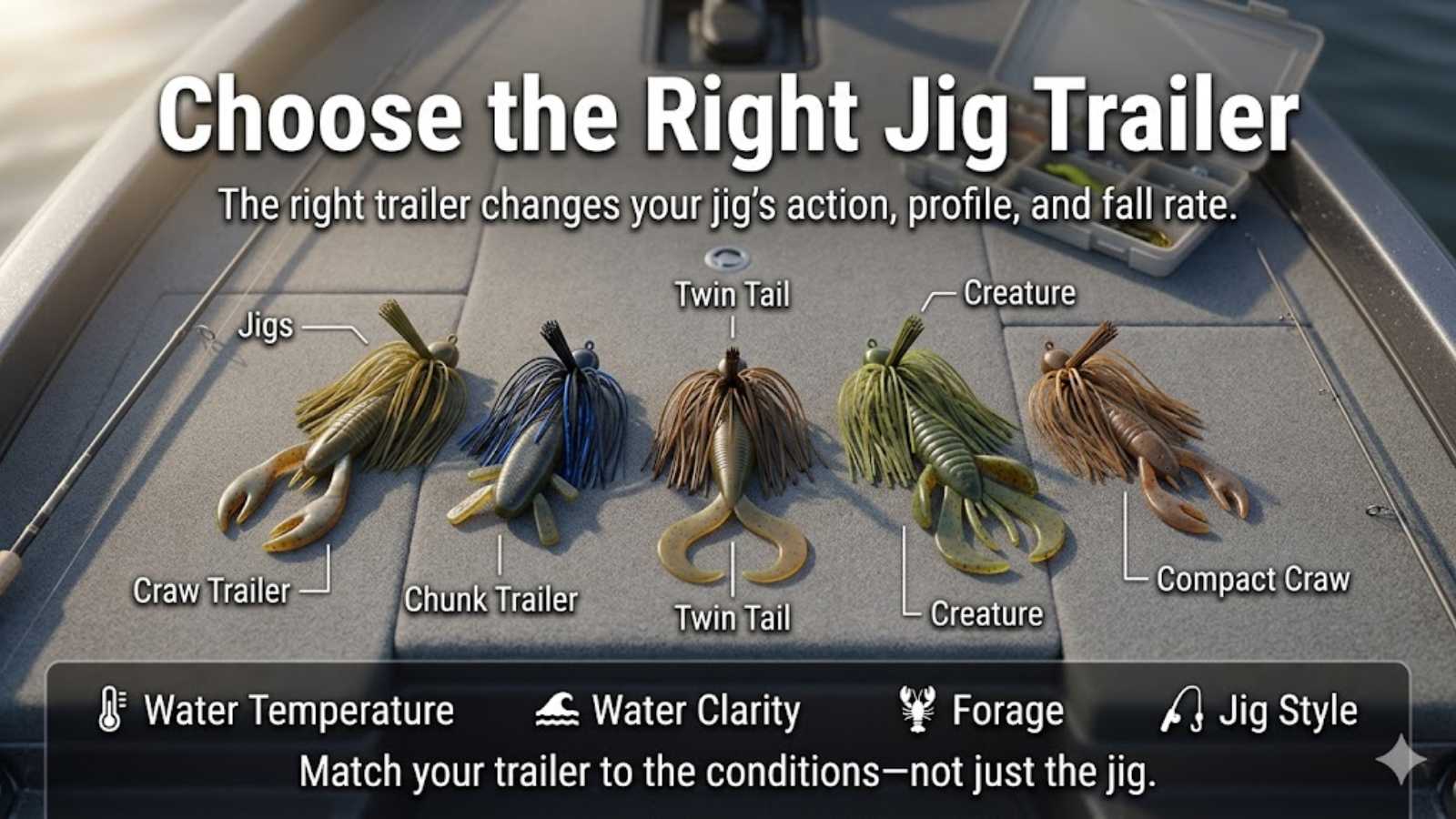
A bass jig is only as effective as the trailer attached behind it. While the jig provides the profile, weight, and hook, the trailer determines how the lure moves through the water, how quickly it falls, how much vibration it creates, and ultimately whether it resembles a crawfish, bluegill, or baitfish.
Many anglers think choosing a trailer is simply matching colors. In reality, trailer selection influences nearly every aspect of the presentation. Two identical jigs rigged with different trailers behave like completely different lures.
A Rage Craw produces aggressive kicking action and slows the fall rate, making it ideal when bass are active and feeding aggressively. A Zoom Super Chunk, on the other hand, glides naturally with minimal movement and excels when bass are sluggish in cold water.
Trailer size also changes how fish perceive the bait. A bulky trailer increases the overall profile and appeals to larger bass feeding on mature crawfish or bluegill. Downsizing the trailer creates a compact meal that pressured bass can more easily inhale.
Water clarity plays a major role. In muddy water, trailers that displace more water help bass locate the bait through their lateral line. In clear water, excessive movement often looks unnatural, making subtle chunk-style trailers more productive.
Forage is equally important. Lakes dominated by crawfish often reward trailers with realistic claws and muted colors. Reservoirs where bass feed heavily on bluegill may favor trailers with wider bodies and swimming appendages.
The style of jig should also influence trailer selection. Football jigs dragged across rock generally pair best with craw trailers that mimic defensive crawfish. Swim jigs frequently benefit from streamlined twin-tail grubs that imitate bluegill or shad. Flipping jigs can utilize either depending on available forage.
Rather than asking, "What's the best jig trailer?" experienced anglers ask, "What's the best trailer for today's conditions?" That mindset consistently leads to more bites.
Understanding How Jig Trailers Affect Lure Performance
Every trailer changes four critical characteristics of a jig: fall rate, action, profile, and water displacement.
A bulky craw with oversized claws increases resistance, slowing the jig's descent. This gives suspended bass more time to inspect the lure and often triggers reaction bites during the fall.
Conversely, streamlined chunk trailers allow the jig to reach bottom more quickly. This is especially useful when targeting bass holding tight to deep rock or timber where a faster presentation keeps the lure in the strike zone.
Action matters just as much.
Some trailers begin moving immediately after entering the water. Others require rod movement before becoming active. During warm water periods, aggressive kicking claws create vibration that helps bass locate the lure from greater distances.
Cold-water bass typically prefer restrained movement. Dormant crawfish don't swim wildly, and neither should your presentation.
Profile is another overlooked factor. Bass often evaluate prey based on silhouette before committing. Wide-bodied trailers imitate bluegill exceptionally well. Narrow craws create a more realistic crustacean profile.
Water displacement determines visibility in stained water. Larger appendages push more water, allowing bass to detect the bait even when visibility drops below two feet.
Finally, trailer buoyancy affects the defensive posture on bottom. Floating claws naturally rise upward, mimicking a crawfish raising its pincers. This subtle detail frequently produces additional strikes from inactive bass.
Choosing a trailer isn't simply selecting plastic—it's tuning the entire presentation.
Matching Jig Trailers to Seasonal Bass Behavior
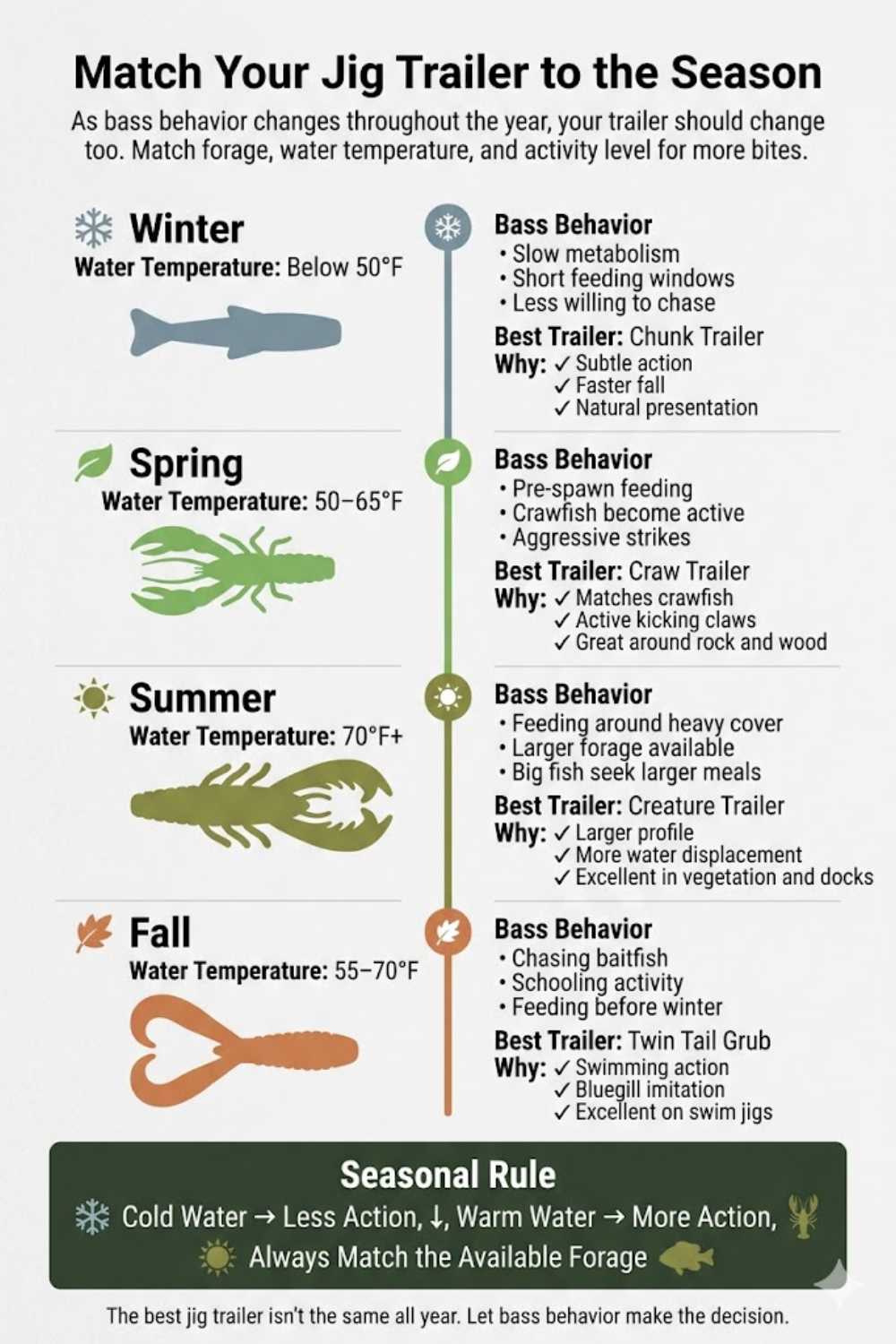
Seasonal bass movements should dictate your trailer selection far more than personal preference.
Winter bass feed infrequently and conserve energy. Crawfish are less active, making subtle chunk-style trailers the better choice. Slow drags, long pauses, and compact profiles consistently outperform oversized, high-action plastics.
As water temperatures climb into the pre-spawn, bass begin feeding aggressively before reproduction. Crawfish become increasingly active, making trailers like the Rage Craw and Paca Craw outstanding options. Their kicking claws closely imitate the larger prey bass actively target.
During the spawn itself, bass often react more from territorial instincts than feeding behavior. Compact trailers work well because they resemble nest-invading crawfish.
Post-spawn introduces another major forage shift. Bluegill begin spawning around shallow cover, and bass focus heavily on panfish. Bulkier trailers with wider bodies often imitate bluegill surprisingly well, especially on flipping and swim jigs.
Summer demands versatility. Deep offshore bass commonly feed on crawfish, making football jigs paired with realistic craw trailers deadly. Learn more about these deep-water presentations in our football jig guide. Meanwhile, shallow grass bass often respond better to streamlined trailers that swim naturally through vegetation.
Fall bass frequently chase baitfish, making twin-tail grubs excellent choices for swim jigs while craw trailers remain productive around rock.
Successful anglers rarely fish the same trailer year-round. Seasonal forage changes should always guide your selection.
Choosing the Right Trailer for Crawfish vs Bluegill Forage
One of the biggest mistakes anglers make is assuming every jig represents a crawfish. In reality, jigs imitate several major forage species depending on the trailer selected.
Where crawfish dominate the diet, realistic craw trailers consistently outperform other options. Bass feeding on rocky points, riprap, bluff banks, and offshore ledges naturally expect to find crawfish along the bottom. Realistic claws, muted greens, browns, and orange highlights help complete the illusion.
For a deeper look at matching bass to crawfish forage, see our crawfish bass fishing guide.
Bluegill lakes require a different approach.
Instead of emphasizing claws, many successful anglers choose wider-bodied plastics that resemble juvenile panfish. Swim jigs paired with Menace Grubs or Flappin Hogs create broader profiles that bass associate with bluegill feeding around grass lines and docks.
Color selection changes as well.
Green pumpkin remains the universal producer because it effectively imitates both crawfish and bluegill under most conditions. Black and blue dominate muddy water. Watermelon patterns excel in exceptionally clear lakes.
Observation matters.
If you notice bluegill spawning around docks, switch immediately to bluegill-style trailers. If crawfish shells cover the shoreline, lean heavily into craw imitations.
Matching forage often matters more than matching hatch colors.
How Water Clarity Changes the Best Jig Trailer
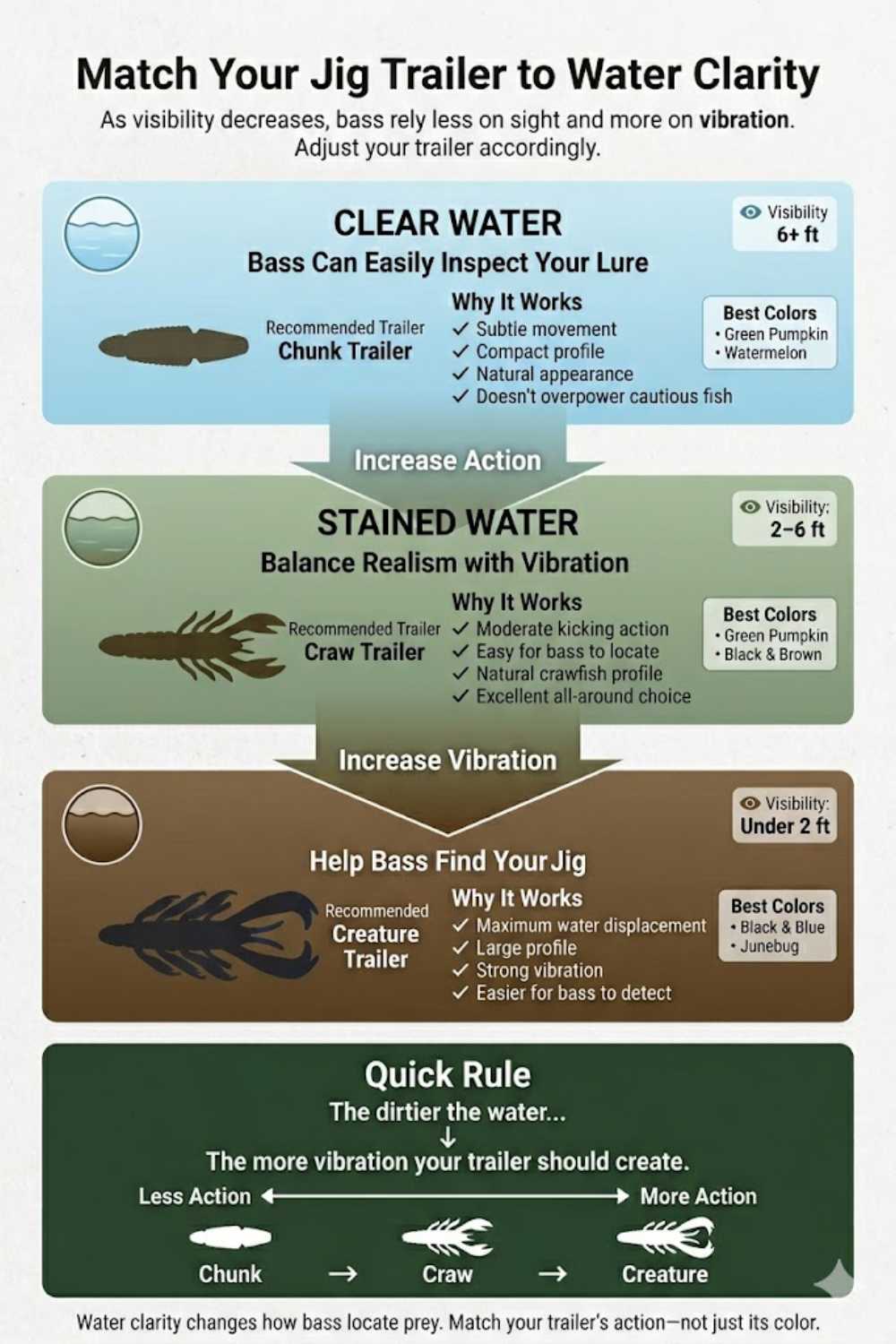
Water clarity influences trailer choice more than almost any other environmental factor.
In clear water, bass rely heavily on vision. They have time to inspect the lure, making natural movement essential. Excessive vibration or oversized appendages can actually reduce bites because the presentation appears unnatural. Compact chunk trailers and restrained craws generally excel under these conditions.
Lightly stained water offers the widest range of productive trailer styles. Moderate action becomes ideal because bass can both see and feel the lure. This is where versatile options like the Rage Craw dominate.
As visibility decreases below two feet, vibration becomes increasingly important. Bass depend more on their lateral line than eyesight. Larger kicking claws create pressure waves that help fish locate the jig before seeing it.
Muddy water demands maximum displacement. Black-and-blue trailers with oversized appendages provide both contrast and vibration, making them easier for bass to detect.
Water clarity also affects retrieve speed. Clear water presentations generally require slower, more natural movements. Dirty water allows anglers to fish more aggressively without spooking bass.
Many experienced jig fishermen carry multiple trailer styles in identical colors. Instead of changing color first, they change the amount of action to better match water visibility.
Selecting the Best Trailer for Different Jig Styles
Every jig design has a purpose, and the trailer should complement—not fight—that purpose.
Football jigs excel on rock, gravel, shell beds, and offshore structure. Because these environments naturally hold crawfish, craw-style trailers remain the top choice. Their claws rise naturally when paused, creating an incredibly realistic defensive posture. If you're learning this presentation, our complete jig fishing for bass guide explains when each jig style shines.
Flipping jigs are designed for precision presentations around heavy cover. Compact trailers penetrate vegetation more efficiently while still producing enough movement to trigger reaction strikes.
Casting jigs serve as the all-around workhorse. Almost any trailer can perform well depending on the forage and season, making them ideal for anglers wanting one versatile setup.
Swim jigs represent an entirely different application. Instead of dragging along the bottom, they're retrieved steadily through vegetation and around shallow cover. Twin-tail grubs and streamlined trailers outperform bulky craws because they track straighter and better imitate bluegill.
Summer often sees bass positioned deep on offshore structure while others remain buried in shallow vegetation. During these months, many anglers carry both football jigs rigged with craw trailers and swim jigs rigged with Menace Grubs. For more seasonal adjustments, see our summer bass fishing guide.
Understanding how the trailer complements the jig style allows anglers to fish more efficiently and confidently, ultimately producing more consistent catches throughout the year.
Retrieve Adjustments That Make Jig Trailers More Effective
The best jig trailer in the world won't consistently catch bass if it's presented incorrectly. While anglers often focus on lure selection, experienced jig fishermen know that retrieve speed, cadence, and bottom contact are usually more important than the brand of trailer they're using.
One of the biggest mistakes is fishing every trailer with the same retrieve. Different trailer styles are designed to excel under different presentations.
High-action craw trailers like the Rage Craw and Paca Craw perform best when the jig is constantly moving. Short hops, slow drags, and steady swimming all allow the claws to kick naturally. The trailer creates vibration with very little rod movement, making it ideal for active fish.
Chunk-style trailers require a completely different approach. Their subtle design shines during long pauses. Instead of constantly hopping the jig, drag it several feet, stop for three to five seconds, then gently lift it over rocks or wood. During the pause, the trailer settles naturally and resembles a crawfish trying to remain hidden rather than escape.
Many anglers retrieve too quickly after the jig reaches bottom. In reality, some of the biggest bass will watch a jig for several seconds before committing. Allowing the lure to sit motionless often triggers bites that an aggressive retrieve misses.
When fishing around wood cover, make contact with every stump, branch, or laydown possible. Instead of immediately pulling the jig free after contacting cover, let it rest briefly before easing it over the obstruction. That hesitation often imitates prey attempting to crawl over structure and frequently triggers reaction strikes.
Rock transitions deserve a similar approach. Football jigs paired with craw trailers should maintain nearly constant bottom contact. Rather than hopping the jig high into the water column, crawl it slowly across rocks so the trailer naturally rises and falls with the terrain.
Grass requires another adjustment. Swim jigs paired with streamlined trailers perform best with a steady retrieve that occasionally accelerates or pauses when contacting vegetation. Short bursts of speed mimic bluegill fleeing through grass and often produce explosive strikes.
Line choice also influences trailer performance. Fluorocarbon helps maintain bottom contact and increases sensitivity for dragging presentations. Braided line with a fluorocarbon leader excels when flipping vegetation because it improves hook penetration while maintaining abrasion resistance.
Finally, let the fish dictate cadence. If bass are aggressively chasing bait, don't be afraid to swim the jig quickly. During cold fronts or post-frontal conditions, slow down dramatically. A trailer that seemed ineffective at one retrieve speed may suddenly become the best producer after a subtle cadence adjustment.
Common Jig Trailer Mistakes That Cost Anglers Fish
Even experienced anglers unknowingly make trailer mistakes that dramatically reduce their success. Most of these problems aren't caused by poor lure selection—they're caused by mismatching trailers to the conditions.
The first mistake is choosing a trailer that's too large.
Many anglers assume bigger trailers always attract bigger bass. While large trailers certainly have their place, oversized plastics can reduce hook-up ratios, especially when bass are feeding on smaller forage. They also create excessive resistance during the fall, sometimes preventing the jig from reaching fish positioned deep in cover.
The opposite mistake is downsizing too much.
Tiny trailers can make a full-size flipping jig appear unnatural by throwing off its proportions. If the trailer doesn't balance the jig properly, the lure loses much of its intended action.
Color selection is another area where anglers often overcomplicate things.
Bass anglers frequently carry dozens of trailer colors, but experienced tournament fishermen often rely on just a handful:
* Green Pumpkin * Black and Blue * Watermelon * Green Pumpkin with Orange * White
These five colors cover nearly every water clarity and forage situation encountered throughout the year.
Another common mistake is failing to trim the trailer.
Some plastics extend well beyond the bend of the hook. Trimming a quarter to half inch from the nose of the trailer often creates a more compact profile while improving hook penetration. It also allows the trailer to sit tighter against the jig collar, preventing it from sliding down after repeated fish catches.
Many anglers also ignore trailer alignment.
If the trailer is threaded slightly crooked, the jig may roll during the retrieve or fail to track straight. This is particularly important for swim jigs, where a centered trailer dramatically improves swimming action.
Fishing the same trailer all year is another costly habit.
Bass behavior changes with water temperature, forage availability, and fishing pressure. A trailer that excels in July may be a poor choice in January. Keeping multiple trailer styles available allows quick adjustments without changing the entire presentation.
Finally, many fishermen abandon jigs too quickly.
Because jig fishing often produces fewer bites than faster-moving lures, anglers assume the presentation isn't working. In reality, jig bites frequently come from larger-than-average bass. Confidence and patience are two of the most valuable tools a jig fisherman can develop.
How to Build a Simple Jig Trailer Selection System
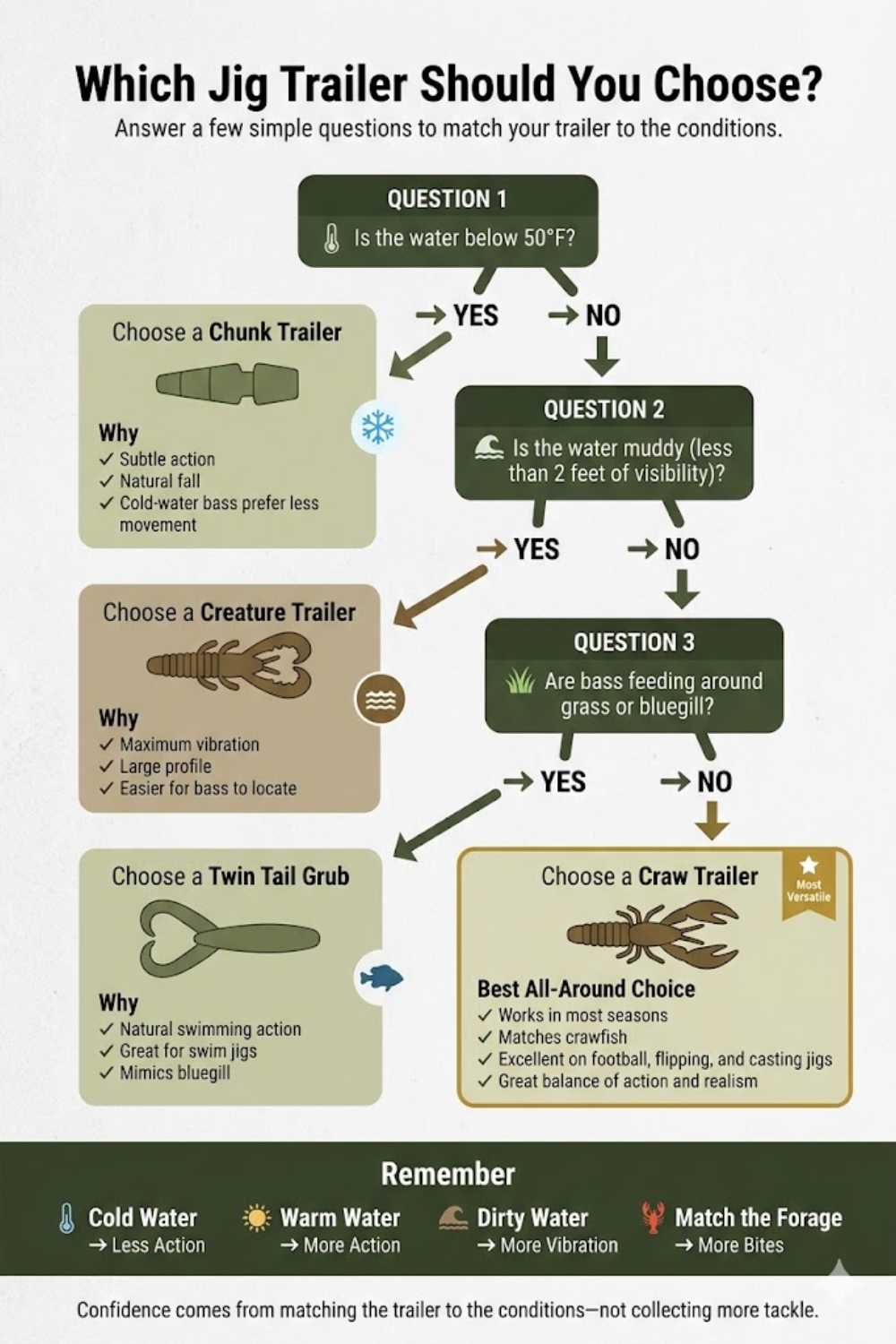
One reason jig fishing intimidates anglers is the overwhelming number of trailer options available. In reality, you don't need dozens of different plastics to cover almost every bass fishing situation.
A simple five-trailer system will handle nearly every lake in North America.
Start with a versatile craw trailer like the Rage Craw. This becomes the default choice whenever conditions don't clearly favor another option. It performs exceptionally well across multiple jig styles, seasons, and water clarities.
Next, carry a subtle chunk trailer for cold water and heavily pressured fisheries. Whenever water temperatures fall below roughly 55 degrees or bass appear reluctant to chase moving baits, switch immediately to the chunk presentation.
The third trailer should be a high-vibration craw like the Paca Craw for muddy water. Whenever visibility drops significantly after rain or strong wind, increased vibration helps bass locate the jig.
Fourth, include a streamlined twin-tail grub like the Menace Grub. This trailer excels on swim jigs around grass, docks, and bluegill-oriented bass.
Finally, keep one oversized creature-style trailer like the Flappin Hog for targeting trophy bass around heavy cover and offshore structure.
This simple system allows anglers to make logical adjustments based on conditions instead of guessing.
Rather than asking which trailer is "best," evaluate four variables before every trip:
* Water temperature * Water clarity * Primary forage * Cover type
Cold water generally favors subtle trailers.
Warm water favors increased movement.
Rock usually favors craw profiles.
Grass often favors swimming profiles.
Bluegill forage suggests wider-bodied plastics.
Crawfish forage favors realistic claws.
Using this process eliminates much of the uncertainty surrounding jig selection and builds confidence much faster than randomly experimenting with dozens of different trailers.
Instead of collecting more plastics, learn exactly when each one performs best.
Final Verdict: Choosing the Best Jig Trailer for Every Situation
There isn't a single jig trailer that's perfect for every bass fishing situation, but there are clear standouts depending on the conditions you're facing.
If you could only own one trailer, the **Strike King Rage Craw** earns the top spot because it performs exceptionally well across nearly every season, jig style, and water clarity. Its combination of realistic profile, consistent action, and versatility makes it an easy recommendation for both beginners and experienced tournament anglers.
When bass become inactive during winter or after strong cold fronts, subtle presentations consistently outperform aggressive ones. That's where the **Zoom Super Chunk** shines. Its restrained movement closely matches dormant crawfish and keeps the presentation natural when fish refuse excessive action.
If dirty water is the primary challenge, the **NetBait Paca Craw** deserves a place in every tackle box. Its oversized claws produce vibration that helps bass locate the jig even when visibility is extremely limited.
For anglers chasing larger bass around docks, brush piles, or offshore structure, the **Gary Yamamoto Flappin Hog** creates the bulky meal profile that often attracts quality fish instead of numbers.
Meanwhile, the **Strike King Menace Grub** remains one of the most versatile swim jig trailers available. Whether imitating bluegill around shoreline grass or shad during the fall, its streamlined design allows swim jigs to track naturally while maintaining enough tail movement to trigger strikes.
The most successful jig fishermen don't simply tie on their favorite trailer and fish all day. They continually adjust trailer style, size, and action to match seasonal bass behavior, water clarity, available forage, and fishing pressure.
Mastering those adjustments is what transforms jig fishing from an occasional confidence bait into one of the most productive techniques for consistently catching quality bass throughout the year.