Why a Real Game Plan Beats a Full Tackle Box
Two anglers launch at the same ramp at 6 a.m. Both have identical gear, identical electronics, and identical home-lake experience. By 11 a.m. one has five fish and a limit forming; the other has one short and a growing pile of retied leaders. The difference is almost never in the tackle. It's in the plan — or the absence of one.
The angler with the plan spent 20 minutes the night before looking at the forecast, checking the last two cold-front cycles, and noting which creek arms would be wind-protected on a south wind. He knew before he launched that the primary pattern would be a wind-blown chunk-rock bank in 4–8 feet, and if that failed, the backup would be shaded docks on the main lake with a jig. He didn't decide any of that at the ramp. He verified it.
The angler without the plan fished yesterday's spots because they worked yesterday. That is not a plan. That is a memory. Fish don't fish memories — they respond to today's conditions. This guide is the framework the first angler runs every trip.
The Five Inputs That Actually Matter
There are dozens of variables you can consider before a trip. Five of them do most of the work. If you nail these, most other decisions get easier.
1. Season and Water Temperature
Season sets the stage bass are in — prespawn, spawn, postspawn, summer, fall transition, or winter. Water temperature confirms and refines it. A 58°F lake in early April is prespawn regardless of the calendar. A 75°F lake in early May is post-spawn even if the guides last month were still throwing jerkbaits.
Before every trip, check the most recent surface temperature from a local marina cam, a fishing report, or your own last graph reading. Then map that temperature to the stage. Full breakdown lives in the bass fishing water temperature guide, with stage-specific patterns in prespawn, post-spawn, summer midday, and fall guides.
2. Weather Trend (Last 48 Hours)
Weather is not a single number — it's a trajectory. What matters is what happened for two days before your trip and what's happening for the next 12 hours. The same 65°F, sunny, light-wind day fishes completely differently after a cold front (tough) versus during a warming trend (loaded).
- Stable, no major front for 3+ days: bass are settled, patterns hold, standard seasonal approach works. See bass positioning in stable weather.
- Pre-front (pressure falling, warm, humid, wind picking up): the best window of the month. Reaction baits, aggressive presentations. See bass fishing before storms.
- Post-front (cold, bluebird, high pressure, north wind): the toughest window. Slow down, fish tight to cover, downsize. Best bass lures after a cold front and cold-front lure categories.
- Warming trend after a cold snap: the second-best window of the month. Bass push shallow quickly, especially on north banks catching sun.
3. Wind Direction and Strength
Wind is the single most under-planned variable in bass fishing. It decides which banks push baitfish, which banks hold current seams, and which banks fish flat and dead. In summer especially, the difference between a wind-blown bank and its sheltered opposite can be six-to-one in bites.
- Plan primary spots on wind-blown structure — points, chunk-rock banks, main-lake grass edges.
- Note the wind's expected direction and forecast shifts. A morning south wind that flips to west by 11 a.m. changes which side of the lake is active.
- Cross-reference wind with structure in wind and bass positioning and best baits for windy conditions.
4. Water Clarity
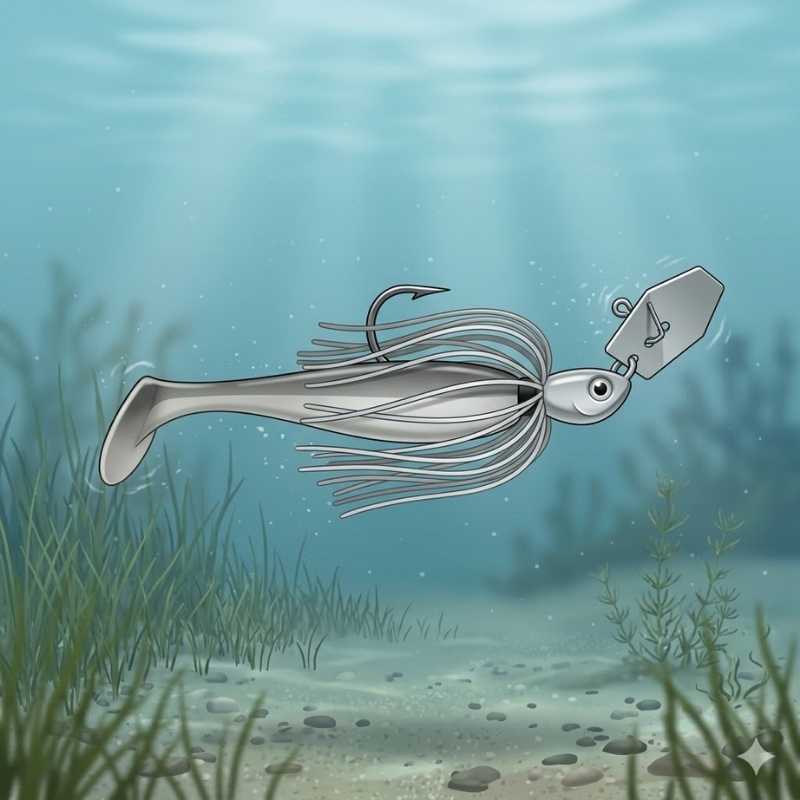
Clarity dictates color, silhouette, and profile — not category. Every category still catches fish across the clarity spectrum, but the version of that category changes. Chatterbaits in muddy water want dark skirts and heavy vibration; chatterbaits in clear water want translucent skirts and tighter action.
Check reports or last-trip observations for clarity on each section of the lake. Rivers and creek arms are almost always dirtier than the main lake, and both change fast after rain. Full framework in water clarity and lure selection, with clarity-specific picks in clear water and muddy water.
5. Dominant Forage
What bass are eating on your lake this month is a huge lever. A spring bluegill spawn, a shad spawn, a summer bluegill bed cycle, a fall shad migration, or a herring push each pull bass to specific structure and make specific presentations obviously better than others.
- Shad spawn — May/June low-light shallow flurries.
- Bluegill spawn — full moon flats and hard bottoms.
- Herring spawn — main-lake points, blowbacks, seawalls.
- Fall shad migration — creek mouths, backs of pockets.
- Crawfish molt cycle — chunk-rock banks, spring and fall.
Match forage to season using the bass forage guide. When one of these events is on, everything else in this framework flexes to serve it.
The Night-Before Planning Sequence
Twenty focused minutes the night before is worth two hours of scrambling at the ramp. Run this sequence every trip.
- Check the 48-hour weather trend and the day's forecast. Note pressure trend, wind direction/speed, cloud cover, and sunrise/sunset. This is the frame everything else fits inside.
- Confirm season and current water temperature. Pull the most recent number you can find or extrapolate from the last week's trend. This tells you which stage-driven pattern to consider.
- Identify the dominant forage event, if any. Time of year plus lake reports. If a shad spawn or shad migration is on, your plan should center on it.
- Choose two lake sections that match the wind. One primary, one backup. Wind-blown structure on the primary; a protected pocket or shade-heavy area on the backup for when the wind lays down or the sun climbs.
- Choose a primary pattern and a genuinely different backup pattern. Primary is what you expect to work. Backup assumes the primary fails — so it must be different in depth, retrieve speed, or location type, not a color swap.
- Mark 8–15 waypoints in 2–3 clusters. Enough water for a full day, grouped tight enough that you're not burning fuel between them.
- Pre-rig four rods for the primary pattern and two for the backup. Rig at home, not on the water. First-light minutes are worth more than any other minutes in the day.
Primary Pattern and Backup Pattern: The Rule of Difference
The most common planning mistake is picking a backup that isn't really a backup. If your primary is a chatterbait on wind-blown chunk rock and your "backup" is a spinnerbait on wind-blown chunk rock, you have one pattern, not two. When the primary dies you'll switch to the backup and get the same result.
A real backup differs on at least two dimensions:
- Depth or column — shallow moving bait vs. deep bottom bait.
- Speed — reaction vs. slow presentation.
- Location type — wind-blown open water vs. shaded cover.
Example plans built to that rule:
- Prespawn stable weather, 55°F. Primary: jerkbait on secondary points and staging flats. Backup: ¼-oz shaky head on the same points at 12–18 feet if the jerkbait dies. See best bass lures for 55° water.
- Post-front bluebird, 68°F. Primary: drop shot on isolated brush 15–20 feet on the main lake. Backup: shaded docks with a compact jig if wind builds. See high-pressure bass fishing.
- Summer midday, 84°F, light wind. Primary: offshore ledge and hump crank/football jig rotation. Backup: shaded dock/laydown flip in creek arms as the sun climbs. See summer midday bass fishing.
- Fall shad migration, 62°F, cloudy, south wind. Primary: lipless crank and squarebill in the backs of pockets and up creek arms. Backup: swimbait or jerkbait on the last main-lake point on the way out. See best lipless crankbaits.
Route the Day: Light Windows Beat Miles
Once patterns and areas are set, route the day around light windows, not around geography. The best window of the day should be spent on the highest-percentage area, even if it's inconvenient to run.
- First light to 8:30 a.m. The highest-percentage window for shallow reaction bites. Spend it on your primary pattern in its best area. See early morning bass lures.
- Mid-morning to noon. The transition window. Move deeper, into shade, or onto structure as light climbs. This is where most anglers lose the day by staying too shallow too long.
- Noon to 3 p.m. Deep structure, shade lines, dock skipping, offshore. The framework in midday summer bass fishing applies most of the year on bluebird days.
- 3 p.m. to sunset. The second-best window of the day. Wind often rebuilds; fish push shallow again. Return to your primary area if it hasn't been beaten to death, or work a fresh wind-blown bank.
Anglers who fish the same area from launch to load usually miss two of these four windows entirely.
Reassess Every Two Hours
A plan is a hypothesis. If two hours of honest fishing in your primary area on your primary pattern produces no signal — no follows, no short strikes, no marks — the hypothesis is wrong. Move.
Reassessment questions:
- Am I on the right pattern for the current window?
- Are conditions still what I planned for (wind, sun, clarity)?
- Are my electronics showing fish where I expected them?
- Have I refined enough within the pattern, or have I only surface-fished it?
If conditions changed (wind flipped, front arrived early, clouds broke), rebuild the pattern to match the new inputs. If conditions held but the pattern didn't produce, move to the backup — fully, not half-heartedly. This is where how to adjust when the bite dies takes over inside a single area, and where how to know bass have stopped feeding tells you whether the fault is the pattern or the fish.
Scenario: Planning a Fall Post-Front Day
Friday night before an October Saturday. The last two days brought a cold front — 20°F drop, north wind, bluebird sky forecast for Saturday. Water temperature has fallen from 68°F to 62°F. Shad are already pushing into creeks. Wind Saturday: north at 10, laying down by afternoon.
Season/temp: fall transition, shad migration in progress.
Weather trend: post-front, high pressure, bluebird.
Wind: north, protecting the south banks and blowing into north-facing pockets.
Clarity: creeks stained from last week's rain; main lake clear.
Forage: shad migration into creek backs.
Primary pattern: lipless crankbait and squarebill in the backs of creeks where shad have pushed, tight to laydowns and stained water. The clarity break protects the bite from bluebird light. Primary area: the two largest creek arms on the lower half of the lake, both north-facing (wind blowing shad into the backs).
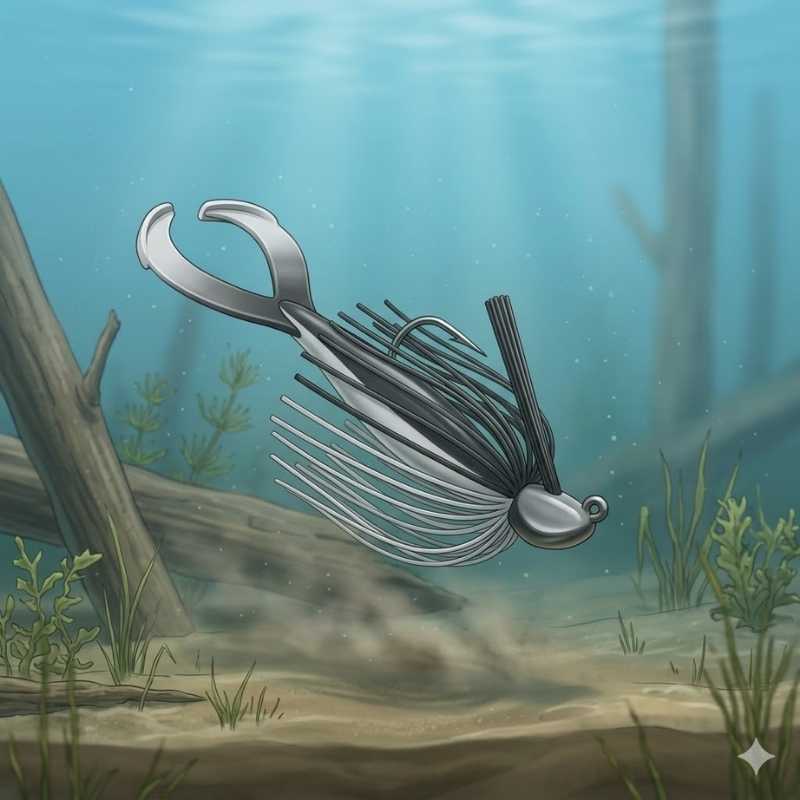
Backup pattern: ½-oz football jig on main-lake points at 18–22 feet, for the bluebird midday window when the shallow bite dies. Completely different depth, speed, and location type — a real backup. See deep crank and jig options.
Routing: first light to 9:30 in creek back #1. If it produces, refine it. If it dies by 9:30, move to creek back #2 for the second wind push. Around 11, transition to main-lake points for the football-jig backup through the bluebird window. Last hour: back to whichever creek was hotter at first light — cold-front fish often reset in the last light.
That's a plan. Not a milk run, not a hope, not a "we'll figure it out at the ramp." A plan built from the five inputs, with a real primary, a real backup, and a route that spends the highest-percentage windows on the highest-percentage water.
Common Planning Mistakes
- Fishing memories, not conditions. Yesterday's plan for today's weather is the fastest way to blank.
- Planning too many spots. Twenty-five waypoints means you'll fish none properly. Fewer, higher-percentage areas beat scattered water.
- Planning a "backup" that's really the same pattern. If your Plan B fails for the same reason as Plan A, you had one plan.
- Ignoring wind direction. The best-mapped structure on the lake fishes dead when it's on the wrong side of the wind that day.
- Refusing to abandon a plan. Sticking to Plan A at 1 p.m. when it clearly isn't working is not perseverance. It's stubbornness with a rod.
- Never writing the plan down. Held in the head, a plan drifts. On paper or in a note, it holds you accountable when conditions push you around.
What a Season of Planned Days Actually Builds
The point of planning is not any single trip. The point is the pattern library it builds over a season. When you plan honestly, execute the plan, and note what actually happened, you learn which of your assumptions were right on this lake and which were wrong. After 30 trips you'll know that on your home reservoir the wind-blown bank always beats the calm bank in October, that the shad get to the creek backs three days earlier than the guide reports claim, and that the first hour after a cold front resets on your lake, not the second day like the magazines say.
That personal, lake-specific pattern library is the thing separating consistent anglers from occasional ones. Planning is how you build it. Fishing memories is how you never do.
The Framework and the Application: Today's Fishing Strategy
Building a game plan is what serious anglers run through the night before every trip: season and temp, weather trend, wind, clarity, forage, primary pattern, backup pattern, routing. Learn the framework and you'll stop launching with vague hopes and start launching with real hypotheses to test.
The framework teaches how to plan. Applying it to today's specific conditions is what Today's Fishing Strategy does in under 30 seconds. Plug in water temperature, clarity, weather, and wind, and the tool returns the primary presentation to lead with plus the finesse fallback to bring when the primary dies — the exact primary/backup shape this guide teaches, applied instantly to the day in front of you. Learn the framework here; apply it there.