Editor's Pick97%
Zoom Trick Worm
Green Pumpkin
View Product →The best bass lures for 65°F water — peak spawn and the transition into postspawn. Sight-fishing baits, flipping jigs, topwater walking baits, and how to read bedding vs cruising fish.

Affiliate Disclosure: As an Amazon Associate I earn from qualifying purchases. Recommendations reflect on-the-water testing and the LureLogic ranking engine — not paid placement.
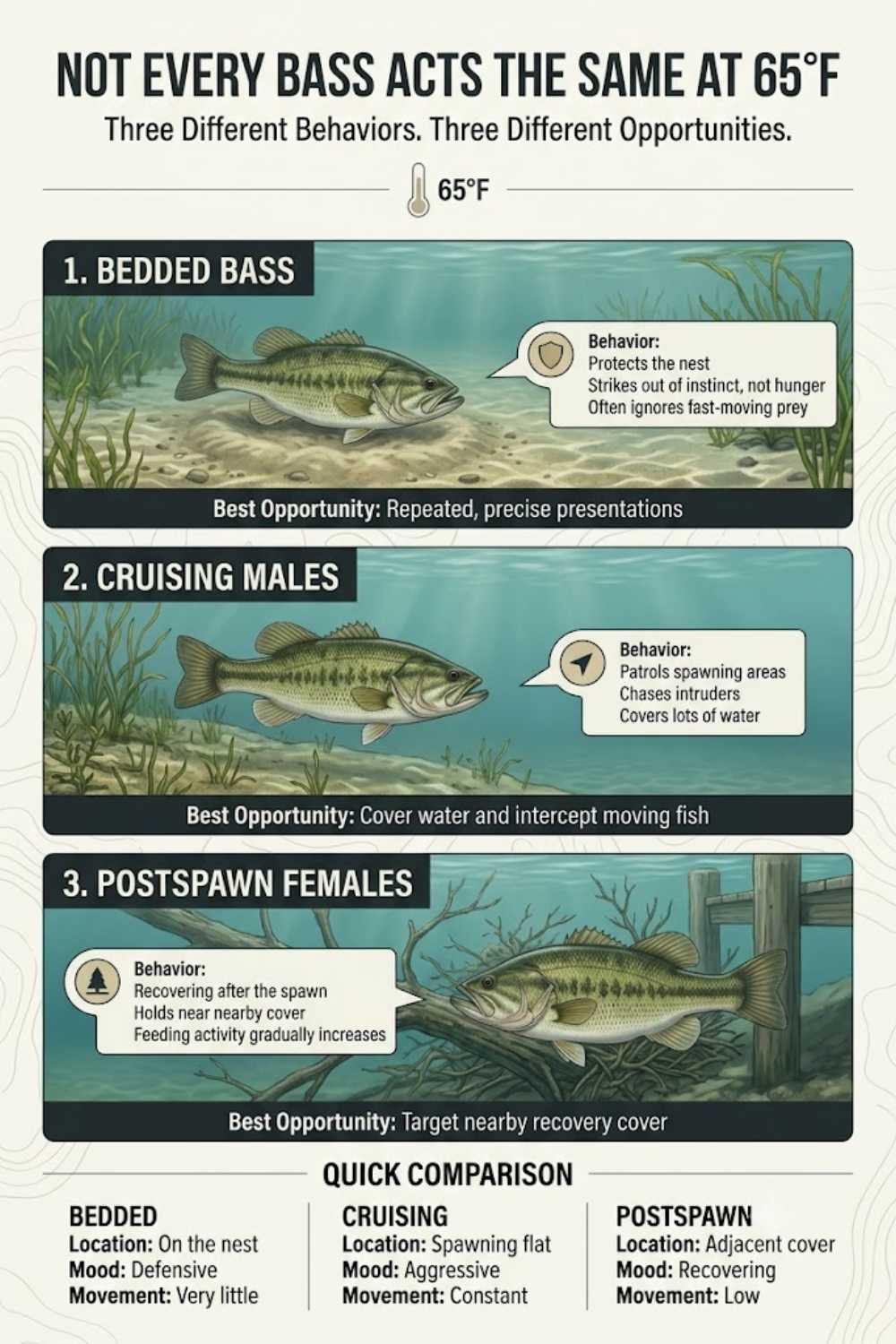
65°F water is the spawn temperature on most reservoirs. The exact bedding temperature varies by latitude, water type, and even individual fish (some bass bed at 62°F, others wait until 68°F), but 63–67°F is the heart of the spawn window across most of the country. Bass populations split into three concurrent behaviors during this window: actively bedded fish, cruising males protecting the spawning area, and recovering early-postspawn females on the first deep cover.
The spawn changes the lure decision. For the rest of the year, bass primarily eat for energy — calories drive feeding decisions. During the spawn, bedded bass strike out of territoriality rather than hunger, treating any object that approaches the bed as a threat to remove. The same Strike King 1.5 squarebill that triggered aggressive reaction strikes at 60°F gets ignored by a bedded fish at 65°F. The bedding strike trigger is repeated presentations into the bed perimeter, increasing fish irritation until it commits to eating (and thereby removing) the offending object.
Cruising males operate on a different program. They patrol the spawning area perimeter, chase females toward the beds, and protect the spawning territory from intruders. A male will crush a moving bait (chatterbait, spinnerbait, walking topwater) that crosses the spawning area. These are aggressive easy fish for blind-casting.
Postspawn females recovering on the first deep cover are not actively feeding initially but begin to feed within a few days as recovery progresses. They respond to slower presentations (Texas-rigs, jigs, slow-rolled chatterbaits) around their recovery cover and produce some of the biggest postspawn bass during the 65°F window.
The spawn-window lure decision is therefore three-part: which behavior are you targeting, what cover are the fish using, and what water clarity supports your presentation type.
Zoom Trick Worm — Editor's Pick (Sight-Fishing). A Texas-rigged 6-inch Zoom Trick Worm in white, watermelon-red flake, or pumpkinseed is the universal 65°F sight-fishing bait. The slow fall, slim profile, and bright (white) or natural (watermelon) color combine to invade beds repeatedly until bedded fish commit. The white Trick Worm is particularly productive because it stays visible to the angler throughout the presentation. See the best finesse worms guide.
Gary Yamamoto Senko — Best Versatile Spawn Bait. A 5-inch wacky-rigged Senko in green pumpkin or watermelon-red flake produces on bedded fish, cruising males, and recovering postspawn females. The fluttering fall and weightless presentation triggers strikes across all three behavior categories. The most productive single bait of the 65°F window for many anglers.
Dirty Jigs Compact Pitchin' Jig — Best Cover Bait. A 1/2 oz green pumpkin or bluegill-pattern jig pitched into spawning-area cover (laydowns, brush piles, dock cover) produces the biggest postspawn females during the 65°F window. Slow drag presentation with 5-second pauses. See the flipping jigs guide.
Heddon Super Spook or Spook Jr — Best Topwater. The first reliable topwater window of the year. Cruising males crush walking topwater across spawning flats. Bone or bluegill colors are the universal starters. See the topwater lures guide.
Z-Man JackHammer ChatterBait — Best Search Bait. A 3/8 oz JackHammer with a Keitech FAT trailer covers spawning flats efficiently, triggering cruising males and roaming postspawn fish. Particularly effective in stained water where sight-fishing isn't an option. See the chatterbaits guide.
Roboworm Straight Tail (Drop Shot) — Best Finesse Bait. A 4.5-inch Morning Dawn Roboworm on a drop shot rig produces on bedded clear-water fish that have refused larger Texas-rig presentations. The drop shot suspends the bait at controlled distance from the bed, letting the angler invade the bed perimeter repeatedly. See the drop shot baits guide.
War Eagle Spinnerbait — Stained-Water Search. A 3/8 oz spinnerbait covered across stained-water spawning flats produces cruising males and aggressive roaming fish. See the spinnerbaits guide.
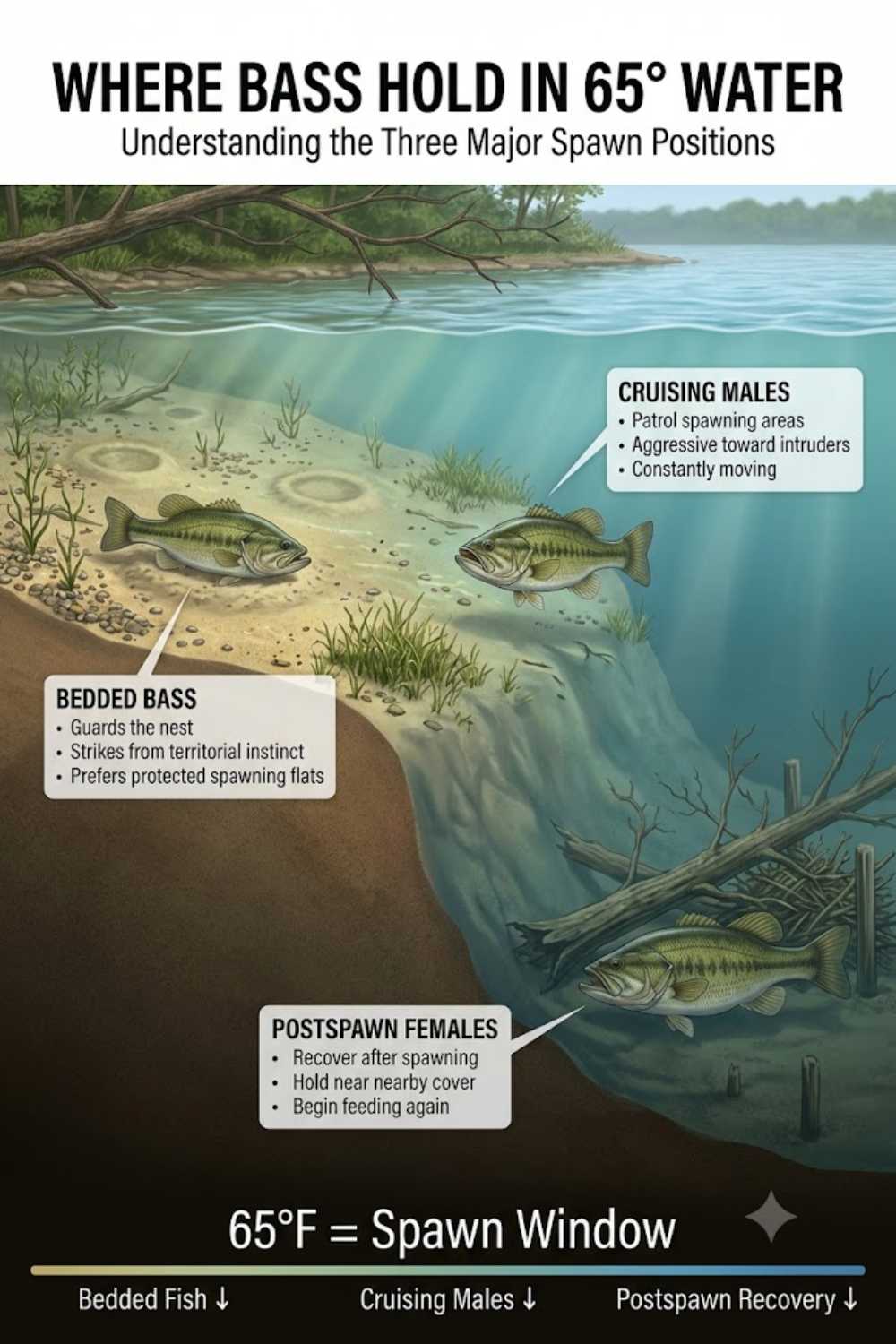
Three concurrent positioning patterns during the spawn.
On beds — Protected pockets, shallow flats with hard bottom (sand, gravel, or hard mud), spawning bays adjacent to deep water. Beds are 1–4 ft deep on most reservoirs, deeper (5–8 ft) on extremely clear lakes. Locate beds by sight-fishing in clear water, or by recognizing the spawning-area geography in stained water.
Cruising the spawning area perimeter — Males patrol the perimeter of the spawning flats and bays, chasing other bass and intruders away from the spawning territory. These fish are caught on moving baits worked across the spawning area or along its outside edges.
Postspawn recovery cover — The first deep cover adjacent to spawning areas: shallow brush, shaded laydowns, dock cover at the mouths of spawning creeks. Recovering postspawn females hold here for several days after the spawn before resuming aggressive feeding. Post-spawn bass fishing guide covers the pattern.
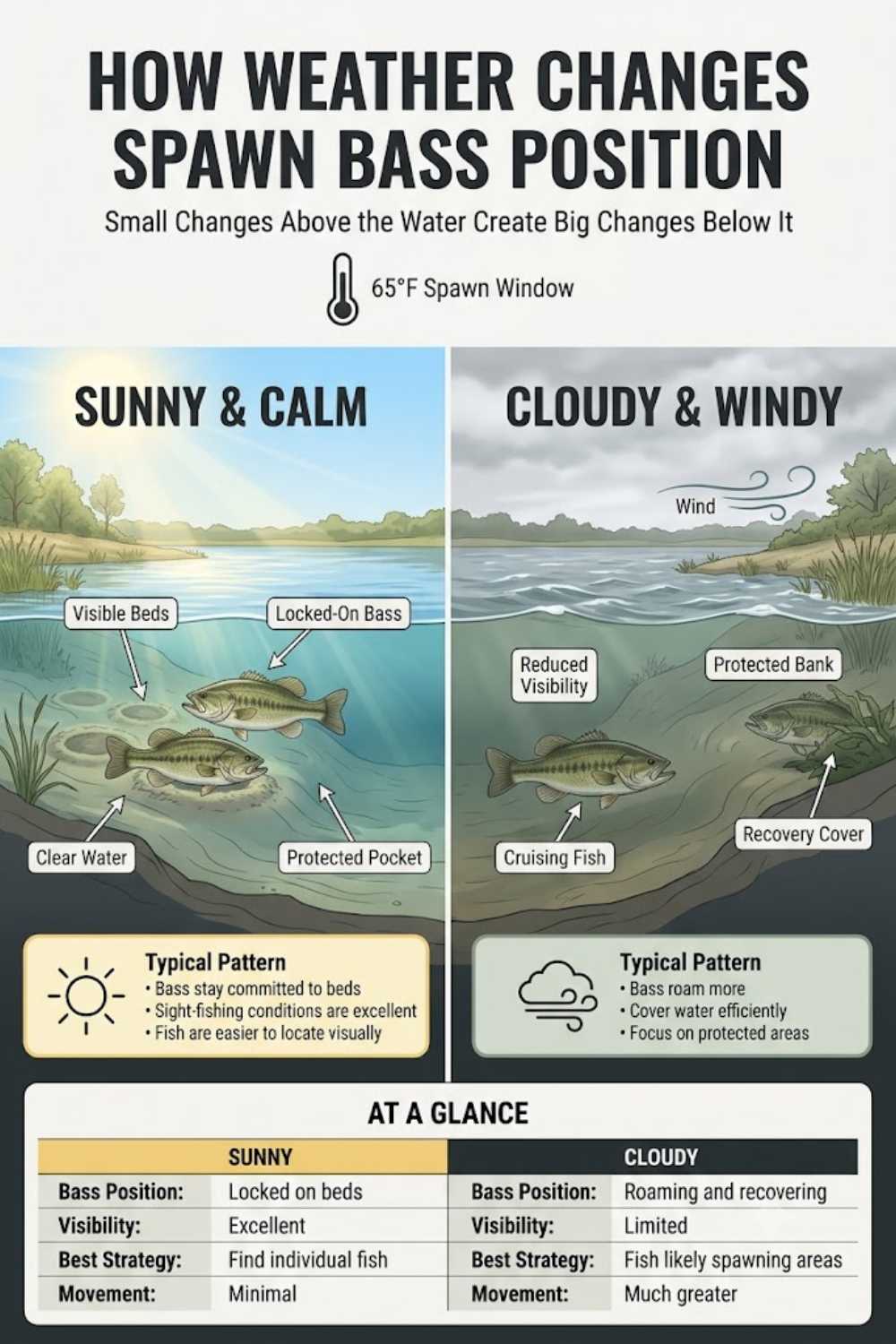
Reading conditions — Sunny days favor sight-fishing (visibility is best) and concentrate bedded bass tight to beds. Overcast days favor blind-casting and produce more cruising-fish bites; bedded bass back off the beds slightly under overcast skies. Wind concentrates fish on protected sides of structures during the spawn (bass dislike wind during bedding); calm conditions concentrate fish in the most-open spawning areas.
The 65°F productive window typically lasts 14–21 days on a typical reservoir, longer on extended-spawn lakes. Fish hard but also adjust patterns as the spawn progresses — early-spawn fish are mostly prespawn-staged, mid-spawn fish are on beds, late-spawn fish are mostly postspawn.
Sight-fishing bedded bass is a specialty skill that produces the biggest bass of the year for anglers who master it.
Locate beds — Polarized sunglasses, a high vantage point (standing on the front deck), and patient observation. Beds appear as light-colored circles or ovals (cleared substrate) approximately the diameter of the bass standing on them. Look for fish first, then identify the bed.
Classify the fish — A bedded bass is either a male (smaller, more aggressive, less wary) or a female (larger, more cautious, less aggressive). Both can be caught but require different approaches. Males typically eat within 5–15 minutes of repeated presentations; females may take 30–60+ minutes and may require multiple bait changes.
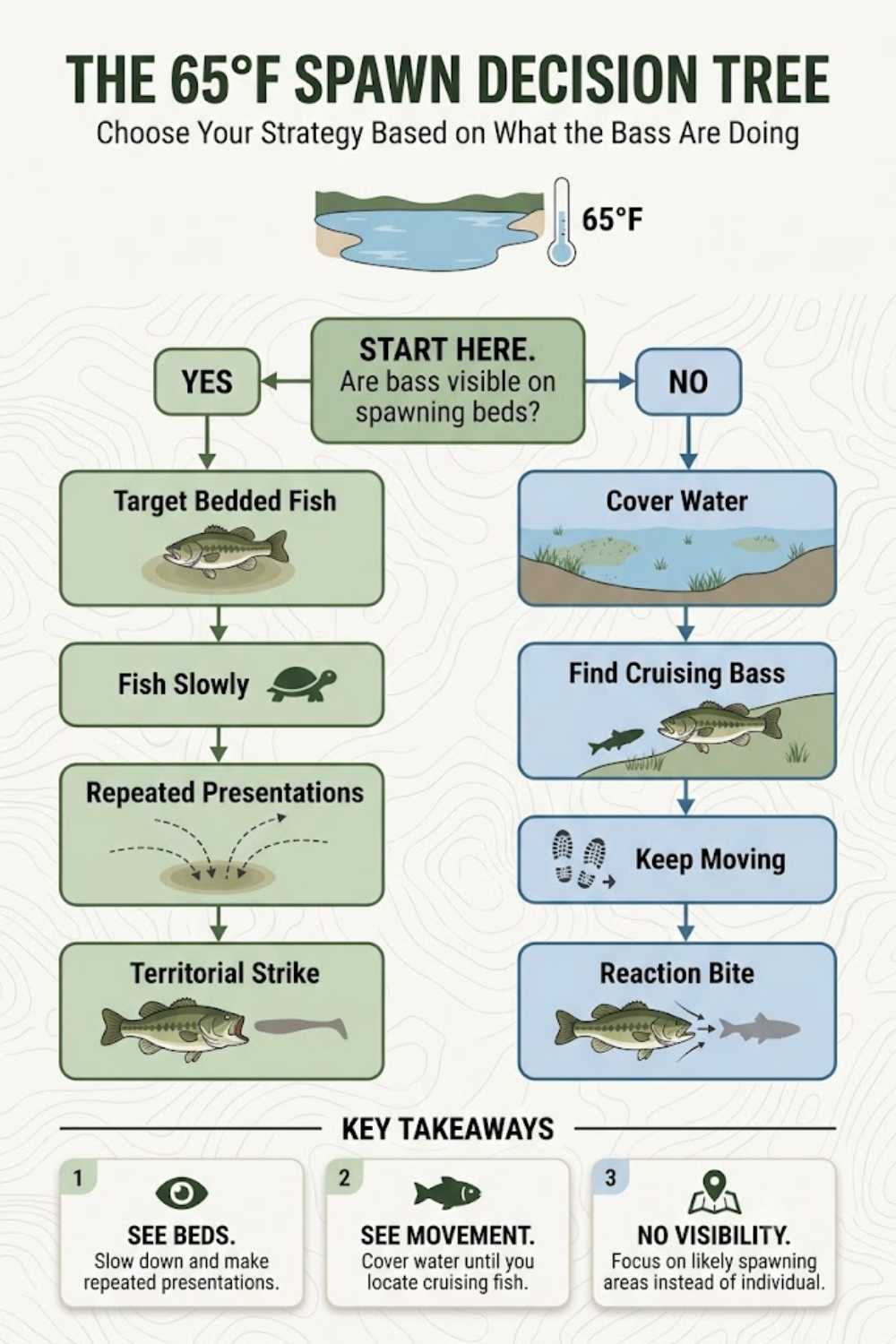
Presentation — Cast past the bed and work the bait into the bed perimeter slowly. The bait must repeatedly invade the bed perimeter to trigger the territorial response. Drop the bait directly on the bed (sometimes works on aggressive fish), then if no commitment, work it into the bed from various angles. Watch the fish's posture: a fish that drops down and flares gills is about to strike; a fish that backs off the bed is losing interest and needs a different presentation.
The strike — Bedded bass typically pick up the bait and carry it off the bed to drop it. Most bites are felt as slight pressure or seen as the fish moving with the bait. Set the hook firmly when you see the fish has the bait — don't wait for a hard thump.
Ethical considerations — Some anglers and fisheries discourage sight-fishing for bedded fish due to impact on spawning success. Check local regulations and consider catch-and-release for bedded fish during peak spawning periods.
Blind-casting produces in stained water and on cruising and recovering fish.
Blind-casting spawning flats — A chatterbait, spinnerbait, or walking topwater swam across stained-water spawning flats produces aggressive cruising males and roaming fish. Make long casts and cover water efficiently.
Working spawning-area cover — A flipping jig, Texas-rig worm, or wacky-rigged Senko pitched into the shallow cover at the edges of spawning bays produces both bedded fish (territorial strikes) and recovering postspawn fish (developing feeding response).
Postspawn recovery cover — A jig with a craw trailer or a Texas-rig worm worked slowly through shaded laydowns, shallow brush piles, and dock cover adjacent to spawning areas produces the biggest postspawn females. The bites are subtle initially (fish are still recovering) but build in aggression as days pass.
Topwater on the cusp — On warmer 65°F days (66–67°F), the first reliable topwater bite of the year develops. A walking bait or popper worked along the outside edges of spawning bays produces cruising and recovering fish. See early-morning bass lures for the dawn topwater window.
Line and rod — 12–17 lb fluorocarbon for most reaction baits and Texas-rigs; 50–65 lb braid for flipping jigs into heavy cover; 8–10 lb fluorocarbon for clear-water sight-fishing and drop shot presentations.
Match presentations to behavior — On a day with both bedded fish and cruising fish, run two rods: a sight-fishing Texas-rig setup for the bedded fish and a reaction-bait setup for the cruisers. The combination produces more bass than committing to one or the other.
65°F is the spawn window — the most varied lure-decision period of the year. Sight-fishing Texas-rigs and Senkos produce bedded fish; chatterbaits, spinnerbaits, and walking topwater produce cruising males; jigs and Texas-rigs in postspawn recovery cover produce recovering females. Read the fish behavior, pick the appropriate technique, and the spawn window will produce some of the biggest bass of the year.
For the warmer postspawn window, see best bass lures for 70-degree water. For the cooler prespawn window, see best bass lures for 60-degree water. For the broader spawn playbook, see post-spawn bass fishing guide.
Dead-stick fall that bass simply can't refuse.
Heavy cover — pitch in, let it sink on slack line.
As an Amazon Associate I earn from qualifying purchases.
Staging fish on transition banks and the baits that work.
Fry guarders and the recovery slowdown.
Walking baits, frogs, and poppers in heat.
Deep structure or shade — pick one.
Shade plus structure in the heat of the year.
Shad migration and aggressive pre-winter feeding.
Plug in today's water temp, clarity, weather, and forage — the tool returns the highest-confidence presentations.
Build Today's Strategy →