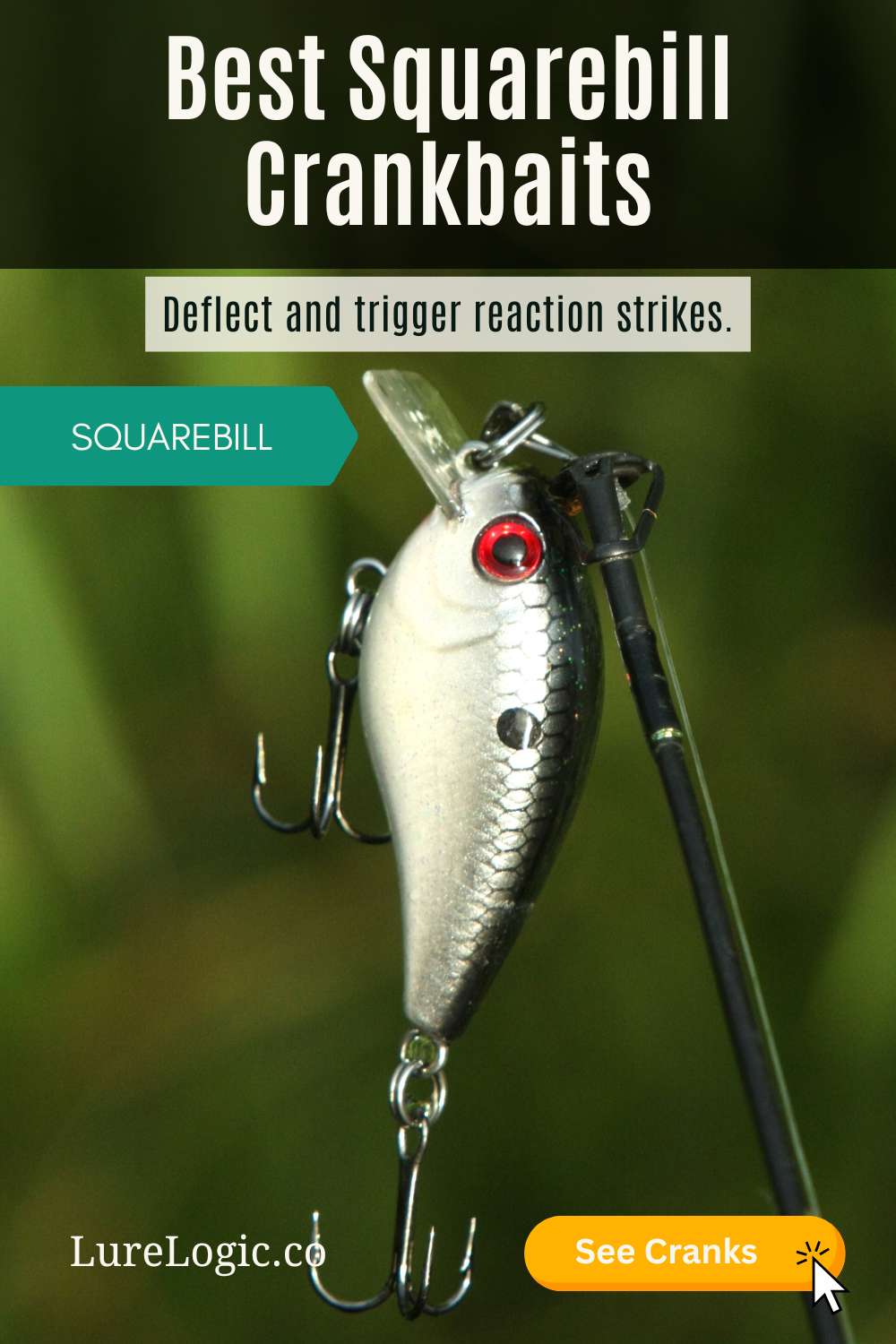
Why Squarebills Trigger Bass
Strike King KVD 1.5
Deflects off cover like nothing else — the go-to shallow crank.
Shallow wood and rock — make it deflect off cover.
As an Amazon Associate I earn from qualifying purchases.
Alternative Options
- Lucky Craft LC 1.5 →Alternative
The square lip is the defining feature. Compared to a round or coffin lip, it produces a wider, more erratic wobble and lets the bait deflect off cover instead of hanging up. That deflection is the entire reason the bait exists. Bass holding inside or alongside wood, rock, and grass ambush as the bait's path changes — that's the trigger, not the bait's "realistic" profile. A squarebill that runs cleanly through open water is almost worthless. The same bait kicked sideways off a stump triggers a strike from a fish that ignored it on the cast in.
This is why squarebills are part of the shallow-water bass lure rotation and not a generic crankbait choice. Their job is cover deflection. Pick spots accordingly — see bass fishing laydowns for the wood-cover positioning that gives squarebills their best opportunity.
The Squarebills That Actually Produce
Three lures cover the vast majority of shallow-water cranking:
- Strike King KVD 1.5 — the benchmark. Aggressive wobble, fast displacement, deflects hard and recovers fast. The default in stained or muddy water and anywhere thump matters more than realism.
- Rapala BX Brat — a balsa-core hybrid with a tighter, more refined wobble. Better in clear water and on pressured fish where the KVD's loud action gets refused.
- SPRO Little John 50 — a balanced middle option, great running depth-to-action ratio. Strong choice when fish want a 1.5-size profile but the bait needs to dig a little deeper.
A 1.5-class runs 3–5 feet on 12 lb fluoro. Step up to a 2.5 (KVD 2.5, BX Brat 06, Bandit 200) for 6–8 feet of running depth and bigger profile — better fall and prespawn choice when fish are on bigger bait.
Where to Throw a Squarebill
The bait demands cover. The high-percentage targets:
- Stump-lined banks and shallow timber — the squarebill's classic home water. Deflect off every stump you can identify.
- Riprap on causeways and bridge approaches — angled retrieves parallel to the rock so the bait ticks the stones for the entire cast.
- Laydowns and any wood off the bank — pitch past the tree, crank through the limbs, kill the reel on contact.
- Hard-bottom transitions — gravel-to-rock or rock-to-sand seams hold bass because the substrate change concentrates bait. See bass fishing transition banks for the why.
- Shallow grass edges — works best where grass is sparse enough to rip free. A squarebill ripped through scattered hydrilla triggers reaction strikes that subtler baits can't.
Bass Positioning for a Squarebill Pattern
Squarebill bass are nearly always relating to a piece of cover. They face into current (wind or generation) and hold on the down-current side of the obstruction, waiting for a baitfish to be swept past. This is why a squarebill cast retrieved with the wind almost always outproduces one cast against it — the bait approaches the fish from the angle they're already looking.
Through the day, squarebill fish move shallower in low light (dawn, dusk, wind, cloud cover) and tighter to thick cover under high sun. On bluebird days after a cold front the squarebill bite collapses — fish bury in cover and won't move to deflection. See best bass lures after a cold front for what to do instead.
Cover quality matters more than cover quantity. A single isolated stump on an otherwise clean bank usually holds the biggest fish — bass concentrate on the only ambush point. Mark these spots and re-fish them on every pass.
Seasonal Considerations
- Pre-spawn (48–58°): red and red-craw squarebills on rocky banks and riprap as bass stage near spawning pockets. The classic Catawba-chain pattern — covered in Lake Wylie prespawn.
- Spawn: not a primary spawn bait, but a yo-yo'd squarebill near visible beds can trigger a defensive strike when sight-fishing fails.
- Postspawn: shad-pattern squarebills cranked past laydowns and dock corners produce fry-guarders.
- Summer: early-morning shallow window only. Once the thermocline sets up, the bite shifts deeper than a squarebill reaches.
- Fall: the second prime window. As shad push into the backs of creek arms, sexy-shad squarebills cranked through stumps and laydowns produce daily — see fall bass fishing bait guide.
- Winter: usually outclassed by jerkbaits and slow-rolled jigs, but a slow-cranked red squarebill on sunny riprap on a 50° January afternoon will surprise you.
Water Clarity Adjustments
Clarity dictates color and how aggressively the bait can be retrieved.
- Clear (4+ feet): ghost minnow, sexy shad, natural craw. Tighter-wobble baits (Brat, Little John) outperform aggressive cranks. Lengthen casts and watch the bait approach — bass often follow before committing. See clear-water bass lures for the broader framework.
- Stained (1–4 feet): chartreuse-shad, citrus shad, red craw. The widest workable color window. Aggressive wobble works fine — bass aren't getting a long look anyway.
- Muddy (under 1 foot): solid red, chartreuse-and-black, painted craw with high-contrast bellies. The fish needs to feel the bait first. A loud KVD 1.5 in solid red is hard to beat. Full breakdown in muddy-water bass lures.
- Cold-water prespawn: red. Red squarebills imitate an early-season crawfish, and this color works disproportionately well from late February through early April regardless of clarity.
Retrieve and Cadence
Steady retrieve broken up by deliberate cover contact. After a deflection, kill the reel for half a second — the bait floats up about 6 inches, which is when most strikes come. This burn-pause-burn cadence triggers reaction strikes that a steady retrieve will miss.
Speed depends on temperature. Below 55° slow the retrieve enough that the bait barely wobbles, and let it sit a full second on cover contact. Above 65°, burn it — fast-and-loud cadence produces more strikes than the fish can refuse. Wind helps; calm water hurts. A squarebill in calm clear water is one of the easier baits for a bass to refuse.
Lure Selection Logic: Why Deflection Wins
Bass are ambush predators wired to react to sudden change. A steady-moving baitfish is processed as "something to consider"; a baitfish that suddenly changes direction is processed as "wounded — strike now." The squarebill's wide wobble plus its tendency to kick erratically off cover replicates the panic motion of a baitfish that's just been bumped. That's the trigger.
Choose the bait class accordingly. Lipless cranks fish open water faster; jerkbaits suspend; squarebills exist specifically to deflect. If your spot doesn't have wood, rock, or hard-bottom irregularity, throw something else. See the broader lure selection guide for the category-to-condition decision tree.
Common Mistakes
- Throwing it in open water. A squarebill that never hits cover rarely produces. Use a jerkbait, lipless, or spinnerbait for clean lanes — save the squarebill for shoreline cover and rocky structure.
- Wrong rod. A medium-power glass or composite cranking rod absorbs the strike and keeps treble hooks pinned. A stiff graphite rod pulls hooks on the headshake — this is the single most common reason anglers lose squarebill fish.
- Hooks too small. Stock factory trebles are often undersized for the body weight. Upgrade to strong size-2 trebles (Owner ST-36 or Gamakatsu Round Bend) — squarebill fish often head straight back into the cover they came from.
- Reeling through cover. Pause after every deflection. Half a second of dead-stop pause produces more strikes than three more cranks.
- Wrong size for the depth. Throwing a 1.5 in 8 feet means the bait never reaches the cover. Step up to a 2.5 when the stumps or laydowns sit at 6–8 feet.
Real-World Application
A mid-October afternoon, water 64°F, slight wind. Shad have pushed into the back third of a creek arm. The bank is stump-lined with a 45-degree gravel taper and scattered laydowns. Stained water from recent rain, maybe 2 feet of visibility, mostly overcast.
Decision tree:
- Cover type — stumps and wood = squarebill is the right class.
- Depth — stumps at 3–5 feet = 1.5-size lure (KVD 1.5).
- Clarity — stained = sexy shad or chartreuse-shad color.
- Season + forage — fall shad migration = shad pattern over craw pattern.
- Sky — overcast = aggressive wobble fine; no need to downsize.
- Wind direction — slight tailwind = parallel casts working with the wind, deflecting off every stump.
Result: KVD 1.5 in sexy shad on a 7'2" medium-power glass cranking rod with 12 lb fluoro. Cast 5 feet past each stump line, retrieve at moderate speed, kill the reel for a half-second on every contact. Move down the bank at trolling-motor speed and pick off the fish that the bait deflects past. For the broader fall pattern, see our fall bass fishing bait guide.