Editor's Pick97%
Strike King KVD 1.5
Sexy Shad
View Product →At 60°F bass hit the late-prespawn peak. Squarebills, chatterbaits, lipless cranks, and jigs — which to throw, the cadence, and where bass hold at 60 degrees vs 55 and 65.
Affiliate Disclosure: As an Amazon Associate I earn from qualifying purchases. Recommendations reflect on-the-water testing and the LureLogic ranking engine — not paid placement.
The short answer at 60°F: throw a squarebill around shallow cover, a chatterbait to cover grass and flats fast, a lipless crankbait on 6–12 ft staging structure, and a flipping jig when you want the biggest female in the pocket.
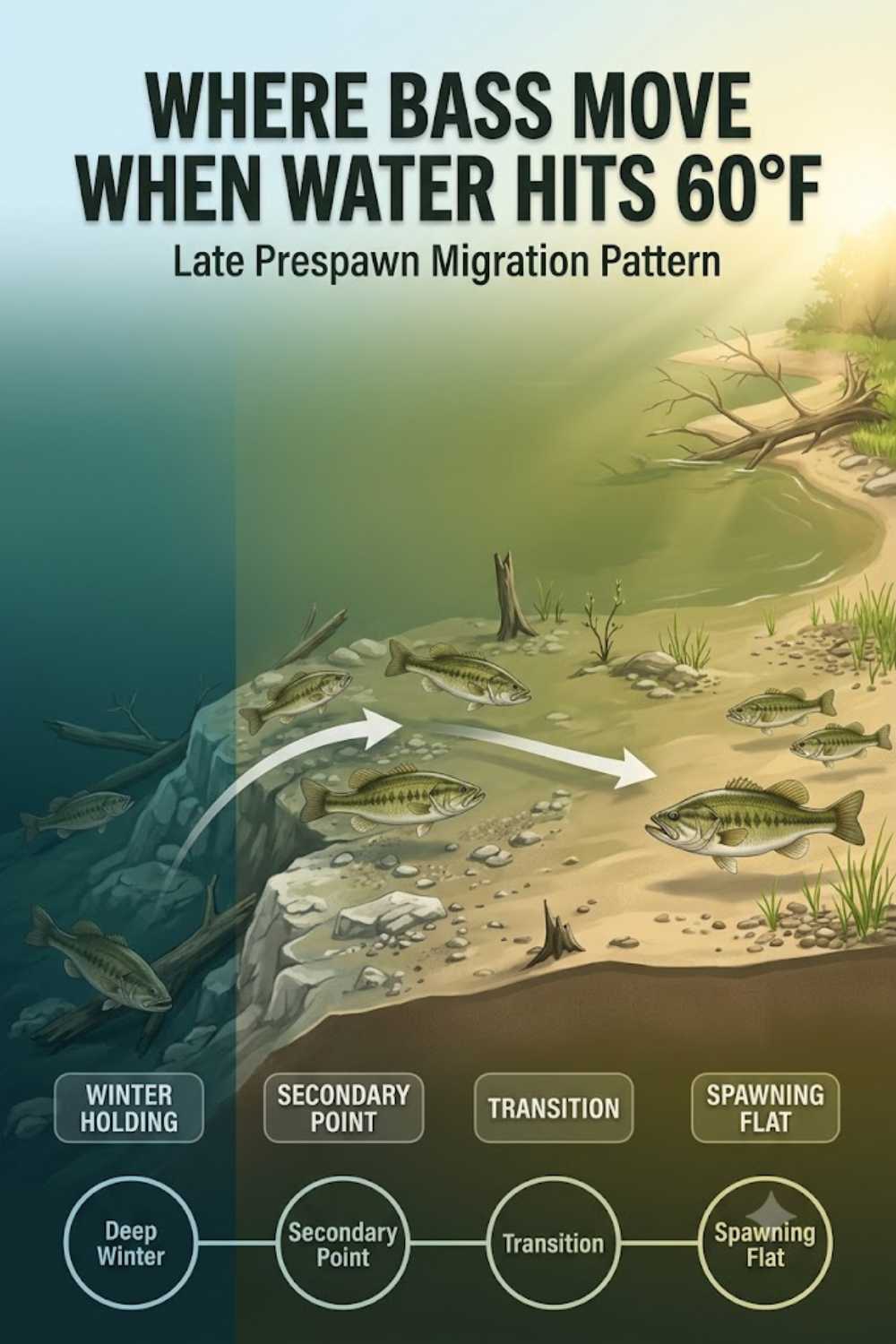
What makes 60°F different from its neighbors: at 55°F bass are still staging on secondary points and want a moderate horizontal retrieve with pauses. At 60°F they have moved inside the spawning bays and will chase — burn the bait and deflect it off cover. By 65°F the first wave is locking onto beds, so sight-fishing and slow soft plastics start taking over from reaction baits. Fish 60°F like the last full-speed window before the spawn shuts the chase reflex off.
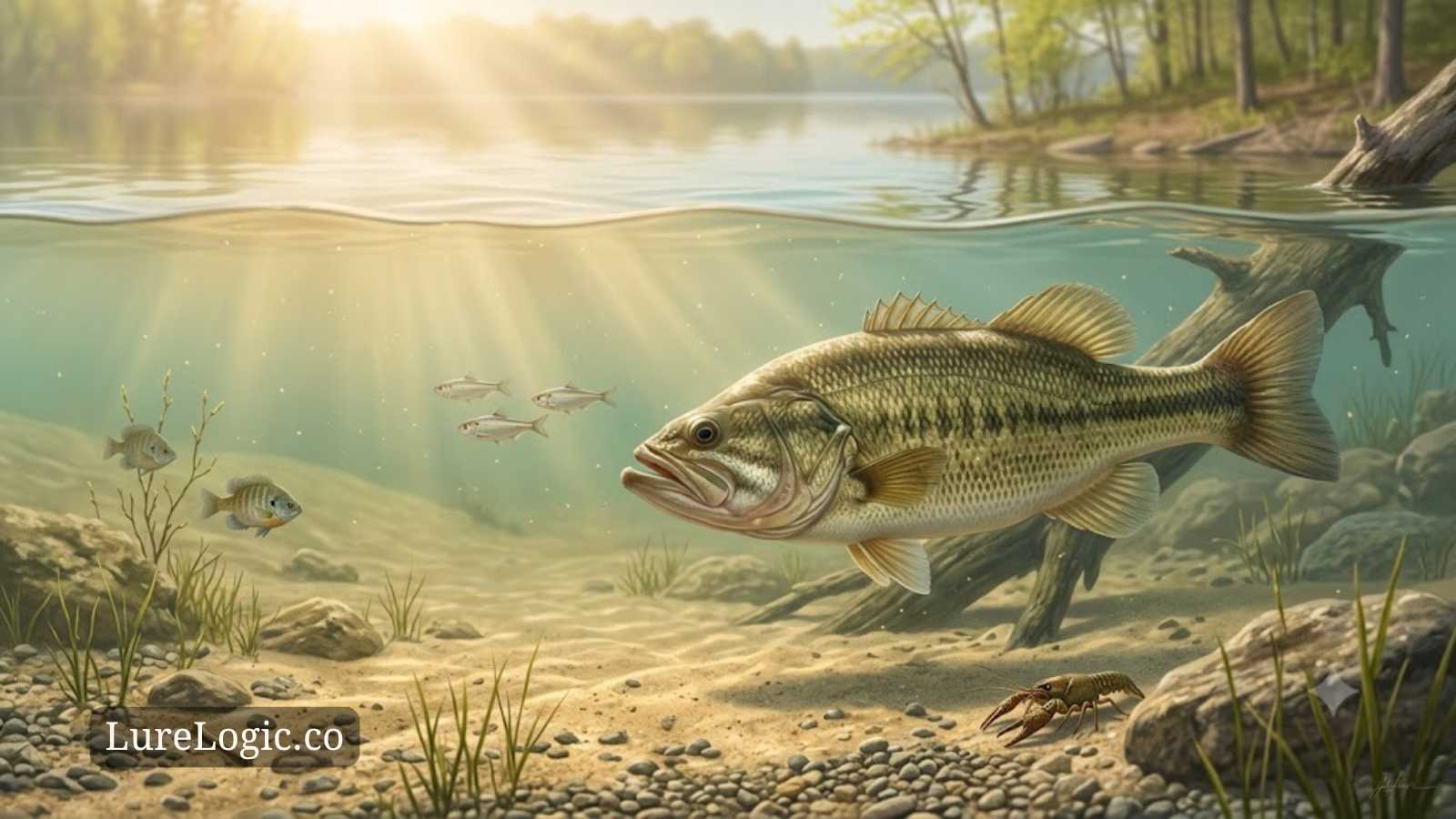
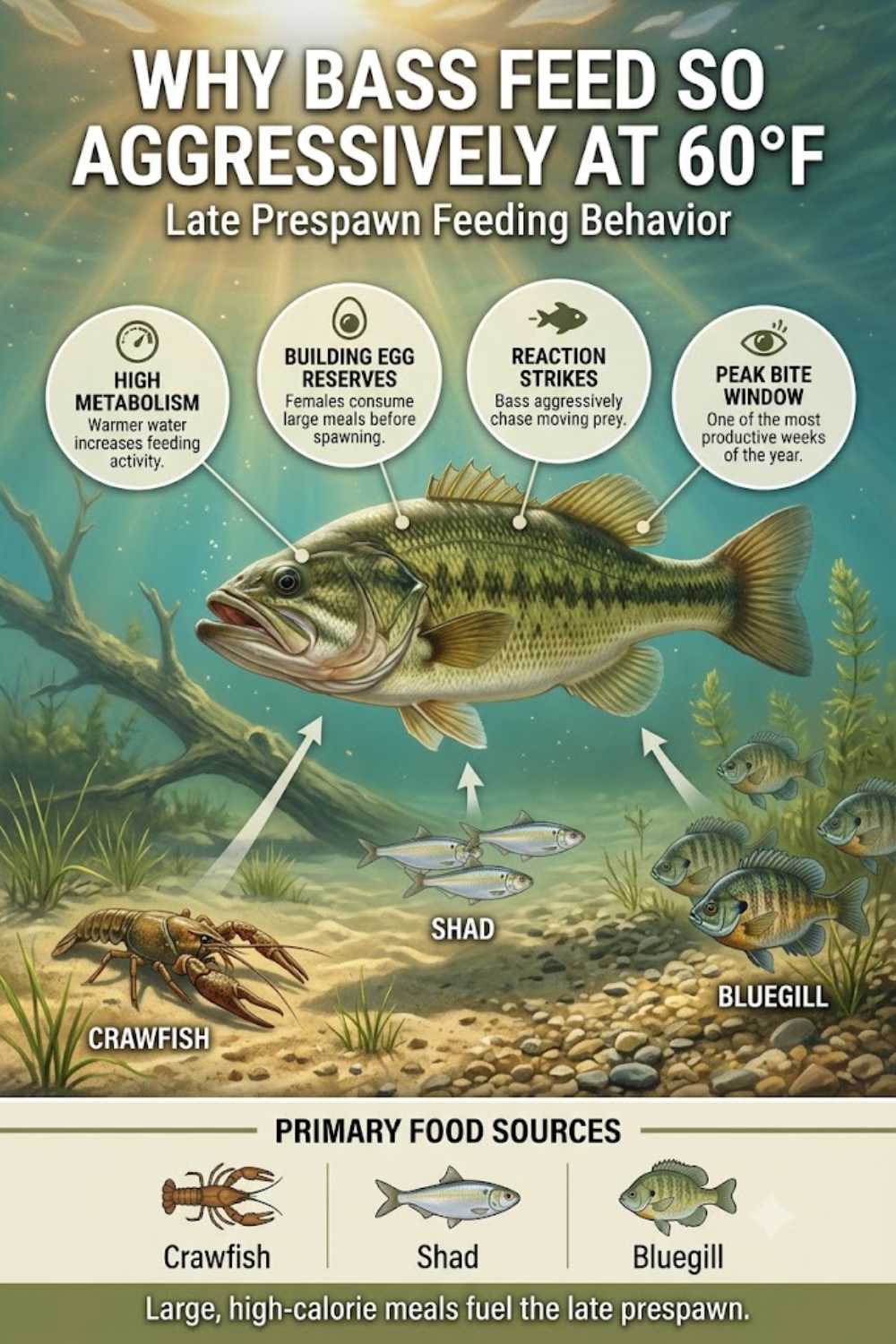
60°F water represents the absolute peak of the prespawn feeding window. Bass have completed the migration from winter holding into spawning areas, have switched fully into late-prespawn metabolism, and are aggressively feeding to build the calorie reserves needed for the spawn itself. Bite frequency at 60°F exceeds nearly every other water temperature in the year — it is the highest-bites window many anglers experience.
The biology is straightforward. Female bass entering the spawn need substantial energy reserves to produce eggs (a 5-lb female may carry over 1 lb of eggs), recover from the spawn, and survive the recovery period when they cannot effectively feed. Late prespawn at 60°F is when those reserves are built. The fish actively hunt high-calorie meals (crawfish, bluegill, and large baitfish) and commit on aggressive presentations.
Bass positioning at 60°F shifts from the staging structure of the 55°F window into the actual spawning areas. Bass move onto spawning flats, into protected pockets, and onto the first hard-cover targets adjacent to spawning areas. Some fish stage on the transitions into these areas (secondary points, channel-swing banks at creek-arm mouths, rocky transitions), but the majority have moved inside.
The presentation philosophy at 60°F is the opposite of cold-water presentations. Where 50°F demanded slow vertical and 55°F demanded moderate horizontal, 60°F supports the fastest reaction presentations of the prespawn window. Squarebills bumped through cover, chatterbaits and spinnerbaits covering water efficiently, lipless crankbaits yo-yoed aggressively, and topwater on the warmest days all produce. Cold-water presentations (jerkbaits with long pauses, dead-stick Ned rigs) become secondary at 60°F — they still produce but the reaction-bait window dominates.
Strike King KVD 1.5 Squarebill — Editor's Pick. The single most productive 60°F lure for shallow-water bass. The 3–6 ft diving depth covers the prime depth band where 60°F bass hold, the deflection-driven reaction trigger excites aggressive prespawn fish, and the chartreuse-with-blue-back color is universally productive in 60°F water. See the best squarebill crankbaits guide.
Z-Man JackHammer ChatterBait — Best Search Bait. A 3/8 oz JackHammer with a Keitech FAT trailer covers water faster than any other reaction bait and finds scattered late-prespawn bass efficiently. Particularly productive on lakes with submerged vegetation where bass stage adjacent to spawning grass. See the chatterbaits guide.
Strike King Red Eye Shad — Best Reaction Bait. A 1/2 oz lipless crankbait yo-yoed across rocky transitions and staging flats produces aggressive 60°F bites. The rattle profile and falling-and-recovering action match injured shad — the dominant late-prespawn forage on most reservoirs. See the lipless crankbaits guide.
War Eagle Spinnerbait — Cover-Search Bait. A 3/8 oz spinnerbait (double-willow blade for clear water, Colorado-willow for stained water) burned across shallow cover produces in stained-water 60°F situations. Particularly effective on windblown banks. See the spinnerbaits guide.
Megabass Vision 110 — Pressured-Fish Backup. For the toughest 60°F days (highly-pressured tournament water, post-front conditions), a suspending jerkbait with 2–4 second pauses still produces. Shorter pauses than 50–55°F but the suspending presentation triggers fish that have refused the moving baits.
Dirty Jigs Compact Pitchin' Jig — Big-Fish Specialist. A 1/2 oz black/blue or green pumpkin jig pitched into spawning-area cover (laydowns, brush piles, dock cover) produces the year's biggest females during the 60°F window. Slow drag presentation with 5-second pauses. See the flipping jigs guide.
Zoom Trick Worm or Senko (Texas-rig) — Pressured-Fish Backup. For clearer-water 60°F fish that have been pressured by reaction-bait anglers, a slowly-fished Texas-rigged worm or wacky-rigged Senko in spawning-area cover produces the most pressured fish. See the finesse worms guide.
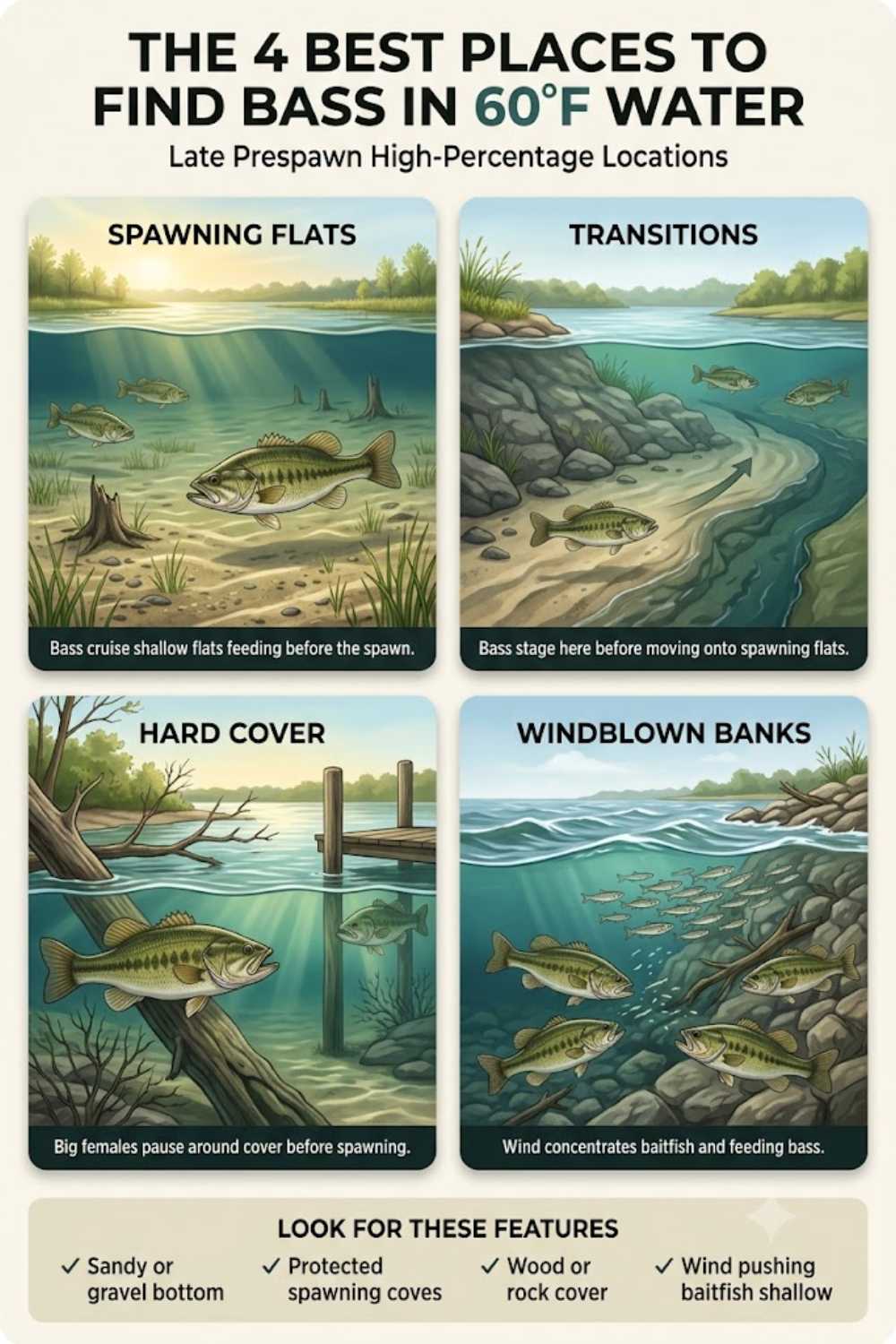
Four high-percentage 60°F positioning patterns.
Spawning flats — The shallow areas (typically 1–6 ft) where bass actually spawn. Late-prespawn bass cruise these flats hunting calorie-loading meals before locking onto beds. Hard-bottom flats with sparse cover (isolated stumps, scattered rock, sparse grass) are the highest-percentage. A squarebill, chatterbait, or lipless crankbait worked across the flat produces.
Transitions into spawning bays — Secondary points, channel-swing banks at creek-arm mouths, and rocky transitions adjacent to spawning flats. Late-prespawn bass moving in and out of spawning areas concentrate on these transitions. A chatterbait or lipless crank covers these transitions efficiently.
Hard cover adjacent to spawning areas — Laydowns on the banks of spawning bays, brush piles on secondary points, dock cover at the mouths of spawning creeks. Big late-prespawn females stage on these cover targets before committing to beds. A flipping jig or Texas-rig worked through this cover produces some of the year's biggest fish.
Windblown banks — Wind concentrates bait and warmer surface water on the wind-blown side of any structure or bank. A windblown bank with hard cover (rock, laydowns, dock cover) during the 60°F window is one of the most productive single setups of the year. Wind and bass positioning covers the wind pattern.
Reading conditions — Sunny days favor the spawning-flat pattern; overcast days favor the transition and hard-cover patterns. Warming trends concentrate fish in shallow spawning areas; cooling trends (post-front) push fish back to the transitions and hard cover. Sunny day bass fishing and overcast day bass fishing cover the daily-pattern adjustments.
60°F supports faster cadences than 50–55°F but still slower than peak summer.
Squarebill — Moderate-to-fast retrieve with deflection-triggered strikes around cover. Bump every rock, stump, and dock post you can reach; the deflection-and-recovery is the primary bite trigger. Occasional stop-and-go cadences (3 cranks, brief pause, resume) produce reactionary strikes from following fish.
Chatterbait — Moderate steady retrieve with occasional rod-tip pops. The pops trigger neutral fish. Make casts parallel to cover edges (grass lines, dock fronts, laydown shorelines) so the bait stays in the strike zone the maximum amount of time.
Lipless crankbait — Yo-yo presentation across staging structure and rocky transitions. Steady burning retrieve across spawning flats. The lipless adapts to both depth bands depending on retrieve.
Spinnerbait — Moderate burning retrieve across shallow cover. The faster-than-cold-water retrieve matches 60°F metabolism. Particularly effective on windblown banks during warming trends.
Jerkbait — Jerk-jerk-pause with 2–4 second pauses. The jerkbait is a backup at 60°F but still produces on the toughest fish.
Jig — Slow drag with 3–5 second pauses. The jig is the big-fish bait at 60°F — slower than reaction baits but produces the largest fish in spawning-area cover.
Line selection — 12–17 lb fluorocarbon for most reaction baits; 50–65 lb braid for flipping jigs into spawning-area cover; 8–10 lb fluorocarbon for clear-water finesse presentations.
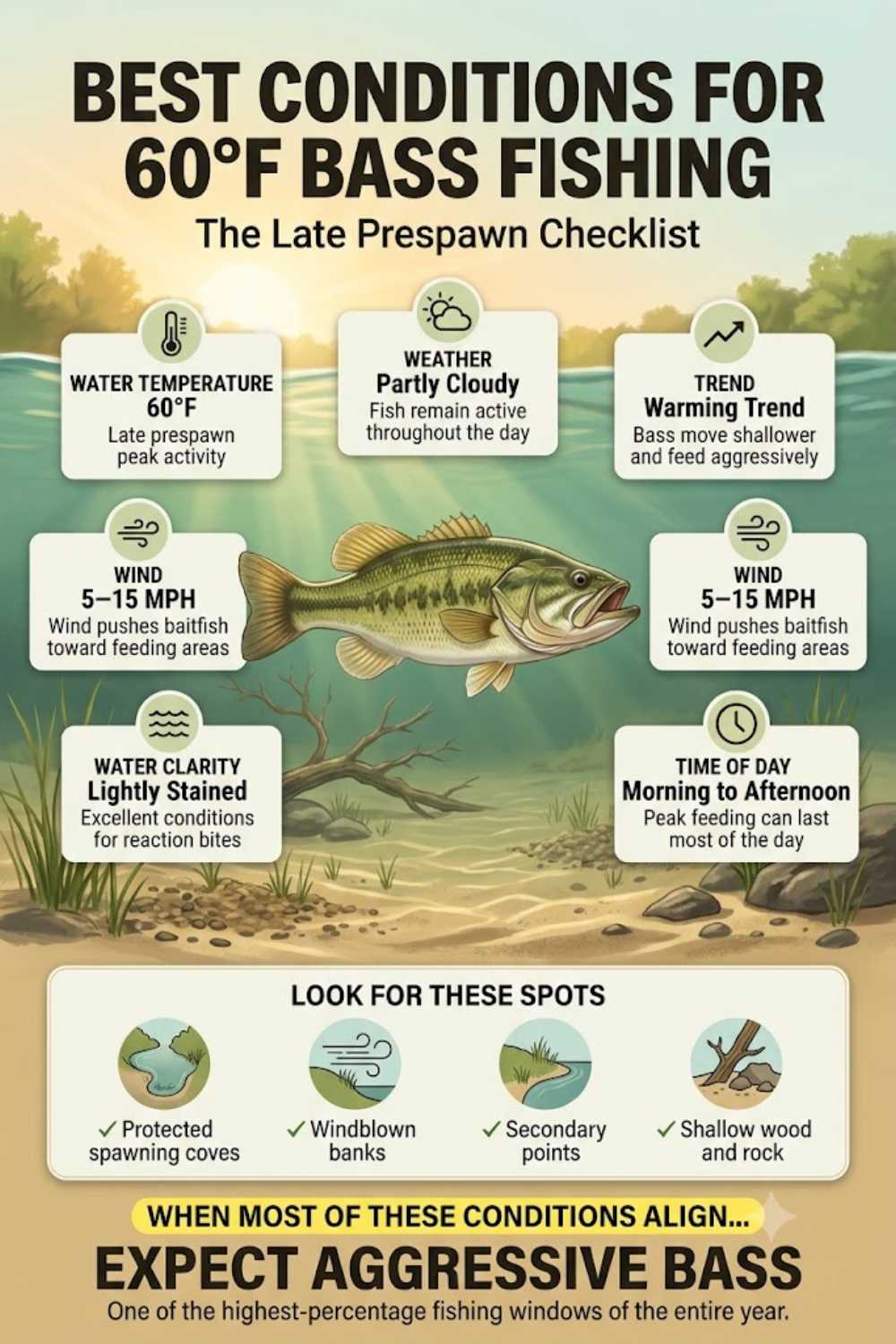
Best 60°F conditions — Stable barometric pressure, slight warming trend, partly cloudy skies, and 5–15 mph wind. These conditions trigger active feeding across the full day. The 60°F productive window typically opens at dawn and produces consistently through the afternoon, slowing only briefly in mid-afternoon bluebird conditions on extremely clear lakes.
Good 60°F conditions — Stable overcast days with light wind. Production is consistent across the day but slightly lower peak rates than ideal conditions. Reaction baits produce throughout the day.
Difficult 60°F conditions — Post-cold-front days with falling barometric pressure followed by high-pressure stable cold mornings. The bass back off the spawning flats temporarily and slide toward the transitions and hard cover. Switch to slower presentations (jerkbaits, Texas-rig worms, flipping jigs) and concentrate effort on the transition structure. Cold front bass fishing lures covers the post-front pattern.
Wind — Critical at 60°F. Windblown banks concentrate baitfish and feeding bass; a 60°F windblown rocky bank during the prespawn peak is one of the highest-percentage setups in bass fishing. Heavy chop favors the chatterbait and lipless crankbait (which trigger by vibration through choppy water); calm conditions favor the squarebill and jerkbait (which trigger by visual profile).
Water clarity — Clear water (4+ ft visibility) favors squarebills and natural-color presentations; stained water (1–4 ft) favors chatterbaits, lipless cranks, and brighter colors; muddy water (under 12 inches) favors black/blue chatterbaits and slow-rolled black/blue spinnerbaits. See water clarity lure selection for the broader logic.
The 60°F prespawn peak typically lasts 7–14 days on a typical reservoir before the spawn proper begins. Fish hard during this window — bite frequency and average fish size will not be matched again until the postspawn-to-early-summer window. Best bass lures by water temperature covers the broader seasonal arc.
60°F is the late-prespawn peak — the highest-bites window of the year for most anglers. Squarebills, chatterbaits, lipless crankbaits, and flipping jigs all produce. Focus fishing time on spawning flats, transitions into spawning bays, hard cover adjacent to spawning areas, and windblown banks. The bite is aggressive across the full day under stable conditions; adjust to slower presentations after cold fronts.
For the slightly cooler end of the prespawn, see the best bass lures for 55-degree water. For the warmer end, see best bass lures for 65-degree water. For the broader prespawn playbook, see prespawn bass fishing lures and best bass lures by water temperature.
Deflects off cover like nothing else — the go-to shallow crank.
Shallow wood and rock — make it deflect off cover.
As an Amazon Associate I earn from qualifying purchases.
Staging fish on transition banks and the baits that work.
Fry guarders and the recovery slowdown.
Walking baits, frogs, and poppers in heat.
Deep structure or shade — pick one.
Shade plus structure in the heat of the year.
Shad migration and aggressive pre-winter feeding.
Plug in today's water temp, clarity, weather, and forage — the tool returns the highest-confidence presentations.
Build Today's Strategy →