Tournament Favorite97%
Z-Man JackHammer ChatterBait
Green Pumpkin
View Product →The best all-around chatterbait trailer is a 3.75-inch pearl paddle-tail. Here are the five trailers worth carrying, and exactly when to run a paddle tail, a straight tail, or a craw by water clarity, season, and forage.

Affiliate Disclosure: As an Amazon Associate I earn from qualifying purchases. Recommendations reflect on-the-water testing and the LureLogic ranking engine — not paid placement.
If you only want one paddle-tail trailer in the box, make it a 3.75-inch Pearl or White soft-plastic paddle-tail with a thick body and a thumping tail kick. It matches the bulk of an average shad, slows the chatterbait fall enough to keep the bait in the strike zone, and adds the extra tail vibration that calls bass from outside a tight strike-zone window.
For stained-to-muddy water and big-bite fishing, go up to a 4-inch bulky paddle-tail (Zako-style or Strike King Rage Swimmer 4.75) in Green Pumpkin or Black / Blue. The larger profile pushes more water and gives bass a bigger silhouette to lock onto. For clear-water and pressured-fish scenarios, drop to a 3.3-inch finesse paddle-tail or a straight-tail trailer in a natural translucent shade — the smaller profile reads less suspicious to inspecting fish.
A craw-style trailer (Rage Craw, Hyper Worm, Razor Tail Craw) is the slow-roll specialist. Use a craw when slow-rolling a chatterbait in cold water (below 55°F), when fishing the bait deeper than the paddle-tail will let you, or when bass are clearly eating crawfish (rocky banks, postspawn, fall on rip-rap). Three trailer styles in three sizes covers the entire chatterbait calendar.
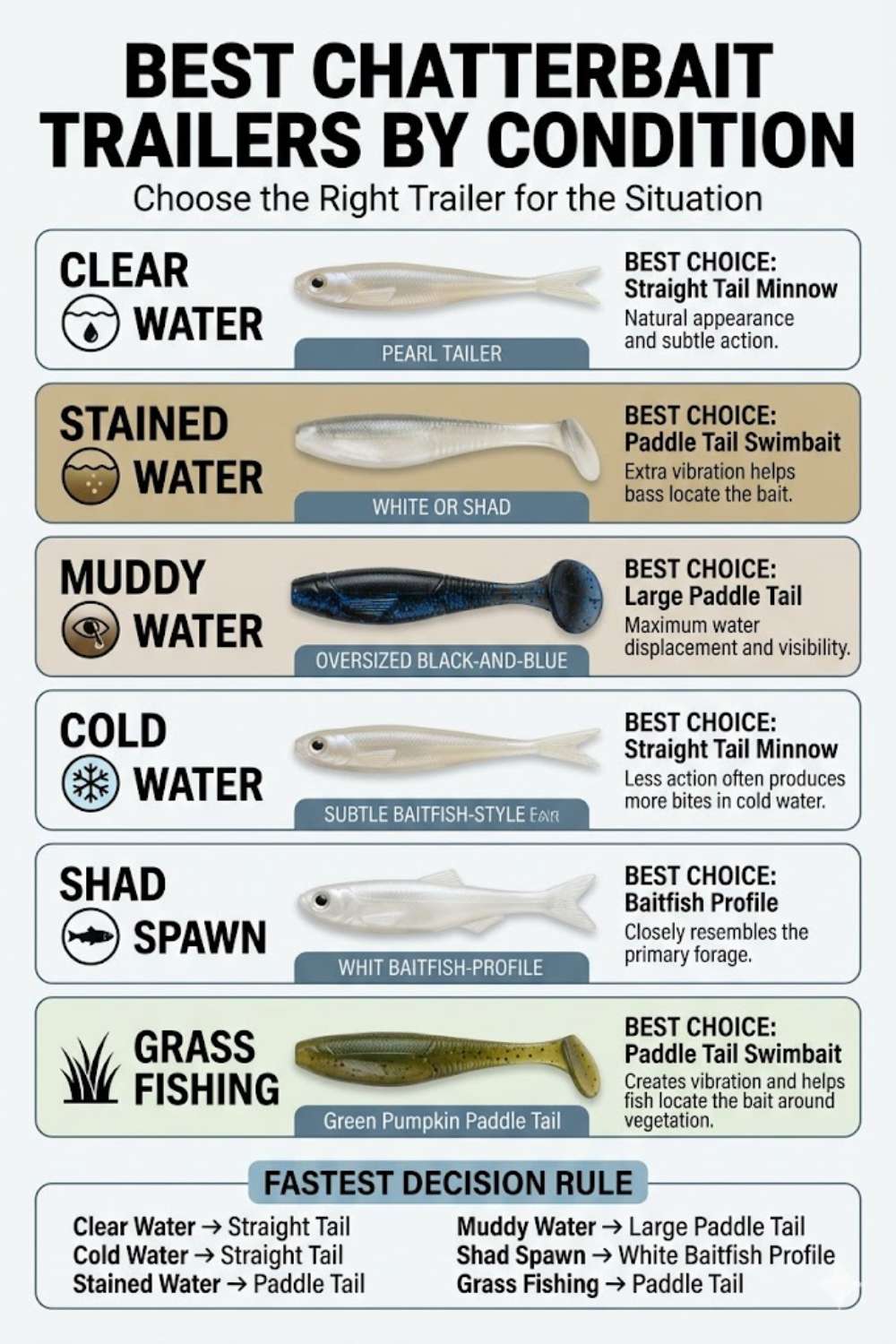
Carry three trailer styles at all times: a 3.75–4-inch paddle-tail for the default presentation, a craw-style trailer for slower bottom presentations around grass and rock, and a straight-tail or finesse paddle-tail for clear water and pressured fish. Color logic for the chatterbait itself — skirt colors, blade finish, and how the two work together — is covered in our chatterbait buying guide; this page stays focused on the trailer.
Z-Man Razor ShadZ (4 inch) — Profile: slim baitfish silhouette with a thumping forked tail. Vibration: medium-high — the forked tail kicks aggressively without overwhelming the blade pulse. Best forage match: threadfin shad and small gizzard shad. Water clarity: stained to muddy is the sweet spot; works in clear water with a smaller profile pattern like Smokey Shad. Seasons: prespawn through fall as the everyday workhorse. The Z-Man elaztech material survives multiple fish without tearing and the tail keeps kicking even at slow retrieve speeds.
Yamamoto Zako (4 inch) — Profile: bulky shad-shape with a wide ribbed body and a wide paddle-tail. Vibration: high — the wide body and tail combination pushes a lot of water and stacks heavy displacement on top of the blade pulse. Best forage match: gizzard shad and bigger threadfin. Water clarity: stained to muddy where bigger profile helps; not the best clear-water choice. Seasons: prespawn through postspawn as the big-bait big-bite trailer; fall when bass are eating year-class gizzard shad. The Zako shines for tournament anglers culling for bigger fish — the extra profile selects for larger bass that ignore smaller trailers.
Strike King Rage Swimmer (3.75 or 4.75 inch) — Profile: slim taper with an aggressive boot tail. Vibration: high — the Rage tail kicks at any retrieve speed, even painfully slow ones. Best forage match: threadfin and small gizzard shad in the 3.75; bigger gizzard shad in the 4.75. Water clarity: every clarity — translucent patterns in clear water, opaque whites and chartreuses in stained, dark patterns in muddy. Seasons: every season but especially strong prespawn through summer. The Strike King is the most universal trailer in the category — if you carry one bag, make it Rage Swimmer in your local shad color.
Keitech FAT Swing Impact (3.8 or 4.3 inch) — Profile: thicker midsection with a large paddle-tail. Vibration: medium-high with a wider tail kick that creates a slightly different displacement signature than the Razor ShadZ or Rage Swimmer. Best forage match: shad, herring on Southeastern lakes, blueback fisheries. Water clarity: stained primarily, decent in clear water with natural colors. Seasons: prespawn through fall. The Keitech salt and scent infusion produces a noticeable secondary attraction in muddy water and on tough bites.
Z-Man HellraiZer / Big TRD Swim Tail (4 inch) — Profile: tall ribbed body with a tight, lively paddle-tail. Vibration: medium — tighter and less aggressive than a Zako, more aggressive than a finesse paddle. Best forage match: shad, bluegill on hybrid fisheries. Water clarity: clear to stained. Seasons: postspawn through fall on pressured fisheries where bass have seen every Zako and Rage Swimmer. The HellraiZer is a sleeper trailer that out-produces standard paddle-tails on heavily-fished lakes.
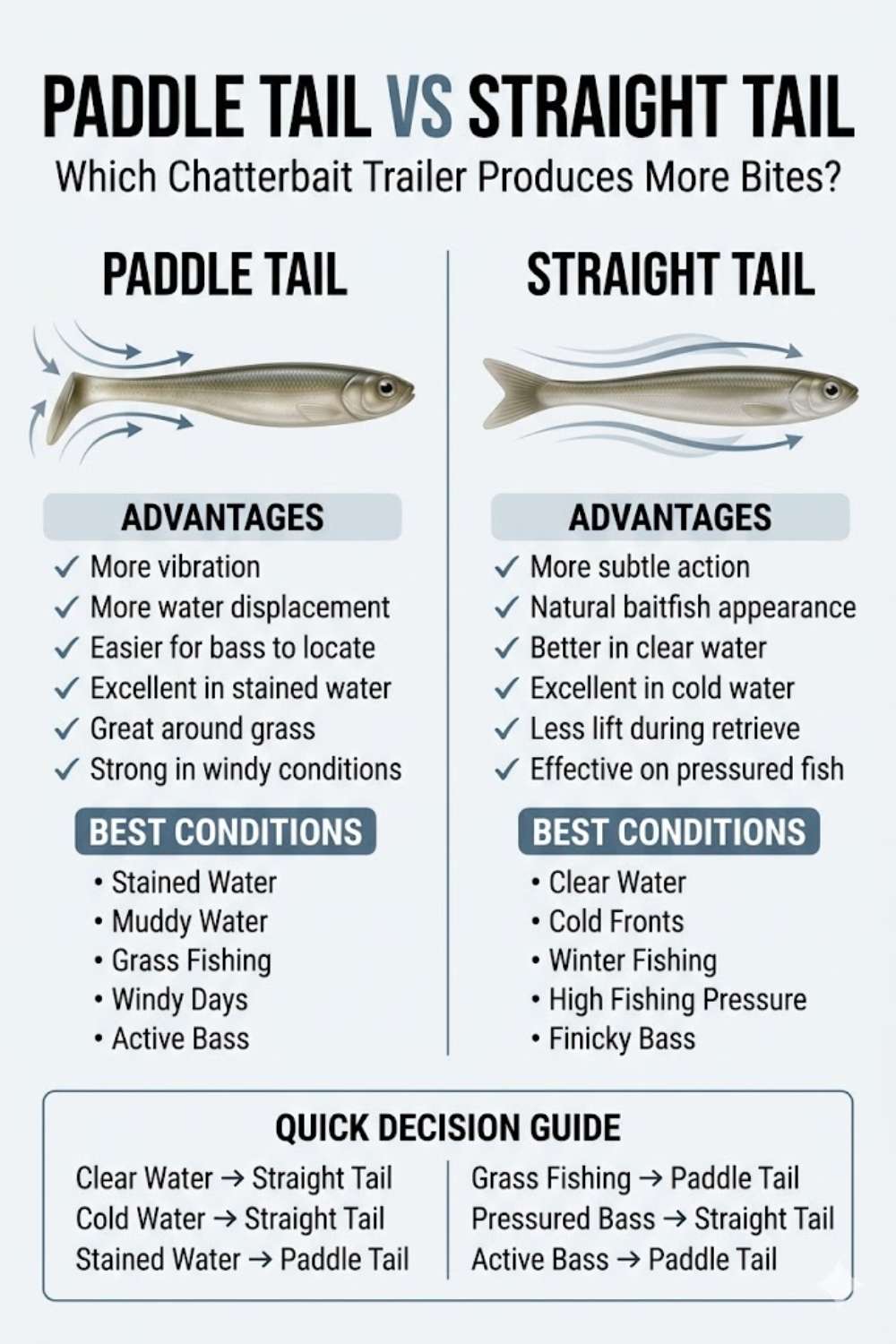
The single biggest decision in chatterbait trailer selection is paddle-tail versus straight-tail. The two styles produce dramatically different baits and the right choice changes with water clarity, temperature, and the mood of the fish.
Vibration differences — A paddle-tail kicks back and forth as the bait swims, stacking low-frequency tail vibration on top of the blade's mid-frequency pulse. The combined signature is loud, broad, and easy for bass to locate on their lateral line. A straight-tail simply trails behind the bait with minimal independent motion; the bait's vibration signature is dominated by the blade alone. In stained and muddy water (less than 2 ft of visibility), the extra tail vibration of a paddle-tail is often the difference between a fish locating the bait and missing it entirely. In clear water (3+ ft visibility), the extra vibration can over-do it and put pressured fish off — the tighter, quieter signature of a straight-tail looks more natural.
Lift differences — A paddle-tail provides hydrodynamic lift on the retrieve. That lift lets you swim the bait higher in the water column at slower retrieve speeds — important when you want to keep the bait above grass tops, over a flat, or just under the surface for a waking presentation. A straight-tail provides almost no lift; the bait runs at the depth its weight pulls it to, period. In shallow grass-flat scenarios (1–4 ft of water with submerged grass), a paddle-tail trailer lets you fish the bait clean over the grass tops without burying in the salad.
Speed differences — A paddle-tail still works correctly at very slow retrieve speeds because the tail kicks on its own as long as water is moving past it. A straight-tail needs more forward speed to look natural — at very slow retrieves the bait simply trails as a dead piece of plastic. In warm-water fishing (above 65°F) when bass want a faster presentation, either style works. In slow-roll situations (below 55°F or deep summer presentations), the paddle-tail keeps producing tail action long after a straight-tail goes dead.
Cold water performance — Counterintuitively, both styles have a place in cold water. A small (3–3.5 in) paddle-tail in a translucent natural color is the easier cold-water choice because the tail kicks on its own and gives the slowly-retrieved bait a touch of action without requiring rod movement. A straight-tail trailer with an angler-imparted twitch-and-drop cadence triggers reaction strikes from lethargic cold-water bass — the bait looks dead, then briefly alive, which can trigger a reflex strike. In water below 50°F, drop one size and lean on natural translucent colors regardless of tail style.
Warm water performance — In water above 65°F, paddle-tails are usually the better answer. Warm-water bass want a strong vibration signature and a tail-kick adds the trigger that pulls fish off cover and onto the bait. Use larger 4–4.5-inch paddle-tails in stained-to-muddy water and smaller 3.75-inch paddle-tails in clear water during the warm-water months.
Pressured fish situations — On heavily-fished lakes where bass have seen every standard paddle-tail combination, switching to a slim straight-tail or a finesse paddle-tail breaks the pattern. The reduced vibration and tighter swim looks like a wounded baitfish rather than the standard prey signature bass have been conditioned to ignore. A 4-inch straight-tail in a natural smoke-or-pearl color is a quietly devastating trailer on pressured fisheries.
Decision framework — Start with water clarity. If visibility is under 2 ft, paddle-tail. If visibility is over 3 ft, lean straight-tail or finesse paddle-tail. Then layer water temperature: above 60°F skews paddle-tail, below 55°F can go either way. Then layer pressure: on heavily-fished water, downsize one notch in whichever direction you started.
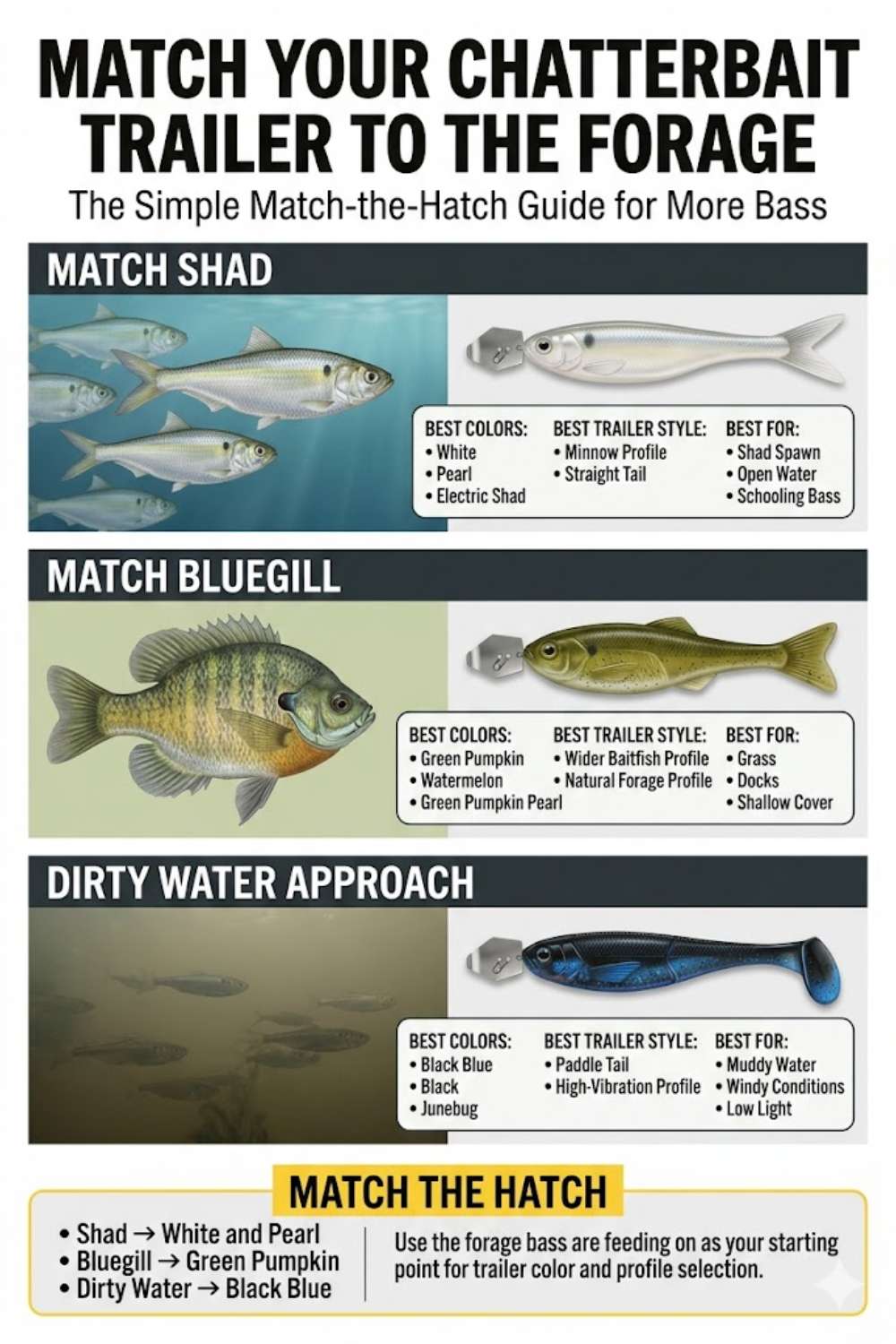
Forage matching is the highest-leverage decision in trailer selection after water clarity. Bass on a given fishery have a primary forage species they key on, and a trailer that matches the size, profile, and color of that forage produces dramatically more bites than a generic shad pattern.
Threadfin shad — Threadfin run 2.5–4 inches and are the dominant chatterbait forage on most reservoirs in the South and Southeast. Trailer style: a 3.75-inch slim paddle-tail (Razor ShadZ, Rage Swimmer 3.75). Trailer size: 3.75 inches matches the average year-class threadfin perfectly. Trailer color: Pearl, White, Smokey Shad, or a translucent ghost pattern. Ideal chatterbait setup: 3/8 oz or 1/2 oz chatterbait in a White or White / Chartreuse skirt, retrieved at a moderate speed across shallow cover, points, and creek-arm flats. This is the textbook chatterbait setup and the one most anglers default to. When bass eat your trailer cleanly with no short strikes, you have the forage match correct.
Gizzard shad — Gizzards run 4–7 inches as adults and require an upsized trailer to match. Trailer style: a 4–4.5-inch bulky paddle-tail (Zako, Rage Swimmer 4.75, Keitech FAT 4.3). Trailer size: 4.5 inches is the cull-for-bigger-fish answer. Trailer color: Pearl, White, Sexy Shad with a darker back. Ideal chatterbait setup: 1/2 oz or 3/4 oz chatterbait in a White / Chartreuse or Sexy Shad skirt, fished slower than a threadfin presentation. Gizzard shad bass are typically bigger fish — match the bait and you select for size.
Bluegill — On bluegill-driven fisheries (especially in the Mid-South and Southeast) chatterbaits in bluegill colors with a green-pumpkin trailer outproduce shad colors. Trailer style: a 3.75-inch paddle-tail with a green-pumpkin and orange highlight pattern. Trailer size: 3.75 inches matches an adult bluegill profile. Trailer color: Green Pumpkin with Orange or Chartreuse highlights; full bluegill pattern. Ideal chatterbait setup: 1/2 oz chatterbait in a Bluegill skirt, fished slowly along the perimeter of shallow bluegill spawning flats from late May through July. A craw trailer in green pumpkin can outproduce the paddle-tail at times — bass eating bluegill also eat the craws hiding in the same rocks.
Perch — On Northern smallmouth and Great Lakes fisheries, perch are a primary forage. Trailer style: a 3.75–4-inch paddle-tail in a perch pattern (green back, yellow sides, vertical bars). Trailer size: 3.75–4 inches matches an adult perch. Trailer color: full perch pattern with yellow, green, and orange. Ideal chatterbait setup: 1/2 oz chatterbait in a perch or natural greenish skirt, fished around rocky points, gravel transitions, and weed lines. Smallmouth on perch lakes will inspect the bait — a realistic perch trailer commits them.
Crawfish — On rocky, cool-water fisheries (Northern lakes, Highland reservoirs, postspawn windows) crawfish dominate the bass diet. Trailer style: a soft-plastic craw with two beaver-style claws (Rage Craw, Hyper Worm style craw). Trailer size: 3.5–4 inches matches a typical adult bass-eating craw. Trailer color: Green Pumpkin, Black / Blue, Black / Red, or natural craw with brown and orange. Ideal chatterbait setup: 1/2 oz or 3/4 oz chatterbait in Black / Blue, Green Pumpkin, or Sprayed Grass skirt, slow-rolled along rocky banks and points. The craw trailer slows the fall and gives the chatterbait a craw-eating profile that pulls fish off rock.
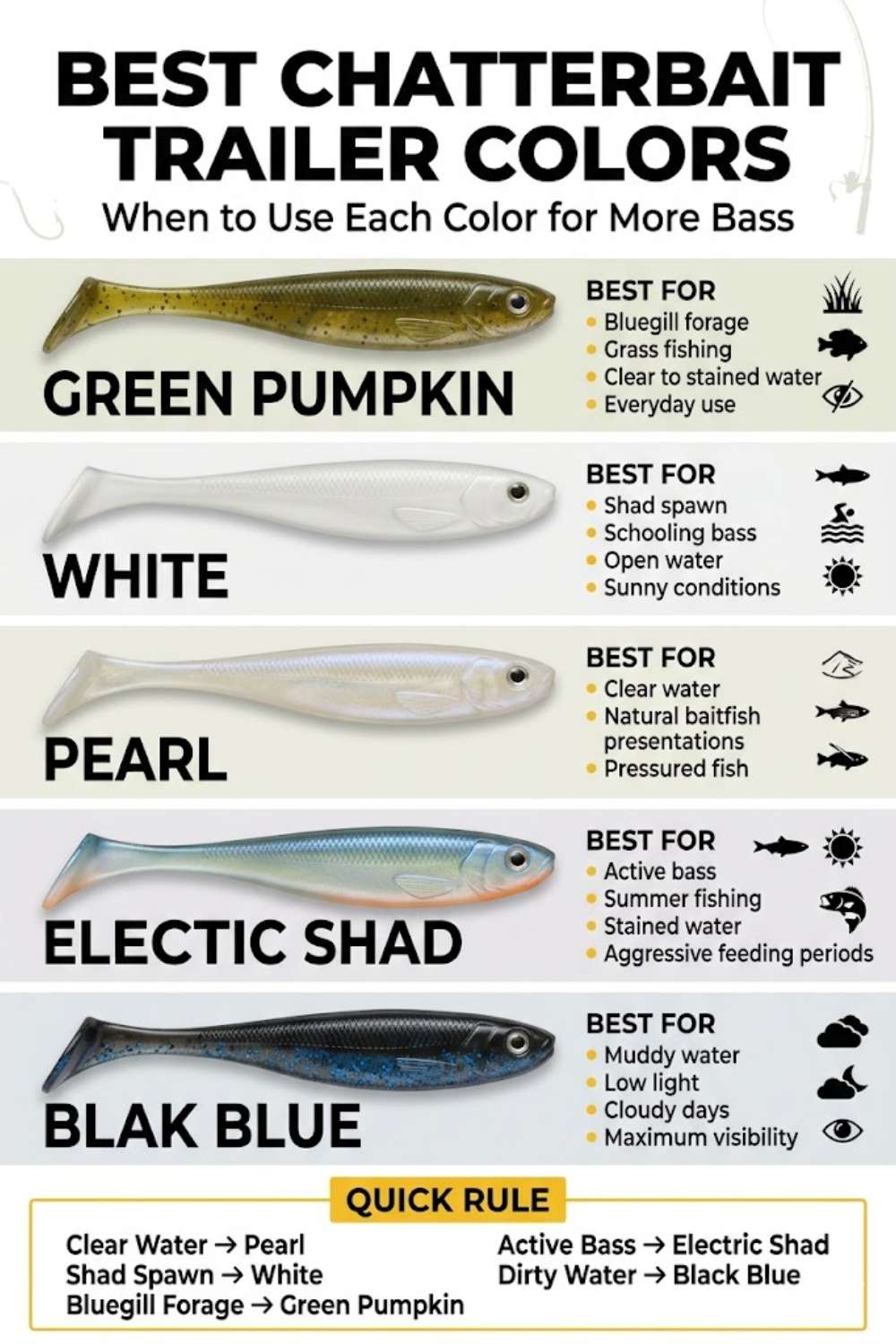
Trailer color choice is dictated by water clarity, sky condition, and forage. The five colors below cover the vast majority of chatterbait trailer scenarios in bass fishing.
Green Pumpkin — The most versatile single chatterbait trailer color in bass fishing. Green pumpkin reads as a natural baitfish in clear water, blends with bluegill and craw colors on bluegill-driven fisheries, and works in stained water with the addition of a chartreuse tail dip. Best water clarity: clear to stained (works in light muddy with contrast). Best sky conditions: sunny to partly cloudy where the natural color stays visible. Best forage situations: bluegill spawn, craw bites, prespawn rocky banks. Best seasonal use: prespawn through fall as a default; lean on it heavier postspawn and summer when bass eat more bluegill and craws than shad.
White — The standard shad-color trailer and the right default in stained water. Best water clarity: stained (1–3 ft visibility) where the white silhouette stands out cleanly. Best sky conditions: cloudy to mixed; works on sunny days too with smaller blade and skirt. Best forage situations: any shad-driven scenario, shad spawn, fall shad migration. Best seasonal use: all four shad-driven seasons — prespawn, spawn, postspawn-shad-spawn, fall. Pair with white or white-and-chartreuse chatterbait skirts.
Pearl — A translucent shad pattern with a slight color shift in the body. Pearl is the clear-water shad color of choice — the translucency breaks up the silhouette in high-visibility water and the slight color hints register without looking unnatural. Best water clarity: clear (3+ ft visibility). Best sky conditions: sunny days where translucency reads as natural. Best forage situations: clear-water shad scenarios, smallmouth and spotted-bass fisheries, postspawn clear-water flats. Best seasonal use: postspawn through fall on clear-water fisheries.
Electric Shad — A bright shad pattern with chartreuse, blue, and silver highlights on a white or pearl base. Electric Shad is the stained-water shad color that bridges natural and high-contrast. Best water clarity: stained to slightly muddy (12–36 in visibility). Best sky conditions: cloudy days where extra color helps bass locate the bait. Best forage situations: stained-water shad bites, cold-front days when bass need a stronger color signal. Best seasonal use: prespawn through spawn and again in fall when wind stains banks.
Black Blue — A dark profile color with red, blue, or purple highlights. Black / Blue is the muddy-water and low-light specialist. In muddy water, the dark silhouette is actually more visible than any bright color because it stands out against any available overhead light. Best water clarity: muddy (under 12 in visibility) and very stained. Best sky conditions: overcast, low-light, dawn / dusk, night fishing. Best forage situations: craw-driven bites in dirty water, night fishing for shad-spawn bass, post-rain muddy creeks. Best seasonal use: prespawn after rain events, summer night fishing, fall creek arms after storms. Pair with Black / Blue chatterbait skirts for a single dark profile.
Trailer style, size, color, and retrieve all shift with water temperature across the four seasons. Below is a season-by-season framework that you can apply to any fishery.
Prespawn (water 45–58°F) — Trailer profile: slim paddle-tail or finesse paddle-tail; a small craw trailer for slow-rolling. Trailer size: 3.75 inches as the default; drop to 3.3 if water is below 50°F. Trailer color: Green Pumpkin on rocky banks, Pearl or White on cleaner banks, Black / Blue if water is muddy from runoff. Water temperature: target the warmest part of the lake — creek arms with afternoon sun, banks protected from north wind. Retrieve speed: slow to moderate. The chatterbait should barely vibrate on the slow end. Location: transition banks, secondary points, the first hard drop into spawning pockets.
Spawn (water 58–68°F) — Trailer profile: medium paddle-tail with a strong tail kick to trigger guarding males. Trailer size: 3.75 to 4 inches. Trailer color: Pearl or White around bluegill flats, Bluegill pattern on bluegill spawning beds, White / Chartreuse in stained water. Water temperature: target the spawning bays once water is above 60°F. Retrieve speed: moderate to fast — burn the bait past beds to trigger reaction strikes from guarding males. Location: shallow grass lines, the inside edge of spawning pockets, isolated cover next to beds.
Postspawn (water 65–72°F) — Trailer profile: medium-to-large paddle-tail; this is the prime window for the bigger Zako-style trailer. Trailer size: 4 to 4.5 inches as bass key on bigger shad. Trailer color: Pearl, White, Electric Shad during the shad spawn window; Bluegill on flats where bluegill have started to bed. Water temperature: target shallow points and creek mouths. Retrieve speed: fast in warm water — burn it past shallow cover. Location: secondary points, shallow flats, riprap, seawalls during shad spawn.
Summer (water 72–88°F) — Trailer profile: paddle-tail; downsize to finesse paddle-tail in clear water midday. Trailer size: 3.75 inches as the default; 4.5 inches for big-bait big-bite scenarios on offshore schoolers. Trailer color: Pearl or Sexy Shad in clear water, White / Chartreuse in stained water, Black / Blue for night fishing. Water temperature: chatterbaits work all summer but the prime windows are dawn, dusk, and windy days. Retrieve speed: moderate to fast — match the speed of fleeing baitfish. Location: deep grass lines, shady-side of points, offshore brush and rock for schooling bass, windy banks during midday wind.
Fall (water 72–55°F) — Trailer profile: paddle-tail to match migrating shad. Trailer size: starts at 4 inches in early fall, drops to 3.75 inches as water cools through October. Trailer color: White, Pearl, Sexy Shad, Electric Shad. Water temperature: follow the shad — bass push into creek arms behind migrating bait. Retrieve speed: fast in warm fall water, slow as water drops through the 50s. Location: pockets in creek arms, secondary points, isolated cover near migrating bait.
Winter (water below 50°F) — Trailer profile: small finesse paddle-tail or small straight-tail; small craw for slow-rolling. Trailer size: 3 to 3.5 inches. Trailer color: translucent natural patterns — Smokey Shad, Green Pumpkin, Pearl. Water temperature: target the warmest water in the lake — creek arms with afternoon sun, channel swing banks that absorb heat. Retrieve speed: extremely slow — the chatterbait should just barely vibrate. Location: bluff walls, channel swings, deep grass edges, and the first hard-bottom drop on points.
Water clarity dictates trailer shape, size, color, and retrieve. Below is the four-tier clarity framework that should anchor every trailer choice.
Clear water (3+ ft visibility) — Trailer shape: finesse paddle-tail or straight-tail; tight, natural action. Trailer size: 3.3 to 3.75 inches; downsize one notch from your default. Trailer color: translucent or natural patterns — Smokey Shad, Pearl, Green Pumpkin, Smoke Silver. Avoid solid bright colors that look painted in high-visibility water. Retrieve modifications: faster retrieve so bass do not inspect the bait; long casts on fluorocarbon line; vary speed to create reaction strikes. Pair with a lighter chatterbait (3/8 oz) and a sparse, natural-color skirt.
Light stain (2–3 ft visibility) — Trailer shape: standard paddle-tail; the all-purpose answer. Trailer size: 3.75 inches as the default. Trailer color: Pearl, White, Green Pumpkin, Electric Shad. Slight color shift toward more visible tones without going aggressive. Retrieve modifications: moderate retrieve, vary it occasionally with a brief pause or a rod-tip pop. This is the textbook chatterbait clarity — work cover methodically and let the standard bait do the work.
Moderate stain (1–2 ft visibility) — Trailer shape: standard-to-bulky paddle-tail; step up the profile one notch. Trailer size: 3.75 to 4 inches. Trailer color: White, White / Chartreuse, Electric Shad, Green Pumpkin with chartreuse tail dip. Retrieve modifications: slower than clear-water retrieve so the bait's vibration has time to register; bring the bait closer to bass with deflection retrieves into cover. Apply the same clarity framework when fishing grass lines, stained water, or working banks on cloudy days.
Dirty water (under 12 in visibility) — Trailer shape: bulky paddle-tail; maximum displacement. Trailer size: 4 to 4.5 inches. Trailer color: high-contrast dark patterns — Black / Blue, Black / Red, with a contrast chartreuse or orange tail dip for a strike target. Bass cannot see exact colors in muddy water; they see silhouettes against any available overhead light, so dark profiles outproduce bright ones. Retrieve modifications: very slow — the bait must work close to bass because the strike zone shrinks to inches. Make repeated casts to the same target. Upsize the chatterbait to 1/2 or 3/4 oz to push more water and pulse stronger.
Six mistakes account for the majority of bad days on the chatterbait. Avoid these and the bait will produce in every condition discussed above.
Oversized trailers — A 5-inch trailer on a 3/8 oz chatterbait throws off the balance, slows the fall too much, kills the blade vibration, and looks unnatural to inspecting bass. Match trailer size to chatterbait weight: 3.3–3.75 in for 3/8 oz, 3.75–4 in for 1/2 oz, 4–4.5 in for 3/4 oz. The bait should swim level and the blade should vibrate cleanly at the retrieve speed you intend to use. If the bait is dragging tail-down or the vibration feels mushy, the trailer is too big.
Wrong color matching — A trailer that clashes with the skirt reads as two baitfish glued together rather than a single cohesive profile. The fix is simple: match the trailer to the skirt as a default, and only contrast deliberately for strike targets in muddy water. The common version of this mistake is grabbing the first trailer in the bag without checking color — five seconds of attention prevents an entire day of fewer bites.
Too much action — High-vibration trailers in clear water or on pressured fisheries can over-do it. The bait calls bass in but the aggressive vibration signature triggers rejection rather than commitment. The fix is to downsize trailer size and switch to a tighter-action paddle-tail or a straight-tail. If you see fish following but not eating in clear water, this is usually the diagnosis.
Too little action — A straight-tail or finesse paddle-tail in muddy water gives bass nothing to lock onto on their lateral line. The bait passes through the strike zone without bass ever locating it. The fix is to upsize the trailer to a bulky paddle-tail and slow down enough that the tail kicks visibly on the retrieve. In muddy water, the only acceptable answer is a high-vibration trailer.
Ignoring forage — Throwing a generic shad-colored paddle-tail on a fishery where bass eat bluegill or craws cuts the catch rate in half. Walk the bank, look at what is in the shallows, and match. On bluegill-driven fisheries, run a Bluegill chatterbait skirt with a Green Pumpkin or Bluegill trailer. On craw-heavy rocky fisheries, run a Black / Blue chatterbait with a craw trailer. Forage matching is free and dramatically out-produces generic shad presentations on the right water.
Ignoring water temperature — Burning a paddle-tail through 45°F water gets one or two bites a day; slow-rolling that same trailer gets ten. Running a finesse straight-tail in 80°F water below a bait ball wastes the warm-water reaction-bite window. Match retrieve speed and trailer profile to water temperature: small-and-slow below 55°F, medium-and-moderate from 55–65°F, full-size-and-fast above 65°F. The temperature dictates the cadence; the trailer choice supports the cadence.
The benchmark bladed jig — premium hardware and perfect vibration.
Stained water, wind, scattered grass — moderate-paced reaction bait.
As an Amazon Associate I earn from qualifying purchases.
How to follow the fall shad migration into the creeks and stay on feeding bass.
Full-moon waves and shallow ambush patterns.
Molt cycles, color shifts, and bottom-bouncing.
Forage-driven positioning across the season.
How bass position, feed, and select prey around each shad species.
Timing, structure, and lures for the blueback herring spawn.
Plug in today's water temp, clarity, weather, and forage — the tool returns the highest-confidence presentations.
Build Today's Strategy →